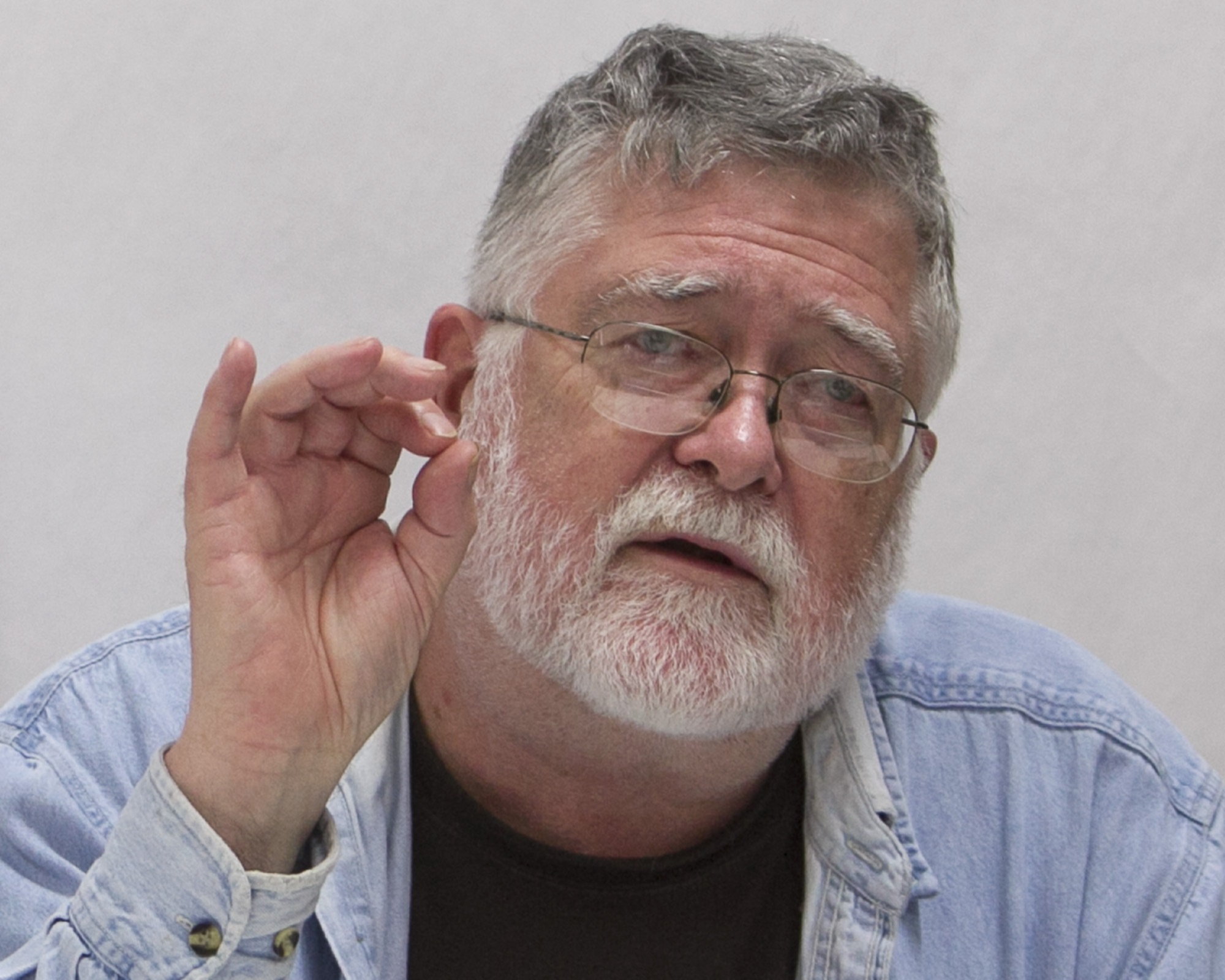
Richard Dauenhauer gave a lecture during Celebration 2014. (Photo by Brian Wallace/Sealaska Heritage Institute)
Tlingit expert, linguist and award winning writer Richard Dauenhauer passed away Tuesday morning at Bartlett Regional Hospital. He had been diagnosed with pancreatic cancer about a month ago. Dauenhauer was 72 years old.
He was married to Tlingit poet and scholar Nora Marks Dauenhauer. Together they authored many books, including the Classics of Tlingit Oral Literature series published by Sealaska Heritage Institute and University of Washington Press. They are two-time winners of the American Book Award.
He was poet laureate of Alaska in the 1980s and started teaching at the University of Alaska in 1984. In 2013, the University of Alaska Foundation honored him with the Edith R. Bullock Prize for Excellence for his contributions in preserving Alaska Native languages.
Assistant professor of Alaska Native Languages at UAS Lance Twitchell called Dauenhauer a “powerhouse” who merged the Tlingit world with the academic world.
“I remember telling him years ago and then I told him about a month ago that his work changed my life and put me on a path that I’m very thankful for and because of his work, I know what I’m supposed to be doing. And so, it’s amazing to have people like that close to you that can have such an impact on so many people in such a positive way,” Twitchell said.
The plan recommends replacing or retiring the Malaspina, Matanuska and Taku by the year 2024. The bottom of the M/V Matanuska ferry. (Photo by Heather Bryant/KTOO)
Planners with the Alaska Department of Transportation fielded questions from a packed house of skeptical residents from Petersburg and Kupreanof last week. The DOT officials were vetting a draft of the state’s latest plan for transportation for Southeast. Local residents were concerned with a loss of ferry service. They also faulted the plan’s focus on construction of new roads while existing pavement goes unmaintained.
The document helps outline priorities for the state Department of Transportation over the next decade. The most recent Southeast Alaska Transportation Plan came out ten years ago. DOT highway planner Marie Heidemann explained the need for the plan update:
“You know the purpose of the plan is partly because we need to meet requirements. We need to meet federal requirements, we also need to fulfill the requirement for an Alaska Marine Highway System long-range plan. But more important than that we need to every so often we need to revisit every so often what are the current trends that are happening in the region. What are the current projects and priorities of the state? We need to look at that, look at the trends and use those to guide how we want to the transportation system to look.”
One of the trends the DOT has identified is an excess of capacity on the state’s ferry system. Southeast region planning chief Andy Hughes said ridership has not risen despite relatively stable fares.
“We’ve added vessels, we’ve added frequency of service and we’re moving less people. In spite of the fact that, when you consider that we haven’t really raised our fares much over the period. And when you keep fares nearly level that in effect means you’re actually reducing fares relative to people’s income.”
Hughes said the Marine Highway could retire a ferry and still have enough capacity for the current demand. The plan recommends doing just that with the older mainline ships. Those are the vessels connecting Southeast Alaska communities to Bellingham, Washington or Prince Rupert, British Columbia. It recommends replacing or retiring the Malaspina, Matanuska and Taku by the year 2024. Two planned Alaska Class ferries would take up service in Lynn Canal and one new mainline ferry could be built for an estimated 226 million dollars.
Dave Kensinger thought the plan would leave Petersburg with less ferry service.
“From a person that has actually used the ferry system extensively for 37 years from the time when some of these vessels were nearly new, I can tell you that if you get rid of the Mal, the Mat and the Taku and at some point in the future you plan on building another mainliner, we’re going to be without transportation here. All you need to do is pick up a ferry schedule and see what provides our transportation.”
Kensinger said ferry stops in Petersburg used to be more frequent and more convenient for other communities to visit here.
“People from Kake could ride the ferry LeConte into town here, they had a two tide layover. They came here, they shopped, they left the boat in port for eight hours and they went back to Kake. They did that for darn near 20 years. So, I mean we had a transportation system that worked for the communities in central Southeast Alaska for many decades. And guess what, we had the same vessels then as we do now, plus a few more. So everybody out here is kinda asking the question, guys, why can’t I get anywhere on the ferry now?”
Other commenters focused on scheduling of the state ferries and thought the state’s estimates for demand were not accurate. Stephen Samuelson thought the system’s ridership numbers are faulty because of poor scheduling and redundant service.
“And the reason being is because the I’ve watched the Malaspina run up Lynn Canal or even come through here and then an hour later you watch the Matanuska go right behind it.” Samuelson explained that people crowd onto the first ferry through and the second boat just behind remains empty.
Cindi Lagoudakis wanted to make sure the plan’s anticipated costs for school travel would be addressed.
“Our students travel on the ferry frequently to academic and to sports activities and some of what you are proposing will end up precluding that participation and some of it will end up costing the school much more money to have teachers and students traveling for more extended periods of time.”
Much of the focus at the meeting in Petersburg was on a road project included in the plan. The state has appropriated $40 million for a road across Kupreanof Island. If that one lane road is built along with a shuttle ferry across the Wrangell Narrows it would allow motorists to drive between Kake and Petersburg.
Hughes fielded questions about that road.
“This plan simply is proposing to construct a local road for local use to the advantage of residents of both communities, primarily Kake to provide them with access to the services, all of the services and resources medical, commercial and transportation resources available to Petersburg, which are considerable compared to what Kake has available,” he said.
Hughes said planners would be surveying residents of Kake and Petersburg to find out why they travel outside of the two communities. That information will become part of the environmental review for the Kake road project, which is being jointly compiled by the Federal Highway Administration and state DOT. A draft environmental document could be out in 2016.
Local residents questioned Hughes about the level of maintenance and snow removal of the proposed road, and costs for law enforcement. Others wondered why the road money could not be spent on a power connection to bring cheap hydro electricity to Kake.
“It seems like that poor community has been held captive for power since I moved to Southeast Alaska 25 years ago,” said Nicole McMurren. “And there seems to be an assumption by the state that roads good – ferry bad.”
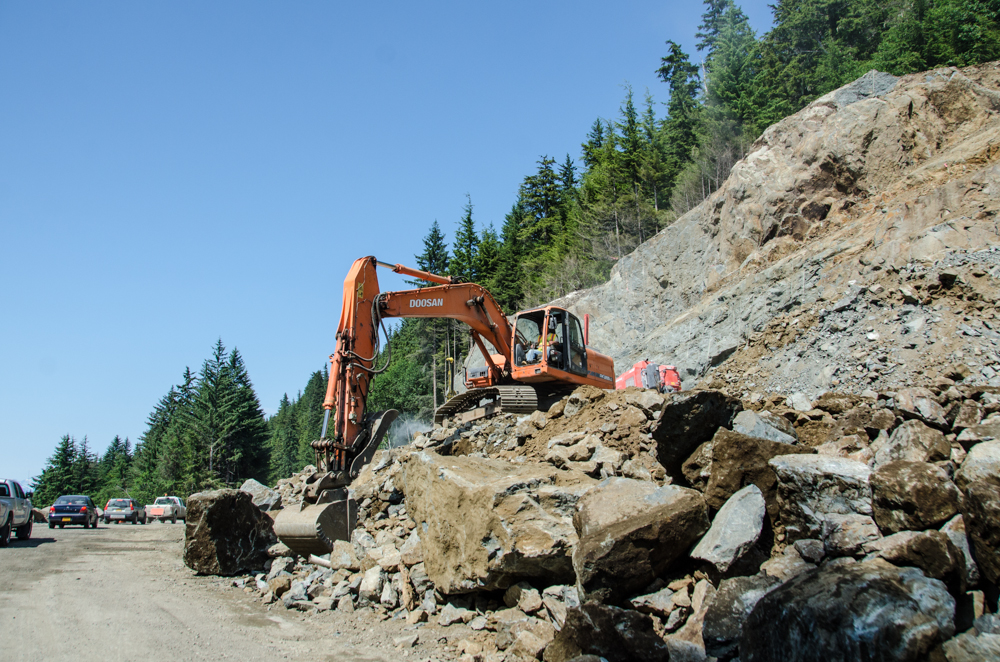
Last summer the road from Juneau was extended to mile 42 and construction continued to improve existing stretches. (Photo by Heather Bryant/KTOO)
The draft plan recommends a major road project out of the Capital City to shorten the ferry route times in Lynn Canal. It also recommends a road and tunnel from Sitka across Baranof Island to a proposed ferry terminal at Warm Springs Bay. That option would allow the state to end direct ferry service to downtown Sitka.
The DOT planners also heard about the poor condition of existing state owned roads in Petersburg. Several are slated for pavement replacement in the next year but that work has been delayed.
Jill Williams praised the DOT maintenance crew in Petersburg but thought they needed more funding to patch roads and put in new crosswalks.
“If they got the go ahead from Juneau they could put in cross walks, it doesn’t take that long. The city does it for us when we need it for safety. And it’s a safety issue for our town. So it’s maintenance. We shouldn’t have to wait for the road to be totally done for the big project. It’s called maintenance, yearly maintenance.”
Other meetings on the draft Southeast plan are scheduled this month in Ketchikan, Sitka and Kake along with meetings in Skagway and Haines early next month.
The document can be viewed on the Department of Transportations southeast region website. Comments are due in by September 30.
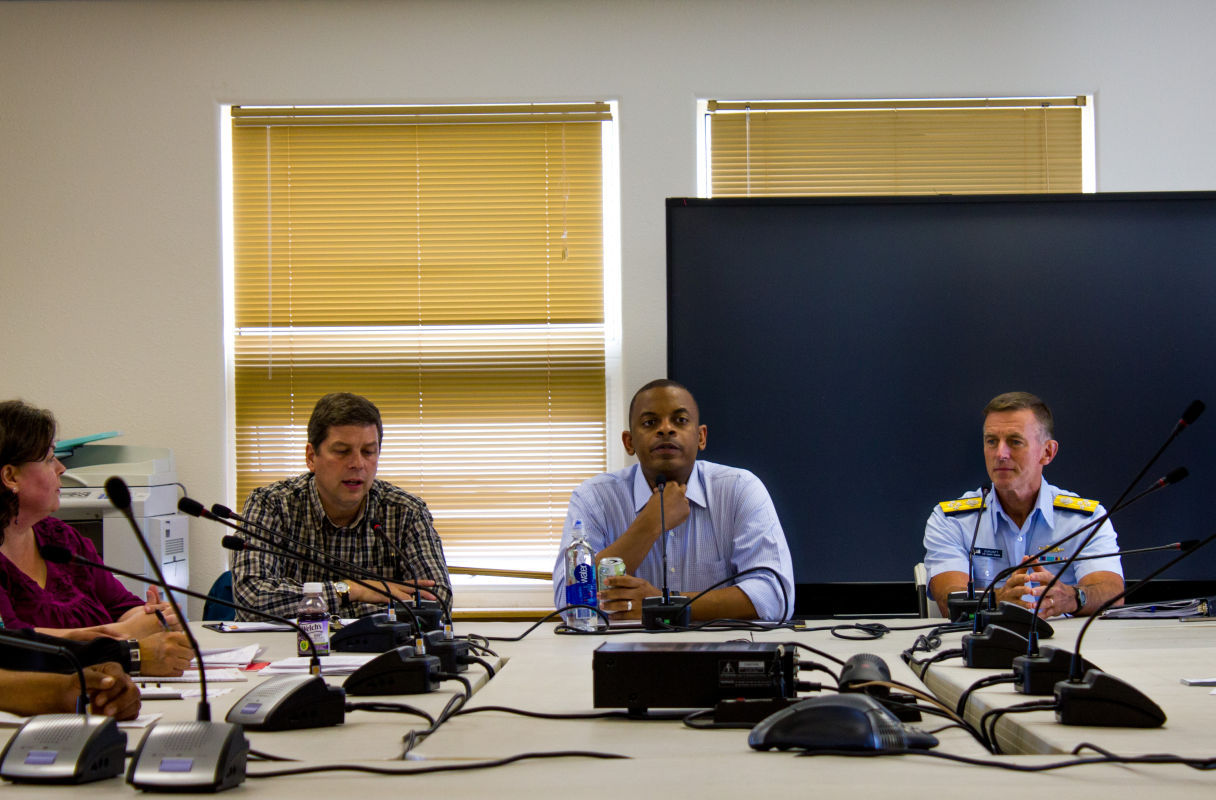
From left to right: Senator Mark Begich, Secretary of Transportation Anthony Foxx, and Commandant Paul Zukunft. (Photo by Caitlin Whyte/KNOM)
Increasing Arctic traffic and a lack of emergency response capabilities—on top of increased demand on maritime and aviation resources—has become a growing concern for communities in Western Alaska.
Looking to assess those concerns, federal officials visited Nome Friday to get a first-hand account of the city’s transportation infrastructure.
Senator Mark Begich led the entourage, which included U.S. Secretary of Transportation Anthony Foxx and U.S. Coast Guard Commandant Paul Zukunft.
Begich wanted Secretary Foxx to understand Alaska’s unique transportation logistics, especially as the Federal Aviation Administration enters reauthorization and as the country develops its first national freight policy.
The U.S. is anticipating freight transportation to double over the next 35 years, and officials are drafting a strategy to deal with the demand.
“It’s going to strain our system if we don’t have the infrastructure in place,” Foxx explained. “So our goal right now is to design a system based on how freight actually moves—that would include maritime projects and ports and locks and dams and lots of things like that— and then to make the case to Congress to put the resources in place to do it.”
Begich said he also wants Commandant Zukunft to understand the region’s need for emergency response capabilities. The Coast Guard is committed to building more icebreakers—with zero environmental footprint—but as far as establishing more bases in Western Alaska, Zukunft told an audience in Nome that Kodiak will remain the branch’s northernmost operating base.
“Our biggest challenge isn’t so much where we tie the ships up, but where do we maintain them, where are we putting in parts, logistics. Then we have to look at the school systems, families, and the overseas screening that we do. But we find that it’s much more cost effective to have larger clustering of Coast Guard presence.”
Zukunft is well aware that Arctic traffic has increased by 400 percent over the past 65 years. Despite a Government Accountability Office report issued earlier this year, Zukunft said that the staggering figure does not anticipate a significant increase in Arctic shipping during coming decade. The federal government usually takes 10 years to respond to changes, Zukunft explained, and earlier action is necessary.
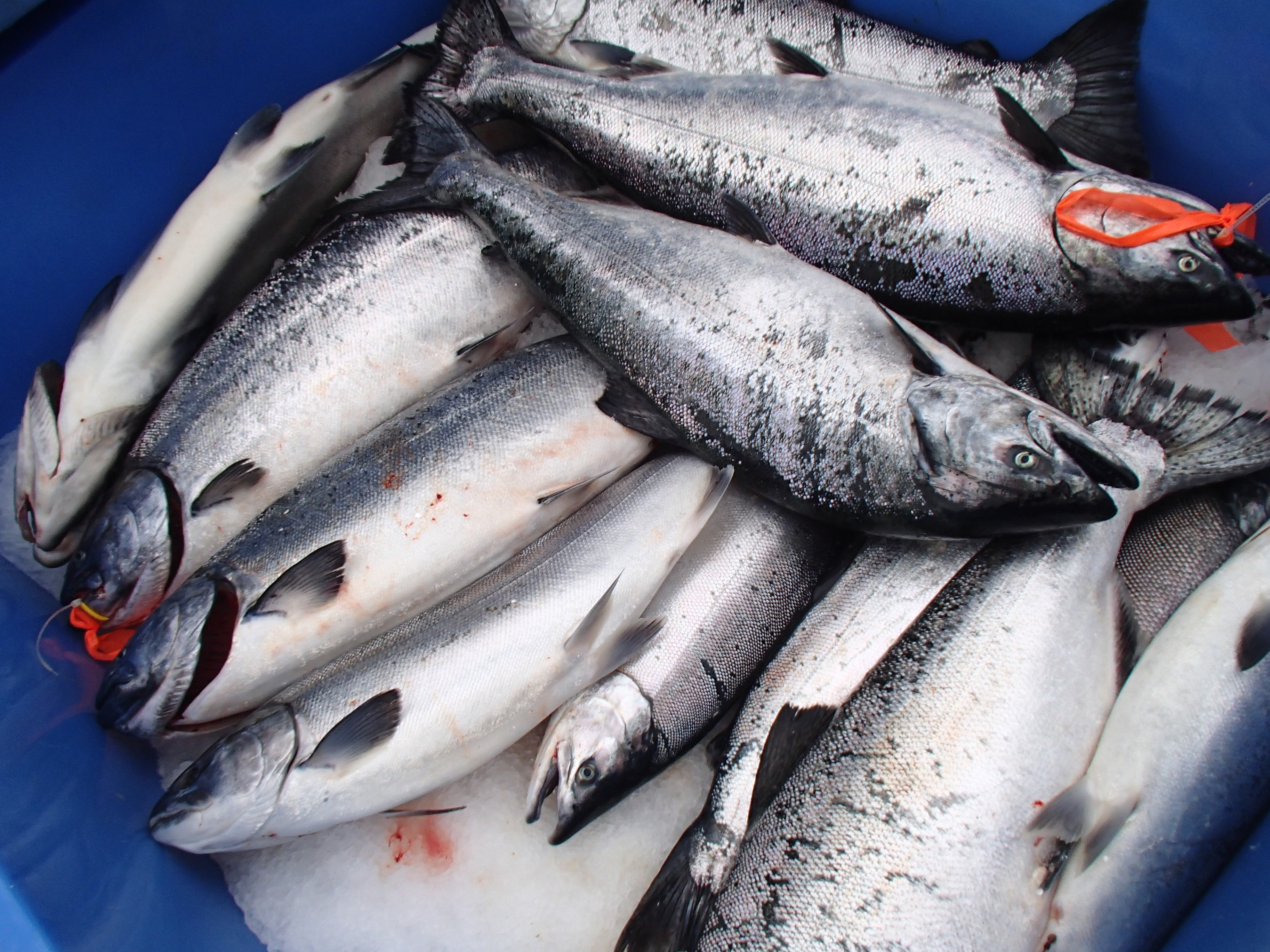
Later in the afternoon the Coast Guard’s jet touched down in Unalakleet. The delegation got a whirlwind tour of town, starting with the Department of Transportation garage housing a sander and heavy equipment. Then they saw ongoing construction to expand the sea-wall on the town’s southern edge—meant to slow down the aggressive coastal erosion issue threatening Unalakleet. And last came a quick visit to Norton Sound Economic Development Corporation’s fish-plant, where large, shimmering Cohos slide through an assembly line as they are gutted, washed, and packed into totes bound for Anchorage.
The quick field trips gave Zukunft, Foxx, and their entourages—replete with staffers and security details—a common point of reference when they spoke with a panel of leaders from regional organizations at the Unalakleet IRA soon afterwards.
It was not just Foxx’s first visit to Unalakleet, but to Alaska, where his department spends a good deal of its $70 billion annual budget on infrastructure projects. Being able to see how and why projects work helps his department design more effective solutions.
“It is actually the case that people are spending money on the United States having poor infrastructure,” said Foxx as the afternoon meeting was winding down. “Whether it’s time that they’re spent stuck in traffic or not able to get from one place to another because the road system doesn’t exist. It’s also just wear and tear on vehicles, so we’re paying the price already.”
And that is part of what Senator Begich says he wants from trips like this one: for national officials in Washington, D.C. to see first hand how their decisions affect remote communities in Alaska.
The Unalakleet visit was fast—less than three hours. A panel of leaders from different regional organizations like Bering Straits Native Corporation, the Bering Sea Alliance, and NSEDC spoke about topics of importance in the Bering Strait—from high fuel costs to subsistence to increased shipping.
One point repeatedly brought up was the need for officials to come more often. Kawerak president Melanie Bahnke thanked Secretary Foxx for flying across the country (he estimated he spent about 12 hours in the air, not counting stops), but encouraged him to log some time driving along dirt trails to get a more direct experience of people’s transportation needs.
“Please think about us,” Bahnke explained to the visitors, stressing the point that unless they are seeing conditions on the ground, the region’s needs can seem abstract, even imperceptible.
“The fact that several of our communities don’t even have water and sewer—we’re living in Third World conditions. We’re in the most generous nation in the world. We provide humanitarian aid to other countries, and [yet] you’ve got some of Alaska’s first people, this nation’s first people still living in Third World conditions. So, I ask that you don’t forget that.”
Afterwards, there was a short period for public comments. Foxx, Zukunft, and Begich talked one-on-one with a handful of audience members, happily snapping photos. Then, with a light rain falling, staffers hustled them back on board the Anchorage-bound jet.
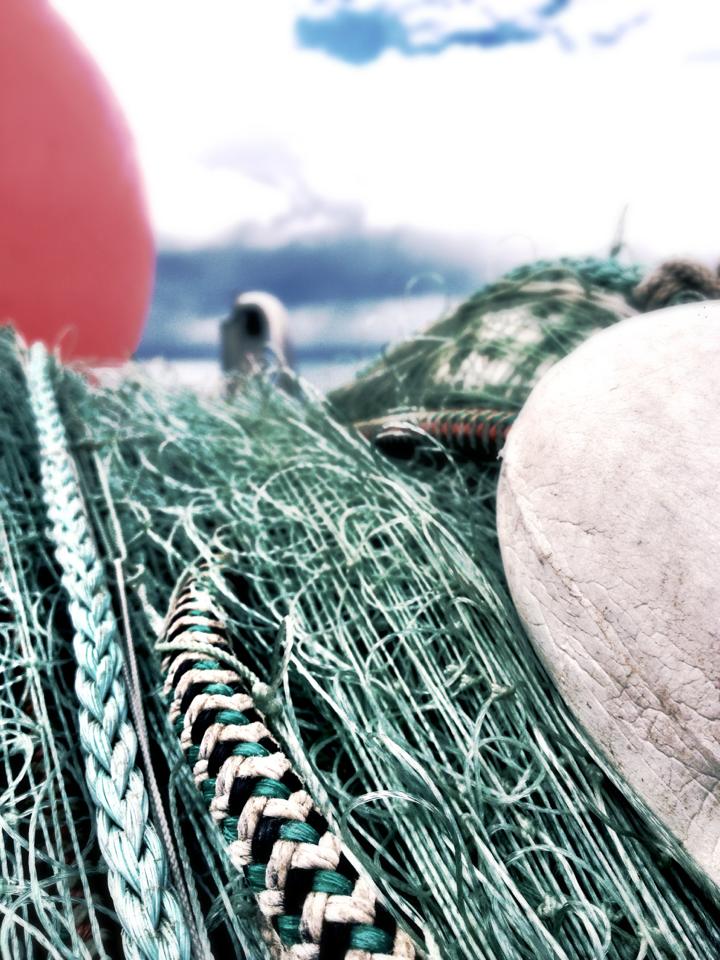
Disposal of fishing nets has caused problems for the harbor department and Public Works. A new recycling initiative for nets aims to curb illegal dumping. (Photo by Asia Fisher/KSTK)
A new recycling initiative aims to curb illegal dumping of fishing nets in Wrangell, and send the old nets to Slovenia to be melted down for re-use.
The Wrangell landfill has a new place for disposing old fishing nets.
“Any commercial fisherman can go to the dump, drop their nets off. They need to be stripped of lead and corkline, and they need to go into this receptacle with the salt bag,” said Trevor Kellar of the Wrangell Cooperative Association
Kellar is with the WCA working as an Environmental Tech Assistant under the Indian Environmental General Assistance Program. Kellar said Trident Seafoods donated large salt bags to contain the nets. Those bags are in a receptacle at the landfill marked for net disposal.
The WCA surveyed residents earlier this summer about their most pressing environmental concerns, and illegal dumping was at the top of the list. The WCA teamed up with the city, the Petersburg Indian Association and Trident Seafoods to do something about fishing nets, which are just part of the larger issue of illegal dumping on Wrangell Island.
Wrangell Harbormaster Greg Meissner said fishing net disposal has been a problem for years.
“Many times they get thrown in our dumpsters, which makes a very large problem for the trucks, because once they get dumped into the garbage truck, it gets tangled up inside the equipment and makes a real mess of it,” Meissner said. “And the Public Works folks who drive the truck, it’s really hard and dangerous for them to get the things cleaned out.”
Meissner said the harbors used to have open-top bins designated for nets, but people put other kinds of waste in there, too.
“It would all go into this receptacle for nets, and then the birds would find the garbage bags and spread it all over the parking lot,” Meissner said. “So we at the harbor just got tired of picking up mess after mess after mess.”
That’s when the landfill started collecting nets instead. The new program will have a different way of collecting and disposing of nets, but Meissner said it still starts with fishermen getting motivated to take their nets to the landfill.
“The fact that they’re going to collect at the landfill is great. It’s a good spot for it, and there’ll be a spot there for fishermen to literally pull up, dispose it right in the location it needs to go. That still requires fishermen to take that step, and take it from their boat and to their truck, and from their truck to the landfill. And not just take the easy route, which is back up to our dumpster with everything else, and throw it all in and make a mess,” Meissner said.
Kellar said that’s why the WCA is trying to incentivize the program.
“We want to make incentives to get this kicked off, get people excited about it, get fishermen to bring us their nets,” Kellar said.
Once nets are brought to the landfill, they’ll be shipped, likely for free, to Petersburg. The Petersburg Indian Association already has a net recycling program, but they haven’t collected enough to meet the minimum poundage required to ship the nets out.
Kellar said with free salt bags and free shipping, the net recycling program will come at no cost.
“And PIA, Petersburg Indian Association, they’ll take our nets for free. So I guess this entire recycling endeavor, it will be completely free,” Kellar said. “It’s everybody in the community helping out, doing their little part.”
Petersburg will ship the nets to Seattle. From there, the nets will be shipped to Slovenia to be melted down and made into new nylon products.
Derby chair Mike Satre says the weather put a damper on fishing.
“We had some pretty wet and windy forecast for the weekend so we had less people participating or people not being able to get to their preferred fishing spots because of the weather,” Satre says.
Participants caught nearly 13,000 pounds of coho and about 2,000 pounds of king salmon. Derby organizer Territorial Sportsmen Inc. sells the fish to Alaska Glacier Seafoods and will get about $1 per pound for coho and $3.65 per pound for kings.
Sale proceeds go into a scholarship fund. Last year, the Territorial Sportsmen gave out three $12,000 college scholarships and one $2,500 vocational scholarship.
Satre says the lower salmon catch likely won’t affect how many scholarships are given out this year.
“It’s not just the money that we got from this year. There is an endowed fund where monies from the derbies over the years are able to grow a little bit. So even though this might be a slightly down year, hopefully they’ll be able to award a similar number of scholarships that they have in the past and hopefully next year we’ll have another big coho year like we did in 2013 and things will start to even out,” Satre says.
Derby awards will be given out tonight at Centennial Hall. Max Mielke is the certified winner of the derby with his 27.9-pound king. He’ll arrive at awards night in a limo and pick up $10,000 in cash as well as other prizes.
Mark Pusich came in second place with a 23.9-pound king and Gerald Voss was third with a 22.8-pound king. Brian McHenry took 68th place winning $2,322 in cash and prizes with a 16.3-pound coho.
The trophy for participants ages 6-12 was won by Jaydn Musielak, 12, who turned in a 19.5-pound coho, good for 14th place overall.
Next year’s Golden North Salmon Derby will take place on August 14,15 and 16, 2015.
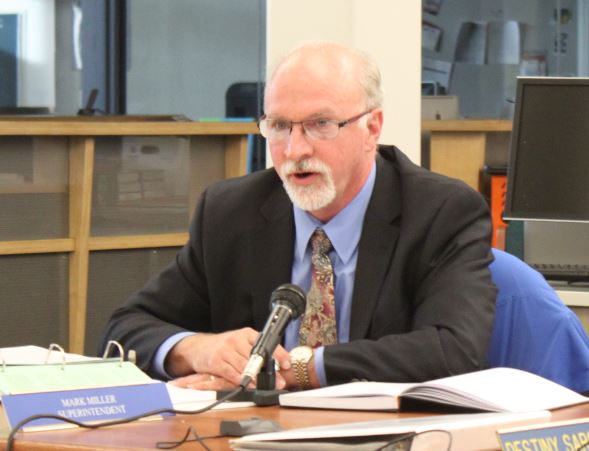
At Tuesday night’s school board meeting, new superintendent Mark Miller says attorney John Sedor will talk to students and staff during the investigation. (Photo by Lisa Phu/KTOO)
The Juneau School District is conducting an independent third party investigation into an alleged hazing incident that took place two days after school ended in May.
New school superintendent Mark Miller says he contacted Anchorage-based attorney John Sedor two weeks ago to help the district with a case involving high school students.
“There’s an allegation that some older students either kidnapped or in some way took some younger students out to a remote area and there was paddling or hitting involved,” Miller says.
He says Sedor has worked with the Juneau School District for years and is an expert in school investigations.
“He’ll be working with the school district, with our employees to determine whether or not our school rules or policies have been violated and ensuring that both the victims and the alleged perpetrators receive due process,” Miller says.
Hazing is considered one of the most severe violations of board policies and school rules. The student handbooks of Juneau Douglas High School and Thunder Mountain High School say the minimum penalty for hazing is up to 10 days of suspension. The maximum penalty is permanent expulsion.
Over the summer, principals from all three Juneau high schools looked into the alleged hazing incident. Miller says the Juneau Police Department completed its investigation without filing any charges. He says the district’s probe is different than the police’s.
“We’re not looking at criminal charges. We’re looking at whether our policies were violated, our rules, which is a different question than what the police were looking for. We also have a lower standard of proof, if you will,” Miller says.
School board president Sally Saddler says the board is not directly involved with the investigation. She says members can’t receive any advance knowledge of it in case any grievances are filed.
She says the board has strong concerns about the hazing culture in Juneau.
“We feel that it’s important to do what we can to change that culture so our kids feel safe because it’s going to be really difficult for our kids to be able to meet their academic responsibilities if they don’t feel safe and secure in our schools. And so it’s incumbent upon us as board members, as a district and as a community to remove those barriers,” Saddler says.
“But that doesn’t mean it’s in practice, right? And I think that’s where board and community and district administration concerns lay. We feel we’ve got a pretty strong policy in place but clearly it’s not working or there are ways in which we need to tweak them,” Saddler says.
The board policy on hazing was last revised in 2011.
Superintendent Miller expects the outside investigation to wrap up within the next two weeks. He says any student discipline that may result will have to remain confidential due to students’ privacy rights.
Close
Update notification options
Subscribe to notifications
Subscribe
Get notifications about news related to the topics you care about. You can unsubscribe anytime.