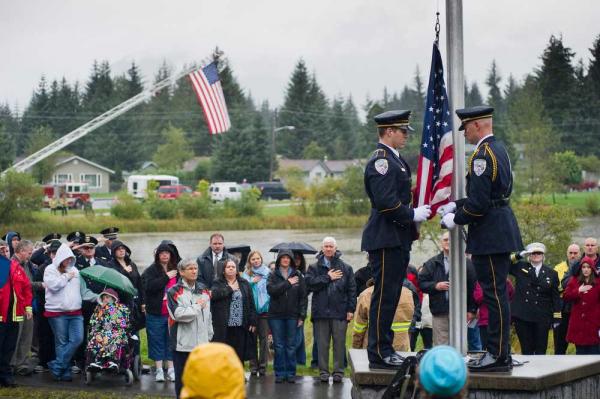
Juneau residents marked the 13th anniversary of the 9/11 attacks on Thursday with a ceremony at Riverside Rotary Park in the Mendenhall Valley.
About 100 people gathered around the park’s Sept. 11 monument to honor those who died and those who were called to serve as a result of the worst act of terrorism ever on American soil.
Speakers included Charity MacKinnon, president of the Juneau-Glacier Valley Rotary Club, Capital City Fire/Rescue Chaplain Dan Wiese, Eagle Scout candidate Konnor Mueller and volunteer firefighter Carl Bottorf. Alyssa Fischer sang the national anthem, while the Juneau Police Department Color Guard raised the United States flag to half-staff. Retired JPD Captain and Juneau Assembly member Jerry Nankervis laid a wreath on the 9/11 memorial.
Many of those who attended the ceremony were veterans or Juneau’s first responders.
The Juneau Police Department Honor Guard during a past 9/11 memorial. (Photo courtesy Glacier Valley Rotary Club)
Tomorrow is the 13th anniversary of the Sept. 11 terrorist attacks.
In Juneau, the Glacier Valley Rotary Club has a memorial planned at Riverside Rotary Park at 9:40 a.m. The ceremony takes place at the same time of day as when hijackers crashed into the World Trade Center towers in New York and the Pentagon near Washington, D.C., killing thousands.
The program includes the Juneau Police Department Honor Guard, Eagle Scout candidate Konnor Mueller, Capital City Fire/Rescue’s Carl Bottorf and bagpipe music by Scott Marnon.
Editor’s note: This story has been updated to correct the spelling of Carl Bottorf’s last name. It was misspelled as “Rottrof.”
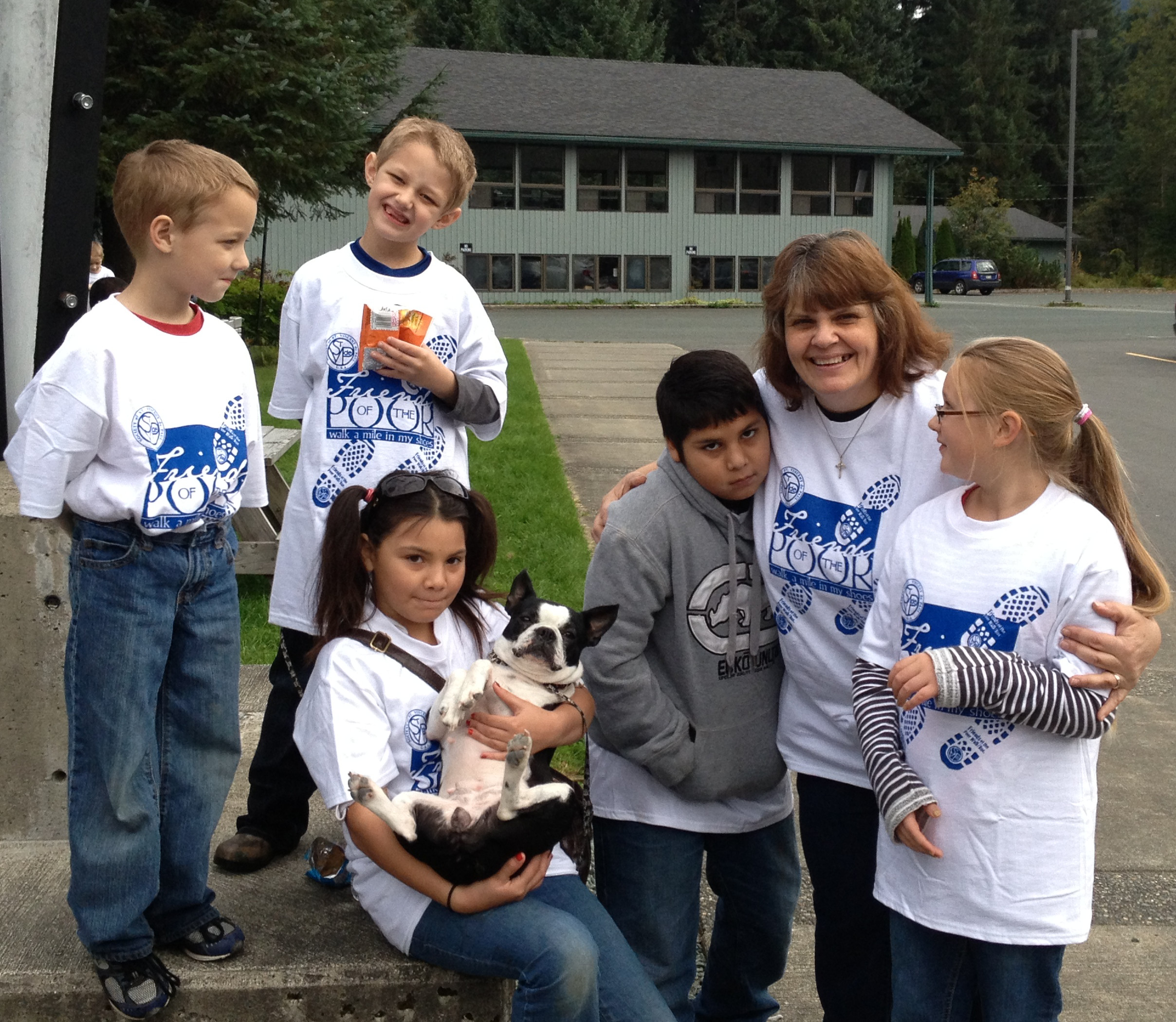
St. Vincent de Paul housing manager Tamee Martini did last year’s walk with many of the children living in the shelter. (Photo courtesy of Tashina Gordon)
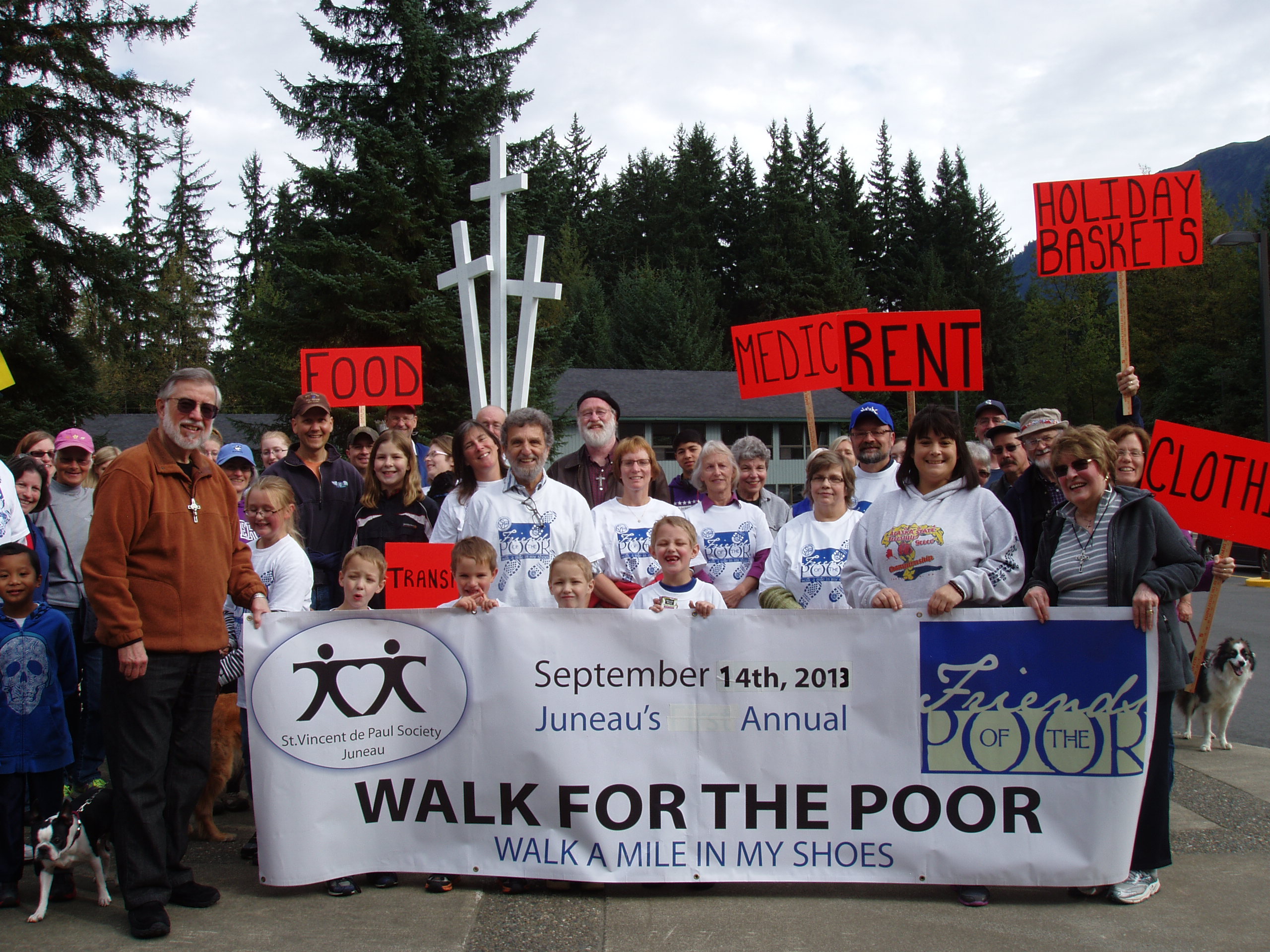
St. Vincent de Paul will hold its annual Walk for the Poor Saturday morning. This is the nonprofit’s only fundraiser of the year.
The organization distributed $84,000 of direct assistance to Juneau residents last year, the majority of which came from donations. The walk alone raised $17,000.
St. Vincent de Paul offers rental, utility and medical assistance to individuals and families. During the holidays, it gives out gifts and hundreds of food baskets.
St. Vincent de Paul also runs a thrift store and shelter.
“We use the thrift store to support our homeless shelter and we use donations to support our aid to people who do not live in our shelters, to the community as a whole,” says general manager Dan Austin.
Walk for the Poor 2013 (Photo courtesy of St. Vincent de Paul)
About 70 people participated in the Walk for the Poor last year. Austin says the short walk offers an opportunity for fun and contemplation.
“Try to envision yourself as living on $5,000 a year or something like that. Envision yourself living like that and walk a mile in their shoes,” Austin says.
Registration for Saturday’s Walk for the Poor is at 9 a.m., walk begins at 10 from St. Paul’s Catholic Church. The walk is about a mile long. There is no fee to register.
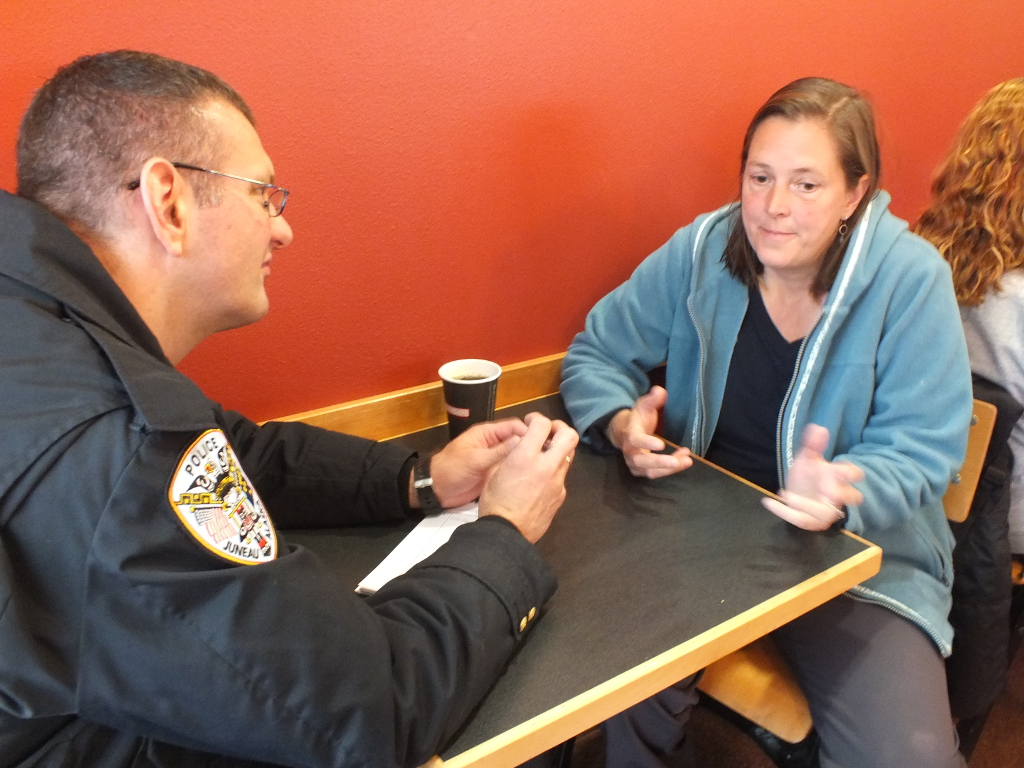
Downtown resident Noelle Derse talks with Juneau Police Chief Bryce Johnson at Coffee with a Cop. JPD started the program this week to improve outreach to the public. (Photo by Casey Kelly/KTOO)
With the recent unrest in Ferguson, Mo., police departments across the country are under a lot of scrutiny. Questions are being raised about use of force, police militarization and racial profiling.
Against that backdrop, the Juneau Police Department this week launched a new outreach program.
Coffee with a Cop
It’s a busy Wednesday morning at the Heritage Coffee shop on 2nd Street in downtown Juneau. A mix of tourists and locals are sipping lattes and eating fresh-baked treats.
Police Chief Bryce Johnson sits at a table near the front door, talking with Noelle Derse. The young mother of three lives downtown and says she loves it. But she feels like the area is kind of sketchy.
“A couple of years ago it was really bad, broken windows all the time,” Derse says. “Every Saturday morning when we took our walk, just filth and vomit and feces and everything all over the streets.”
Derse says she came to Coffee with a Cop to talk to police about increasing patrols in her neighborhood. Overall, she thinks the Juneau Police Department does a good job.
“They work really well one-on-one with people,” she says. “I just want more. I want to see them more. I want to know they’re out here.”
Larri Spengler is with the Thane Neighborhood Association, a community watch group for residents who live a few miles outside downtown. She calls JPD officers helpful and approachable, and says events like this foster good relations between the police department and the community.
“Especially with recent publicity in the nation about police troubles, I mean, I don’t think we have that sense of that here,” Spengler says. “And this kind of thing would help even make it less likely that people would think of the police as other.”
At a recent interview in his office, Chief Johnson says he’s followed the events in Ferguson through the media. He’s thought a lot about how he would handle a similar situation, and says it’s important for people to remember that there are a lot of unknowns. But he says one lesson is “we (police) need to learn how to better communicate with the public in general and with the media.”
Since coming to Juneau a little more than a year ago, Johnson has consistently talked about wanting police to be an open and trusted part of the community.
“We don’t live in police states. They call it a thin blue line for a reason,” he says.
Johnson brought the Coffee with a Cop idea with him from Salt Lake City Police Department, where he worked for 20 years. He says trust is important because cops are only part of the crime prevention puzzle.
“When you look at what causes crime it has a lot to do with economic opportunity, it has to do with family status, it has to do with drugs and alcohol,” Johnson says. “These are all problems that the police department cannot fix. So what we have to do is we have to partner with other community agencies, other community entities, other people, and be part of a solution.”
Police militarization
One of the biggest criticisms leveled at police in Ferguson has dealt with the militarization of law enforcement. Johnson thinks that’s an unfair characterization. He says the Juneau Police Department has received some surplus military gear from the federal government. But he says it’s only used under special circumstances and always to ensure the safety of officers and the public.
“I don’t think it is a bad thing the police department is getting this type of protective equipment,” Johnson says. “I think a better conversation would be when do you use it, when do you deploy it?”
Coffee time
Back at the coffee shop, downtown patrol officer Jim Quinto says he doesn’t feel much negativity or hostility toward Juneau police. Quinto grew up here and has been on the force for 17 years. He says efforts like Coffee with a Cop will only improve communication between the department and residents.
“Like when I walk around, I’m constantly going into stores and saying hi to people,” Quinto says. “Just so they know that we’re out there.”
JPD hopes to make Coffee with a Cop an ongoing program with events every month or two in different neighborhoods. Johnson says it doesn’t cost anything, and hopefully it’ll make the department more accessible.
*Editor’s note: This story originally said Larri Spengler was president of the Thane Neighborhood Association. In fact, she’s secretary.
The owner of a dog killed last week for being aggressive has been cited.
A Juneau animal control investigation into Friday’s incident shows a 15-year-old boy fired warning shots to shoo away dogs that were on his family’s property. But a Rottweiler mix charged him and the frightened youth fired several rounds, killing the dog.
Animal Control officer Ben Peyerk says the boy and his siblings were confronted by the roaming dogs when they got off the school bus in the 5400 block of North Douglas Highway. The three dogs reportedly prevented the kids from getting to their house. Then the dogs left and the kids went home, only to have the pack return.
The investigation indicates the barking, aggressive dogs wouldn’t leave, so the 15-year-old retrieved a gun from his home.
Peyerk says the boy was scared for his family, and his own dog and cats that were outside at the time.
“I can’t imagine walking up your driveway as a young student and being confronted with something like that. That’s nothing I would want anybody to have to experience,” Peyerk says.
The dogs apparently had been wandering for a while. Gastineau Humane Society Director Matt Musselwhite says their behavior fits the description of aggressive animal behavior in the CBJ code.
“Title 8, which is the section of the city ordinance that covers animals, defines an aggressive animal as one that snaps at, jumps upon, of otherwise menaces, injures or frightens a person, domestic animals or livestock,” Musselwhite says.
He says Bianca Lynn Erickson has been cited for an aggressive dog, a $50 fine for the first offense. She also was cited for allowing the dogs to roam, and failing to license the dogs. Musselwhite says Erickson was given a warning for failing to have the dogs vaccinated against rabies.
“Keeping your pets properly restrained is the only way to ensure the safety of your pets and the general public,” he says. “You know, it really is. If you have your animal contained, a thing like this doesn’t happen.”
Investigating officer Peyerk put it this way: An animal was killed and it was 100 percent preventable.
Juneau police are also investigating the incident.
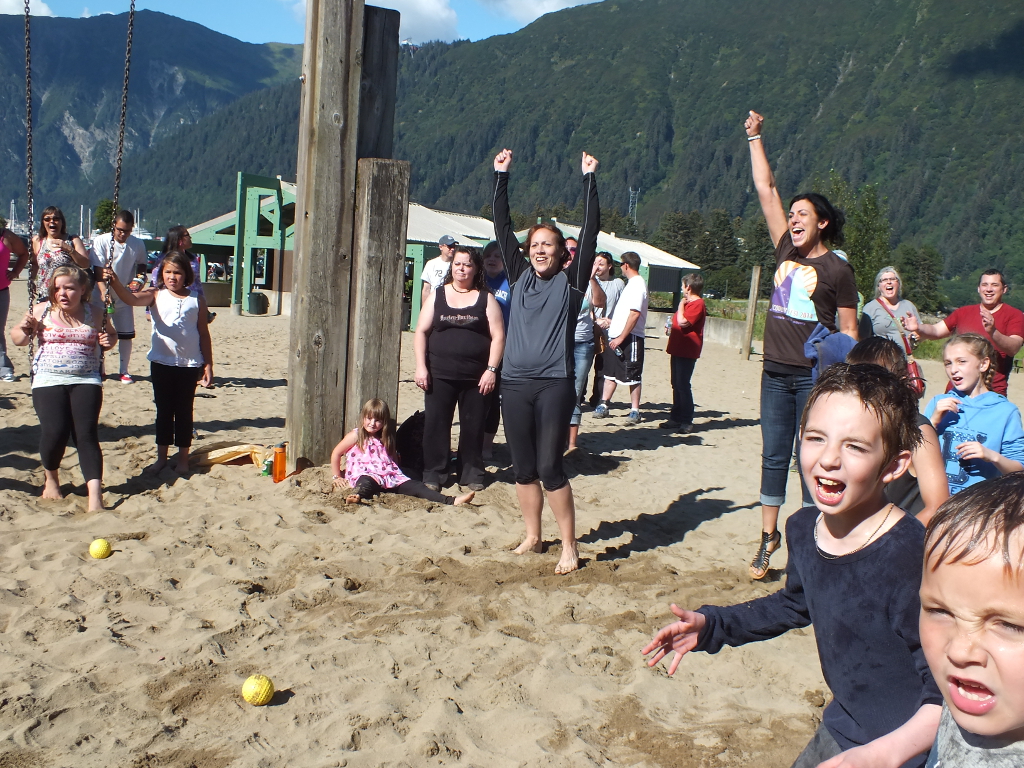
Dusty Dumont and Kara Nelson jump to celebrate a dunk tank bull’s-eye at a recent Juneau Recovery Fest event. (Photo by Casey Kelly/KTOO)
Alcohol and drug abuse cost Alaska’s economy more than $1 billion every year. That includes millions in lost productivity and millions more spent on health care, social services and the criminal justice system, according to a 2012 McDowell Group report.
Shame and stigma can make it difficult to get help for substance abuse. But a group of Juneau residents is out to change that. They organized last weekend’s Recovery Fest to celebrate those seeking to overcome addiction.
It’s a sunny afternoon at Sandy Beach in downtown Douglas, and a crowd is gathering around a dunk tank filled with several gallons of cold water. Dusty Dumont, a parole officer for the state Department of Corrections, sits on a platform above the water, dry for now. Then someone throws a ball that’s right on target and Dumont splashes into the water as the crowd lets out a cheer.
Carol McDaid was a guest speaker at Juneau’s Recovery Fest. The Washington, D.C. lobbyist for addiction services is a recovering drug and alcohol addict herself. (Photo by Casey Kelly/KTOO)
“I did get dunked quite a few times,” Dumont says later, wrapped in a towel and standing next to a picnic shelter.
“For a good cause,” she adds with a laugh.
The cause she’s talking about is addiction recovery. Programs like 12 step, Alcoholics and Narcotics Anonymous, professional counseling and peer-to-peer treatment.
“The majority of the people on my case load are struggling with addiction, and I would love to see more of this so that people feel like they belong and are part of a strong community that’s sober,” Dumont says.
Kara Nelson is one of the people on Dumont’s case load. The 40-year-old mother of three spent more than half her life abusing drugs and alcohol before sobering up in 2011.
“I never really had a drug of choice,” Nelson says. “Whatever you had I’ll take, whatever’s going to get me out of my right mind right now.”
Like a lot of addicts at Recovery Fest, Nelson says no one event led to her getting clean. Rather, it was a series of what she calls “bottoms.” She says her family, friends and members of her church help her stay sober. She also credits peer-to-peer therapy, where former users support each other.
“If you’re like me, I don’t like to feel like anyone is trying to tell me what to do,” she says. “I mean, I already have so much shame on me. So when I’m with someone who’s already been through that, I definitely can identify, and work through things a little better and get to that humbled spot that we need to get to to move forward.”
Carol McDaid pushed to get addiction services included in the Affordable Care Act as a Washington, D.C. lobbyist for treatment organizations. She’s also been in recovery for drug and alcohol abuse for 16 years.
“The thing that was my biggest mark of shame is now my biggest asset,” McDaid says.
A frequent guest speaker at events around the country, she talks about putting a face on addiction recovery.
“That’s why we’re out here today. So that people don’t have to think we’re these people under bridges swigging out of brown bags,” McDaid says. “We are tax paying, loving members of our family, and members of our community that add rather than detract. And I think if we do that enough, we will show that there’s a benefit to doing it.”
Katie Chapman, executive director of the National Council on Alcoholism and Drug Dependence Juneau Chapter. (Photo by Casey Kelly/KTOO)
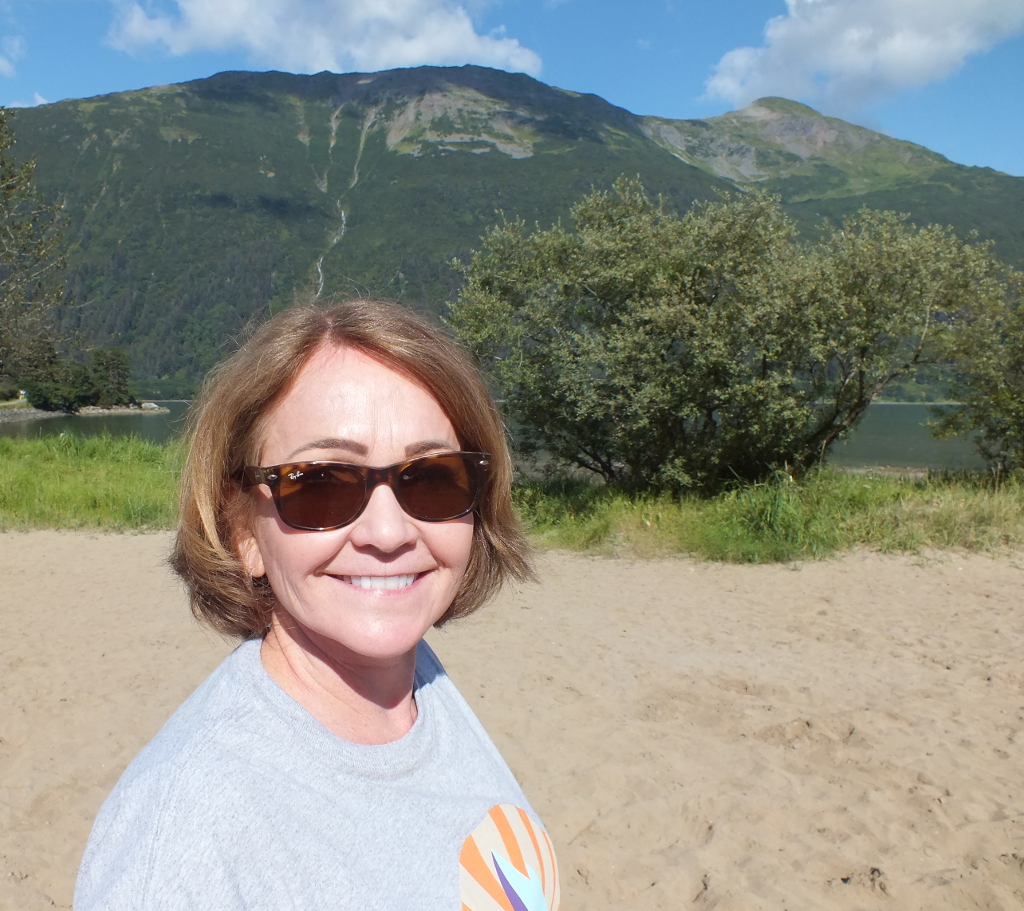
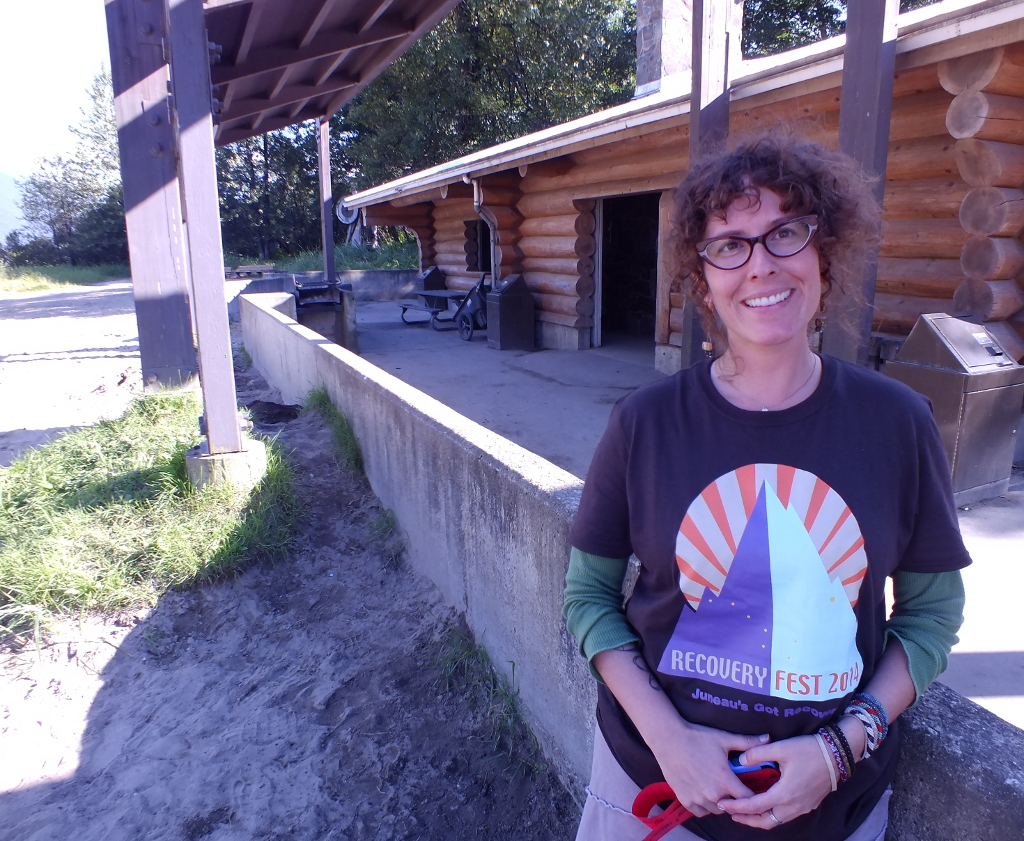
Katie Chapman, executive director of the National Council on Alcoholism and Drug Dependence Juneau Chapter, is celebrating four and a half years sober. NCADD helps organize the weekly Juneau Recovery Community meetings, where the idea for Recovery Fest first took shape. Chapman says the group hopes to hold more public events that shine a light on recovery and reduce the stigma for those struggling to overcome addictions.
“I’m happy to do that here today,” Chapman says. “I’m proudly wearing a shirt that says ‘I got recovery’ on the back of it, because I do and I’m proud of it. It’s something to be proud of.”
Close
Update notification options
Subscribe to notifications
Subscribe
Get notifications about news related to the topics you care about. You can unsubscribe anytime.