




Community

Auke Bay children celebrate their new school

The students of Auke Bay Elementary School on Thursday formally thanked the community of Auke Bay, state and local officials, and the City and Borough of Juneau for their new school.

The old school has been completely gutted and renovated, with much of the work done while school was in session.

The celebration

Auke Bay Elementary School sits on Aak’w Kw’aan land.  The Tlingit were the first people of Auke Bay.

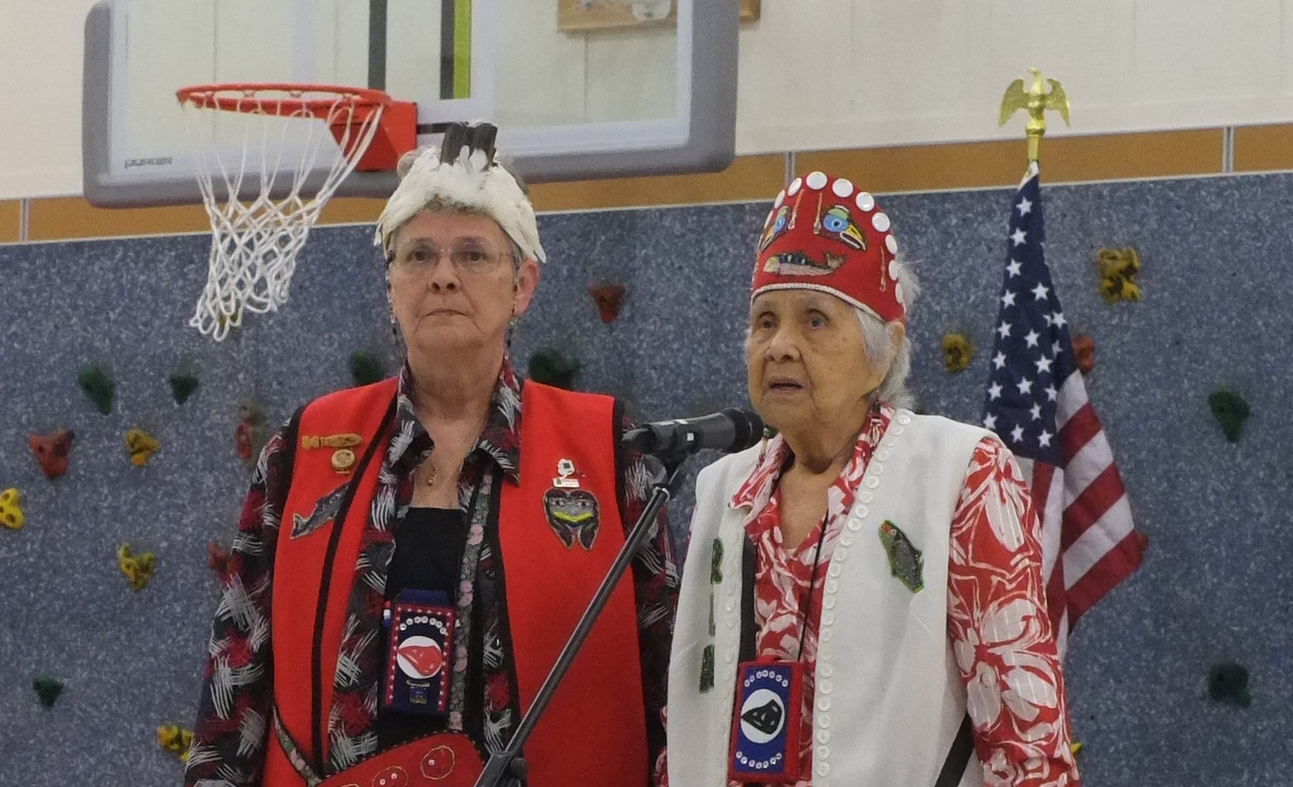
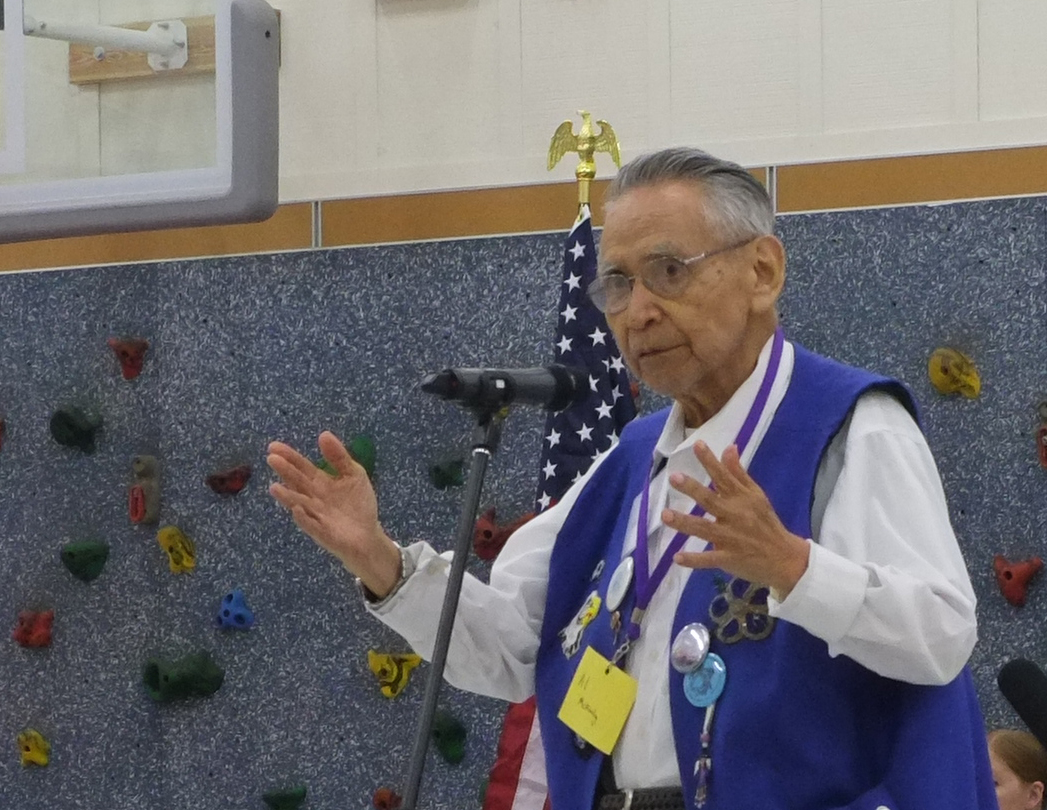
Elders Rosa Miller and Albert McKinley offered the Aak’w Kw’aan welcome to the ceremony in Tlingit and English.

“Our land will be yours,”  McKinley said.

In Tlingit regalia, groups from Harborview and Glacier Valley elementary schools danced the response.

Auke Bay fourth graders sang their school song in Tlingit and kindergartners counted in Tlingit.

Each Auke Bay grade made gifts for the elders and other guests —  necklaces, medallions, bookmarks, tea, even devils club salve.  Before the program began, fifth graders gave each arriving guest a jar of blueberry jam made by teachers and staff.

Lori Hoover has been principal at the school for seven years.

“We are privileged to be here on the land of the Aak’w Kw’aan. As the first peoples of this beautiful land, we honor that you have given it to us, and we hope to do good with our kids and honor you through them.”

Auke Bay school has been on Aak’w Kw’aan land since 1968. The renovation was a complete rebuild.

“We wanted to appreciate the people who envisioned and built our school: Architects, engineers, plumbers, carpenters, roofers, all the people that worked here for 15 months and really gave us a beautiful school,” Hoover said.

The project

While the celebration was confined to the school building, it reflects a thank you to Juneau voters, who in 2010 approved $18.7 million in general obligation bonds for the renovation. A year later, voters approved $1.4 million for a ground source heat system for the school.

CBJ architect Catherine Wilkins managed the three-phase project, which began in 2012.

“School got out May 31st and we started June 1st,” she said.  

The kids came back to school that August in a construction zone. Work continued for the entire 2012 -2013 school year.

Hoover said every construction day held another surprise, from fire alarms to blown circuit breakers. Some days there was no heat, and most days there was dust, dirt and noise.

“The building was literally cut in three pieces and demolished,” she said. “Our mantra was we’ll love it when it’s finished.”

The first phase of the renovation was done in January 2013.

“One side of the building was occupied while the other was torn down and rebuilt, and then we swapped sides,” Wilkins said.

Hoover said the kids used it as a learning experience.

“They watched the construction going up and they would peer through the fence. The construction workers kind of became part of our school family,” she said.

Auke Bay teachers and staff were really good sports, Wilkins said, and the children made it a more cheerful project than most.

“They saw this as one big fun adventure, and that really contributed to sort of a happier construction site,” Wilkins said.

Three-hundred thirty-five children are enrolled this year in kindergarten through fifth grade at Auke Bay. Like Lucas Erickson, many of the fifth graders started kindergarten in the old building, spent fourth grade in modular classrooms while their wing of the building was under construction, and are enjoying their final year of grade school in the new building.

Lucas likes the new technology in each classroom.

“Every room has flat screen. We have iPads, and really nice projectors that aren’t all fuzzy,” he said.

About the only resemblance to the old school now is the location. Though all the major work was done when school started last fall, the building still smells new.

“We’ve been poking along picking up some little items that weren’t quite complete at the beginning of the school year and now we are looking at the art acquisition,” Wilkins said.

City law requires that 1 percent of school construction costs be reserved for art work.  Wilkins says artists are invited to submit proposals by May 23.

Auke Bay was the last of a decade of major renovations to Juneau’s oldest elementary schools.  Mendenhall River Community School and Marie Drake are the next buildings for renewal, but there is no time frame for the projects.


‘I am a girl on the run’

When Molly Barker exclaimed, “I feel beautiful,” the crowd of runners, running buddies, volunteers and family members cheered. When she yelled, “I am a girl on the run,” everyone – female and male alike –  shouted, “I am a girl on the run!”

More than 100 girls from around Southeast Alaska participated in Saturday’s Girls on the Run event in Juneau. The after-school program has been in Juneau since 2008, but this particular run was special – Girls on the Run founder Molly Barker was visiting from North Carolina.

Girls on the Run is a three-month after-school running program that empowers girls to be healthy, happy and confident. Each program session culminates in a 5K run.

Glacier Valley fifth grader Teija Loving says the program works.

“Because you can get fit and you can have new friends and you can, like, just meet a lot of new people and you can have more respect about yourself,” Teija says.

Emma Rice, also in fifth grade, says she’s learned a lot from the program.

“To, like, be confident and never give up on yourself and don’t think that you’re a failure,” Emma says.

Teija and Emma are on the cusp of entering a new phase of life where, Barker says, things starts to get more difficult.

“What I’ve learned is that around sixth grade, which is the age you guys are, the world suddenly – I don’t know if you’ve experienced this – starts to somehow get the focus off of who you are in the inside and put the focus where? On your outsides, like, maybe how you look, your body, your hair, all the other stuff,” Barker said.

Speaking to sixth grade girls at Floyd Dryden Middle School, Barker shared one way to handle this.

“If you are funny, are you going to kind of be a little bit funny if your gift is to make people smile and laugh? No, you’re going to really let that out,” Barker said. “So part of what I think we can do as strong empowered women, instead of focusing on each other’s outsides, we can bring our gifts, walk it into a room and own it.”

This is a lesson that Barker herself didn’t have growing up in the South. She struggled with being popular and fitting in. At age 15, she started drinking. Barker said her struggle continued until she was 32.

“I had this experience while out on a run actually that just changed everything and I became incredibly conscious of the fact that I lived 32 years of my life allowing words and other people to define me and I thought, ‘I can’t live like this anymore,'” she said.

Three years later, Barker created Girls on the Run. It started in 1996 with 13 girls. Now, more than 130,000 girls in the U.S. and Canada are part of the program.

AWARE is Juneau’s women’s shelter and domestic abuse nonprofit. It started Girls on the Run as one of its primary prevention initiatives. The program has spread to 11 other communities in Southeast Alaska and serves more than 350 girls.

Back at the 5K, 11-year-old Eli Mead stands with his little sister, Samantha, who’s in Girls on the Run.

“I’m her running buddy today because I love running,” Eli says. “I’m going to make sure that she never stops and I’m going to compliment her and I’m going to tell her that she’s doing fine.”

Volunteer Leslie Daugherty is also a running buddy.

“It’s just about taking baby steps. So we walk until we feel like running and maybe we don’t feel like running at all, and that’s okay, too. We’ll just be joyful about it and just feel strong and like we can do anything,” Daugherty says.

And that’s what Girls on the Run is all about – bringing joy and confidence. Or, as a girl once told Barker, “teaching girls to be the boss of their own brains.”

Group challenging Alaska’s same-sex marriage ban

Alaska Pride Flag (Photo by Mel Green)

Alaska was the first state in the country to add a ban on same-sex marriage to its Constitution. Now, five gay couples are trying to strike that ban down.

The [icon name=”icon-file-text”]complaint was filed in federal district court yesterday, and it names Gov. Sean Parnell as the lead defendant. The parties are challenging the ban on the grounds that it violates the equal protection and due process clauses of the U.S. Constitution.

Caitlin Shortell is one of three attorneys representing the couples.

“I think there’s a very strong, growing recognition that laws that single out a particular group of people to deny them rights do not square with the U.S. Constitution. And in fact, not with the Alaska Constitution,” Shortell said.

All but one of the couples challenging the ban have already been married in other states. But their marriages are not recognized by Alaska because of the ban that was instated in 1998. The fifth couple is unmarried, but would like to wed in Alaska.

Because the state officials named in suit have not seen the complaint, a spokesperson from the Department of Law could not comment on the case.

The State Supreme Court has ruled as recently as last month that gay couples need to be treated equally under law in situations like employee benefits and tax breaks, but it has skirted the question of whether the marriage ban conflicts with other parts of the Alaska Constitution.

Last summer, the U.S. Supreme Court decided that the federal government must recognize same-sex marriages. Federal judges have struck down marriage bans in several states since that ruling.

Previous Stories:

[icon name=”icon-angle-right”]State reps reject measure to extend military perk to same-sex partners
[icon name=”icon-angle-right”]French introduces measure to strike gay marriage ban
[icon name=”icon-angle-right”]Alaska Supreme Court may review case of same-sex partner denied survivor’s benefits
[icon name=”icon-angle-right”]What does the ruling on DOMA, Prop 8 mean for Alaska?
[icon name=”icon-angle-right”]Alaska couples await Supreme Court decision on DOMA, Prop 8

Update: U.S. Bank apologizes for banking error that delayed state payroll

State Office Building
State Office Building in Juneau. (Photo by Casey Kelly/KTOO)

Update: Tuesday, May 13, 2014

U.S. Bank has apologized to state of Alaska employees whose paychecks were delayed due to a company error.

Department of Administration Commissioner Curtis Thayer forwarded a letter of apology Tuesday to the 15,000 employees affected by the glitch. The letter said it was an “isolated incident, and that U.S. Bank has taken proper steps to ensure this will not recur in the future.”

Thayer also said the department will assist any state workers that “experienced hardship” due to the delay. U.S. Bank said it would cover any banking fees or penalties resulting from the late deposits.

Thayer said the administration department has received numerous confirmations that the direct deposits were made Tuesday morning to employees’ personal accounts.

Original story: Monday, May 12, 2014

About 15,000 state of Alaska employees will wait another day for their paychecks, due to a banking glitch.

Direct deposits were not processed as expected by U.S. Bank on Monday, according to the Administration Department. Spokesman Andy Mills says the deposits are expected to be complete by Tuesday morning.

He says the state transmitted the payroll information to U.S. Bank on Friday, and the error was made by the bank.

U.S. Bank is a new vendor for the state and this is first time the company has processed the direct deposits. Wells Fargo was the previous vendor.

Mills calls it a big disappointment that U.S. Bank couldn’t get it right the first time.

“While our folks processed and did their portion of this payroll transmittal information, U.S. Bank did not complete their part and we’re looking to  make sure this doesn’t happen again,” Mills says.

State workers may end up with fees on their personal bank accounts due to the problem, he says, which will be U.S. Bank’s responsibility.

“U.S. Bank has confirmed that they will be covering employee banking fees that are incurred from this error that they created and we’re going to hold them to that.”

Employees in every agency of the executive, legislative and the judicial branches of government statewide are affected.

Salmon derbies set for Wrangell, other SE cities

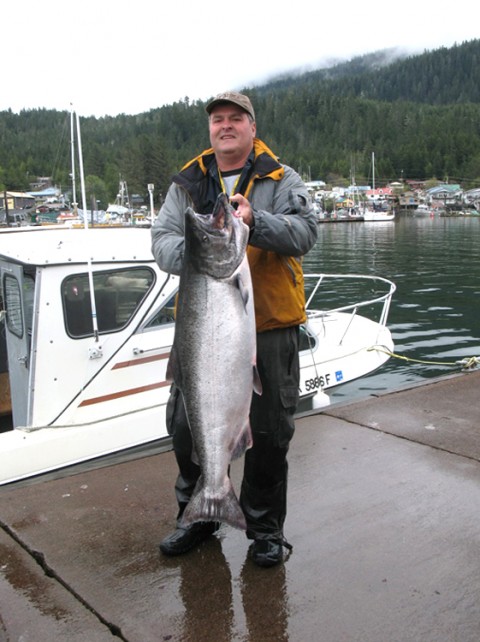
Jan Herron displays the 41.2-pound fish that won Wrangell’s 2008 derby (KSTK)

Wrangell fishermen are getting their gear ready for the chamber of commerce’s king salmon derby. But some anglers in other towns are already out on the water.

Organizers say things are looking good for this year’s Wrangell King Salmon Derby.

Now, organizers are always optimistic. But this year, they’ve got evidence.

“I’ve been seeing some pictures on Facebook. People are already out there catching fish. So I think it’s going to be a great year,” says Cyni Waddington, who runs the derby for Wrangell’s Chamber of Commerce.

The organization promises more than $30,000 in prizes for contestants. They range from $6,000 for the overall biggest Chinook to smaller prizes for youth and seniors.

Not all winners get cash.

“One of the local Native artists … does a sterling silver salmon bracelet for the woman who catches the biggest fish in the derby and that’s very popular,” she says.

Wrangell’s salmon derby runs through the first week in June.

Ketchikan, Sitka, Haines and Petersburg have salmon derbies over the Memorial Day weekend. Ketchikan continues for two more weekends, Haines and Sitka for one.

Skagway’s Game Fish Derby is near the end of June. And Craig and Klawock have one running this and next month, with another starting in July.

Juneau has two large derbies, and one is already underway.

“It seems like the run is just fantastic this year. I don’t hear anyone complaining about long rod hours. Everybody’s catching,” says Leslie Isturis, organizer of the capital city’s Spring King Salmon Derby.

It’s a project of the regional Central Council of Tlingit and Haida Indian Tribes of Alaska. Proceeds go to scholarships.

The contest runs all of this month, and the prize for the top fish is $10,000.

Isturis says other payouts are a little different from last year.

“Rather than have a lot of the money in the regular prize listing, we split it up between daily and weekly prizes,” she says.

Juneau’s longest-running derby, the Golden North, runs the second weekend in August.

Many of the prizes are goods or services rather than cash.

Wrangell’s Waddington says that’s part of the fun.

“We actually get lots of prizes from the community … for derby award night. We just basically go down the ladder from the largest weight. I think last year everybody who entered a fish got a prize of some sort,” she says.

Tlingit-Haida’s derby has its own collection of prizes donated by individuals and businesses.

Isturis says there’s even a mystery prize, donated by two local carvers.

“They gave me a check inside an envelope and they said we’ll let you know about half-way through what the weight is. They won’t even tell me,” she says.

The derbies help merchants sell fishing gear, groceries, and other important supplies, such as beer.

Wrangell’s Waddington says they also promote tourism.

“There’s a good number of people who come from other places in Alaska, but there’s definitely a good number of people who come from the Lower 48 as well, who make this one of their travel destinations to come fishing,” she says.

Anglers should have a better chance to catch the big one this year.

The resident bag limit is three kings a day, 28 inches or larger, with no annual limit. That’s up from one a day in 2013.

The Dauenhauers teach tour guides how to teach tourists

Nora and Dick Dauenhauer wrote Russians in Tlingit America. The book is used to train Sitka’s park rangers. (KCAW photo/by Emily Forman)

Two of greatest living scholars on Sitka’s Russian and Tlingit past were in Sitka last week to train National Park rangers on the historic battles that took place here. Park rangers give programs, of course, but sometimes they’ll interact with visitors for only a few minutes at a time. So the challenge is: How do you teach visitors about the culture in a way that will have impact – when the most commonly-asked question is “Where’s the bathroom?”

I’m on a bus tour. All the passengers are trained historical interpreters. And the tour guides are the leading scholars on the topic. They literally wrote the book.

Dick: One of the earliest recordings of the history is from Sally Hopkins. And her daughter asked Nora if she would transcribe and translate this…

Nora and Dick Dauenhauer are the author’s of Russians in Tlingit America – the definitive work on the battles of 1802 and 1804.

The bus stops in old Sitka. It’s just a patch of grass near the ferry terminal. But in 1802 it was where Tlingit warriors attacked the Russian fort.

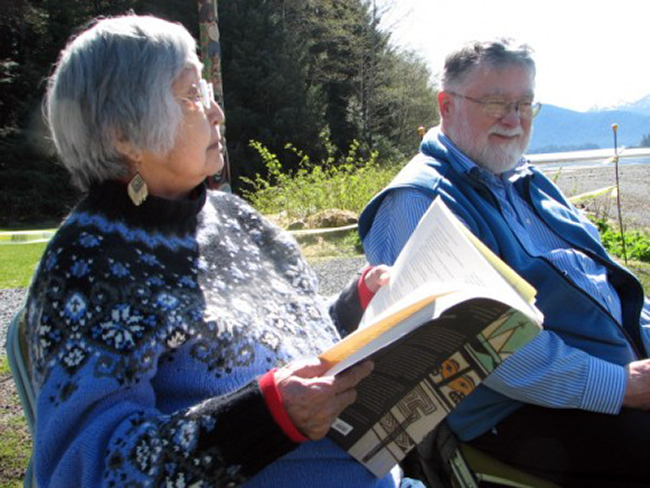
Latanich: This is Dick and Nora is right there in the blue sweater.
Dick: Hello
Park ranger: I like your book!
Dick: Thank you.
Park ranger: I make all of my staff read it.
Dick: It’s a good one I’m glad it’s in there because my memory isn’t what it used to be so at least it’s all in there now.

The Dauenhauers are in town to advise Sitka park rangers how to reinterpret the history for transient cruise ship passengers who know nothing about it.

Nora is Tlingit and a native speaker of the language.

Nora: The way we got into this was I was teaching Tlingit in Juneau high school and I got this letter from a professor.

Dick was the professor, he admired her work. The rest is history.

Dick: We’ve been partners in scholarship for over 40 years and we had our 40th anniversary in November…

Somewhere along the line they got married.

Dick: Still doing business but slower than we used to be.

While their relationship was always solid. The making of Russians in Tlingit American was an on again off again kind of affair.

Dick: The first issue that came up to us in doing this book was who owns history.

Nora was asked to translate Tlingit oral histories recounting the battles. But then Native elders didn’t want to rehash the past, which put the book on hold. When the elders died the new generation wanted to know the history. Then the Soviet Union crumbled – freeing up access to Russian archives. It took decades of cultural and political change before they could complete the book.

Dick: So, these are difficult issues. I think it’s important to kind of be up front that this is living history that this is not just something that happened 200 years ago. People are very aware of that here.

Sitka park rangers take tips from the the Dauenhauers on how to engage tourists. (KCAW photo/by Emily Forman)

Sitkans might be very aware of the history, but tourists from… Idaho? The challenge is getting visitors to care. I asked second season tour guide Janet Drake about her approach.

Forman: So much research, and so many different sources, a combination of written and oral history, and then you have to try and synthesize this for a group of tourists that…
Drake: know nothing about this place and..
Forman: How do you do that?
Drake: I know, that’s the challenge – finding those pieces that hit home for people.

Forman: What’s the most common question you get?
Drake: Where’s the bathroom? Hahaha! Just kidding… But actually that’s kind of serious.

Chief of Interpretation Becky Latanich is always thinking about how to make the history relatable.

Latanich: I think visitors have a hard time relating to this story. They come here and they don’t know anything about it and they think Sitka and they think totem poles. The battle is a little difficult for people because it’s not well know. It’s not Gettysburg. So do you have any suggestions for our staff about what themes you’ve encountered that people might be able to relate to?

Dick: Whoever controlled Sitka controlled the whole Northwest fur trade… If you got a flare for the dramatic you can reinterpret for the tourists… Imagine Katlian coming down, the Russians on the beach, and all of a sudden the Russians are behind them and here’s Katlian with his hammer because it’s easier to bash heads in than it is to pull a dagger out.

While engaging tourists is one thing, retelling the story in a way that’s respectful of the families that have a personal connection to the history is another. Some parts of this history are so sensitive that the Dauenhauers were actually asked to omit some of the detail. And they did because that’s the respectful thing to do.

Dick: And that’s of course the challenge of ethnohistory you are dealing with the families, family memories, and family traditions.

The idea that family history is complicated? Most people, even out of town visitors, can relate to that.

Site notifications
Update notification options
Subscribe to notifications