Community

Update: fire warning canceled, city reiterates water conservation request

Salmon Creek water level is close to normal, but turbidity is high and the reservoir can't be used for drinking water at this time. (Photo courtesy Scott Willis)
Salmon Creek water level is close to normal, but turbidity is high and the reservoir can’t be used for drinking water at this time. (Photo courtesy Scott Willis)

Update, Sunday, May 18:

The National Weather Service has canceled its Red Flag Warning for fire danger in the area, but the city is still asking residents to conserve water while Salmon Creek reservoir remains offline.

Meanwhile, city landscape crews will start planting flowers Monday in the Egan Drive median, at the airport, city docks and Centennial Hall, as well hanging flower baskets in downtown.

But Parks superintendent George Schaff says water for those plants will not come from the city water supply.

“What we’re going to be doing is actually drawing water from Gold Creek below the city well field and filling tanks in our trucks from the creek instead of from the municipal water supply,” Schaff says.

The temperature in Juneau on Saturday was 72 degrees.  The normal high for May 17 is 57 degrees. The last time it was 72 degrees in Juneau on May 17 was 1945.

Original story, Friday, May 16:

With warm weather expected this weekend, Juneau residents should continue to conserve water and be careful when conducting open burns.

Capital City Fire/Rescue is not implementing a burn ban, according to a Friday afternoon press release. But with the National Weather Service issuing a red flag warning, the fire department urged caution when it comes to fire safety. A warning means severe fire conditions are imminent in the area.

Meanwhile, the city’s water supply remains low. Salmon Creek, Juneau’s secondary water source, is offline due to turbidity, so it can’t be used for drinking water.

While capacity in Juneau’s seven reservoirs is up to 46 percent, CBJ Public Works Director Kirk Duncan says it’s wise to reduce water use until Salmon Creek is again part of the CBJ system. That could be a couple weeks, he says.

“When we talk about 46 percent, Crow Hill and West Juneau are basically totally full as is Lena reservoir. But East Valley and Lemon Creek are lower than 46 percent and they’re the high use. So if we had a fire out in the Valley it would have a major impact on our water source,” Duncan says.

The city has about 4.6 million gallons of water on hand.

“Just to put that into perspective, we use about 3.2 million gallons a day. We have used up to 5.2 million gallons a day, when residents are using water intensely,” he says.

Juneau does not have a water crisis, but Duncan says it could become one.

He suggests conserving by reducing the time watering lawns, or washing boats and cars. Wait to have that car wash fundraiser until Salmon Creek is again producing drinking water, he says.

Check back for updates.

(Full disclosure: Kirk Duncan is a member of the KTOO Board of Directors.)
Remembering Harvey B. Marvin

Lillian & Harvey Marvin at a Tlingit & Haida Central Council Native Forum luncheon. (Photo courtesy of Jodi Garrison)
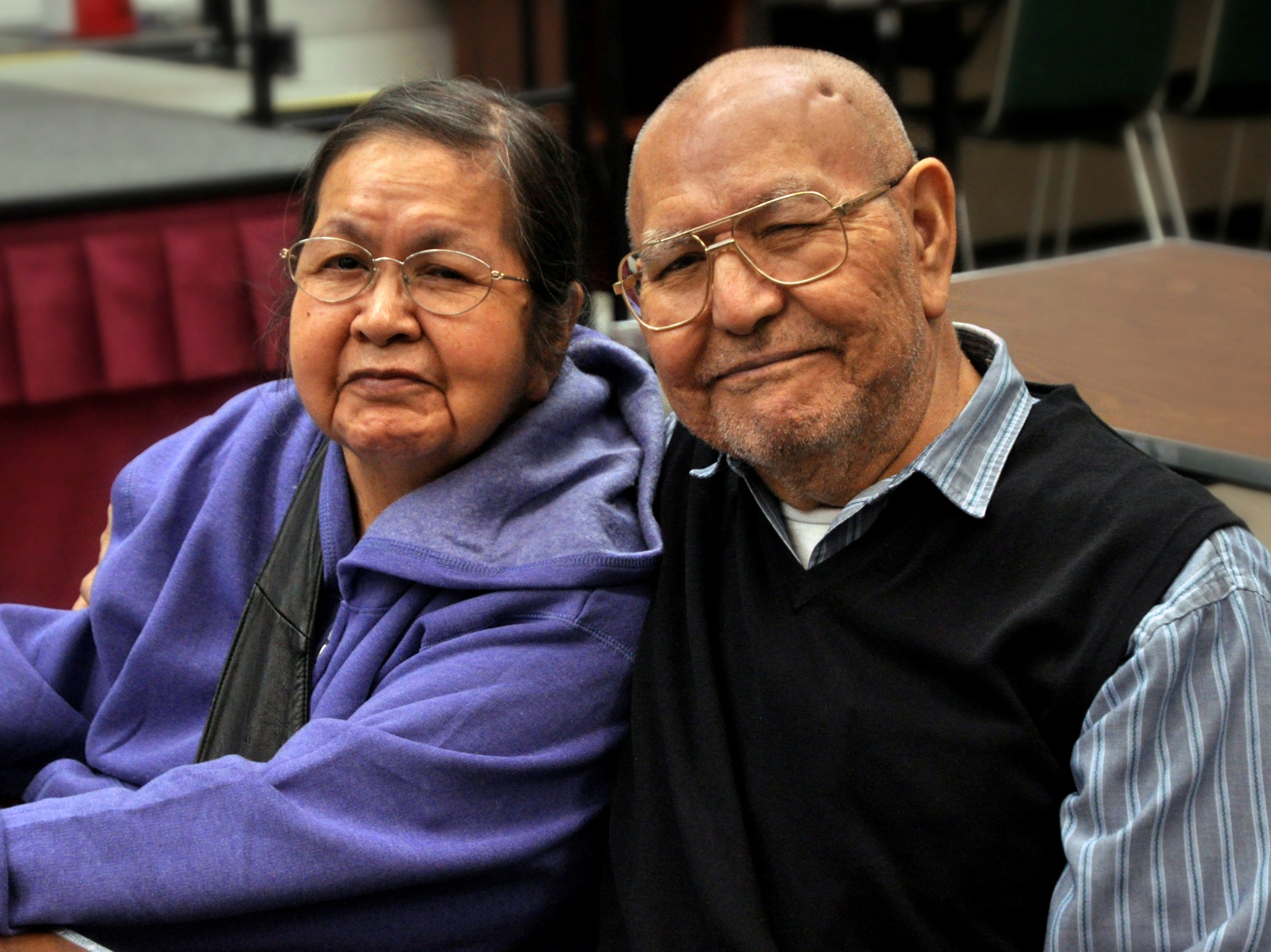
Lillian & Harvey Marvin at a Tlingit-Haida Central Council Native Forum luncheon. (Photo courtesy of Jodi Garrison)

Tlingit elder Harvey B. Marvin, of Juneau, has died at the age of 81.

Marvin grew up in Hoonah, worked for the public health service in Sitka and was the state of Alaska’s first Native auditor.

He was born in 1933 in Excursion Inlet to Lillian Pratt Marvin Smith, who was of the Kaagwaantaan clan, and John Marvin, of the T’ak Dein Taan clan, and a grandchild of the Chookaneidi. He was one of their 12 children.

He went to Mt. Edgecumbe High School, business school in Chicago and served in the U.S. Marine Corps in the Korean War.

Native land claims

Marlene Johnson grew up with Marvin in Hoonah.

“We were of opposite clans.  He was an Eagle and I was a Raven, but we were good friends,” she says with a chuckle.

That friendship came in handy during the years they would work together on the Alaska Native Claims Settlement Act.

Marvin and Johnson were among the five members of the Tlingit-Haida Central Council Executive Committee to lobby Congress. When ANCSA passed in 1971, Huna-Totem was created as the Hoonah village corporation.

Marvin was appointed corporation treasurer. Johnson was a board member.

“He was at every meeting and worked with us as we looked at the history, and doing the land claims and other important things for the corporation,” she says.

These were complicated issues. Johnson says Marvin was just the guy to explain them.

“He  was very fluent in Tlingit, so he could explain it in Tlingit to the elders that didn’t understand English that well,” Johnson says.

As they met with new shareholders in Hoonah and other parts of Southeast, she says Marvin also listened well, so he could tell the board what Huna-Totem members wanted in their corporation.

Marvin later transitioned from treasurer to board member, serving 19 years. He was a member of the Alaska Native Brotherhood and active with Tlingit and Haida. In 2005, he was named Citizen of the Year by the Central Council for what the organization called his “extreme dedication” to the Alaska Native community.

“He was with and very loyal to Tlingit-Haida Central Council since the ’60s,” says Edward Thomas, who was Central Council president at the time.

Super voters

Lisa Worl keeps the family tree for her large family. She always called Harvey Marvin great grandfather, though he was actually her great uncle.

Worl is on the Juneau School Board. Marvin and his late wife Lillian were there when she was sworn into office.

She can recite the work Marvin has done for his people through Native organizations, as a Sitka Assembly member, and other political involvement.

Harvey and Lillian Marvin were Democrats and “super voters,” she says.

“It was more a matter of civic duty and always making sure the family was aware of the issues and make sure they voted. They never pushed any people but obviously they had their people they were supporting,” Worl says.

Former Juneau Rep. Beth Kerttula was one of them. Kerttula got to know Marvin when her father, Jay Kerttula, was a state senator and chairman of the Legislative Budget and Audit Committee. Marvin was the auditor.

Years later, when Beth Kerttula ran for Juneau’s downtown seat in the state House, Marvin sat her down for a tutorial on the nuts and bolts of Juneau politics.

“He had almost every twist and turn and nuance, and knew the groups I needed to reach out to and knew the people I needed to go talk to,” she recalls.

But it didn’t stop there. Both Marvins worked hard on all five of her campaigns and were in the gallery at the state capitol when she took the oath of office.

Kerttula calls him an astute politician.

“You know I think Harvey would have been governor or U.S. Senator in a different day,” she says. “He just had that kind of talent and ability.”

More importantly, she says, the Marvins set a great example of how to be good human beings.

Lillian Marvin passed away in February, just after the couple celebrated their 59th wedding anniversary.

“The two love birds are back together,” Worl says.

A memorial service for Harvey Marvin is Saturday at 3 p.m. at Alaska Memorial Park on Riverside Drive. A private family viewing is 1 p.m.

With wedding on the line, plaintiffs prep for same-sex marriage challenge

Five gay couples are behind the lawsuit challenging Alaska’s ban on same-sex marriage. The suit was filed Monday in federal court. And in this case, the political is especially personal.

Courtney Lamb is in the early stages of planning her wedding.

“I’ve asked people to be like, you know, bridesmaids. And I have my veil and my shoes.”

She has ideas for a dress, too. For a location, she’s thinking Girdwood. And when it comes to the reception, Lamb wants it to be more fun than traditional.

“Like I want a cupcake tower, not like a big eight-tier cake,” says Lamb.

There’s just one big wrinkle: Lamb doesn’t know if the state will allow her to marry her fiancée by their wedding date.

She and her partner Stephanie Pearson are one of five gay couples fighting an Alaska ban on same-sex marriage. Since the U.S. Supreme Court ruled the federal government must recognize gay marriages, judges all across the country have decided state-level bans are unconstitutional. On Wednesday, Idaho’s ban was struck down. The same thing happened last week in Arkansas. Oklahoma, Virginia, Illinois, Michigan, and Texas have all seen similar decisions from the federal courts this year.

Lamb thinks there’s a good shot that gay marriage could be legal in Alaska — and even nationwide — by next May.

“We’re planning our wedding, and if this goes through and it’s legal by the time we have all of our plans finalized, then that’s wonderful,” says Lamb. “And if not, then we will have a big party with our friends and still celebrate ourselves and our relationship.”

Fellow plaintiffs Matt Hamby and Chris Shelden are on the opposite sides of the spectrum. They’ve already been married — twice.

The first time was in 2008, in Canada, where same-sex marriage has been legal for nearly a decade.

“We were married outdoors, and that time of year it was raining a lot, so we took a lot of umbrellas with us,” says Shelden.

Matthew Hamby and Chris Shelden in 2012. (Photo by Chris Hamby)

They read their vows again this Christmas Eve, this time in Utah. A judge had ruled against the state’s marriage ban that week, and the couple was already there visiting family. So, they took advantage of the moment.

“Of course, when you fill out the license, you have to state that you’re not married,” says Hamby. “So, of course I said, ‘Well, we are married. We’ve been married since 2006 in Canada.’ And she says, ‘Well, as long as you’re marrying the same person, it’s okay.’”

That’s when they realized the possibility for Alaska.

“I think that we saw that if Utah could see that change, that Alaska’s constitutional amendment was probably unconstitutional before the United States Constitution, too,” says Shelden. “It really did give us hope.”

Hamby and Shelden have been a couple for nearly a decade, and they’ve lived in Alaska longer than that. Shelden moved here in 1994. Hamby came up in 1997, right before voters adopted the first gay marriage ban in the country.

Hamby: I thought it was almost devastating. It seemed like I was moving to a place that was creating a different tier of status for gay people.

Shelden: Yeah, you feel like do you even want to stay, but we love Alaska and we don’t really have any desire to be anywhere else. And yet we don’t feel like we’re protected. We don’t feel like we have the same rights as other people. We don’t feel like we can take care of each other properly.

It’s more than just a social stigma, they say. They wanted to get a specific title on their house for legal purposes, but they can’t because their marriage is not recognized.

Hamby says there’s just a greater burden placed on them when dealing with state government.

“Straight couples just have to check a box and put a name and social security number on there and say they’re married,” says Hamby.

Gay couples have to provide an affidavit and have a handful of legal documents like vehicle registrations and wills ready to go to prove they’re together.

Shelden says if their legal challenge is successful, that would be a thing of the past. And he thinks having legal recognition matters for the gay community, especially its younger members.

“For the security of our relationship, it’s not that important. For our ability to take care of each other, it is important,” says Shelden. “But I think this is more important than us.”

The State of Alaska is expected to defend the marriage ban in court.

Opinion in Alaska has recently been shifting toward gay marriage. According to a survey released by Public Policy Polling on Wednesday, 52 percent of Alaskans favor gay marriage, while 43 percent oppose it. Last year, the numbers were essentially flipped.

Previous Stories:

[icon name=”icon-angle-right”]State reps reject measure to extend military perk to same-sex partners
[icon name=”icon-angle-right”]French introduces measure to strike gay marriage ban
[icon name=”icon-angle-right”]Alaska Supreme Court may review case of same-sex partner denied survivor’s benefits
[icon name=”icon-angle-right”]What does the ruling on DOMA, Prop 8 mean for Alaska?
[icon name=”icon-angle-right”]Alaska couples await Supreme Court decision on DOMA, Prop 8

Juneau residents finish journey to citizenship

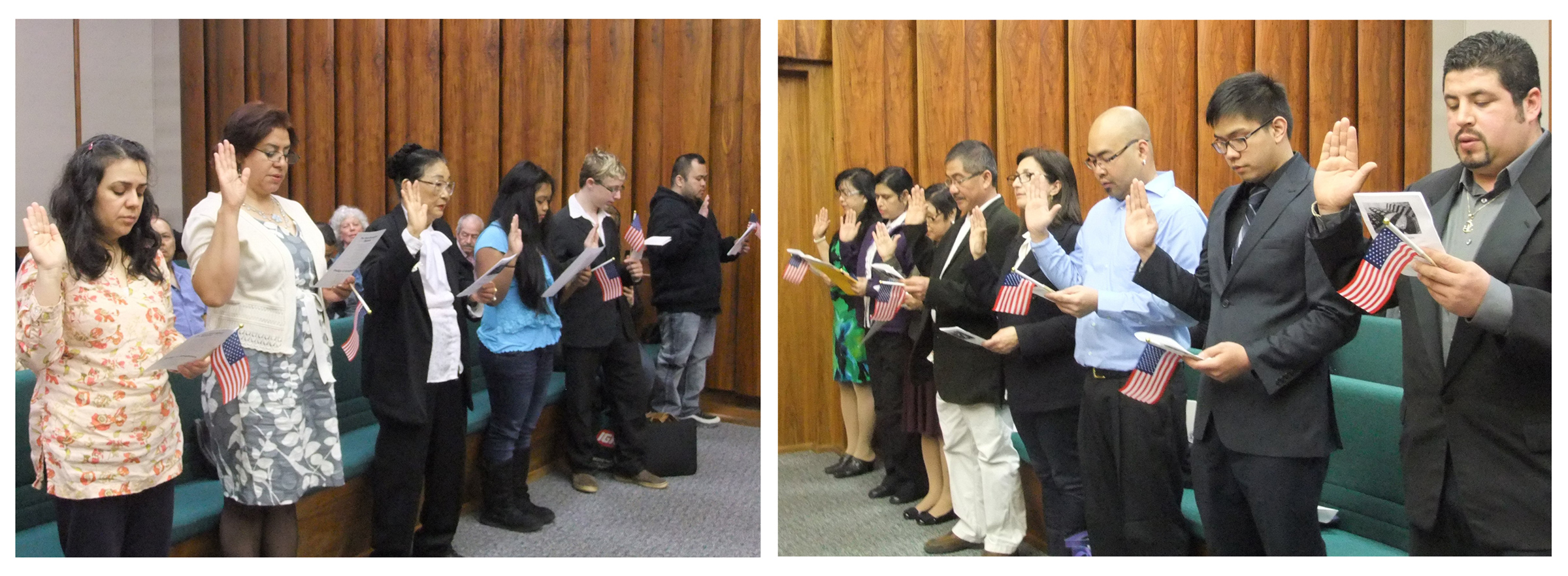
Juneau residents from other countries take the Oath of Allegiance to the U.S. to become American citizens at a ceremony on May 14, 2014. (Photo composite by Rosemarie Alexander/KTOO)

Juneau has 11 new American citizens. Immigrants from the Philippines, Mexico, Spain and South Korea took the oath of citizenship Thursday in U.S. District Court in Juneau. More than half were from the Philippines.

U.S. Magistrate Leslie Longenbaugh was the presiding judge. She said she looks forward to each naturalization ceremony.

“It’s completely inspiring to see people born in different nations raise their hands and swear an oath to become citizens of the United States of America,” she said. “Each generation of immigrants renews our national character and revitalizes our culture.”

For some, the journey to U.S. citizenship has been years and many said it had been a personal goal.

Maria Rosales has been in Juneau since 1998. She said she was happy to become a citizen, but one of her sons remains in Mexico. She said she has petitioned U.S. Immigration Services, but he has been denied entrance to the U.S. for ten years.

“I am so sad with this law. That’s why I want to be a citizen, to work and (do) whatever I can to review the laws, because the laws affected (sic) a lot of people,” Rosales said.

The next steps

Immigration officer Gary Johnson is based in Anchorage and comes to Juneau for naturalization ceremonies several times a year. He told the new citizens they should apply for their U.S. passport, social security card, and register to vote.

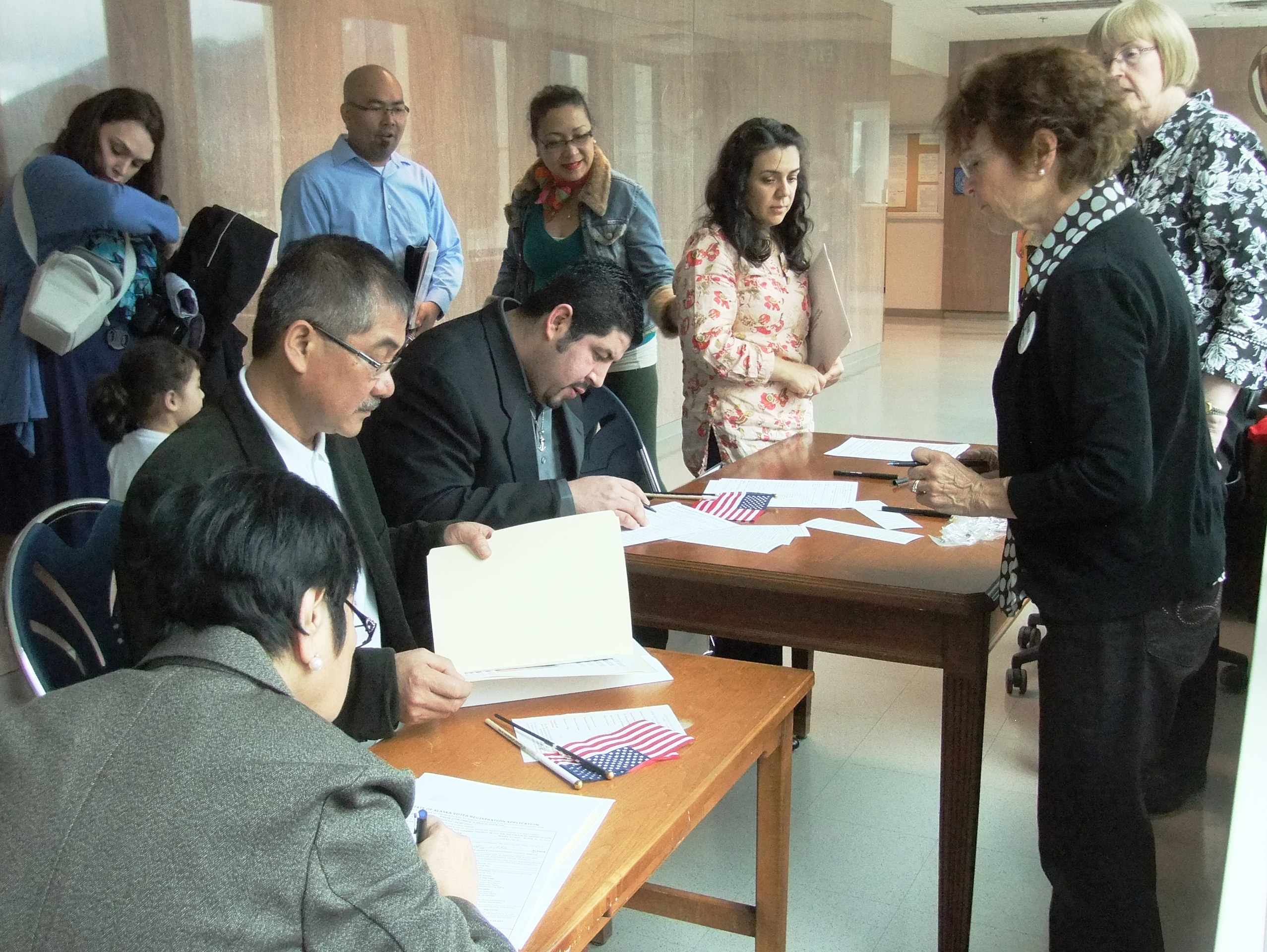
The new American citizens registered to vote before leaving the courthouse. (Photo by Rosemarie Alexander/KTOO)

But he told them not to put a picture of their naturalization certificate on Facebook.

“What we found is that with social media people would zoom in on the information that’s on the certificate and take over that individual’s identify. They’ve got their name, they got their alien registration number, and they have their certificate number. It can cause a lot of problems for the new citizen,” he said.

Before they left the courthouse, most of the new Americans registered to vote, with the assistance of the Juneau League of Women Voters.


(Full disclosure: Magistrate Longenbaugh is on the KTOO Board of Directors)

Miners Postal to reopen as Kindred Post

Christy NaMee Eriksen will reopen the former Miners Postal post office as Kindred Post June 2. (Photo courtesy of Christy NaMee Eriksen)
Christy NaMee Eriksen will reopen the former Miners Postal post office as Kindred Post. (Photo courtesy of Christy NaMee Eriksen)

Miners Postal in downtown Juneau will reopen this summer as Kindred Post, a postal station and community gathering space.

Juneau resident Christy NaMee Eriksen won the contract with the United States Postal Service on May 9.

Miners Postal, which was also a gift shop, closed its doors on May 3. Christy Hartman had run the USPS contract station since 2005.

When Eriksen reopens the business in June, she says she’ll focus on post office operations. In the fall, she plans to expand Kindred Post into a retail store and place for people to gather.

Eriksen says it will provide “opportunities for people to come together, learn new things, be creative together, share ideas and just generally be in community with one another.”

The business will host creative workshops, poetry readings, book clubs, and First Friday events.

Eriksen calls it a space where people connect with one another.

“You go to a post office, you’re sending something off to somebody else who’s ultimately going to receive it. And I like the idea of evolving that principle into something larger where it’s this space that’s an active physical space that the community can come and interact with each other,” she says.

Eriksen works for Sealaska Heritage Institute and is also an artist. She recently released a spoken word album and has a small business, Kindred Design Co.

She plans to feature work from independent artists as well as her own designs at Kindred Post.

Eriksen is not new to the post office world. Her father, Kent Eriksen, worked for USPS for more than 35 years and retired as Juneau’s postmaster.

(Disclosure: Christy Hartman, who ran Miners Postal, works for CoastAlaska, a group of Southeast public radio stations, of which KTOO is a member.)

Alaska Supreme Court hears same-sex survivor benefits case

The Alaska Supreme Court heard oral arguments Tuesday in a case that challenges whether or not same-sex couples should receive survivor benefits.

Deborah Harris’ long-term partner Kerry Fadely was shot and killed when working at Millennium Hotel in 2011. According to Alaska law, spouses receive survivor benefits if their husband or wife is killed from a work-related injury. Same-sex couples do not because same-sex marriage is illegal in Alaska.

Harris said after her partner was killed, she had to leave their home because she did not receive the benefits.

“I still don’t have a home, not really…” she haltingly told the press after the oral arguments closed. “I work on the Slope for three weeks because housing’s included. And the other three weeks I stay with my children still, because you know, you don’t plan on these things happening, so you don’t have the resources…”

Attorney Donald Thomas argued on behalf of Millennium Hotel, which declined to provide Harris with death benefits. “Thus if the marriage amendment is precluding same sex couples from marriage, it is inherently, implicitly denying them – any person who’s not validly married, the rights and benefits of marriage,” he told the Court.

Lambda Legal staff attorney Peter Renn represented Harris. He said same-sex couples are denied the same safety nets as opposite-sex couples.

“State law absolutely discriminates against loving, committed same-sex couples in this context, and it has absolutely no reason for doing so,” he told the press after the arguments finished.

Renn said the case is not directly challenging the same-sex marriage ban, but the Court could choose to take up the matter. “We’ve given the Court an option of menus. It could take a smaller bite and decide only the death benefits issue that is raised here for Ms. Harris. But it could also decide to take a somewhat broader step and declare the marriage amendment itself unconstitutional. So that is available to them. They could go there.”

This is the third case before the state’s Supreme Court that has challenged unequal benefits for same-sex couples. In both 2005 and 2014 the court ruled that same-sex couples should not be discriminated against. However, the Court did not strike down the marriage ban amendment.

Renn said the Court will likely issue a ruling late this year or early next year.

Monday five couples filed a case in federal district court directly challenging the ban. A circuit court in Arkansas overruled that state’s same-sex marriage ban last week.

Site notifications
Update notification options
Subscribe to notifications