Vandalism at Juneau-Douglas High School Thursday morning left a nasty mess in the entryway of the school and required the commons be closed for a while.
While officials say there was no threat to student or staff health, the prank included urine and feces, and doors cemented shut. There was a better side to it – lots of balloons.
Principal Paula Casperson says the school was cleaned up before classes began.
She described the vandalism as a senior prank, but confidentiality policies won’t allow her to release much information. It’s not clear if the students involved were all seniors. Casperson says Juneau School District policies prescribe the punishment.
“We are concerned. Certainly there are consequences and those consequences could in fact include not being allowed to participate in the commencement ceremonies,” she says.
Graduation is Sunday.
“And we certainly want to celebrate all of that. We don’t want to be mired in the negativity of the decisions of one or two kids. We want to celebrate the Class of 2014,” she says.
JDHS graduation is at 4 p.m. on Sunday in the gymnasium. TMHS is at 7 p.m. in the TMHS gym. Yaakoosge Daakahidi ceremony is at 1 p.m. at Centennial Hall.
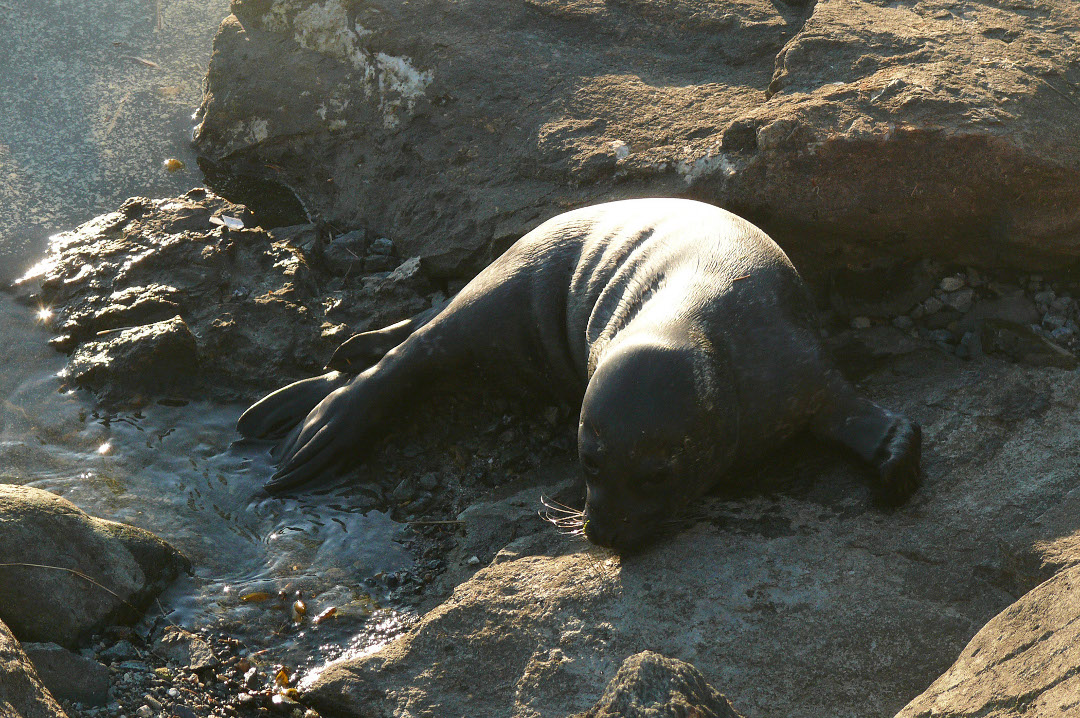
NOAA Fisheries is monitoring this harbor seal pup, which has been hauled out near the Auke Bay boat ramp since Thursday. The agency says Juneau residents should not harass the animal. (Photo by Kate Savage/NOAA Fisheries)
Update | Sunday May 25 8:30 a.m.
A specially trained team of marine mammal experts late Friday captured a harbor seal pup that had been hauled out near the Auke Bay boat ramp since Thursday.
The capture operation took about 20 minutes and the pup is in good condition, according to a NOAA Fisheries release sent Sunday morning. NOAA Spokeswoman Julie Speegle writes that the pup was taken to the Alaska SeaLife Center in Seward, where it will be trained to fend for itself. The plan is to reintroduce it to the Juneau area, she says.
Officials were worried for the pup’s safety with increased traffic expected in the Auke Bay area over Memorial Day weekend. Speegle says it’s common for harbor seal mothers to leave their young hauled out while the mothers forage for food. While there were adult harbor seals nearby, NOAA officials were not able to determine if one of them was the pup’s mother.
Original post | Friday May 23 1:00 p.m.
Marine mammal experts are asking Juneau residents to avoid disturbing a harbor seal pup that’s been hauled out near the Auke Bay boat ramp since Thursday.
With increased boating activity expected over Memorial Day weekend, officials are concerned for the pup’s safety. NOAA Fisheries Spokeswoman Julie Speegle says the animal appears to be in good health, but if it has too much interaction with humans its mother may abandon it.
“This is normal harbor seal behavior,” Speegle says. “Mothers will often leave their pups hauled out in a spot and the pups generally stay where their mama leaves them while the mother goes and forages for food. She just chose a really busy spot to leave her pup.”
Speegle says officials are not sure if the seal pup has been abandoned already. If so, a specially trained team of marine mammal experts may be brought in to capture the animal and take it to the Alaska SeaLife Center in Seward. The center would train the pup to fend for itself before releasing it back into the wild.
“We will see what activity is like in the Auke Bay area this weekend,” Speegle says. “And if the activity seems to be too much or too dangerous for the pup, then we may go ahead and take action, or we may wait and see if the mother comes back.”
Speegle says people should keep their pets on a leash to keep them from approaching the seal as well.
It’s illegal to harass harbor seals under the Marine Mammal Protection Act. If you see harassment, call NOAA Fisheries Law Enforcement at 1-800-853-1964.
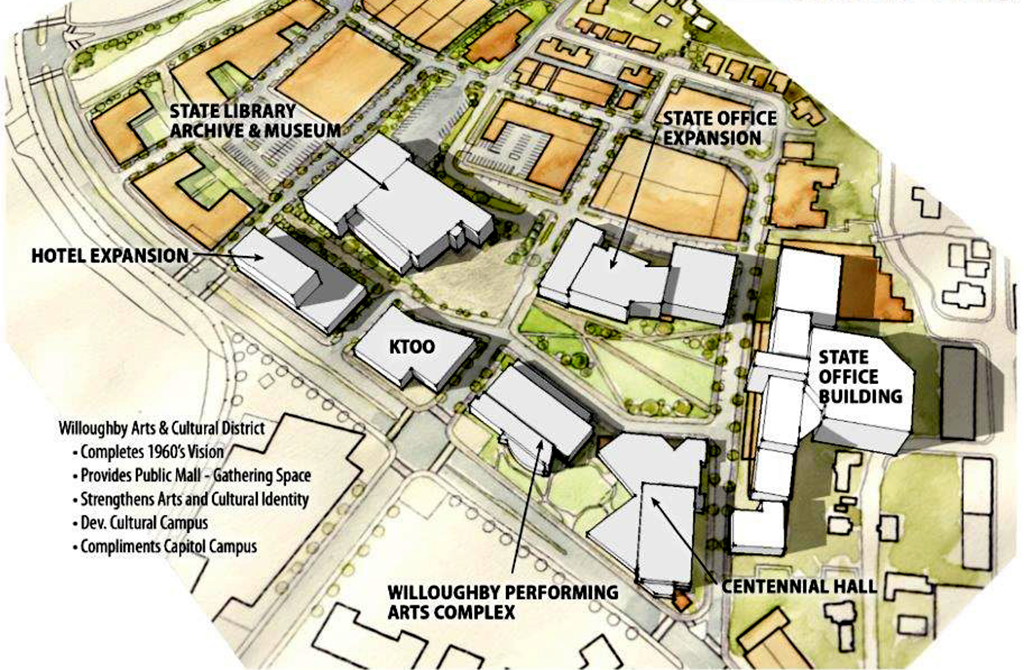
The CBJ Comprehensive Plan designates the Willoughby District as a cultural center in Juneau. (Image courtesy of James Bibb/North Wind Architects)
Planners hope to begin architectural design of the proposed Willoughby Arts Complex this summer. The multiuse performance space would include, or take the place of, the existing Juneau Arts and Culture Center. In 2012, Juneau voters approved spending $1 million from sales tax revenue to support the project. Earlier this week, interested groups heard the latest on the project.
If you’re unfamiliar with the project, here’s a summary. Both Perseverance Theatre and the Juneau Arts and Humanities Council have needed new spaces for years. About a year ago, says Perseverance Theatre’s Executive Artistic Director Art Roach, the organizations came to a realization:
“Instead of building two buildings, let’s build one. Makes sense. And let’s share in the design of it, and the operating of it, and the fundraising for it, and selling it to the community–all of those tasks are going to have to get done to make this real. Let’s do it together because if we work together we can do it more efficiently, and we can get more for the money.”
They formed a nonprofit entity called “The pARTnership” that will own and operate the building. The city, which owns the land, gave the group until 2019 to break ground. That’s where consultant Tony Forman of the international firm Theatre Projects Consultants comes in.
“We are not architects. We are a resource for architects to help them design a very unique building type, which is a performing arts space that has very specific and unique requirements to be successful,” says Forman.
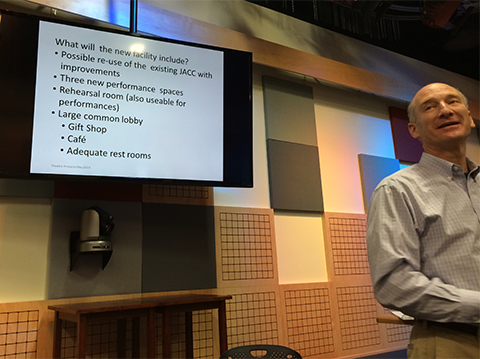
Tony Foreman, a consultant with the international firm Theatre Projects Consultants, talks about plans for the center. (KTOO Photo)
That includes planning the general environment, the spaces that allow for the best interaction between actor and audience, the specialized equipment like lighting and rigging, and the question of the night: the size and number of rooms and theaters. In addition to the JACC space, a 275-seat, multiuse or community theater, a 170-seat theater for Perseverance, a smaller 30- to 45-seat performance space, a rehearsal room, a classroom, offices, a café, and more. It’s going to be bigger than the JACC is now. And speaking of the old building, will it stay or will it go? Forman says it’s tricky.
“Renovation is 95- to 115-percent of new construction. You can save a little money, and it can also be more expensive. You have things like asbestos abatement and lead paint and underground tanks that you may not even know are there when you start the project.”
While the renovation versus new construction question is not unique, Forman says that two non-profits joining forces is.
“In the past, communities have done that on a civic level where the city, town, or municipality has undertaken the project and owns and runs a building. That’s a model that has been successful for many years but it’s starting to change. I think the way Juneau is approaching this with these two organizations taking the lead is the wave of the future and very exciting.”
Juneau Arts and Humanities Council Executive Director Nancy DeCherny says there is still a lot of work to do, including fundraising.
“People are worried that we will build something that we cannot afford—we will not do that. We realize that this is a huge philanthropic stretch for this community. We have a target in mind and we are going to build what we can afford.”
DeCherny hesitates to give an estimate, but knows it will be difficult. Still, she’s enthusiastic.
“It’s been a dream in this community since I moved here in 1975 and it’s exciting to be part of seeing it though. And I think the whole community should be excited about this. We’ve got the SLAM Building being completed, we have the Walter Sobeloff Center, we’ve got this. Juneau’s going to be a hot place pretty soon.”
To raise the funds, The pARTnership has begun formation of a capital campaign committee that will be coordinated by Charlotte Fox of the Alaska State Council on the Arts.
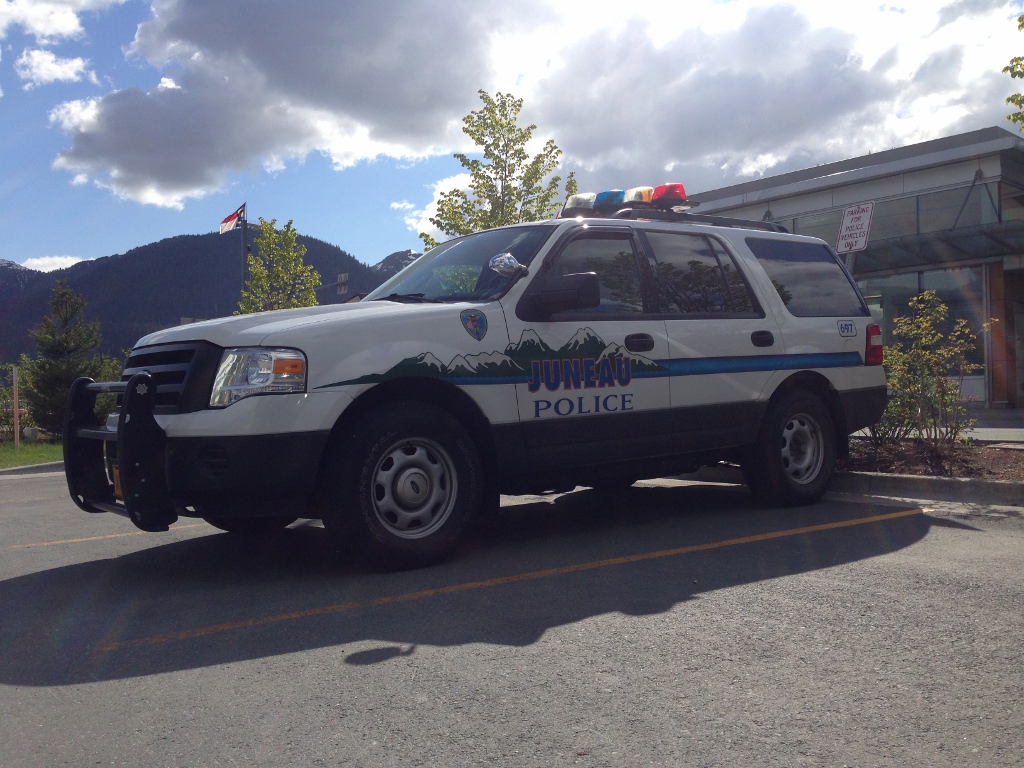
Juneau police are increasing patrols for Memorial Day weekend. (Photo by Casey Kelly/KTOO)
Juneau police are planning enhanced patrols for Memorial Day weekend.
Lt. David Campbell says 13 additional officers will work Friday through Monday, covering the entire city and borough road system. This is also graduation weekend for students at Juneau high schools.
“We’re going to have quite a few officers on duty for the entire weekend, not only in town but also out the road, where people tend to congregate and party,” Campbell says.
JPD’s Mobile Incident Command vehicle will be parked out the road past Amalga Harbor all weekend and will be staffed 24 hours a day, he says.
In addition, Juneau Crime Line is increasing its reward for reporting drunk drivers from $100 to $200 for the last two weekends of May.
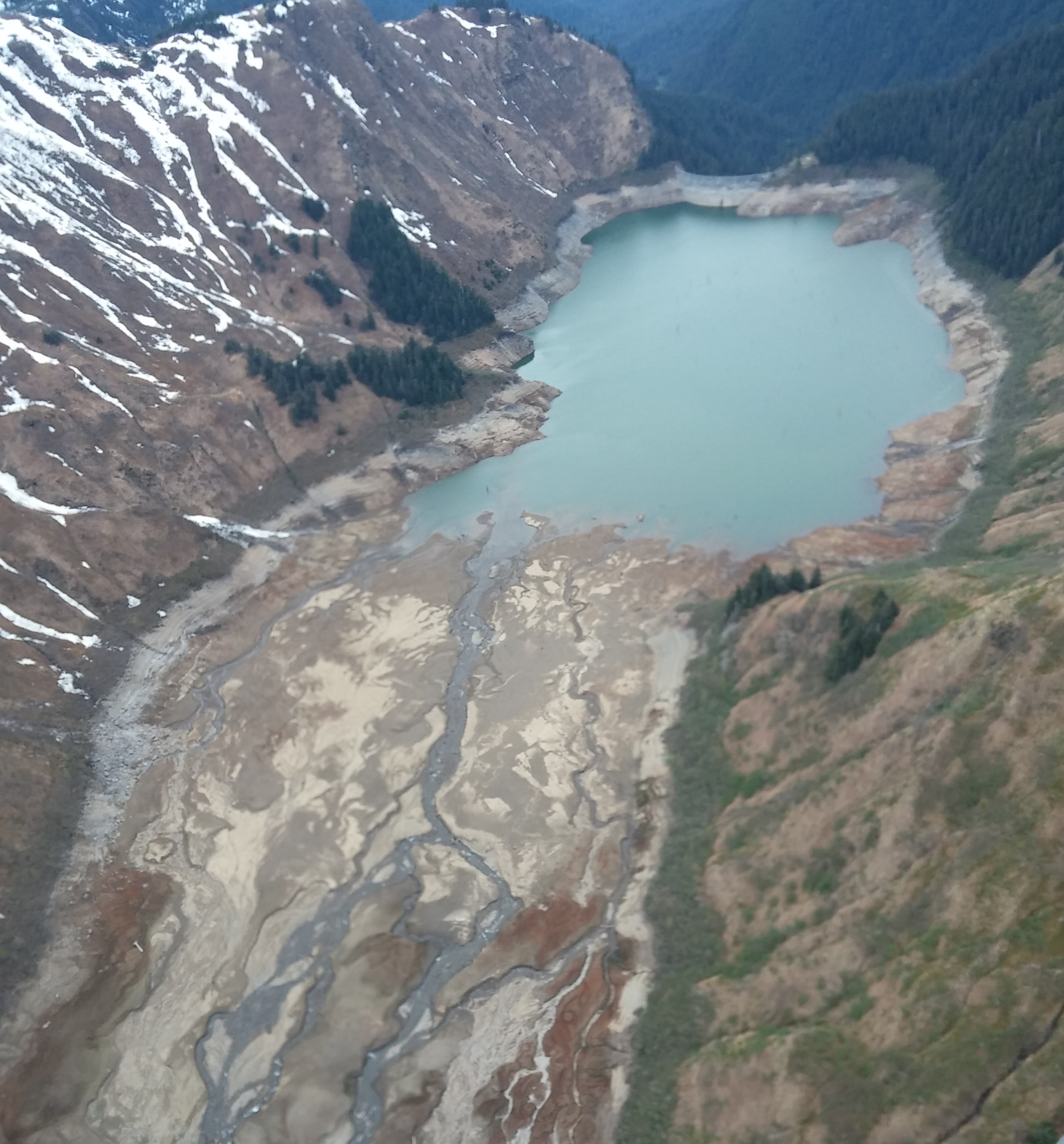
Channels at the upper end of Salmon Creek may be the source of much of the turbidity in the lake during spring runoff. (Photo courtesy Scott Willis/Alaska Electric Light and Power)
Spring cleaning is underway in Juneau this week: Streets and sidewalks are being swept, storm drains flushed and flowers planted. The water required to do the work is being drawn from Gold Creek and not from the city water supply.
That’s because the level of water throughout the system remains lower than usual and Salmon Creek reservoir is still too turbid to be used for drinking water.
Turbidity is cloudiness in the water. It can hide germs such as giardia and make people sick. Every spring, turbidity becomes a problem in Salmon Creek.
The reservoir belongs to Alaska Electric Light and Power and is used by the city and borough as a drinking water source. The water is not filtered and has to meet stringent standards.
Turbidity is measured by an instrument called a nephelometer. When cloudiness reaches 1.49, Salmon Creek is shut off.
“So the system will automatically turn itself off to take water out of Salmon Creek if the turbidity is above 1.49 for three days. Or if it goes above 4 NTU at any point,” says Cindy Christian, compliance and engineering manager for the state’s drinking water program. She knows municipal systems well.
NTU is a nephelometric turbidity unit.
“The higher the turbidity, the higher the potential there could be pathogenic organisms in the water,” Christian says.
Runoff produces turbidity. Over Salmon Creek dam’s 100 years, sandy gravel has formed a delta around the lake. AELP’s Scott Willis flew over the lake last week and describes “little stream channels” running through a large flat area.
“That silty material is easily eroded and we think that’s where it picks up some silt and sediment and causes the higher turbidity in the spring time during run off,” he says.
Nearly every spring Salmon Creek is taken out of the city water system until the cloudiness settles and turbidity units fall.
“It’s not just that delta, it’s as the snow melts there’s water flowing down the hillsides and picking up debris and things like that,” Willis says.
Turbidity only affects drinking water. It has nothing to do with power generation.
“We keep Salmon Creek running all year long and it’s online right now,” Willis says.
Salmon Creek generates 5 percent to 7 percent of Juneau’s hydroelectricity. About 45 miles south, AELP’s Snettisham hydroelectric project produces about 70 percent.
Willis says the water levels in Snettisham’s Long Lake and Crater Lake are above normal for this time of year.
“There’s more water in those lakes now than there was in the last five years,” he says.
Lake Dorothy is smaller than the Snettisham lakes. Willis, who is vice president of generation for the power company, says Lake Dorothy is right where he wants it.
“I like to pull it down a little bit harder, so it’s in a good spot right now. It’s at its low point, but it’s not unreasonably low by any means,” he says.
Until it’s needed in town, Lake Dorothy sells electricity to Juneau’s interruptible customers, including Hecla Greens Creek Mine on Admiralty Island and some cruise ships.
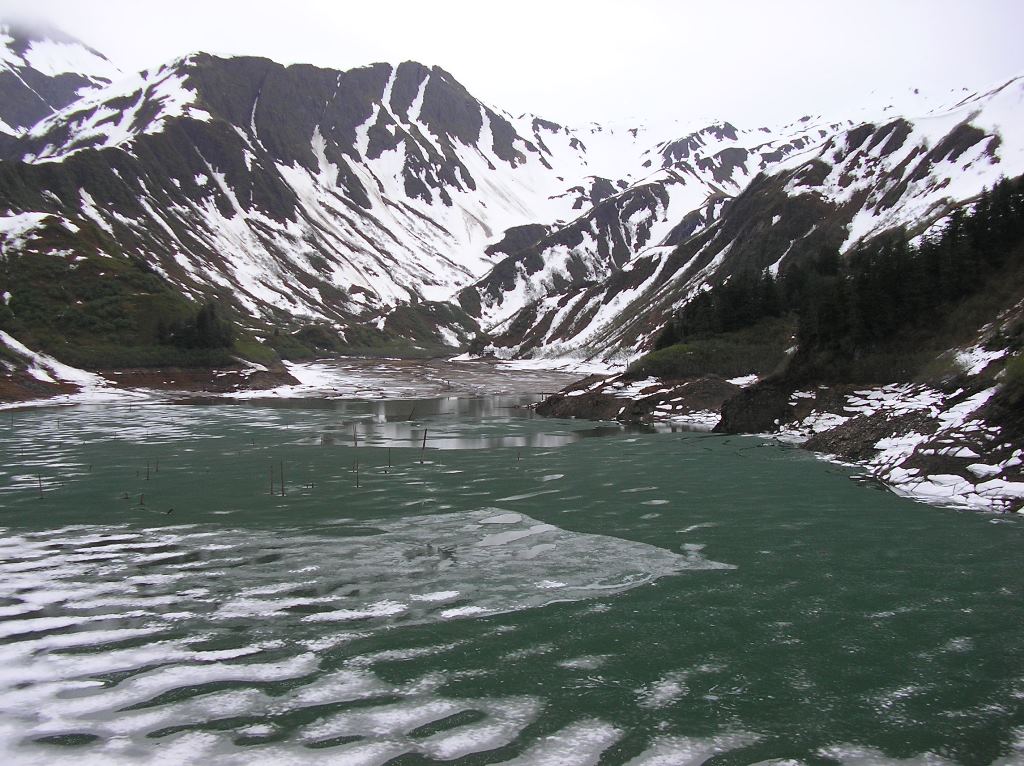
Salmon Creek reservoir, May 26, 2009. Water level is within a foot or two of the current elevation, but there’s more ice on the lake and snow on the hillsides. (Photo courtesy Scott Willis/ AELP)
Willis watches water levels every day. He says January’s warm and wet weather brought those levels up.
“The precipitation that was stored as snow on the hillsides, at least at the lower elevations, melted off and ran into the lakes,” he says. “The lakes actually jumped up in January.”
But there’s not much snow pack left.
“I’m looking real good now when I look at the chart on the wall and see where the lake is. If we have a wonderful, glorious, beautiful summer in July and August, I’ll be worried,” he says.
When levels are low in AELP lakes, the company must supplement its hydroelectricity with diesel fuel.
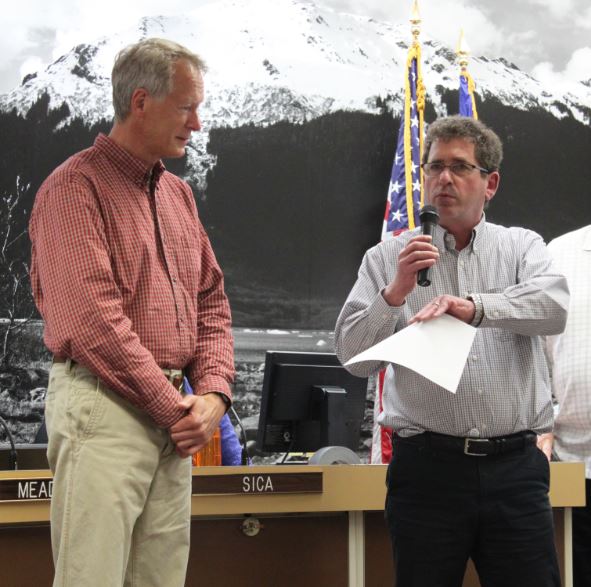
Capital Transit superintendent John Kern and deputy city manager Rob Steedle (Photo by Lisa Phu/KTOO)
Capital Transit superintendent John Kern is retiring after 37 years with the city. The Juneau Assembly Monday bid him farewell, said goodbye to longtime city employee Bonnie Chaney, then welcomed the hospital’s new CEO.
Deputy city manager Rob Steedle recounted Kern’s career, which started in community development in 1977. Kern moved to Capital Transit in 1983.
“And when he began, the fleet consisted of six buses that had been purchased used, three of them were Army surplus buses, so it was quite a fleet,” Steedle said. “So back then, we had hourly service to the Valley and Douglas six days a week and in ’92 added Sunday service and since then, the service has continued to expand.”
Under Kern’s leadership, Capital Transit was named one of the Ten Best Small Transit Agencies in North America in 1999 by METRO Magazine and recognized by the Community Transportation Association of America in 2003. The Governor’s Committee on Employment and Rehabilitation of People with Disabilities awarded Capital Transit a Barrier-Free Design award in 2006.
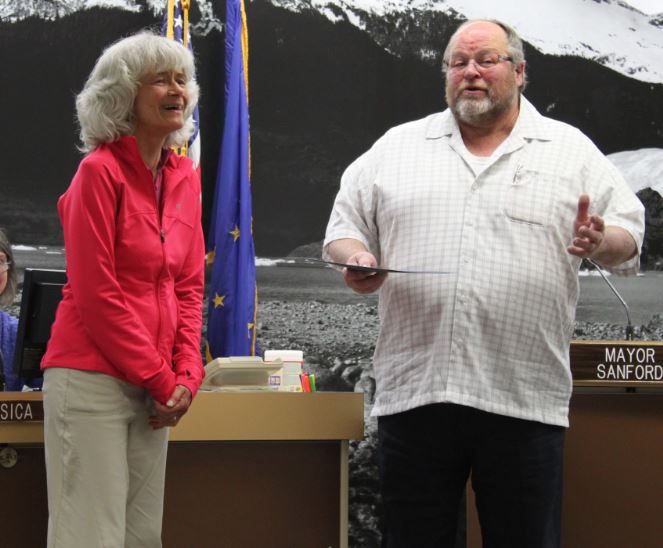
Budget analyst Bonnie Chaney and Mayor Merrill Sanford (Photo by Lisa Phu/KTOO)
Budget analyst Bonnie Chaney has been with the City and Borough of Juneau for 28 years.
Finance Director Bob Bartholomew said he’s learned a lot from her. Chaney’s been responsible for putting together the city’s budget book, which was nationally recognized by the Government Finance Officers Association.
With her retirement, Bartholomew said the city is losing a lot of institutional knowledge.
“It was demonstrated this year. Several assembly members, during the budget process, [said], ‘You know, I’d like to know the history of this fund.’ And early the next morning, Bonnie would come in and she’d put together a spreadsheet and she’d email it to me and say, ‘Well it started in ’83 and here’s every penny that went in and every penny that came out,'” Bartholomew said.
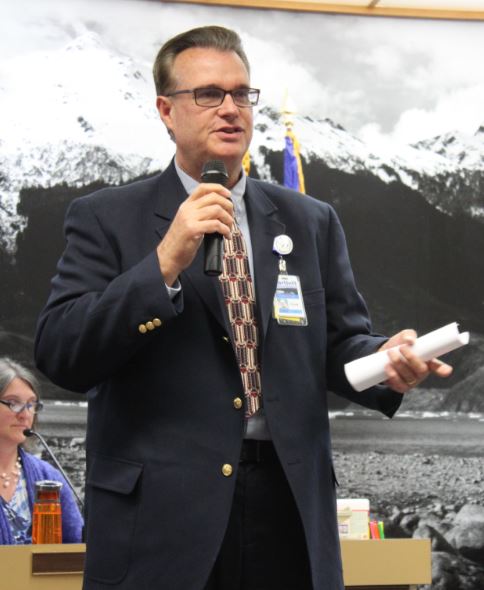
Bartlett Regional Hospital CEO Chuck Bill (Photo by Lisa Phu/KTOO)
Bartlett Regional Hospital Chief Executive Officer Chuck Bill has been on the job for only a week. Mayor Merrill Sanford introduced him to the assembly.
“If you can do as good as these two people that are leaving us here in the near future and be here for 24 to 37 years, you’ll be doing very well,” Sanford said.
Bill moved to Juneau from Durango, Colo., where he was an assistant administrator of physician development at Centura Health Physician Group.
“My wife and I are thrilled to be coming to Juneau. My mom grew up here so we have family ties and I do have a cousin that still lives in town, so it’s not totally new to us, although we haven’t been through all the seasons so we’ll figure them out,” Bill said.
Bill spent last week meeting staff and getting oriented at Bartlett during last week’s National Hospital Week. He’s previously held other CEO positions at hospitals in Arizona, California and Colorado.
Close
Update notification options
Subscribe to notifications
Subscribe
Get notifications about news related to the topics you care about. You can unsubscribe anytime.