Community

Report finds weaknesses, solutions in Sitka’s food system

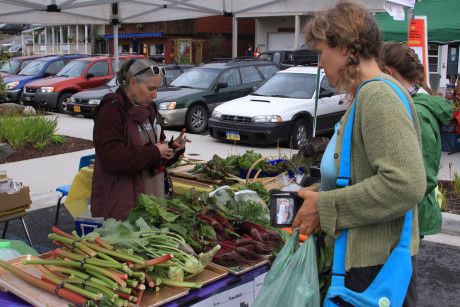
Lisa Sadleir-Hart distributes excess produce from her garden at Sitka’s Farmers Market. (SLFN photo)

The reliability of the food supply is not something most communities devote much thought to. Agriculture, transportation, and grocery stores all work pretty well — even in relatively isolated parts of Alaska like Sitka. And depending on where you live, there can be abundant wild foods.

But a recent report called “The Sitka Community Food Assessment” reveals that our food system is vulnerable — especially to the unpredictable costs of fuel.

Lisa Sadleir-Hart coordinated the assessment. She stopped by KCAW recently to talk with Robert Woolsey about what Sitka — and communities like it — can do to become more food-secure.

The idea for taking a look at Sitka’s food supply took root, so to speak, at the Community Health Summit in the fall of 2012. At that time, food security was still kind of abstract.

That changed on the night of January 4, when Sitka was rocked by a magnitude 7.2 earthquake. We had 45-minutes to get to high ground, leaving behind all of our grocery stores, and most all of our food, at sea level.

“And it became very real, on a community level, when we actually had that event.”

But even before the threat of a tsunami focused Sitka’s attention on food security, people were feeling the pinch of the high cost of groceries, aggravated by the economic recession beginning in 2008.

“Many of us working in the food arena for a long time also realized that because we were seeing rising food prices, we had a lot of concerns about what that meant for household food security. So we’ve got two layers: Overall community food security — can we provide for ourselves and feed ourselves as a community? And secondarily, Can households do the same?”

With the goal of finding answers to those questions, Sadlier-Hart and her work group adopted the US Department of Agriculture’s Food Security Assessment Toolkit and went to work. They surveyed over 400 Sitkans, conducted focus groups, met with community leaders, and explored alternative sources of information like the Cooperative Extension Agency at the University of Alaska.

A year after the earthquake, food security was no longer abstract. Sadlier-Hart has hard data. Her report brings home several key points.

Read the 2014 Sitka Food Assessment Indicators Report.

“I think a big one that’s a real plus, is how generous our community is. And how reliant we are on customary and traditional foods — what people often call subsistence foods. We eat a lot of deer in this town. We eat a lot of fish and seafood, and we also forage and harvest. And a lot of that gets shared from one household to another. Sometimes related households, sometimes they’re friends. That really jumped off the page at me.”

Sadlier-Hart says that the use of food stamps has increased by 40-percent in Sitka since the mid-2000s. Grocery prices began a sharp climb in 2008, harnessed to the cost of fuel. The assessment shows clearly who is bearing the brunt of this perfect storm of economic insecurity.

“When we talked to elders in a focus group, some of them go without. They don’t eat. And others get real creative. Some single-parent families, they’ll show up at church potlucks to try to get a meal for them and their kids. Some real interesting strategies. That sort of stuff also popped out at me.”

The food assessment is a huge source of information about economic conditions in Sitka. It’s also a tool for making policy. Sadleir-Hart says a first step is to begin to make more public land available for gardening.

Sadleir-Hart We know that for many households, 95-percent of their food is imported. Most of the food we eat in the state is imported — 95-percent of it from somewhere else. As recent as the 1950s, that was only 50-percent. I think we can get to 50-percent over the next couple of decades. This is a long-term venture. It took us a long time, with cheap oil and transportation to kind of get us into this really — I don’t know if you would call it lazy — but we’ve not had to work very hard at accessing our food.
KCAW — 50-percent is a lot of potatoes.
Sadleir-Hart — It’s a lot of potatoes, it’s a lot of seaweed, it’s a lot of deer, it’s a lot of lingcod. It’s a lot of gardens. You can grow a lot of food. I grow a lot of food out of my garden. A lot of which I don’t eat, which I donate to the Farmers’ Market. So if I can do it, I think other people can do it.

Sadleir-Hart also believes it’s important to maintain eligibility for food stamps, as much for the economic impact of the program as for its contribution to nutrition. She says it pumps about over $1-million annually into the economy.

She also says Sitka’s rural subsistence designation — and the access it allows to customary and traditional foods — is more than a lifestyle choice. Hunting, fishing, and gathering are a major economic component of food security.

“Deer meat alone was almost $1.5-million in a year. So if we were going to try to replace deer meat out with some other equivalent protein source, most households couldn’t afford to buy it, quite frankly.”
River watch teams prepare for breakup

Teams are heading out to keep an eye on breakup conditions along Alaska’s largest river systems. The National Weather Service is predicting below average flooding this year, but the state wants villages to be ready just in case.


Even though flooding caused by this spring’s breakup should be less severe than normal, the State Division of Homeland Security and Emergency Management spokesman Jeremy Zidek says Interior communities could still see some flooding.

“Generally, when we see the below-average years and we do experience flooding, it’s one community, not a series of communities like we saw last year with the flooding all along the Yukon River,” Zidek said.

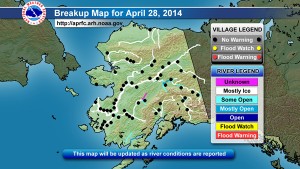
Click to find the most recent National Weather Service breakup maps.

Galena was devastated last year after an ice jam caused a massive flood, keeping much of the town underwater for days and forcing most residents to evacuate. Once the waters receded, residents returned to largely unsalvageable homes and other problems from lack of power, to spoiled food.

The village of Circle and several other Interior communities were also hit by flooding.

Zidek says the first river watch team has already been deployed to the Upper Yukon River and is stationed in Circle Hot Springs.

“Generally, we do launch our river watch program a little bit later in the year,” he said. “There’s been higher than normal temperatures in the Interior and there’s a lot of reports of ice moving early in the sloughs and small tributaries that feed into the major rivers.”


Each river watch team consists of three people: a local pilot, a National Weather Service river forecast center hydrologist, and a Division of Homeland Security and Emergency Management emergency manager. Zidek says each team monitors a particular section of the river, tracking the breakup process.

“For the most part it is aerial observations,” Zidek said. “The river forecast center takes those aerial observations, past models, and also other observations that have been made along the river system where people just provide their own feedback, put that all together and make their flood potential forecasts, and if there’s any issues, they can issue the flood warnings and advisories.”

If the teams do spot something that might be troubling for nearby communities, the emergency manager will land and consult with the local residents and coordinate with the state emergency office.

Five river watch teams will be deployed – three to the Yukon River and two to the Kuskokwim River.

[icon name=”icon-cloud”]Here’s more information on flood preparedness.

City Hall packed by Augustus Brown Swimming Pool supporters last night

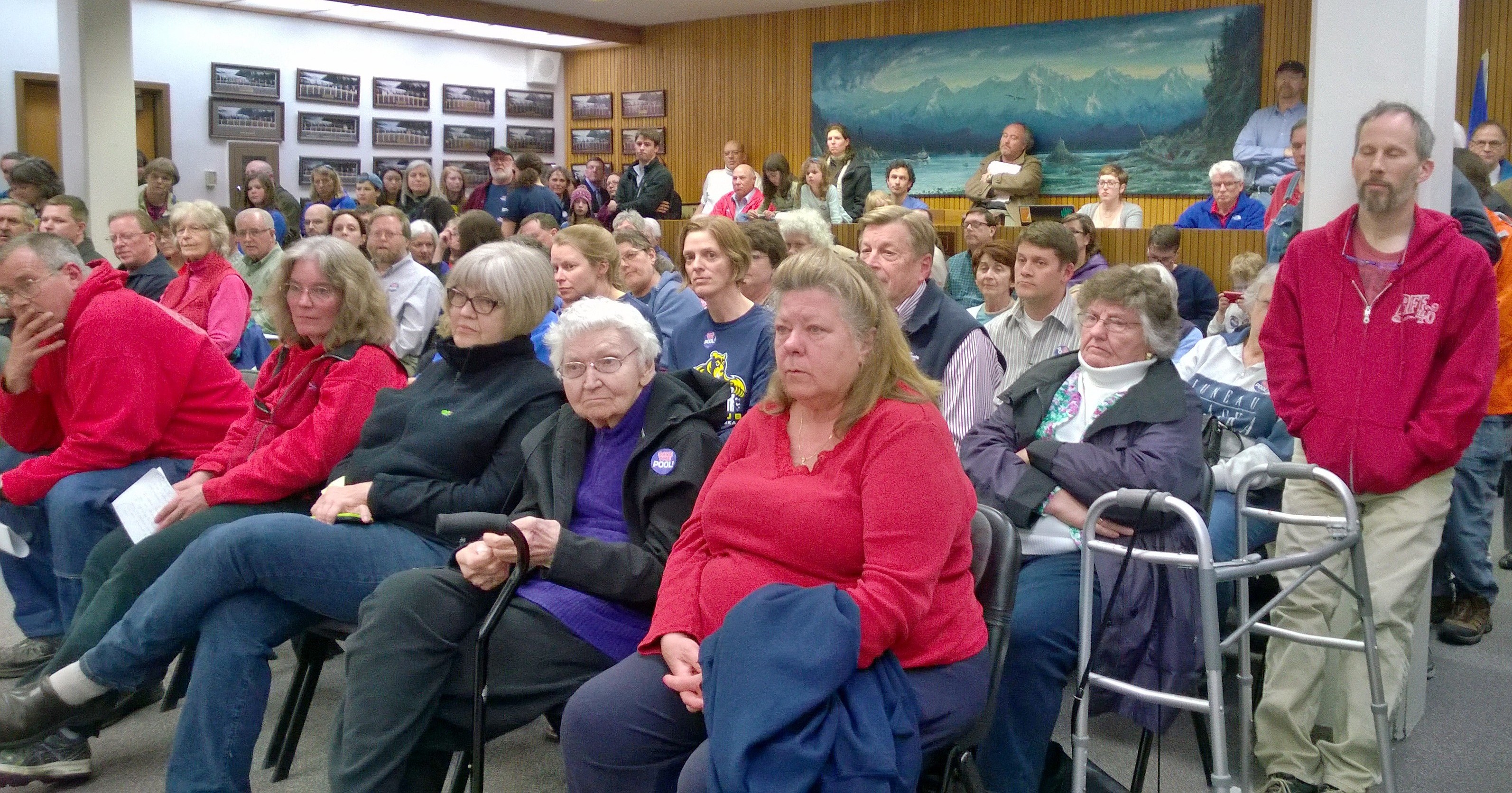
Assembly chambers were packed for Monday's hearing on the budget. (Photo by Jeremy Hsieh/KTOO)
Assembly chambers were packed for Monday’s hearing on the budget. (Photo by Jeremy Hsieh/KTOO)

A Delta Airlines vice president has pledged $10,000 to the city and borough of Juneau to help keep the Augustus Brown Swimming Pool open.

Mike Medeiros came to the Juneau Assembly Monday night to thank the city for the hospitality Delta has received as the company gets ready to provide service between Juneau and Seattle next month.

Let us know what we can do to help the community,” Medeiros said. “And I think as a first start, I’d like to just help by saying we’ll do something on the pool.  I’d like to offer a $10,000 donation to help keep the pool open, if that helps.”

The packed city hall chambers erupted in cheers.

“And I’m sure we’ll take you up on the $10,000,” quipped Mayor Merrill Sanford, as the assembly settled in for a long evening of public testimony on the budget, most of it meant to save the pool.

The city is facing a $12 million shortfall over the next two years, having already approved using about $3 million in fund balance to pay for negotiated wage and benefit increases for city workers.

Sales and property tax revenues are expected to be less than projected. The assembly is considering a combination of increased property taxes and fees as well as budget reductions to close the gap.

City Manager Kim Kiefer has proposed temporarily closing the downtown swimming pool, which could save the city about $775,000 over the next two years, and would be an opportunity to assess pool renovation costs.

Kiefer and assembly members have received hundreds of comments on the idea, most against. No one at Monday’s meeting spoke in favor of closing the pool.

Empowered boards

Glacier Swim Club president Steve Brockmann started off the testimony, presenting the assembly with a petition of more than 800 signatures of pool users who want to keep Augustus Brown pool open.

The 250-member swim club shares the downtown pool and Dimond Park Aquatic Center with the general public and school groups.

“We would really like to see an empowered board to run both pools, with a clear mission, a charter, to increase cost recovery and increase efficiencies at these pools,” Brockmann said.

The city’s Aquatic Facilities Advisory Board is also recommending an empowered board. Aquatics board member Rosemary Hagevig, a former member of the Juneau Assembly, said now is the time to create such a board for aquatics.

“My previous experience working with CBJ, with the enterprise and the other empowered boards, is that great things have happened. I think we have some excellent models to work from and I think we’ve got nowhere to go but up here,” she said.

The city has several empowered, or enterprise boards. Created in city charter, the boards operate Eaglecrest Ski Area, the Juneau International Airport, Docks and Harbors, and Bartlett Regional Hospital.

Each board’s authority is laid out in a separate city ordinance.

“The ordinance talks about what the scope of their authority is and then they are authorized to make decisions on behalf of the city within the scope of their authority,” says city attorney Amy Mead.

Proposed revenue increases

Young and old told the assembly Monday night that they would pay increased fees to use the pools. As Wilma Kirkpatrick approached the microphone, Mayor Sanford said, “Good evening, ma’am, how are you?”

“Old,” she replied to a roomful of laughter. Kirkpatrick said Augustus Brown pool is the only public exercise facility in downtown Juneau for senior citizens.

“The city has provided ball fields, soccer fields, ice rink, Eaglecrest, track and field, which are great, but not for the elderly,” she said. “So please don’t take the one place we have in the downtown area to keep us all going.”

Increased property taxes are on the assembly’s list of options for balancing the budget.  The proposal calls for a .44 mill rate increase, with a total mill rate of 11.20. If approved, property taxes would go up 44 cents for every $1,000 of assessed property value, or $44 for every $100,000 of value.

Juneau Chamber of Commerce members called raising taxes a poor budget strategy. In a recent poll, chamber members voted two to one against the proposed tax increase, according to Lorene Palmer, chair of the chamber’s Government Affairs Committee. She said about 20 percent of  chamber members responded to the poll, and made comments.

“The main themes running through these comments were that the city needs to reduce its operating costs, prioritize services, reorganize departments to gain operational efficiencies, and establish long-term budget forecasting,” Palmer said.

Chamber president-elect Lance Stevens said the city is on an “unsustainable financial path.”

But many Juneau residents at the hearing said they would be willing to pay increased taxes for such programs and services as the swimming pool.

The city budget and mill rate increase are now before the Assembly Finance Committee. The city must adopt the budget by June 15.

NOTE: Updated with additional information on enterprise boards.

Author, peace activist John Dear to spread message of nonviolence

Author, lecturer, and peace activist John Dear

Nobel Peace Prize nominee the Rev. John Dear is in Juneau as part of a national tour for his most recent book, “The Nonviolent Life.”

Dear has written over 30 books and devotes his life to giving lectures and organizing demonstrations.

He has two masters in theology from Graduate Theological Union in California and says nonviolence is at the heart of all world religions.

“You cannot claim to be a Christian or a person of any religion and support violence or war. Period. In other words, to be a Christian and to be Jewish, Muslim, Hindu, and Buddhist is to be a person of nonviolence,” Dear says.

Dear has worked with Mother Teresa to stop capital punishment and was mentored by anti-war activist brothers David and Philip Berrigan. Dear was nominated in 2008 for a Nobel Peace Prize by Archbishop Desmond Tutu.

“But most of all I know thousands and thousands of ordinary American activists who are working to change our country and our cities and move it from militarism and corporate greed toward greater equality and more peaceful attitude toward the world. And it’s those ordinary people who give me the most hope,” Dear says.

Dear wants to reach more ordinary people during his time in Juneau.

Tonight he’ll speak on “Peace Making, Civil Disobedience and Truth Telling in a World of Permanent War.” He’ll talk about how he got involved in the peace and justice movement, his experience in war zones, and spending time in jail.

On Saturday, Dear gives an all day workshop on “Living a Nonviolent Life.”

“How can we become like Gandhi and Dr. King? How can we help Alaska become more nonviolent and the whole country and the whole world become more nonviolent? That’s our only hope and it’s the most crucial question of our time,” he says.

Tonight’s talk is at 7 p.m. @360 and Saturday’s workshop is from 9 a.m. to 4 p.m. at Northern Light United Church.

For more information, go to johndear.org.

Lessons from Taylor White’s last ride

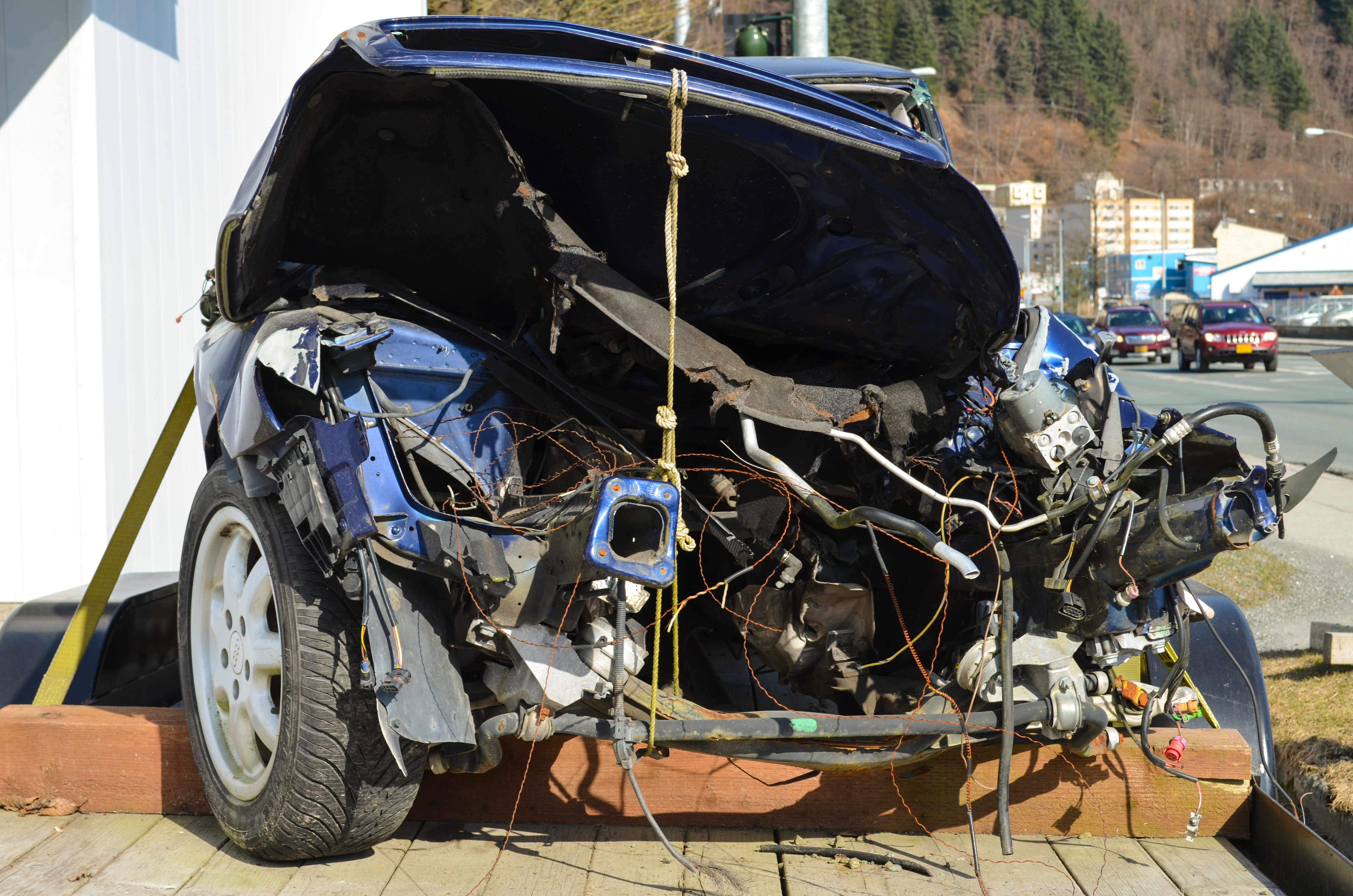
The 1999 Audi was driven by Tyler Emerson in the drunk driving accident that killed Taylor White. (Sarah Yu/ KTOO)

As cars rush by at the end of a busy workday, curious pedestrians stop to look at a mangled, bright blue Audi in the KTOO parking lot.

The car is part of a display from the Taylor White Foundation for Advancing our Community, Inc., started by Taylor White’s parents, after the 18-year-old Juneau-Douglas High School graduate was killed in a drunk driving accident in 2009.

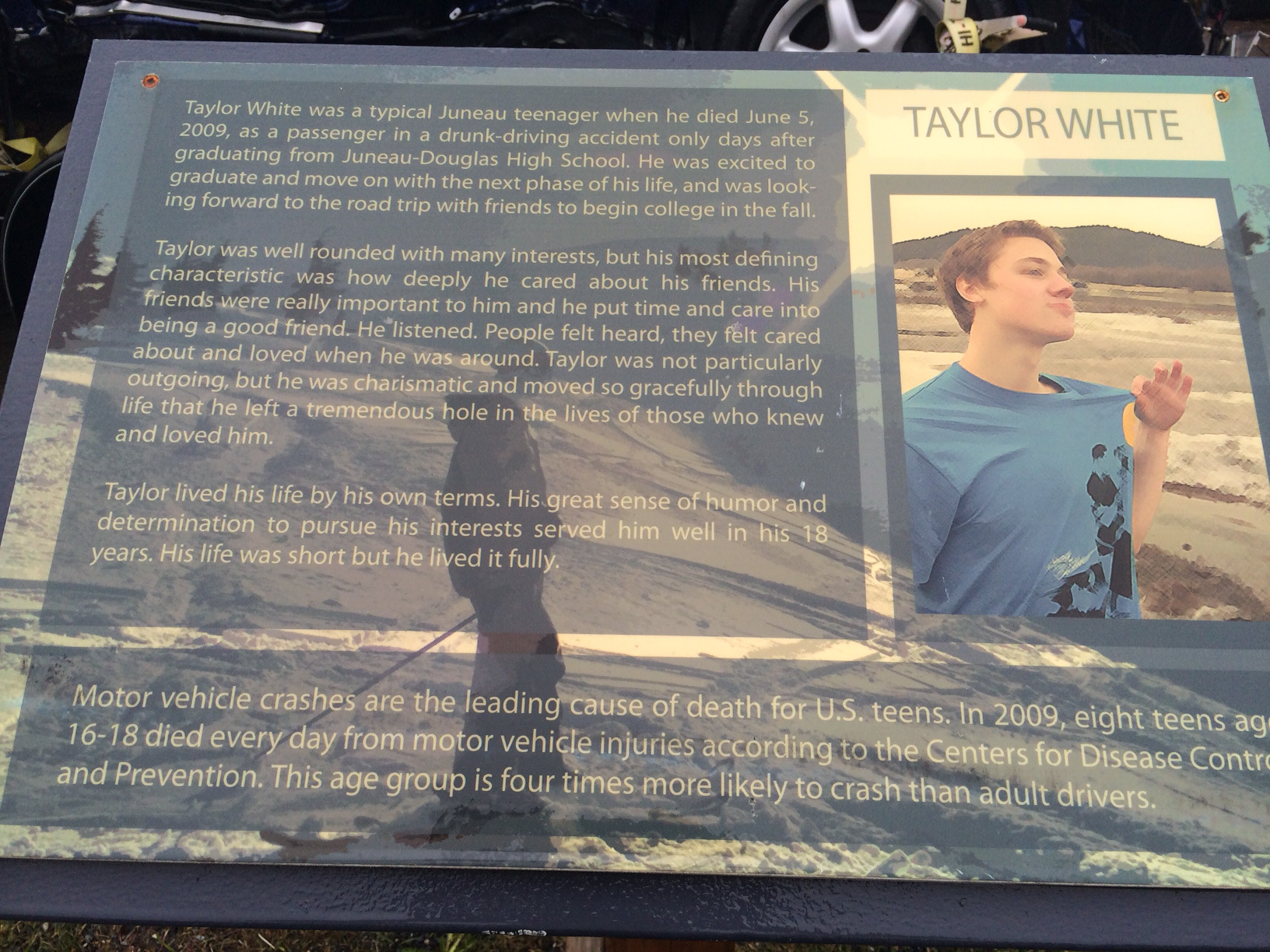
Four signs explaining the incident were created by students in the Thunder Mountain High School Digital Art Class. According to Carol White, Taylor White’s mother and co-founder of the foundation, it was important to get Juneau’s youth involved.

“It needs to be messages that kids are giving other kids rather than adult generated messages,” says White.

The Juneau Police kept the vehicle in the impound lot for a year as possible evidence. The driver, 18-year-old Tyler Emerson, pleaded guilty to criminally negligent homicide in August 2010. He was sentenced to six years in prison with five years suspended. He went back to jail for nine months in 2012 after violating his probation.

The Whites got permission from Emerson and his family to show the car and “to be sure everybody was feeling like it was gonna be worth the pain,” White says. The car has been displayed 15 times in the past four years.

One of the signs designed by the Thunder Mountain High School Digital Art Class. (Sarah Yu/KTOO)

The narrative is deeply personal, describing Taylor White as a good friend, though not particularly outgoing. 

Other signs recount the accident in great detail and include facts about drunk driving that put the tragedy into perspective. For example, car crashes are the leading cause of death for U.S teens.

The crushed Audi sparks different reactions from different people.

A teenage couple, on their way to get ice cream, refers to it as the “creepy car.”

“Seeing the car kinda made me melt inside,” says Honour Miller-Austin, a student at Thunder Mountain, adding that it reminds her of a friend that had recently passed away.

They agree that five years after the accident, drunk driving is still a major problem in Juneau.

“I think it’s exactly something that could happen to friends. My brother lost his best friend in a drunk driving accident,” says Chris O’Brien, also a student at Thunder Mountain.

The display, though aimed at teenagers, also makes adults stop and think.

“I often wonder what it would be like if they made Juneau a dry town. Things like this wouldn’t happen,” says Wayne Smallwood, an MMA fighter and Native carver.

Jessica Louise Billy, an 18-year-old Juneau-Douglas senior, died in a car crash last month. According to Alaska Department of Transportation & Public Facilities, six teenagers died in car crashes in Alaska in 2013.

The car in the KTOO parking lot is part of a safe driving initiative spearheaded by KXLL, KTOO’s sister station, and includes student-voiced public service announcements and a high school dance which raised $400 for the Taylor White Foundation.

(*Editor’s note: The story originally stated that Tyler Emerson went to trial. Emerson actually pleaded guilty without going to trial. The story has been updated to reflect these changes.)

Remembering Bob Janes

Bob Janes St. and son Bill at the top of Black Bear chair in 2010.
Bob Janes Sr. and son Bill at the top of Black Bear chair in 2010.

A three-year Forest Service assignment to the Tongass National Forest became 49 years in the capital city for the late Robert C. Janes Sr., whose life will be celebrated on Sunday.

He passed away at the Juneau Pioneers’ Home in March at the age of 92.

Ski area reconnaissance

Bob Janes arrived in Juneau in 1965 with the U.S. Forest Service.  Used to moving with the agency, he thought it would be another short stint.

At the time, Douglas Ski Bowl – also known as Third Cabin — had a rope tow and snowcat to get Juneau skiers to the top.

Janes had been working in the Sierra Nevada Mountains in California and was soon assigned to help come up with another location for a ski area.

“The regional forester put me to work. (He) said go out with Craig Lindh and find a new ski area.  That’s what we tried to do,” Janes said in an interview a few years ago.

Lindh was also with the Forest Service. He had transferred to Juneau to work on the ski area project.

“He was pretty enthusiastic when I first came to Juneau and met him and we chatted about skiing,” Lindh said.

So the two foresters and avid skiers hooked up to find a place with better access than Third Cabin. Lindh said they had lots of input from Juneau skiers and finally settled on the Fish Creek area.

“From the top of Third Cabin area you could look down into the Fish Creek drainage and that’s what got people interested,” he recalled.

The land was taken out of federal ownership and in 1975, Eaglecrest opened with the Ptarmigan lift up the west side. The ski area is owned by the city and borough of Juneau.

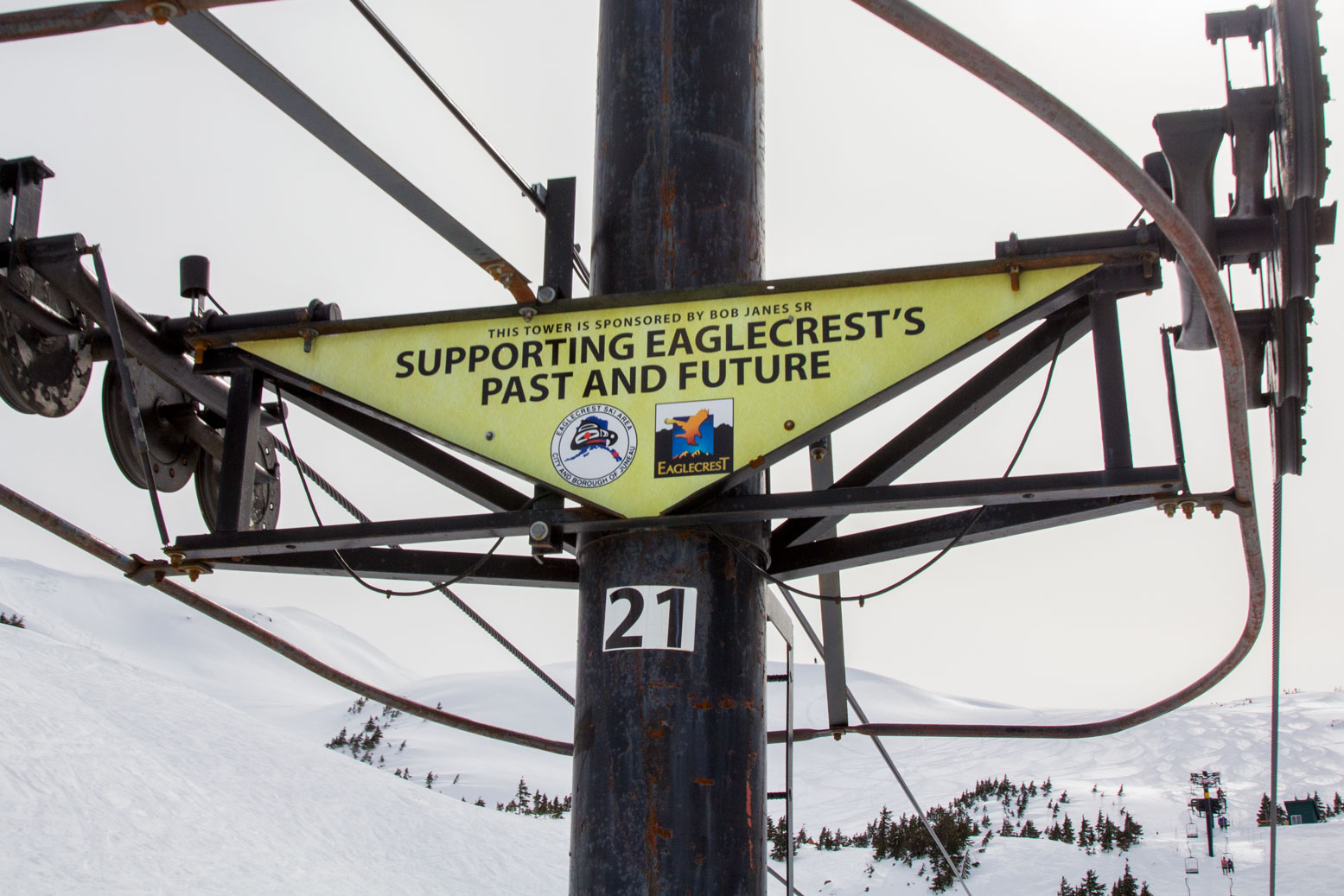
By the 2009 / ’10 season, Eaglecrest had grown to four lifts. Black Bear was installed on the east side with the help of gifts from Eaglecrest users.  Bob Janes sponsored tower 21, which reads:

Supporting Eaglecrest’s past and future.”

Black Bear chairlift Tower 21
Tower 21 of the Black Bear chairlift at Eaglecrest is sponsored by Bob Janes Sr. (Mikko Wilson / KTOO)

He was 88 that year and no longer skiing. An Eaglecrest employee took him by snowmobile to Black Bear, so he could ride the lift and see the sign in place.

“It’s nice looking I think. I kind of am proud of that sign,” Janes said later.”There are many other nice signs and people that have contributed. It shows the community spirit.”

He juxtaposed the first Eaglecrest logo with the current logo. The sign reflects Janes’ early reconnaissance work and subsequent years as a skier and a ski patrol volunteer.


A love of snow

Janes grew up in California. His family writes that he could have been a beach bum, but after earning a degree at the University of California Berkeley, he joined the Forest Service and eventually started working in snow.

In the 1950s he trained in avalanche control with Monty Atwater, who was considered the father of avalanche science in the U.S. In 1960, he was  part of Atwater’s team of Forest Service snow rangers for the 1960 Winter Olympics at Squaw Valley, Calif.

When Tom Mattice was hired as Juneau’s emergency program manager a few years ago, Janes was on the board of directors for the Southeast Alaska Avalanche Center.

“You know, he was one of the first avalanche mitigation specialists in the nation,” Mattice said. “It’s neat to have that kind of experience in our region.”

Janes brought his expertise to Juneau, and in the 1980s worked to create a statewide avalanche forecasting system, which ended when the state dropped out. He advocated for Juneau’s avalanche advisory program and often shared his knowledge of how certain weather events in Juneau contribute to slides, Mattice said.

“How Taku wind events tend to be some of the events that lead to some of our instabilities in the urban environment, but also some of the dangers that loom in the back country up Douglas and other places,” Mattice said. “He wanted to make sure the public had the information they needed to make educated decisions.”

Lion Bob

Searching the KTOO archives produced tape of Bob Janes, the Lions Club member, selling tickets at the 55th Gold Medal Basketball Tournament.

“What do you see for the future of Gold Medal?” the reporter asked.

“Well, after 55 years, I think it’s going to go on forever, don’t you?” Janes quipped.

He missed Gold Medal this year, which was the 68th annual competition that brings Southeast communities together on the basketball court in Juneau.  It’s a major fundraiser for the Juneau Lions Club, part of the international service organization.

“That’s our motto, ‘we serve,’ and that’s where our resources come from. Somebody that wants to join the club and do something for somebody else,” Janes told the reporter.

When Ted Burke joined the Lions Club in 1987, Janes became his mentor. Burke said the education in all things “Lionism” never stopped, even when Janes moved into the Pioneers’ Home.

“That’s when he called me up and told me I had to become the historian of the Juneau Lions Club to relieve him of those duties,” he said, laughing.

Janes took on the job of historian for many of the organizations he joined.

Burke said Janes was always clued into the needs of the community.

“It was Lion Bob that started us in a quest to make sure that whatever we were able to do for our community that youth came first,” he said.

In 1980, Janes was elected as District Governor for Alaska Lions Clubs. That same year, he founded the Lions Club adaptive ski program, which continues today at Eaglecrest, under Southeast Alaska Independent Living, or SAIL.  Janes brought Joe Tompkins into the program, who went on to compete in four Winter Paralympic Games with Lions Club support.

The definition of a gentleman

Burke and Mattice and just about everyone you talk to about Bob Janes called him a gentleman. The definition in this case: A man whose conduct conforms to a high standard.

A celebration of life for Bob Janes Sr. will be held Sunday, April 20, at the Juneau Arts and Culture Center at 5:30 p.m.

Site notifications
Update notification options
Subscribe to notifications