Juneau visual and teaching artist MK MacNaughton works in charcoal, oil, and sculpture. Her current art show, “Secrets,” is up at the Juneau-Douglas City Museum. The show explores the emotional energy of individuals’ secrets and includes both written material and charcoal portraits.
“Secrets” will be on display at the museum through March 22nd.
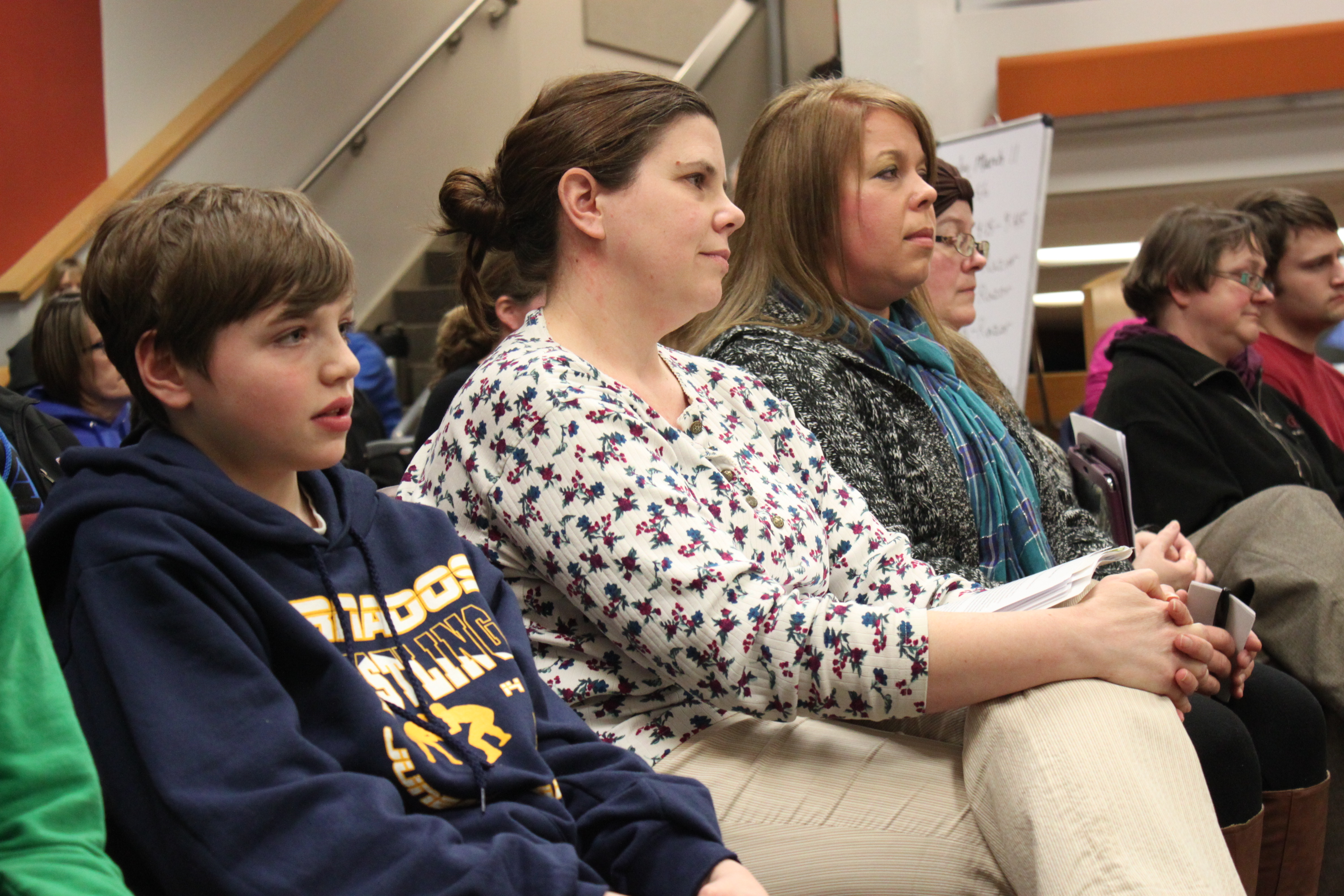
Dzantik’i Heeni Middle School student Connor Norman, his mother Michelle Norman, and school budget committee member Jennifer Lindley all testified during Tuesday night’s school board meeting urging the board to reconsider the ban on middle school sports travel. (Photo by Lisa Phu/KTOO)
The Juneau School Board will not reconsider the ban on middle school sports travel, at least for the rest of the school year.
Floyd Dryden Middle School teacher Jeannette Sleppy is a member of the community task force created to come up with alternatives to the travel ban. Sleppy was one of several who spoke out in unanimous opposition of the ban during Tuesday night’s Board of Education meeting at Juneau-Douglas High School.
“Our superintendent was quoted recently stating, ‘Building trust comes down to doing what the community is asking you to do through the elected board and following through with that.’ I urge you, the board, to build trust with us, this community, and continue to allow our middle school athletes the opportunities that competitive travel offers and has offered the middle school students of this community for many years.”
Sleppy said the task force conducted an online survey and received 263 responses. Only 9 percent of those responses support the ban on middle school sports travel she said.
In its final report, the task force recommends permitting out-of-town travel under certain conditions. These include making travel available to all team members and limiting each team to only one trip per school year.
Tom Rutecki is a member of the school district’s Activities Advisory Committee. He says the group did not put forward a recommendation to the task force, “but we do agree that travel should be allowed for middle school activities and athletics.”
Rutecki says before any policy on travel is developed, the board needs to establish a philosophy on middle school sports. He says the Activities Advisory Committee has started working on one.
“We basically are trying to get away from a competitive philosophy of teams that win to a developmental approach. We want to recommend establishing grade level teams. Go away from the skill-based teams and divide them into teams where fundamental, social and physical skills are developed.”
Following public testimony in favor of permitting middle school travel and the presentation by the task force, school board President Sally Saddler asked the body if they wanted to reconsider the ban:
“Can I get a show of hands of board members who want to see this on the agenda next month?”
When no hands went up, the packed audience broke out in a murmur.
School board member Barbara Thurston said the task force’s recommendations didn’t bring the board any closer to resolving the issues and the board wasn’t ready to reconsider the ban.
“The conclusion I get from this is that the ideal situation at the middle schools is that it involve both an intramural and a competitive component. And we have one school that has a competitive program but not an intramural program, and one that has intramurals and not competitive. And if the proposal and the resources allowed for both at both schools, I think that’s where we could go, but it really sounds like we have to choose, that neither school can afford to do both,” Thurston said.
“I feel bad for Juneau kids who are in elementary school or middle school who aren’t going to have those opportunities in the future,” Kurland said.
While Kurland didn’t get the outcome he was hoping for, he says the group will likely not pursue the issue.
“I don’t think so. I think this committee has done its work,” he said.
Saddler said the school board will not look into the middle school travel ban again this school year unless the Activities Advisory Committee comes forward with a philosophy.
The Riverside Shakespeare is commonly used during Bard-A-Thons. (Photo by Lisa Phu/KTOO)
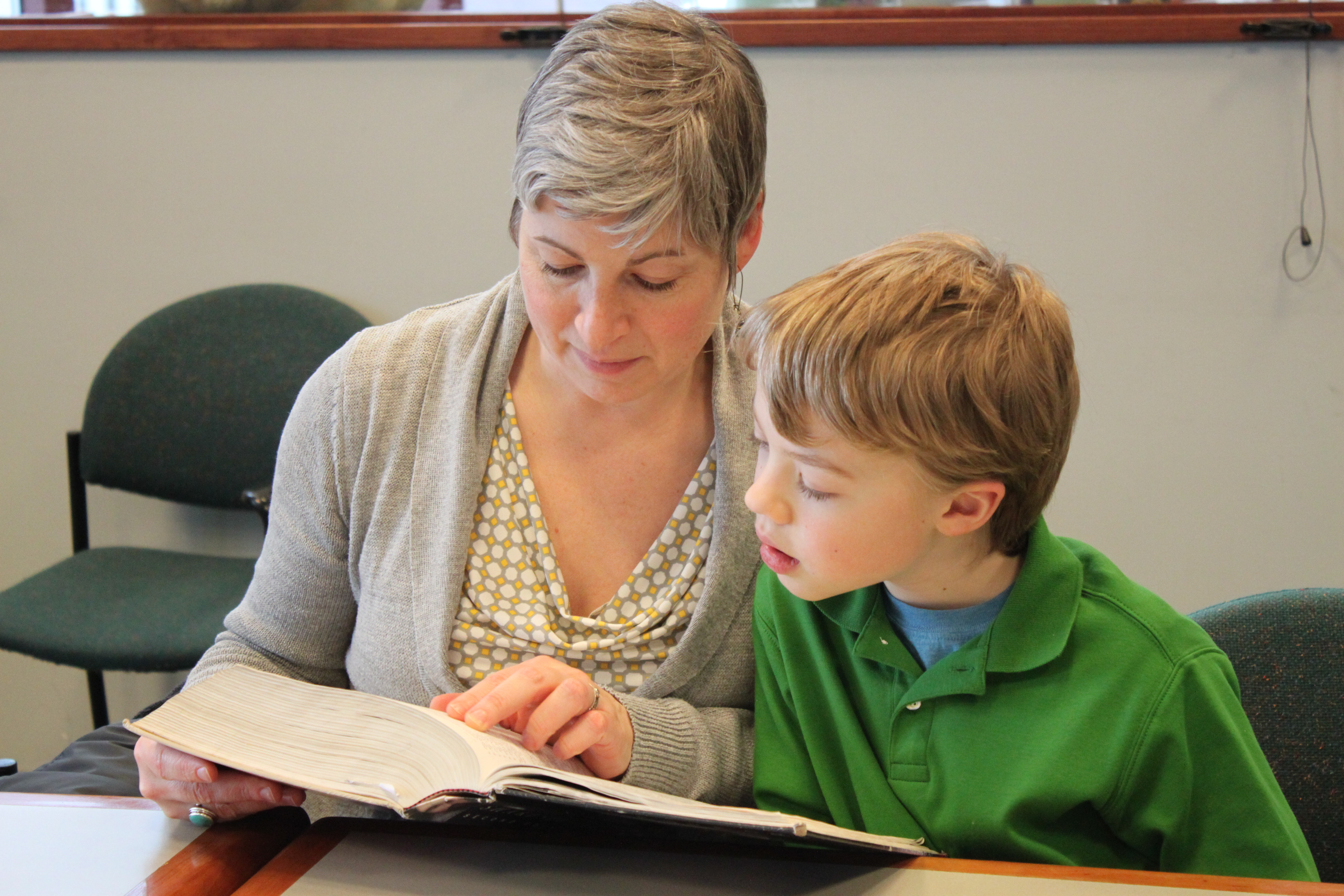
Sante Lesh and son Cahal Burnham share one book. (Photo by Lisa Phu/KTOO)
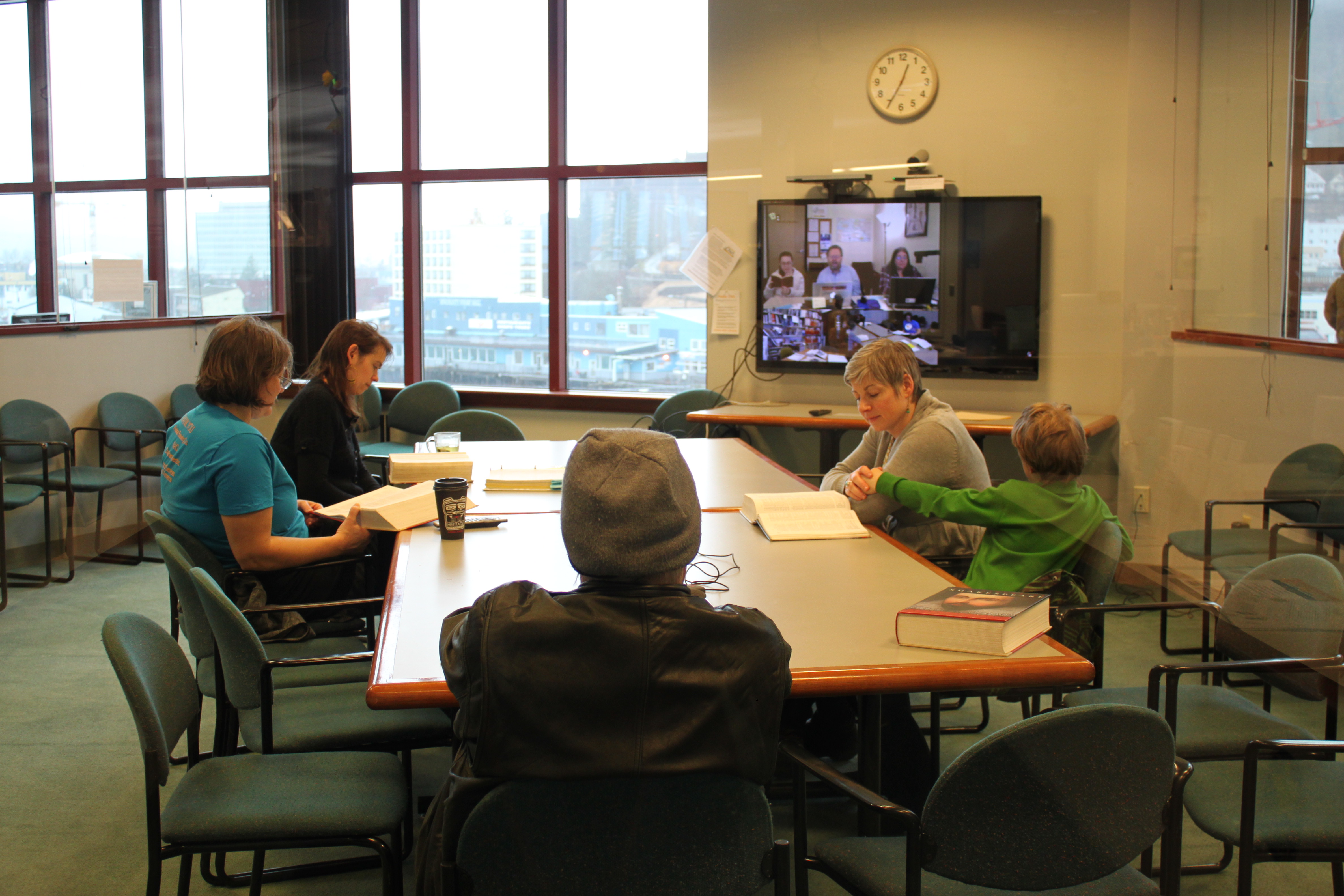
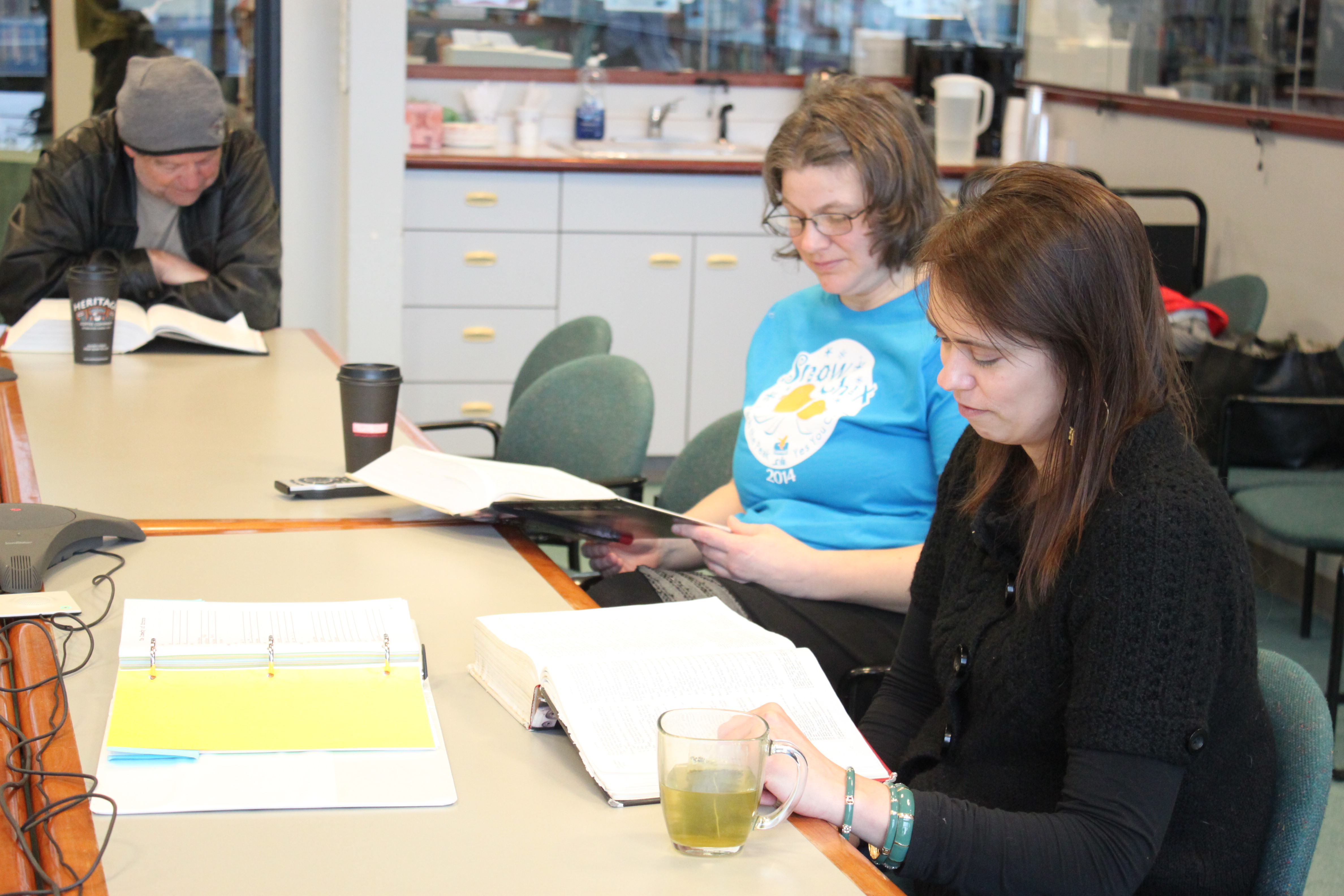
On Day Four of the Bard-A-Thon, several people spend their lunchtime at the Downtown Public Libary to read Shakespeare. (Photo by Lisa Phu/KTOO)
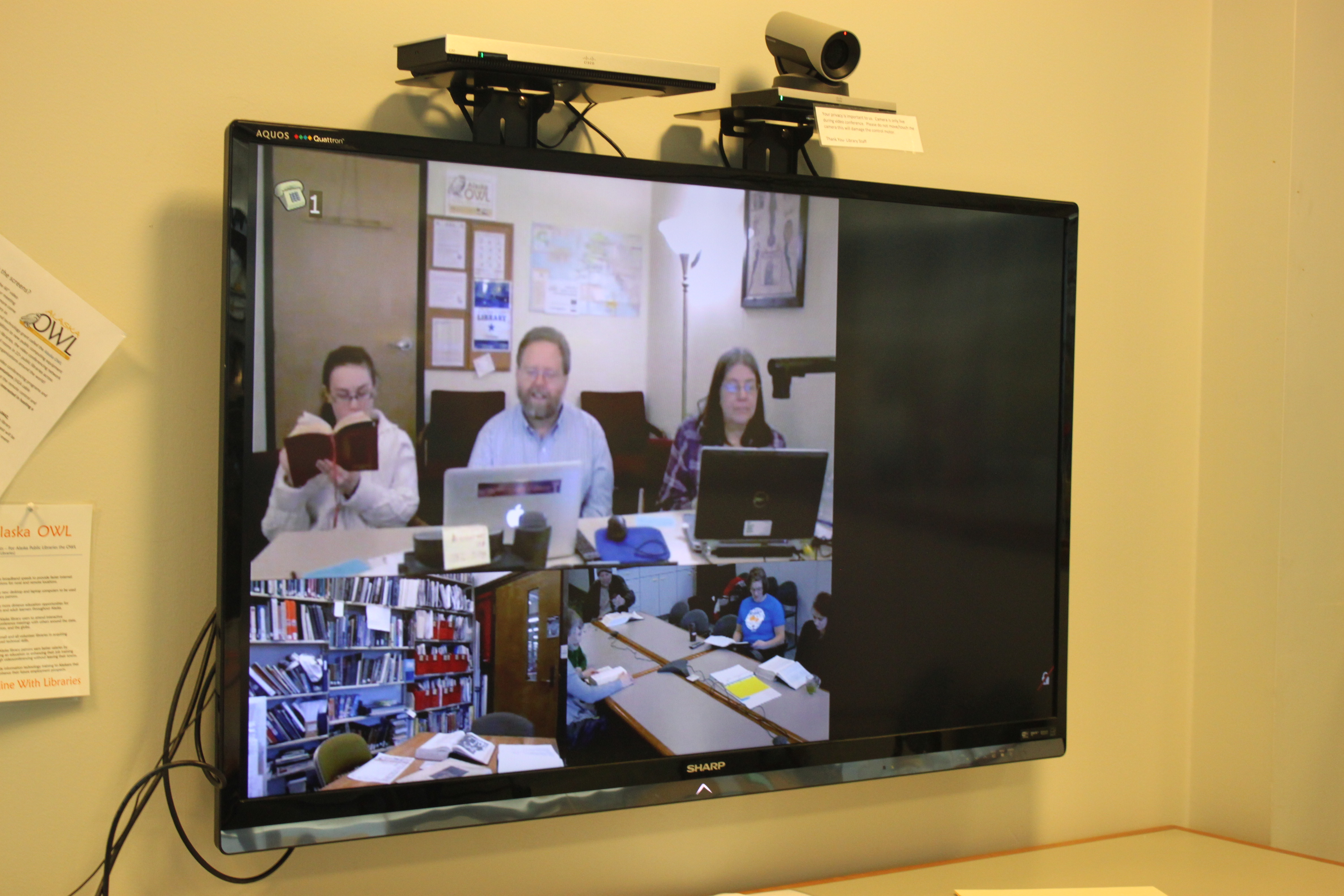
Three staff members at the Alaska State Library participate in Bard-A-Thon through video conference. (Photo by Lisa Phu/KTOO)
Fairbanks Shakespeare Theatre Artistic Director Bruce Rogers reads "The Comedy of Errors" with Juneau Public Library staff members Beth Weigel and Amelia Jenkins. (Photo by Lisa Phu/KTOO)
If he were alive today, William Shakespeare would be 450 years old in April. In honor of the event, the capital city is celebrating with its first Bard-A-Thon, 24 hours of Shakespeare readings for eight consecutive days. The Juneau Public Library is hosting the event.
Non-stop Shakespeare kicked off on Saturday. Here’s a glimpse of the Bard-A-Thon on the fourth day.
Cahal Burnham is missing school at Montessori Borealis to read the part of Luciana in Act 2 of “The Comedy of Errors.”
“Dromio, thou snail, though slug, thou sot!” he exclaims.
Cahal and four other people are reading the play at the downtown library, while across town at the Alaska State Library, three people are participating by video conference.
City librarian Amelia Jenkins is in charge of organizing each reader’s part.
“Would you like to be Dromio of Ephesus?” she asks Cahal.
“Uh, yeah sure,” he replies.
“Balthasar?” Jenkins calls out, hoping to solicit a volunteer.
When no one replies, event organizer Beth Weigel poses the question over video conference and state librarian Daniel Cornwall volunteers to be Balthasar.
In Act 3 of “The Comedy of Errors,” one of Shakespeare’s most beloved comedies, 10-year-old Cahal reads the part of Dromio of Ephesus, a servant. Dromio’s master and well-respected merchant, Antipholus of Ephesus, is played by 63-year-old Bruce Rogers of Fairbanks.
Antipholus: “Thou drunkard, thou, what didst thou mean by this?”
Dromio: “Say what you will, sir, but I know what I know.
That you beat me at the mart I have your hand to show;
If the skin were parchment and the blows you gave were ink,
Your own handwriting would tell you what I think.
Antipholus: “I think thou art an ass.”
Cahal is with his mother, but it was his idea to participate in the Bard-A-Thon. His interest in Shakespeare stems from reading the children’s book series, “Alvin Ho.”
Cahal laughs. “He was throwing Shakespearian insults out and this was one of them: ‘Be gone ye beshibbering onion-eyed flap dragon.’ It’s funny,” he says.
Bruce Rogers is Artistic Director of the Fairbanks Shakespeare Theatre, which is getting ready to perform its 15th Bard-A-Thon in April. He’s been facilitating middle-of-the-night sessions at Juneau’s Perseverance Theatre, reading parts 1, 2, and 3 of the historical “Henry VI.”
“Nothing else to do when you’re up that late,” Rogers says. “Have another cup of coffee and read a little Shakespeare.”
Juneau organizer Beth Weigel says the Bard-A-Thon is a way for Shakespeare amateurs to begin understanding the literature.
“If you’re at home trying to read it silently, sometimes it doesn’t make sense. It makes more sense when you’ve got different voices reading and you hear the words and you can get a little bit of the jokes that come in and out,” Weigel says.
Thirty-nine plays will be read during the Bard-A-Thon, which is getting statewide attention. Prefer Shakespeare sonnets? Join in reading 100 of the Bard’s poems at 8 a.m. Friday morning at the Douglas Library.
“Hamlet” marks the finale of Juneau’s Bard-A-Thon. Nome public library plans to participate through video conference.
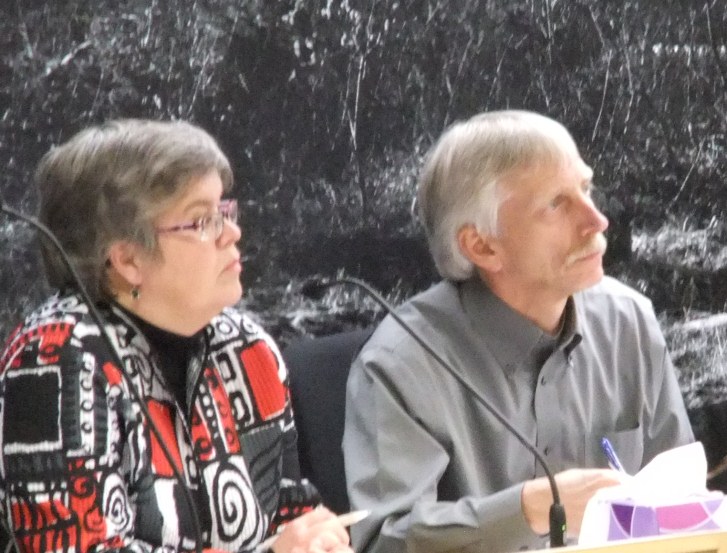
City Manager Kim Kiefer and Finance Director Bob Bartholomew deliver bad revenue news to the Juneau Assembly Committee of the Whole. (Photo by Rosemarie Alexander/KTOO)
The City and Borough of Juneau needs nearly $5 million to balance its budget over the next two years.
Finance Director Bob Bartholomew says federal, state and local revenue sources are down. He told the Assembly Monday night the figures are still preliminary, but members should be prepared for more fiscal challenges as they start their budget work next week.
Bartholomew said the city will lose two federal grants, and a projected 2 percent to 3 percent increase in property and sales taxes did not materialize.
“We’re still seeing slight increases in property tax and sales tax is projected to be flat year to year,” Bartholomew said. “So we backed off our projections for (fiscal years) ’15 and ’16, and that’s why there’s not a lot of new revenue from our existing programs.”
Bartholomew said CBJ also forecast $800,000 a year in ambulance billings, but federal and local reimbursements have declined.
Despite the flat revenues, he said Juneau is coming out of the economic downturn that had a big impact in the Lower 48.
“We’ve gone through a 3 to 4-year period where a lot of pressure has been kept on the operating budget to hold the line, keep positions vacant, only essential services,” he said. “I think that was a successful approach to helping us get through that national economic downturn that affected Alaska in (fiscal years) ’09, ’10, ’11.”
Since several funding sources will be off the mark, City Manager Kim Kiefer said the city will be looking for ways to enhance revenue and reduce spending.
Bartholomew and Kiefer will present the proposed budget to Assembly members on March 19. During the budget process, the Assembly will work as a Finance Committee of the Whole to determine the spending plan for fiscal years 2015 and 2016.
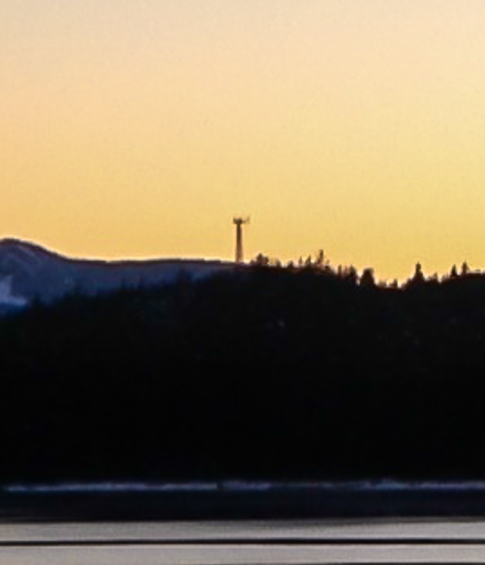
The Spuhn Island cell tower has a constant flashing red light at night and a white strobe during the day. (Photo courtesy Jon Lyman)
The case of the Spuhn Island cellphone tower is closed.
The Juneau Assembly Monday night called off a search for a solution to the 155-foot tower and the flashing lights that have disturbed area residents for more than a year.
The Assembly in January asked city staff to look for ways to mitigate the visual impact of the cell tower lights. At the time, Deputy City Manager Rob Steedle said there were no options. But when pressed, he found six.
“I was wrong. I should have said that CBJ has no good options,” he told the Assembly Committee of the Whole.
He admitted none of his assumptions had been tested. He called the cost of each option “very rough.”
The price tags range from a high of more than $500,000 to relocate the tower, to a low of $175,000 for a dialogue with the Federal Aviation Administration about less intense lighting. Steedle said that could take ten years and he rated the actual chance of conversation very low.
But that was the type of alternative Assembly members seemed to be looking for when they called for the study. Kate Troll said it clearly is time for conversation.
“Have a discussion with the regulatory agencies or the tower and property owners, realizing we can’t compel them to a solution,” Troll said. “But maybe out of their desire to be a good neighbor, they would modify the blinking light.”
The Spuhn Island tower is within the airport flight path. It has a flashing red light at the top and two lower, but steady red lights at night; a white strobe flashes throughout the day. The tower was properly permitted in 2012.
Atlas Tower LLC, of Colorado, owns the tower. It sits on land leased from Spuhn Island Development, a Juneau company. Atlas Tower is in the midst of its first five-year lease, with five, five-year renewals remaining. Verizon is the cellphone carrier.
CBJ Community Development Planning Manager Travis Goddard said the flashing red warning light provides significant information to pilots.
“And the purpose of that flashing light is to help them figure out the three-dimensional aspect of that tower and where those lights are,” Goddard said.
Mayor Merrill Sanford said the FAA regulations are clear and the city should just drop its study.
“This isn’t just for Juneau, this is across the nation,” he said.
City staff assigned to the project did not talk to the FAA, the tower company, or property owners. They’d been asked to consider community mediation – getting all the parties in the same room to talk through the issues and possible solutions. In a memo to the Assembly, Steedle said the approach made no sense in the case of the Spuhn Island tower; he doubted Atlas would be interested in coming to the table.
That annoyed Assembly member Jesse Kiehl.
“I have never heard a response to, for instance, a request that the Assembly try and start a conversation, or that management start a conversation, like the one in this memo, which simply says, ‘well, we don’t have a hammer, so there’s no point in having the conversation. There’s no point in inviting them to talk. The tone and the approach remain an issue of great concern for me.”
For more than a year, Gene and Sue Ann Randall have been asking the city to help broker a solution. Their North Douglas home faces the flashing tower. They were in Assembly chambers for Monday’s discussion and asked to make a statement, but public testimony is never taken at Committee of the Whole meetings.
After the meeting, Randall said Steedle’s options were shortsighted.
“He suggests that community mediation would be of no value, and this is just shameful to dismiss the value of open discussion on an issue that affects the community this much,” Randall said.
While the case of the Spuhn Island cell tower seems to be closed, the city is in the midst of developing a master plan to regulate the placement, design and permitting process of future towers. That process promises neighborhood meetings and public hearings before the plan is adopted.
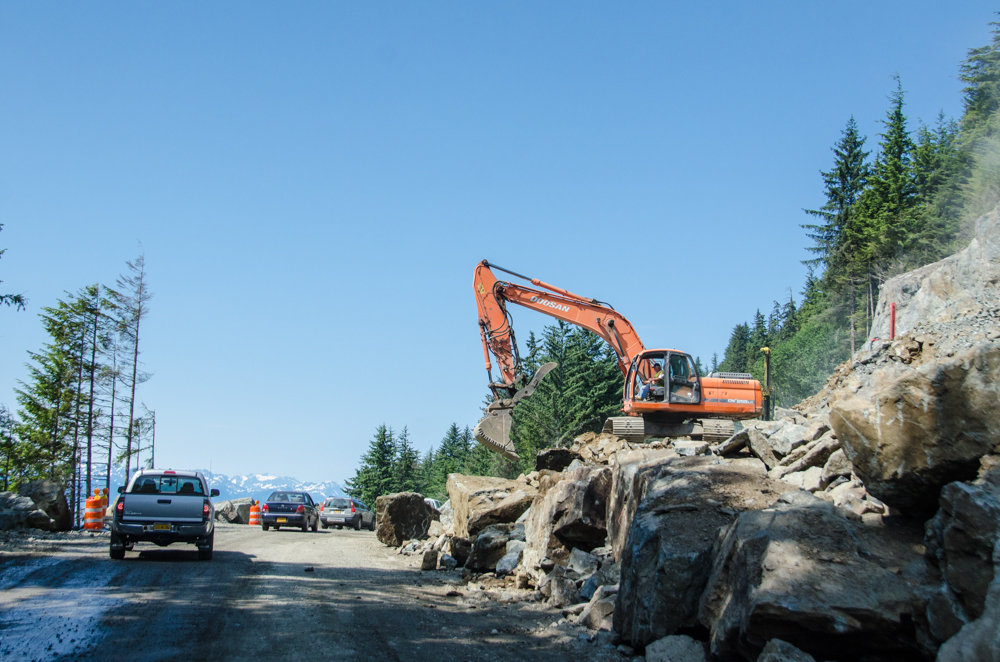
Construction has extended Glacier Highway to Cascade Point. Here crews are shown widening parts of the existing road in June of 2013. (Photo by Heather Bryant/KTOO)
Why should the state of Alaska consider extending roads to take over the function served by ferries?
The question was recently put to Department of Transportation officials at a joint hearing of the legislature’s House and Senate Transportation committees.
From a DOT perspective, the answer is simple: cost.
“One thing about a road is that first investment is retained over decades and decades and decades. It doesn’t wear out,” said Jeff Ottesen, division director of program development for DOT. “In the 50-year life of a ferry we replace it piece by piece.”
Capacity is the other part of the equation. Ottesen said roads give travelers greater opportunity and flexibility.
DOT forecasts indicate 1,484 vehicles a day could travel by road between Juneau, Haines and Skagway in the summer by the year 2020. Current ferry capacity is 154 vehicles a day in summer.
An old argument
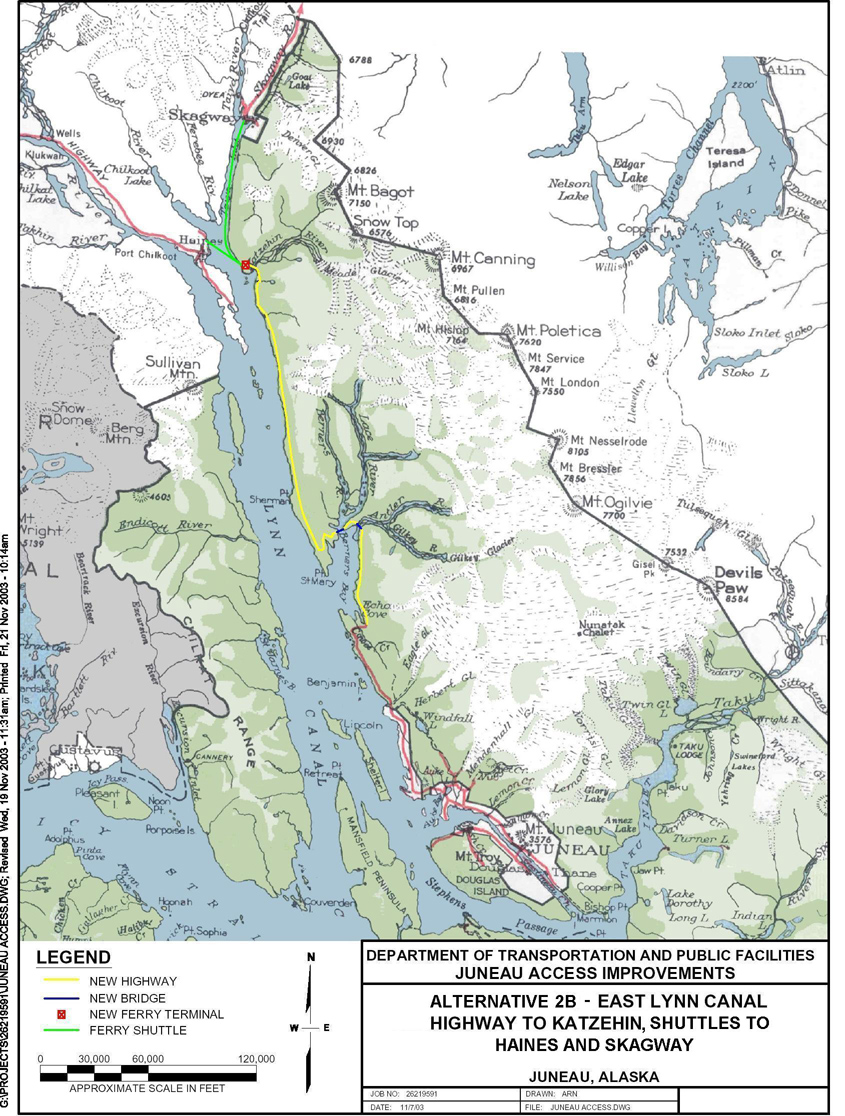
A map of the favored proposed route to Katzehin. (Map courtesy Alaska DOT)
A highway out of the capital city has been debated for decades. It’s slowly grown to Echo Cove and the latest proposal would extend it about 50 miles to the Katzehin River valley, east of Haines, where a ferry terminal would have to be built for the final leg to Haines and Skagway. Those ferries would operate in “a three directional mode,” Ottesen said.
“There’d be ferries from Katzehin over to Haines. Other ferries from Katzehin up to Skagway and then a smaller ferry up to Skagway and Haines directly,” he said.
In the summer, he said, the Katzehin ferry to Haines would run 10 times a day; six times to Skagway. Mainline ferries would no longer operate in Lynn Canal; they’d turn around at Auke Bay.
The latest estimate for the road to Katzehin is $500 million. Ottesen said the initial cost ultimately becomes savings.
“Roads will greatly increase the capacity of the corridor by almost a factor of ten. And we believe that capacity will be filled.”
Testimony at the transportation hearing was by invitation. Though the committee received some letters, Juneau-Douglas High School teacher Clay Good was the only person testifying who was not affiliated with the state transportation department.
“As a student growing up in Juneau and now as a teacher, I’ve taken students on field trips throughout Southeast Alaska, and the ferries were and are the safest, most affordable transportation option,” Good said.
Good has read the reports that describe a road periodically closed in winter due to avalanches and rock slides. He sees no utility in what he called an “expensive and dangerous road.”
“Imagine 40 students on a winter ferry to Haines. I can see it, a bunch of kids having fun, running around. Now imagine those 40 students in a bus in the winter driving to a very remote ferry terminal to catch another ferry,” he said. “What would parents choose if they could?”
The next segment
Next year’s DOT proposed capital budget includes $35 million for the Juneau Access project. Just what the money would cover did not come up during the hearing.
At this point, there is no detailed plan, because the Juneau Access Supplemental Environmental Impact Statement isn’t done. DOT spokesman Jeremy Woodrow says a draft document could be released within a couple of months then public meetings would be held in Juneau, Skagway and Haines. The final SEIS must be approved before the next segment gets underway, and Woodrow hopes that would be as soon as next fall.
The SEIS has been delayed to include the costs of building and operating two day boats in Lynn Canal, called Alaska Class ferries. If a highway is ever built to Katzehin, the proposed day boats would be used on the route to Haines and Skagway.
Close
Update notification options
Subscribe to notifications
Subscribe
Get notifications about news related to the topics you care about. You can unsubscribe anytime.