Community

Charities ensure every family has a merry Christmas

St. Vincent de Paul volunteers gave out gifts, turkeys, and food baskets to families in need. (Photo courtesy of St. Vincent de Paul)

Many Juneau families in need during the holiday season were still able to put presents under the tree and share a festive meal thanks to charity organizations and community programs like Adopt-A-Family and angel trees.

St. Vincent de Paul provided Christmas gifts for 150 children.

“The children put down one thing that they needed and one item that they wished for and so what we did is we tried to make sure we got the item they wished for and if the need was a coat or something like that, we got all new coats for the kids. We had hats and gloves, socks, we had toys,” said volunteer Louise Wertheimer.

Roughly $50 was spent on each child and Wertheimer said volunteers were able to find almost everything that was desired. “We couldn’t find a green Power Ranger suit or a blue Power Ranger suit.”

As parents picked up gifts on the days leading up to Christmas, St. Vincent volunteers gave out more than 150 turkeys and 75 food baskets.

“It makes you so happy and at the same time it just brings tears to your eyes. They give you a hug and thank you and they got tears running down their face and they tell you that we wouldn’t be having Christmas if it wasn’t for St. Vincent’s, and that’s what makes it all worthwhile is to know that we have helped these families with the children that really need the help,” said Wertheimer.

Carol Pitts is the community resource coordinator at The Salvation Army. As of Christmas Eve, she said the Salvation Army had assisted just over 200 families, totaling 650 people. Those numbers are down from last year when the Salvation Army helped 237 families, but Pitts, who was working Christmas Eve, said requests for food and gifts were still coming in, “We have some emergency situations that just kind of come up at the last minute and people didn’t realize that they were going to need assistance and then they are in a situation where they do.”

While the number of families signing up for assistance remained somewhat consistent, Pitts said the number of those willing to adopt a family was down this year, “Normally, I have about 25 to 30 people who will adopt and that’s organizations and individuals and families. This year I had 13.”

The remainder of families received food boxes donated by various organizations and community members, as well as toys brought in through angel trees.

The Salvation Army continues their efforts even after the holiday season.

“Christmas is just one of the many times that people need assistance and, of course, it’s just more important at Christmas time because it can be a very difficult time and puts a lot of extra burden on families, but people need food all year round,” Pitts said.

Throughout the year, the Salvation Army provides food, grocery store vouchers, and clothes on Tuesday morning and Thursday afternoon.


A mass reading of ‘Twas the Night Before Christmas from APRN

Downtown Juneau Christmas Lights. (Photo by Heather Bryant/KTOO)

In what we hope becomes an annual holiday tradition, we’re proud to bring you a mass reading of “‘Twas the Night Before Christmas,” featuring reporters from throughout the Alaska Public Radio Network.

Actors include:
Dave Bendinger, KDLG
Robert Woosley, KCAW
Casey Kelly, KTOO
Shady Grove Oliver, KSTK
Emily Forman, KCAW
Tony Gorman, KCHU
Rachel Waldholz, KCAW
Brianna Gibbs, KMXT
Shaylon Cochran, KDLL
Rosemarie Alexander, KTOO
Phillip Manning, KTNA
Lisa Phu, KTOO
Ben Matheson, KYUK
Aaron Selbig, KBBI
Emily Schwing, KUAC
Ariel Van Cleve, KBBI
Ed Schoenfeld, Coastalaska
Anna Rose MacArthur, KNOM
Angela Denning-Barnes, KYUK
Jay Barrett, KMXT
Ed Ronco, formerly of KCAW

Selling a small business

Holiday sales are brisk at Hearthside Books’ Nugget Mall store. Co-owner Deb Reifenstein chats with a customer about his family as she rings up a sale.

Reifenstein and Susan Hickey co-founded Hearthside in the summer of 1975. Their first shop was located in the Merchant’s Wharf building in downtown Juneau. It wasn’t too long before they moved to the corner of Franklin and Front Streets. Not long after that, they opened the store in the mall.

Hickey says they’d both been teachers in the Juneau School District before deciding to give the book business a try.

“We came up with this idea: It’d be fun to run our own business for a while,” she says. “We always thought we’d go back to teaching. But we just really enjoyed the creativity involved in owning your own business, being your own boss. It was great. We’ve each raised our children running the stores. The flexibility is there.”

Hickey and Reifenstein are retirement age now. Over the years they’ve discussed selling the business, and finally decided to put Hearthside on the market in February. Reifenstein says it’s time to do something else for a while.

“My husband is retired and he’d like to travel more frequently,” she says. “And I’ve got grandkids in town. So, lots of things on my bucket list to do still.”

Unlike Hickey and Reifenstein, Becca Gaguine is only 28 years old. Just like them, Gaguine’s at a place in her life, where she’s looking to sell her business, B’s Bakery and Bistro. In August, Gaguine gave birth to her first child.

“With the new baby and running a business, I’m not able to take care of it the way that I used to,” Gaguine says. “And I want to make sure B’s is well taken care of, and right now I’m not the person who can do that.”

Gaguine started B’s in 2011, selling sandwiches and cupcakes out of a food cart in front of the state capitol building. A year later, she moved into a small shop on 2nd Street, though her kitchen was still a food truck in the parking lot next door. Earlier this year she ditched the truck and installed a full service kitchen in the shop.

Gaguine wants to find a buyer who can carry on what she started.

“Someone who preferably has some sort of experience,” she says. “And at the very least, a strong passion for, you know, cooking and baking, and people skills.”

Hearthside and B’s are two of a handful of businesses known to be for sale in the Capital City right now. Others include the Southeast Waffle Company in Auke Bay and Rainy Retreat Books downtown.

Ian Grant is assistant state director for the Alaska Small Business Development Center, part of the University of Alaska Anchorage.

“There’s probably other business that aren’t publicly for sale that are also happening right now,” Grant says.

He says businesses – especially small businesses – have life cycle stages. He calls them the think, launch, grow, reinvent and exit stages.

The small business development center works with owners on strategies for each of those stages. For instance, he would help an owner get their books in order and come up with a plan to keep the business running while it is for sale.

“A lot of what becomes overwhelming for businesses that are starting to sell, is that they don’t have a team working with them to do that,” he says. “So when they go to sell the business, a life event happens. And then when you go to sell a business, that life event is taking up your time and it becomes even more difficult to sell if there’s some kind of a downtrend in the business.”

Gaguine says there’s still room for B’s to grow, while Hickey and Reifenstein say Hearthside is as strong as it’s ever been. Besides books, they also sell a fair amount of children’s toys. The Internet has also leveled the playing field for independent book stores competing with big box booksellers.

“There’s a huge resurgence now in the growth in the independent bookstores in this country,” Hickey says. “It’s growing again and it’s really exciting to see.”

Hickey, Reifenstein, and Gaguine say they’re willing to hold out until they find the right buyer. They all say their employees are among the most important considerations when it comes to selling their businesses.

Hickey says Hearthside is looking for someone who lives in Juneau or is willing to relocate. The book store is an active presence in the community, hosting author readings and book signings and selling tickets for concerts and other events. Plus, Hickey says running a small business is a hands-on job.

“I think it would be very difficult to live elsewhere,” she says. “But that’s the fun of it.”

B’s just went on the market and Gaguine says she hasn’t fielded any offers yet. She’s asking $65,000, about what she says she put into the business. Hearthside wouldn’t disclose what they are asking, but Hickey and Reifenstein say all offers are being considered.

Middle school sports travel task force on schedule for recommendations

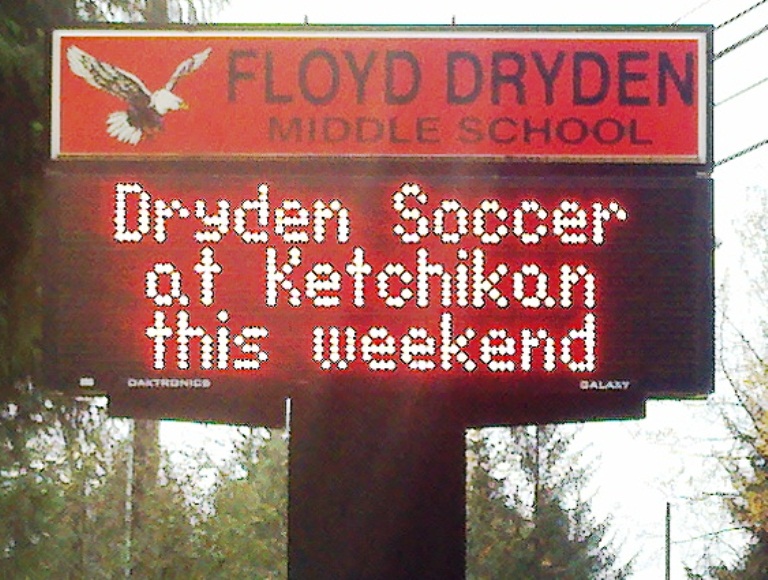
Floyd Dryden Middle School athletes continue to travel to games this school year.  That will end next year unless the ban is modified.  Photo by Rosemarie Alexander.
Floyd Dryden Middle School athletes continue to travel to games this school year. That will end next year unless the ban is modified. Photo by Rosemarie Alexander.

A community task force on middle school sports travel expects to have draft recommendations finished by the end of the month.

The group is called the Stakeholder Committee on Middle School Sports Travel, chaired by parent Jon Kurland, whose children are out of middle school and would not benefit if policies changed.

In September, the Juneau School Board imposed a ban on all travel for middle school athletes, to go into effect next year.  Dzantik’i Heeni Middle School eliminated sports travel last year. The board’s action extended it to Floyd Dryden students.

Kurland asked the board to create a committee to look at the policy, but the board said it would not be involved. The task force is comprised of parents, district officials, teachers and coaches.

Instead, the board will consider recommendations from the committee in the spring.

Kurland told school board members Tuesday he plans to have a draft to middle school principals and site councils in January.

“We want to get feedback from additional folks. They will doubtless point out areas that can be improved. We will make those improvements, we will build in that feedback and then we will come back to you with a final report, most likely in February,” Kurland said.

In an interview with KTOO, Kurland addressed what he called a misconception that school district funds are used for middle school travel.

“There are appropriated district funds that are used for travel at the high school level, but at the middle school level they’ve relied on fundraising for a long time,” he said. “There are some ancillary costs. There are costs of substitute teachers when the teacher coaches travel, and classes need to be covered. There are staff costs in just making the arrangements for travel and the logistics and so forth.  I don’t mean to suggest there’s no cost at all, but the actual cost of ferry tickets and what have you is not something the district’s been  paying for in the past.”

Kurland said the task force is following the school board’s direction to get the report and recommendations to members in time to take action at the May meeting – that’s if they agree the policy banning middle school sports travel should be changed.

Gelbrich makes short list of candidates for Montana job

Glenn Gelbrich
Superintendent Glenn Gelbrich

Juneau superintendent Glenn Gelbrich has reached the second round in the selection process for a new superintendent of the Kalispell, Montana school district.

The Kalispell Public Schools Board of Trustees on Tuesday night narrowed the list of candidates from nine to five, according to Daily Inter Lake reporter Hilary Matheson, in an email to KTOO.  Interviews are scheduled on Jan. 13th and 14th.

Gelbrich came to Juneau in July 2009 from Oregon, where his wife and family still live.  He says the Kalispell job would put him closer to family.

“I think part of the reason for participating in the process is so that you understand the position very, very well and  you know what the work is, because you want to make sure that’s the work that you want to do,” Gelbrich says. “So if it were offered and if I understand it well enough and it feels like it’s a match, then yeah, otherwise I’m wasting their time.”

Gelbrich signed a three-year contract with the Juneau School District in March. It expires in June 2016.

He is currently making $155,000 a year. The Kalispell job was advertised at $125,000 plus benefits, depending on experience.

45-unit housing envisioned for Juneau’s homeless

(Graph by Scott Ciambor/ Alaska Mental Health Board)
(Graph by Scott Ciambor/Alaska Mental Health Board)

The Juneau Assembly Human Resources Committee heard an update Monday night on Juneau’s need for a housing unit for homeless. Alaska Mental Health Board Planner Scott Ciambor says a Housing First project in Juneau was developing quickly before the Alaska Council on the Homeless changed a crucial grant.

“The status of this project is it went really fast really quick, and so once we hit that snag in May of the guiding light of the Special Needs Housing Grant paving the way, things have kind of tempered down a little. But when we were talking prior to that, the size was 45 units, with the idea that 30 would be straight off the street because we have more than enough capacity of folks needing that type of housing,” explains Ciambor.

Scott Ciambor presented on Housing First to the Juneau Assembly Human Resources Committee Monday night (Photo by Lisa Phu/KTOO)
Scott Ciambor presented on Housing First to the Juneau Assembly Human Resources Committee Monday night. (Photo by Lisa Phu/KTOO)

Ciambor says the Special Needs Housing Grant was the pathway for Anchorage and Fairbanks to get housing for homeless. With none in Juneau, Ciambor says the chronic homeless often use the emergency room, department of corrections, and Rainforest Recovery Center for housing. The concept of a Housing First model addresses the need of getting homeless into housing without a prerequisite for sobriety.

“You take a person who needs housing and shelter. You get them out of the streets and into someplace where they can be safe first and then you surround them with the services so that they can make that next step,” Ciambor says.

Human Resources Committee Chairman Jesse Kiehl asked Ciambor to give the assembly an outline of project costs.

Site notifications
Update notification options
Subscribe to notifications