It’s likely to be a cold start to the New Year for Juneau residents who live out the road.
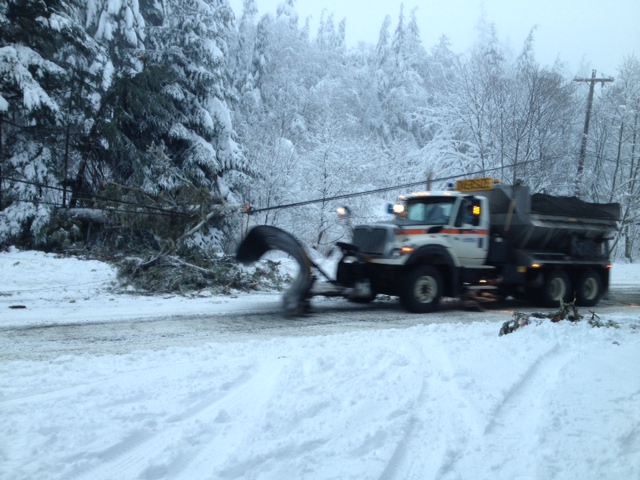
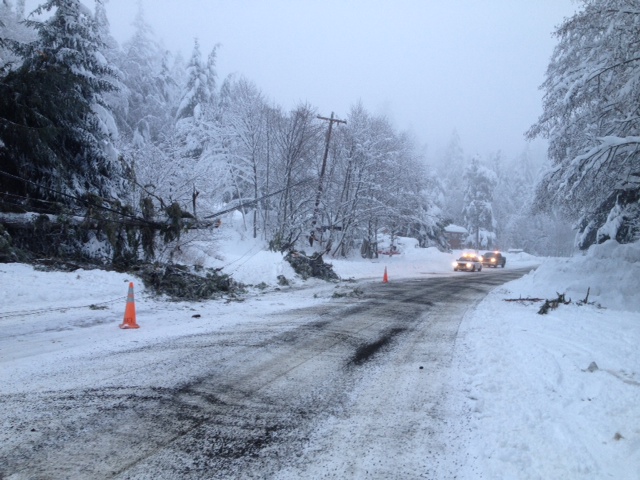
Most places north of Tee Harbor have been without electricity since Monday morning, and Alaska Electric Light and Power Spokesman Alec Mesdag says it could be another 12 to 24 hours before power is restored.
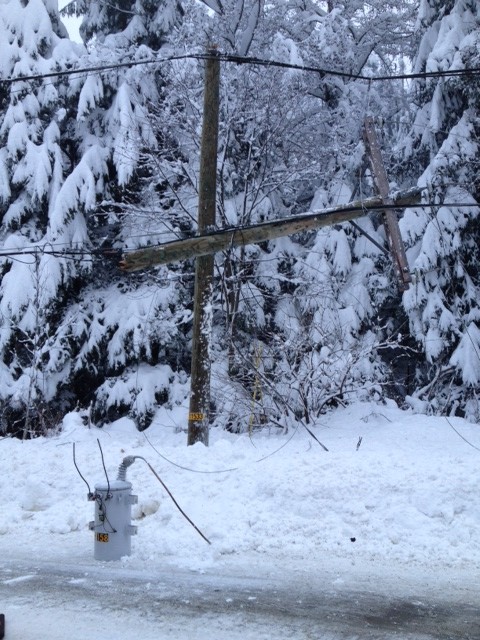
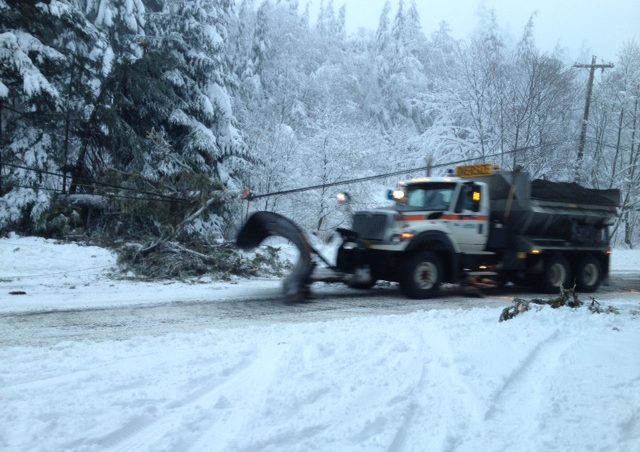
“With the heavy, wet snow, what’s happening is when the trees are coming down there’s so much weight that it’s breaking a lot of lines and it’s breaking poles,” Mesdag says. “So the repairs take a lot longer when that happens. It’s not just going in and cutting some branches out of the lines and then re-energizing.”
When a pole breaks, Mesdag says AEL&P crews have to plant a new one and string the power line to it.
He estimates a couple hundred customers could be without power into New Year’s Day.
“Right now all our crews that are available to work are out [working]. We have to, because this is going on for a while, we have to send guys home to get rest to make sure they are able to work safely,” he says. “So try to plan for being out of power. Make sure you have your outage kits prepared. Make sure you have some food and water, and the ability to stay warm.”
The National Weather Service has issued a winter weather advisory for tonight and early Wednesday morning for the Juneau area. Heavy rain mixed with snow is expected overnight, with heavy rain in the forecast for New Year’s Day.
Leann Thomas owns the Triangle Club Bar downtown. She says 14 bars and liquor stores are participating in the Safe Rides program this year.
“We’re running it from 9 a.m. to 3 a.m. on New Year’s Eve,” Thomas says. “Look for posters around town. It’s also in Capital City Weekly – the last two weeks it’s been running in Capital City Weekly of the locations you can get a free cab ride home.”
Thomas says CHARR fundraises for the program throughout the year and always offers free cab rides home on Halloween and New Year’s. Sometime other holidays are included.
She says as many as 25 taxis participate, and their goal is to pick up customers within 30 minutes of receiving a call.
“They will only take you home. We want to get everybody home. That’s our point, is to make our community safe,” Thomas says. “And another important thing is that you might not get your own cab. If there’s a whole bunch of people going from downtown to the valley, we’re going to load that cab up. So there might be seven people in that van, and we’re going to take you out to the valley and drop you off at your house.”
Thomas says more than 600 people took advantage of the Safe Rides program last year.
Meanwhile, the Juneau Police Department will have extra officers working for the New Year’s holiday.
JPD Spokeswoman Erann Kalwara says officers will be conducting enhanced patrols tonight and New Year’s Day.
“On New Year’s Eve we’re going to have 13 officers working patrol, which is more than double a normal patrol shift,” she says. “And on New Year’s Day we’ll also have extra officers.”
Cracking down on drunk drivers will be a focus for officers. But Kalwara says enhanced patrols can also help with accidents caused by bad weather.
“We hope that folks never drink and drive,” she says. “But the road conditions are an extra hazard and an extra thing to worry about and think about while driving.”
Juneau Police are responsible for enforcing traffic laws throughout the borough. However, Kalwara says the enhanced holiday patrols will primarily be in heavy traffic areas, including downtown, Douglas, Lemon Creek and the Mendenhall Valley.
2013 included turmoil at Bartlett Regional Hospital; failed negotiations between Juneau teachers and the school district, and memorable summer weather.
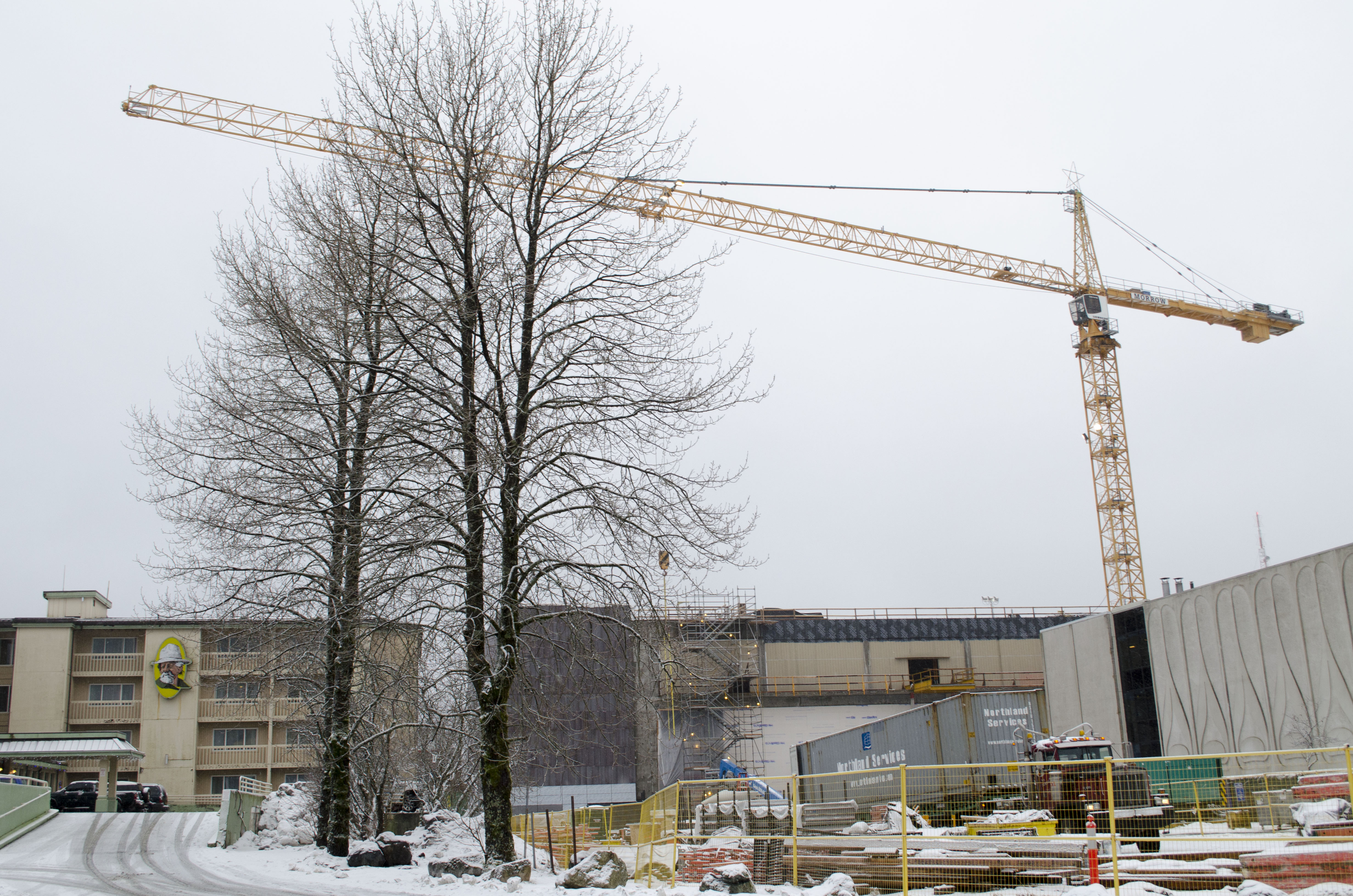
Juneau residents can see progress every day on the SLAM project. Photo by Sarah Yu / KTOO.
The year began with a ceremonial groundbreaking for the largest project to be built in the capital city in years. The State Libraries, Archives and Museum, or SLAM, will house Alaska’s treasures in one building. In early March, the 160-foot tower crane was put in place and Juneau residents can see progress every day.
In June, the ribbon was cut on three more miles of road north of Juneau, when Glacier Highway was pushed from Echo Cove to Cascade Point. The extension was paid for with state funds. Gov. Sean Parnell’s budget proposal for next year includes $35 million in state and federal funds for the Juneau Access project.
Also in June, the state of Alaska said new cubicles would replace some Juneau offices, prompting a union grievance. Many state workers said they couldn’t cram all their gear in the smaller space. Arbitration is planned between the Alaska State Employees Association and the state on the so-called universal space standards.
No controversy here: Juneau and the rest of Southeast Alaska had a great summer. Rainfall in August was nearly an inch below normal. National Weather Service Meteorologist Joel Curtis says that was the downside.
You think about how the ecosystems work in Southeast Alaska, you really do want that normal rainfall and you do want it on the cool side, if nothing else than for our salmon spawning.
Early this fall, most of the Bartlett Regional Hospital administration team resigned, amid allegations of a hostile work environment created by senior management officials. The Human Resources Director, Chief Executive Officer, and Chief Financial Officer were hired after the hospital board ditched its long-term management company in 2012. Now an interim CEO is trying to establish better communications and a more stable work environment for hospital staff.
The Southeast Alaska Regional Health Consortium threatened to close Juneau’s Front Street Clinic for homeless and other low-income residents in October. The agency blamed it on revenue shortfalls.
It didn’t take long for local social service organizations to raise funds to keep the clinic open. When SEARHC gives up management in May, a new group will run the Front Street Health Center. The group says it will be able to provide the same medical, dental and behavior health services as SEARHC, for less money.
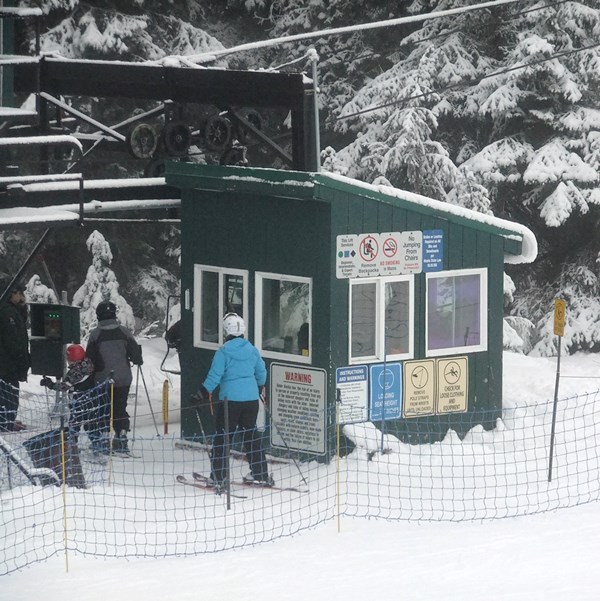
Skiers get on Hooter chairlift Sunday at Eaglecrest.
A social media contest for best ski area in North America put Juneau’s city-owned ski area on the map. In late October, Powder Magazine included Eaglecrest in its Ski Town Throwdown. Eaglecrest became the “little mountain that could,” getting more Facebook votes than every winter resort it was paired against, until the end when it was runner up to Colorado’s Crested Butte.
Ski area GM Matt Lillard said everywhere he went, people were abuzz about Eaglecrest.
The exposure that we’re getting across the social media spectrum on Facebook , Instagram, and Twitter, as far as reaching down south and other areas, not just in Juneau, has been great.
Juneau teachers ended the year without a contract. The Juneau Education Association and school district have been negotiating for 11 months. Mediation failed, and in October the two sides moved to arbitration. They await the arbitrator’s opinion, which will be advisory only. Teachers have authorized the JEA executive board to schedule a strike vote if bargaining efforts fail.
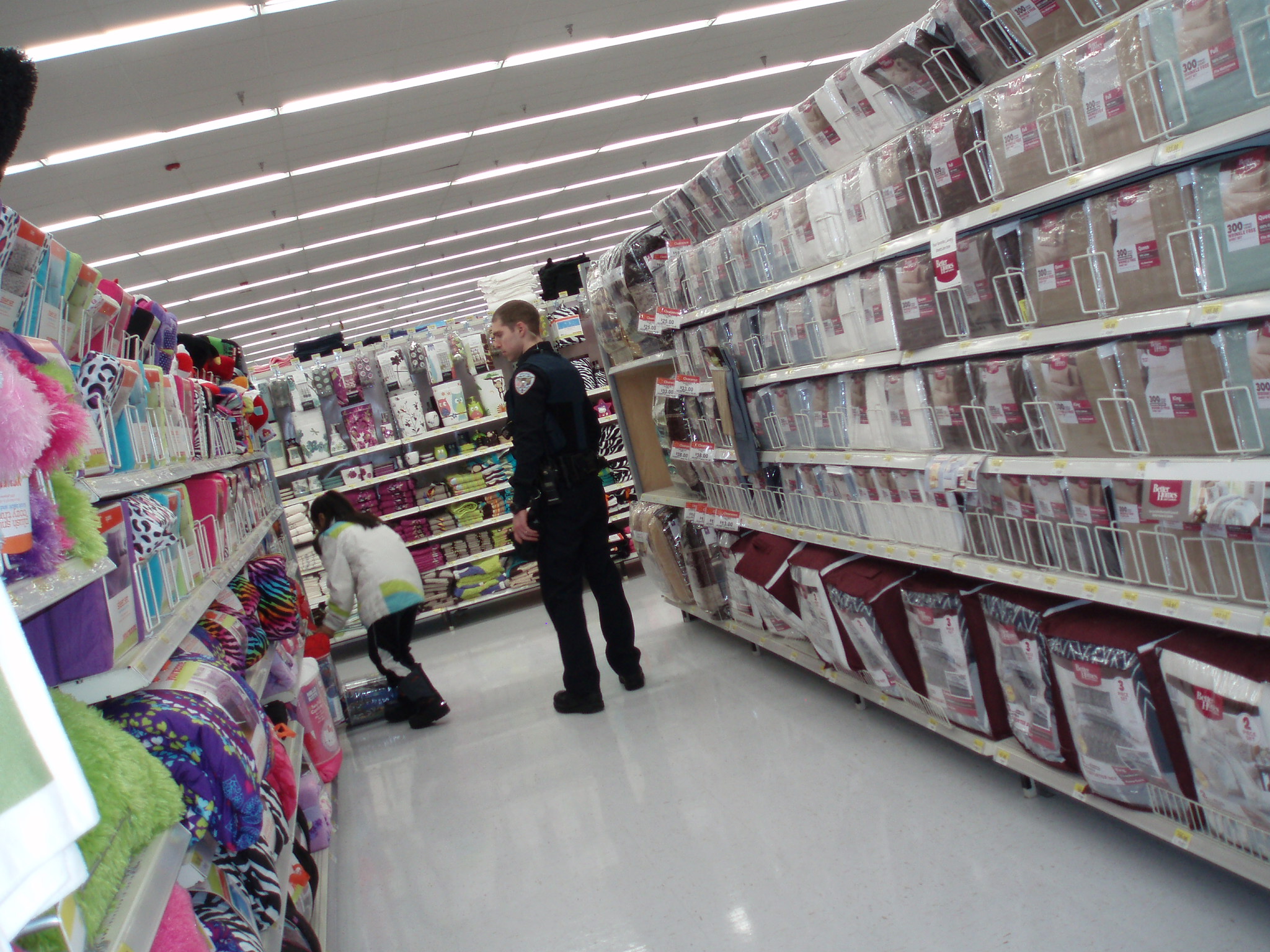
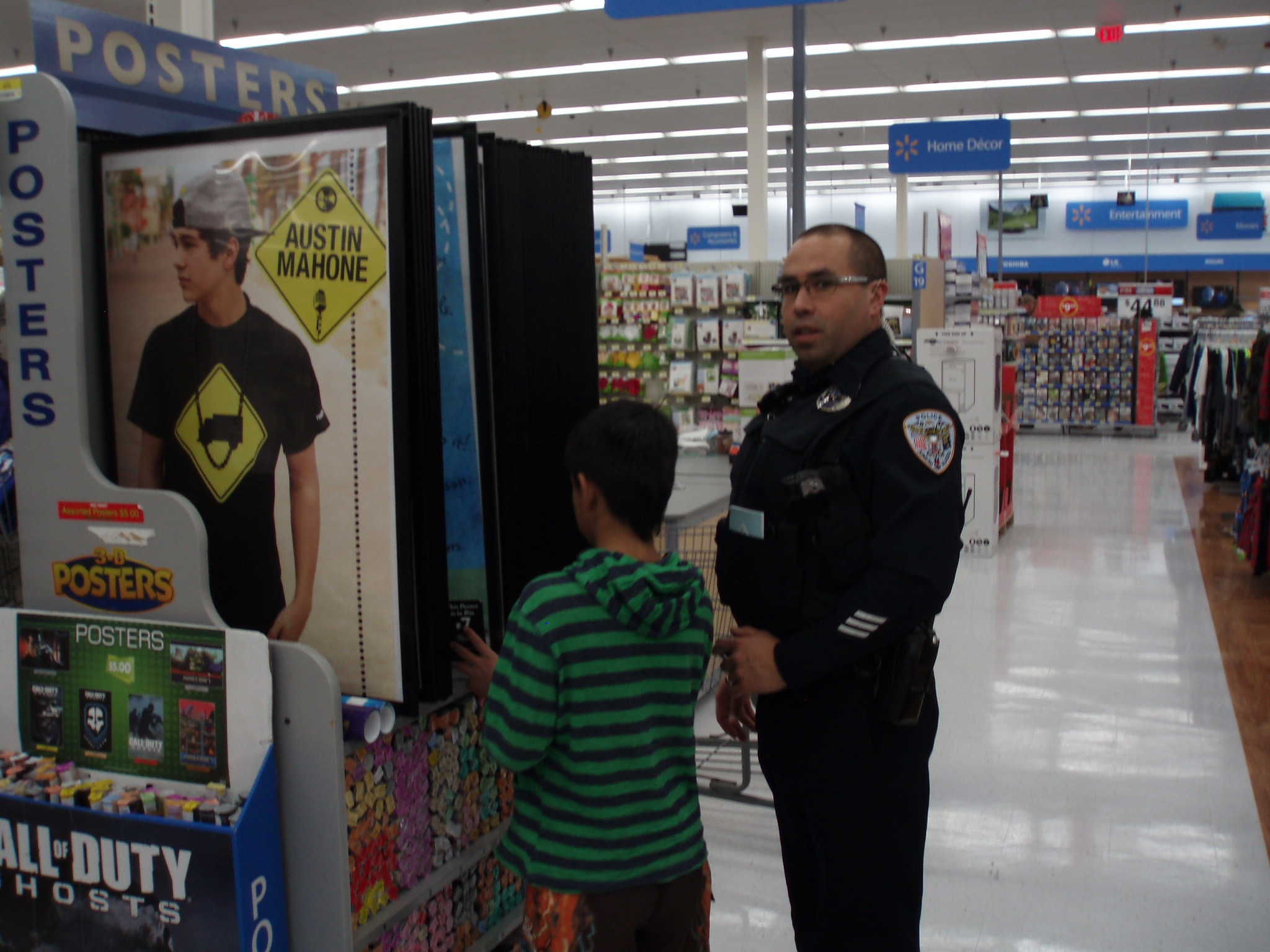
Juneau Police Officer James Dooley peruses the aisles of Wal-Mart with a child during Shop with a Cop. (Photo courtesy of Sarah Hieb/Alaska Peace Officers Association)
Goodwill exhibited during the holiday time often extends well beyond. One holiday tradition that strives to leave a lasting impression is Shop with a Cop.
Juneau Police Department Lt. Kris Sell says Shop with a Cop helps foster good relationships between children and uniformed officers:
“Some of what kids need these days are relationships with adults and someone that they get to know a little bit, someone who’s making good decisions, and so these are just more positive adults to put in their life.”
Several officers from Juneau Police Department, Alaska State Troopers, and National Oceanic and Atmospheric Administration law enforcement spent time with selected Juneau children before Christmas. Each child was picked up at home by an officer in a marked vehicle and, together, they went shopping for presents to give to the child’s family.
Juneau Police Officer Jim Quinto was one of several police officers, State Troopers, and NOAA law enforcement who participated in Shop with a Cop. (Photo courtesy of Sarah Hieb/Alaska Peace Officers Association)
The officers try to make the time with the children as positive as possible. “We talk to them about, ‘What do you want to do when you grow up? What are your dreams?’ We want to talk a lot about, ‘Where do you want to go with your future?’ And, ‘What do you think would make you happy?'”
Nominations from officers help determine what families are chosen to participate in Shop with a Cop. “We get our nominations from a number of different sources, including families that officers just kind of run across,” explains Sell. “Maybe we have had contact with that family at some point and thought they’re getting a pretty tough situation, pretty raw deal.”
Sell hopes the program will create a personal relationship between youth and uniformed officers.
“We want this to be part of kids’ whole impression of these group of adults, that we care about them, we want the best for them. It’s okay to come up to a uniformed police officer and just talk to them,” Sell says.
Shop with a Cop also puts officers in a unique situation. Sell recalls delivering groceries to a family of one of the children, “One of the adult members teared up over just all the food we had brought. It was just a really touching experience for us. Of course, like most cops, we’re uncomfortable with positive emotions, so we ran from the house and fled,” Sell says laughing.
Shop with a Cop in Juneau is organized by the Capital City Chapter of the Alaska Peace Officers Association. In its fourth year, close to $2,700 was raised for the event.
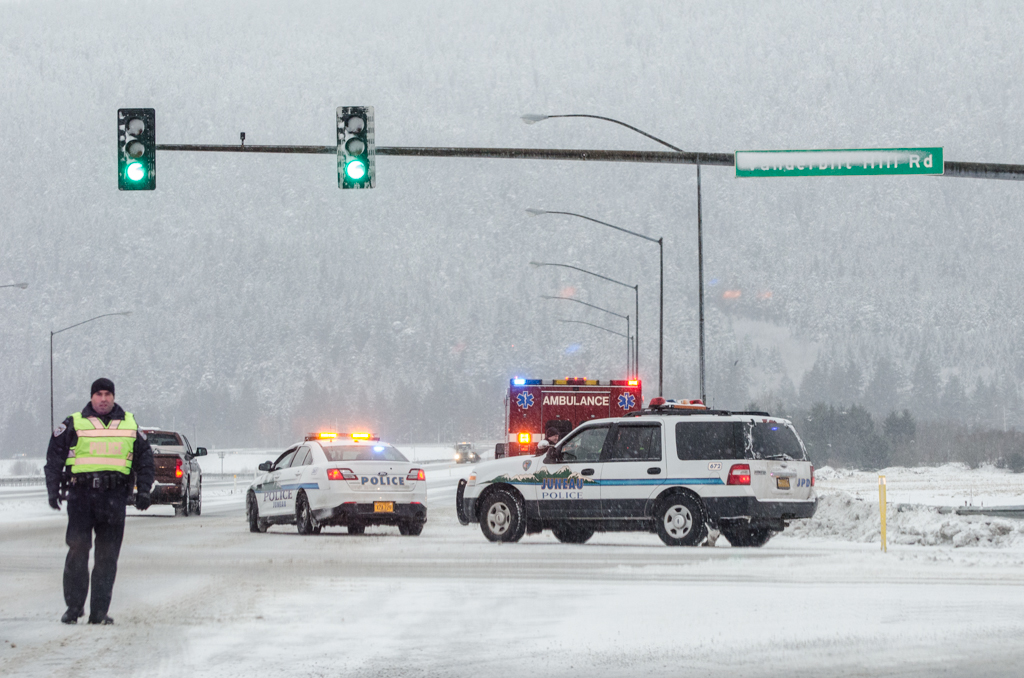
Police blocked the right lane of traffic at the intersection of Egan Drive and Vanderbilt Hill Road earlier this month after a two-car accident. Photo by Sarah Yu/KTOO
Juneau has had lots of winter driving already this year. If you or your teenage driver have had a close call – or just want some winter driving tips — you may want to attend this APOA class.
This is the third year the Capital City Chapter of the Alaska Peace Officers Association is sponsoring the winter driving class, geared especially for teens, though all are welcome.
Lt. Kris Sell says the program is back by popular demand.
“We have had some parents express to us that it’s hard for them to convince their children of certain things and they would like to take their teenager to someone who actually studies the physics of vehicle accidents,” Sell says.
Speed limit is a major issue and officers often find that teenage drivers don’t relate speed limit to conditions.
“They believe that somehow the speed limit is a number that is stand alone, divorced of the environment, when in fact the speed limit is the maximum you’re allowed to go when conditions permit,” she says.
While there won’t be any actual driving time during the class, Sell says pictures and the anatomy of Juneau accidents can tell a powerful story. The class will be taught by Accident Investigation Specialist Sarah Hieb, a training coordinator for the Alaska Police Standards Council. For years, Hieb investigated and reconstructed accidents for the Juneau Police Department.
“When we would have accidents that were serious she would go out to look at the scene to tell us what happened. She is very knowledgeable of the math and physics involved and the behavior of vehicles,” Sell says.
JPD school resource officer Blain Hatch is also an instructor. He knows a lot of young drivers in Juneau high schools.
“At this point in the winter maybe people have had a few close calls and thought, ‘You know, that trip to school or that trip to work was pretty nerve wracking.’ So maybe we can talk a little bit more about why that happened and what’s going to change the behavior of your car or not. Are studded tires really worth it, how should you be braking, how should you be steering when something goes wrong?”
The winter driving class will be held on January 6th from 6 to 8 p.m., at JPD. It’s free and no reservations are needed, but Sell says previous classes have been packed.
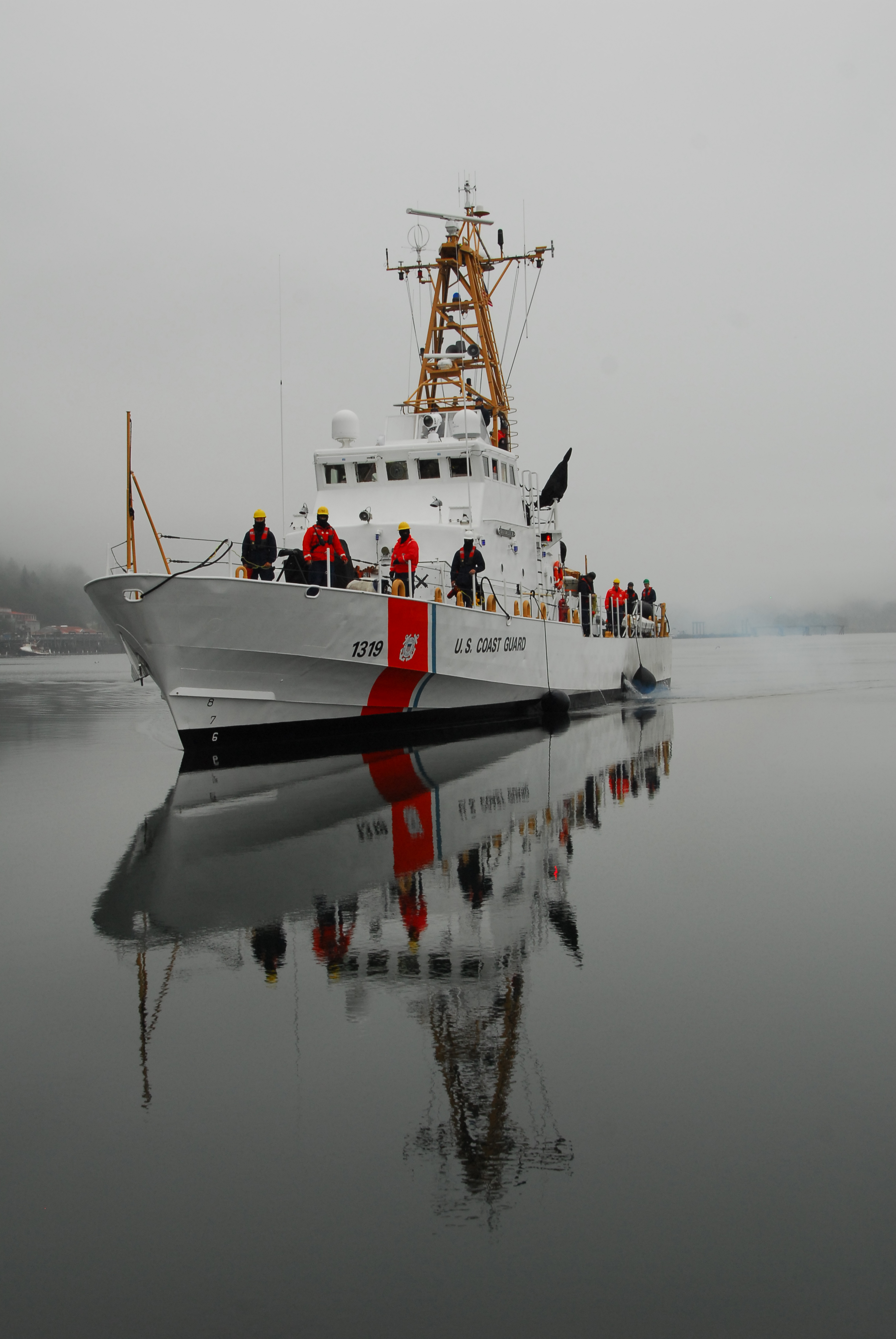
USCG Cutter Chandeleur arrives in Juneau in October 2012. USCG photo by Chief Petty Officer Kip Wadlow.
Sixty percent of all federal dollars spent in Alaska are devoted to defense spending.
A new study shows just how dependent Alaska is on the military.
The state Labor Department estimates the military will spend $486 million next year on Alaska projects. The study is published in the December issue of Alaska Economic Trends magazine.
The largest percentage of residents with ties to the military live in the Fairbanks North Star Borough, where nearly a quarter of the population is employed by the military, or is a military dependent. The Denali Borough, home to Clear Air Force Station, is second with about 22 percent.
Juneau is command headquarters for the U.S. Coast Guard in Alaska, but the largest Coast Guard presence is in Kodiak. About 18 percent of Kodiak residents are involved in the military. Most are in the Coast Guard.
Nearly 31,000 active-duty members of the military and their dependents live in Anchorage, but represent only 10 percent of the population in Alaska’s largest city.
In the capital city, the total number of military active duty and dependents reached 824 last year, representing 2.5 percent of Juneau residents, according to the report.
Close
Update notification options
Subscribe to notifications
Subscribe
Get notifications about news related to the topics you care about. You can unsubscribe anytime.