Community

Congress fails to reauthorize Violence Against Women Act

The 2005 reauthorization of the Violence Against Women Act remains law. No provisions will sunset. When Congress first wrote the bill 20 years ago, it required a check up every few years.

But the Congress that just wound down failed to agree on another round of the legislation. The Democratic controlled Senate passed a version extending protections to gay men, lesbians, bisexuals and immigrants. That didn’t sell in the Republican dominated House.

So if Congress decides to revisit the Violence Against Women Act, or VAWA, both chambers must agree just who deserves legal protection.

David Muhlhausen, research fellow at the Heritage Foundation, called the overall bill a federal overreach. He said he does not want any version to grow beyond its current authority.

“In general, it is bad for the federal government to be involved in what is inherently state and local crime, whether it’s domestic violence or not,” he said Wednesday.

Muhlhausen said he isn’t sure Congress will pick up the measure anytime soon.

Shaina Goodman is. She’s the public policy coordinator for the National Network to End Domestic Violence.

She said a reauthorization could lock in long term funding levels.

“Programs that are operating under unauthorized funding levels are at risk of being underfunded, or defunded, or having their funding scheme tweaked that would be harmful to service providers and victims,” she said.

Peggy Brown made the same argument. She’s the executive director of the Alaska Network on Domestic Violence and Sexual Assault.

“We have all kinds of things in play that we’re planning to do in 2013 and 2014,” she said in a phone interview from Anchorage. “And now everybody is skittish about planning these things because VAWA wasn’t reauthorized.”

She rattled off programs to deal with domestic trafficking in the state, training for prosecutors, aid for health care providers.

“People are a little hesitant to put a lot of energy in there until we find out if there’s funding,” Brown said.

Brown said 90% of her budget comes from VAWA funding. She’d like to diversify, but said it’s hard.

Any help Alaska might offer remains vulnerable too, Brown said, because VAWA incentivizes states to act by tying federal funding to state action.

“In our state where the numbers are at critical mass, and we’re just getting to the point where we’re actually being effective and perhaps getting people up to speed, benefiting victims of all ages, then this happens.”

Congress could debate the reauthorization anytime. But both chambers are out this week. And when the Senate returns to Washington later this month, yet another fiscal debate will take center stage.
School budget process gets underway

The Juneau Board of Education has appointed a 17-member committee to help write the school district’s budget for fiscal year 2014.

The committee will hold seven meetings between now and March 5th, beginning its work on Tuesday (Jan. 15). Superintendent Glen Gelbrich will present the district’s recommended budget during the committee’s third meeting.

For several years, the school board has asked community members to join a budget committee, but this year’s group will have actual authority to submit a budget.

School board member Barbara Thurston will co-chair the budget group.

“We did an evaluation after last year’s budget committee to see what worked and what didn’t work.  And one of the frustrations we found is it felt like there was not sufficient amount of resolution; the committee did not have the authority to finalize any recommendations,” Thurston said.  “So that’s one of the changes we made this year, is that  the budget committee will actually create a proposed budget that will be submitted to the board for full consideration.”

This year’s super-sized committee includes a representative from each of Juneau’s 12 schools and three education unions as well as community members.  Thurston says the seven-member education board also will be involved in the budget process, but will not have a vote.

“And the reason for that is there is so much discussion of priorities (and) there’s a lot of public input.  If the board members sat out that process and then only looked at the budget when it was presented to us in March, there wouldn’t be enough time to really absorb it.  We really need to be in on those discussions,” Thurston said. “I’m sure that board members will contribute things to the discussions during the budget committee, but we don’t actually have a vote.”

The school district must present its budget to the City and Borough of Juneau by the end of March.

The fiscal year 2014 school district budget will be about $90 million.  The operating portion of that is $77 million. The district is expecting a revenue shortfall of $1.2 million.

The school district budget committee will be asking for public input, and prefers written comments.  Two public hearings – one on January 22 and the second on February 19 – will be held to take personal comments.

Comments can be sent to budgetsuggestions@juneauschools.org.


Auke Lake draft plan would restrict jet skis

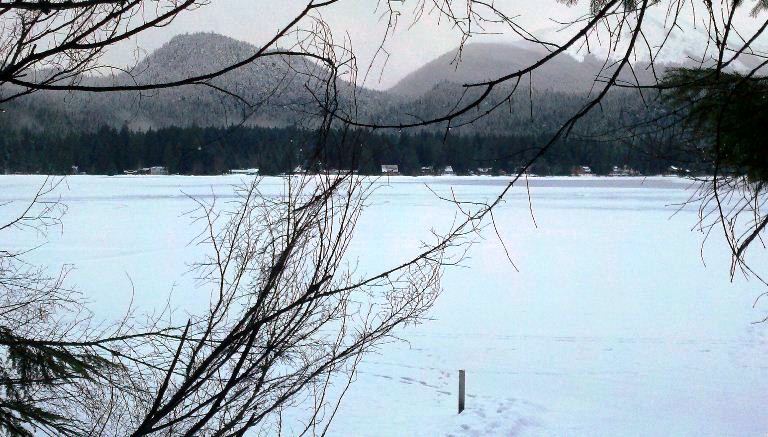
Auke Lake from Auke Lake Trail head.

Jet skis, water skis and wake boards would not be allowed on Juneau’s Auke Lake, under a proposal to limit watercraft to 10 horsepower on the small lake.

The draft Auke Lake Management Plan also recommends towing restrictions.

The proposal was released Tuesday night  to the Parks and Recreation Advisory Committee, or PRAC.

After a Juneau teenager died from injuries in an accident on the lake last summer, the city began a review of ordinances regulating lake uses. Testimony from a series of public meetings, written comments, and other research form the basis of the draft plan, which was written by city parks and recreation department staff.

Director Brent Fischer said the U.S. Interior Department’s Water and Land Recreation Opportunity Spectrum, or WALROS, also was used to determine the carrying capacity – the number of vessels that can reasonably and safely use the lake.  Only 70 acres of the 165-acre Auke Lake are considered useable.

“The existing 16-foot length limit for motorized vessels should be replaced with a 10-horsepower limit,” Fischer said. “Due to the relatively small size of Auke Lake and its limited carrying capacity, the use of multiple high speed vessels is just not appropriate. Speed limits and wake restrictions are virtually impossible to enforce.  A horsepower limit provides a practical means of controlling vessel speeds. This will result in few user conflicts and allow more vessels to safely use the lake.”

The 10-horsepower restriction would not apply to aircraft taxiing on the lake.

The proposal also calls for the city to replace current buoys that delineate restricted areas with markers that comply with state regulations.  New maps and signs would go up, clearly explaining lake use, and regulations would be enforced by a CBJ park  ranger. The draft plan also maintains the existing no-wake zone and operating area, and a ban on refueling.

Fischer acknowledged the difficulty of including all Auke Lake user groups in the management plan.

“It is true that Auke Lake is one of only navigable lakes on the Juneau road system. However, the lack of other options does not change how it should be managed,” Fischer said. “Auke Lake cannot be all things to all users and must be actively managed to best achieve the management objectives developed by the community at large.”  

Only a handful of people came to the meeting and some didn’t stay once they heard that public comments would not be taken.

Commercial fisherman Aaron Woodrow had hoped to testify Tuesday night.  Before the meeting, he said he was teaching his 10-year-old daughter to waterski on the lake the day of the accident that killed Savannah Cayce. He was flagged down by a jet ski to help.

Woodrow said education is key to preventing accidents on the lake.

“There needs to be some guidelines of how to safely tow someone around the lake.  Myself and my friends have always followed some guidelines of towing around the perimeter, you know in straight lines. You don’t go zigzagging around because it’s not that big of a lake,” Woodrow said. “It’s just education.”

Lake shore resident Dave Hannah claims he has not missed a meeting about Auke Lake in the last decade.  He panned the draft management plan as “rife with error.”

“I think they misconstrued the characteristics of the lake.  They’ve misconstrued the attitude of the public. They’ve misconstrued the attitude of a lot of the residents of the lake.  I think they’ve misconstrued the ability of the lake to support the uses that are there,” he said.

Public comments on the draft management plan will be taken at a Parks and Recreation Advisory Committee meeting on January 29th.    Written comments can be made now to parks_rec@ci.juneau.ak.us.

PRAC members will use the comments as they determine changes they would like to see in the draft plan.  The PRAC will forward their recommendations to the CBJ Assembly next month.

Parks and Rec director Fischer said the goal is to have any new regulations in place before the ice melts on Auke Lake.

Robert Meachum services planned for Tuesday

Robert Meachum
Robert Meachum photo courtesy of the Anchorage Public Defender’s office.

Robert Francis Meachum will be remembered during a service at the Northern Light United Church at 3 o’clock Tuesday afternoon, January 8th.

Meachum was a public defender who recently worked out of the Dillingham and Juneau offices. For over 25 years, he defended those accused of crimes or advocated for those who could not afford their own attorney. Many of his clients included those involved in juvenile delinquency and child-in-need-of-aid (CINA) cases, and involuntary mental health commitments.

Author John Straley, who has worked as an investigator for the Public Defender’s office in Sitka, is expected to read a poem.

Family, friends, attorneys, and judges from throughout the Lower-48 and Alaska are expected to attend. Juneau judges, who worked with Meachum earlier in their careers, will be clearing their calendar at the Dimond Courthouse to attend the service on Tuesday afternoon.

Meachum suffered from a combination heart attack and stroke in Dillingham just before Christmas. He was transported to Providence Alaska Medical Center in Anchorage for treatment. He passed away on New Year’s Day at the age of 57.

Meachum is survived by his wife Freda Westman of Juneau and their four children Cecelia, Gabe, Dabney, and Hunter.

A live stream and archive of the service can be found here.

Idle No More in Juneau

Local drummers and dancers perform during an Idle No More rally in Juneau on Jan 4. at the Sealaska Plaza. Photo by Matt Miller/KTOO News

About two-dozen Native dancers and drummers performed at the Sealaska Plaza as nearly an equal amount of spectators watched on Friday afternoon.

Most of the dancers were in their regalia and a few held up signs that read: Idle No More.

Similar events are underway in Canada where First Nations people are protesting their treatment by the federal government. Attawapiskat Chief Theresa Spence is now in the fourth week of a hunger strike in her effort to meet with Prime Minister Stephen Harper over aboriginal equality and treaty rights.

Large and small signs like these read “Idle No More” for the First Nations movement that’s now underway in Canada. Photo by Matt Miller/KTOO News

Ishmael Hope of Juneau calls it a powerful and positive movement.

“It started with us being supportive of our inland relatives,” said Hope. “It’s been happening all over now, all over the world. We’re not going to sit back and take the injustices that come at us.”

Hope says this was the third event organized for Juneau and more are planned. He credited Harold Jacobs for organizing the recent events.

Idle No More was planned for the State Office Building atrium during the noon hour on Friday. But the event was moved to the Sealaska Plaza because it conflicted with the weekly performance of the Kimball pipe organ.

Midnight earthquake shakes Juneau

Update:

The U.S. Geological Survey says the magnitude 7.5 quake struck at midnight Friday Alaska time and was centered about 60 miles west of Craig, Alaska.

The tsunami center says a tsunami with a “significant widespread inundation of land is expected.”

The first wave was expected around 1:15 a.m. (2:15 a./m. PST) in Craig, and 2:50 in Cordova, further to the north.

The center says widespread dangerous coastal flooding is possible.

Reports from Sitka so far don’t indicate any sizable waves.

——————

That rumbling that started at approximately midnight was an earthquake roughly 50 miles south of Port Alexander and 70 miles west of Craig. The preliminary information from the Alaska Earthquake Information Center pegs the quake as a 7.2 in magnitude.

There is a tsunami warning in effect for the coastal areas from the northern tip of Vancouver Island to Cape Suckling, Alaska, approximately 75 miles southeast of Cordova.

An advisory is in effect for areas along the coast between Cape Suckling to Kennedy Entrance approximately 40 miles southwest of Homer.

So far there are no reports of damages in Juneau.


This is a developing story. Check back here for details.

Site notifications
Update notification options
Subscribe to notifications