Community

Peace group helps bring Muslim students to Juneau

December 2002 Juneau Empire advertisement and pictures from various JPPJ activities over the years.

As the world enters a new year, the U.S. is still involved in Afghanistan. Most U.S. troops are out of Iraq, but the future of post-war Iraq is very uncertain. According to the United Nations, the civil war in Syria has killed about 60,000 people. The so-call “Arab spring” countries are still unsettled. The hope for peace seems as dim as ever.

A decade ago, as the United States was getting more and more entangled in war in Afghanistan and Iraq, a small group of Juneau residents founded Juneau People for Peace and Justice. The group continues to be a visible and vocal organization dedicated to cultivating the message of peace.

Amy Paige helped bring the group together, because they were “anxious about what was going on in the world.”

There’s no membership and JPPJ has never organized as a non-profit, but the group has met once a week for ten years. While numbers often swell and ebb with world news, the core has worked to ensure that it’s having some impact. Even if it’s one conversation at a time.

In the last two years, JPPJ has sponsored students from the Middle East at Juneau high schools. Rich Moniak hosted a student  last year. He says the next generation “is part of the hope” for peace.

Moniak started coming to JPPJ meetings after his son was deployed to Iraq for the second time. He’s a firm believer in the sense of hope for peace that such groups can bring.

“What I saw in this group was a lot of people working hard for something larger than themselves,” he says.

Over the years, the group has taken out an anti-war newspaper advertisement, signed by more than 1,000 Juneau residents. A peace march across the Douglas Bridge also drew about a thousand people. There have been demonstrations, town meetings, teleconferences with Alaska’s congressional delegation, and letters to other political leaders. But Judith Maier says affiliating with the Kennedy-Lugar Youth Exchange and Study (YES) Program was “one of the most important things we’ve done. Last year we had four young people here from the Middle East and this year there are three.”
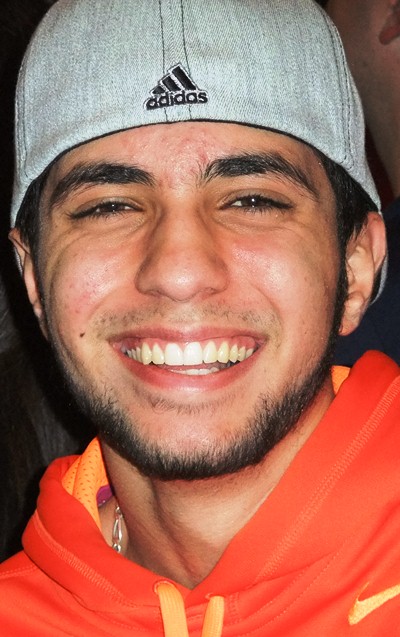
Mohammed Qabani, of Israel, is a junior at Thunder Mountain High School.

Maier says she can’t think of a better use of her tax dollars.  The YES program was founded ten years ago after the terrorist attacks on America. It is funded by grants from the U.S. State Department to provide scholarships for students from countries with large Muslim populations.

This year high school juniors Mohammad Qabani and Ayah Tafesh are studying at Thunder Mountain High School. Hadi Kamj, from Lebanon, is spending the school year at Juneau-Douglas High School, and just enrolled in classes at the University of Alaska Southeast.  They live with Juneau families.  All three are of the Muslim faith.

Other than the cold, Qabani, from Israel, says he likes Juneau and has met lots of people who are respectful to his culture. At first he experienced some bullying at school, including one youth who told him “Arabs are terrorism.”

“But when he like sat with me and we had a conversation, he changed his opinion,” Qabani says.
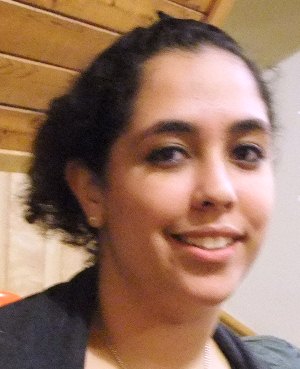
Ayah Tafesh, of Gaza, is a junior at TMHS.

Tafesh is from Gaza. She also has worked one on one with some students. She likens her experience in the U.S. to a mission.

“I like that I’m here to represent my country and people are respectful to me,” she says. “I think that I have a job to give a better point of view about my country, because I think most of the people either don’t know about it or they have a bad point of view about my country.  So I want to present my country and make them change their point of view, maybe.”

As they meet people throughout Juneau, the Muslim students believe they have helped change some minds about their culture. And it’s one way Juneau People for Peace and Justice believe the group has made a difference since the first gathering a decade ago.

[quote]“Never doubt that a small group of thoughtful committed citizens can change the world; indeed it’s the only thing that ever has.”   (Margaret Mead)[/quote]
 

Taking a look at some of the big stories this year in Juneau

In Juneau, 2012 was marked by changes in leadership at City Hall, a lengthy double murder trial, and the tragic deaths of several young people.

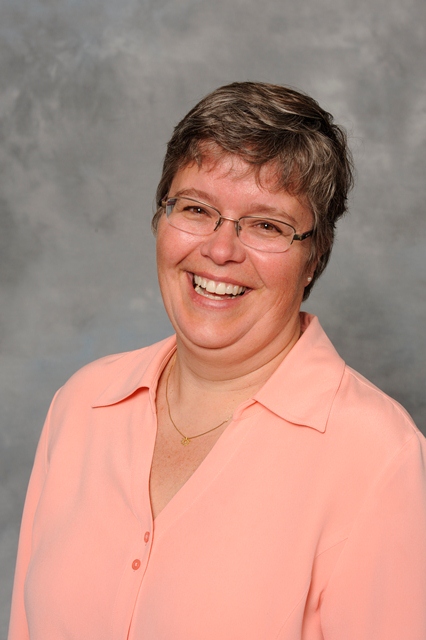
City and Borough Manager Kim Kiefer.

Kim Kiefer replaced a retiring Rod Swope as city manager in April. Kiefer grew up in Juneau and worked her way through the ranks of the city, serving as deputy manager for six years before being promoted.

“I’ve been very humbled by the outpouring of support I’ve gotten from the community, whether it’s been in the grocery store, walking on the street, people stopping and saying, ‘Hey, we think you’re the best.’”

The Capital City also got its first new mayor in nine years. Former Assembly member Merrill Sanford was elected to the top post in October, after running on a pro-business platform.

“We want people to come here and we want people to open stores here, no matter what the store is, and we want jobs here.”

Voters also elected two new assembly members: Loren Jones and Jerry Nankervis.

Outgoing Mayor Bruce Botelho came up with an unusual way to fund more than $60 million in capital projects through a temporary sales tax extension and municipal bond package. Despite opposition from some in the business community, the measures were approved by voters.

Botelho had a busy last year in office, leading a failed effort to re-start the state’s coastal management program. Several prominent Juneau officials joined the cause, including Representative Beth Kerttula, a former coastal management attorney.

The city’s Bartlett Regional Hospital cut all ties with its longtime management company, Quorum Health Resources. The hospital’s board of directors hired Chris Harff as CEO. She moved to Juneau in August from Minnesota.

“It’s been awhile without a permanent CEO so part of it’s a learning process. What am I like? And I’m trying to learn that about the board members and the physicians, so we can have optimal communication.”

John Marvin

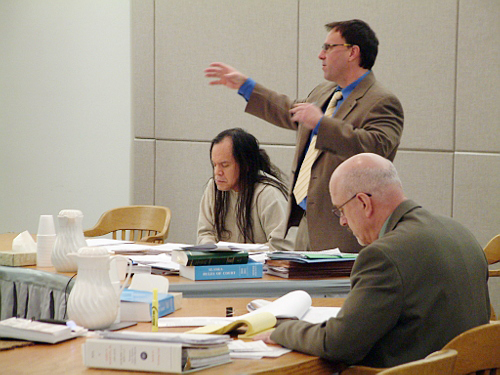
For two weeks in October, the news in Juneau was dominated by the trial of John Marvin, Jr. The Hoonah man was convicted of ambushing police officers Anthony Wallace and Matt Tokuoka in the Chichagof Island community in August 2010.

Marvin’s attorney is challenging whether Officer Wallace was actually performing official duties at the time he was killed.

A sunny weekend in June turned tragic, when 16-year-old Savannah Cayce died after a jet ski accident on Auke Lake. Cayce’s death sparked a review of motorized use on the lake that will continue in 2013. Her step father, Glenn Haight, addressed the Juneau Assembly on the topic earlier this month.

“Auke Lake is a wonderful place to be on a warm day. It also invites careless behavior, simply because fun, fast water craft are allowed open access in a relatively small area, with very few restrictions and no enforcement.”

Flowers float on Auke Lake following the Monday memorial.
Flowers float on Auke Lake following the  memorial for Savannah Cayce. (Photo by Jim Mahan)

Cayce was not the only young person from Juneau to die under tragic circumstances. In late November, brothers Casey and Kelly Newman drowned when their boat capsized near Tenakee Springs. Less than two weeks later, the Newmans’ hunting partner, Jimmy Brown, Jr. — who survived the boating accident — died at a North Douglas house. Police said alcohol was a contributing factor. Brown’s body was sent to the medical examiner’s office in Anchorage for an autopsy.

Former Juneau Assembly member and Alaska Department of Labor Deputy Commissioner David Stone also died unexpectedly in November at the age of 55, about a month after his final assembly meeting.

On November 5th, an entire city block on Franklin Street was threatened by the Gastineau Apartments fire. Will Muldoon was one of approximately 50 residents displaced by the blaze. He awoke from an afternoon nap to a police officer pounding on his door.

“Just had enough time to grab my shoes and my dog and that was about it.”

Firefighters battle the blaze. (Photo by Heather Bryant/KTOO)

An investigation determined the fire was caused by an unattended candle. The building was deemed a total loss.

Mayor Sanford acknowledged the recent tragedies to strike the Capital City at an Assembly meeting last month

“Hopefully we’re done with a few of the catastrophes that we’ve had in our community.”


Photos from the news in 2012

2012 saw a variety of stories and events in Juneau. Here are some of the photos from this year covering major events, breaking news and stories from Juneau and around Alaska.

Alaskans can Pick. Click. Give. to 471 organizations in 2013.

Pick. Click. Give

It’s almost time for Alaskans to file for their permanent fund dividends. And that means they also have the option to give a portion of their PFD to charitable and non-profit organizations through the state’s charitable giving program, Pick. Click. Give. In 2013 there are more organizations than ever to give to.

After four years, Alaska’s charitable giving program, Pick. Click. Give. is still growing. Heather Beaty is the program manager. She says this year they’ve added 56 new organizations.

A graph of Pick. Click. Give. donations. Graph from pickclickgive.org.

The program was created by the Alaska State Legislature in 2008 and allows Alaskans filing for their PFD on-line to donate all or part of it to the campuses of the University of Alaska, community foundations, and eligible charitable and educational organizations. After a three-year pilot project, Pick.Click.Give. became a permanent part of the PFD program. The 50 plus new organizations added for 2013 run the gamut, Beaty says. And, they’ve reorganized the web site, breaking down all the organizations into seven cause types.

“The categories have been broken into Youth & Education, Emergency, Humanitarian, Animals, Arts & Culture, Health and Community. And then within each of those cause types there’s subcategories that get more specific. So, for example, under the Humanitarian category you can break it down and just look at organizations that are providing food assistance or services to the elderly,” Beaty said.

Beaty says the search options on the Pick.Click.Give. website also allows you to search for organizations in a specific geographic location. 100 percent of Alaskan’s Pick.Click.Give. donations goes to the charity of their choice. Last year, more than 23,000 Alaskans pledged more than $2.2 million. Currently about 4 percent of the people who receive a PFD choose to give. The permanent fund dividend filing period opens Jan. 1 and runs through March 31.

Four Juneau youth win Hilary Lindh scholarship

Olympic skier Hilary Lindh and scholarship winners Dalton Hoy, Claire Engstrom, and Iosefa Allen. Not pictured: Daniella Fincher. Photo courtesy Eaglecrest Snow Sports School.

Four Juneau youth are the winners of this years’ Hilary Lindh Scholarships at Eaglecrest. The program gives the students a pass to the city-owned ski area for the 2012-2013 season.

The Eaglecrest Board of Directors awards the passes every year to a boy and girl in kindergarten through 5th grade, and a boy and girl in 6th through 12th grade. Their applications are judged on academic achievement, competitive spirit and financial need.

This year the passes go to Claire Engstrom, a Gastineau Elementary School 4th grader; Iosefa Allen, 1st grader at Riverbend Elementary School; Dalton Hoy, in 6th grade at D’zantik’I Heeni Middle School, and Daniella Fincher, a senior at Yaakoosge Daakahidi High School.

Claire Engstrom says she likes to jump over hills and go through the trees at Eaglecrest. She is in Gastineau school’s marathon club and has finished in the top three in several races.

Iosefa Allen says he plans to use his pass to learn to snowboard. He’s a swimmer, in the Riverbend marathon club, and has jumped with the Riverbend Ropers. He says he loves everything outdoors.

Daniella Fincher maintains a 4.0 GPA at Yakoos and plans a career in nursing after college. She says she will snowboard at Eaglecrest this season.

In addition to skiing this season, Dalton Hoy plays hockey. He’s also a musician, playing the trumpet in the DZ band and the cello in the Student Symphony.

The Hilary Lindh scholarship program was established in 1992 in recognition of Lindh’s silver medal in the 1992 Albertville Winter Olympics as well her dedication to ski racing. Lindh learned to ski at Eaglecrest and went on to become a professional racer with the U.S. Ski Team. During her 11-year career, she was the first American to win the downhill title in the World Junior Championships, then won three World Cup championships, and had 27 top-ten finishes. Lindh was inducted into the Alaska Sports Hall of Fame in 2009.

Parnell proposes Alaska Grown school lunch funding

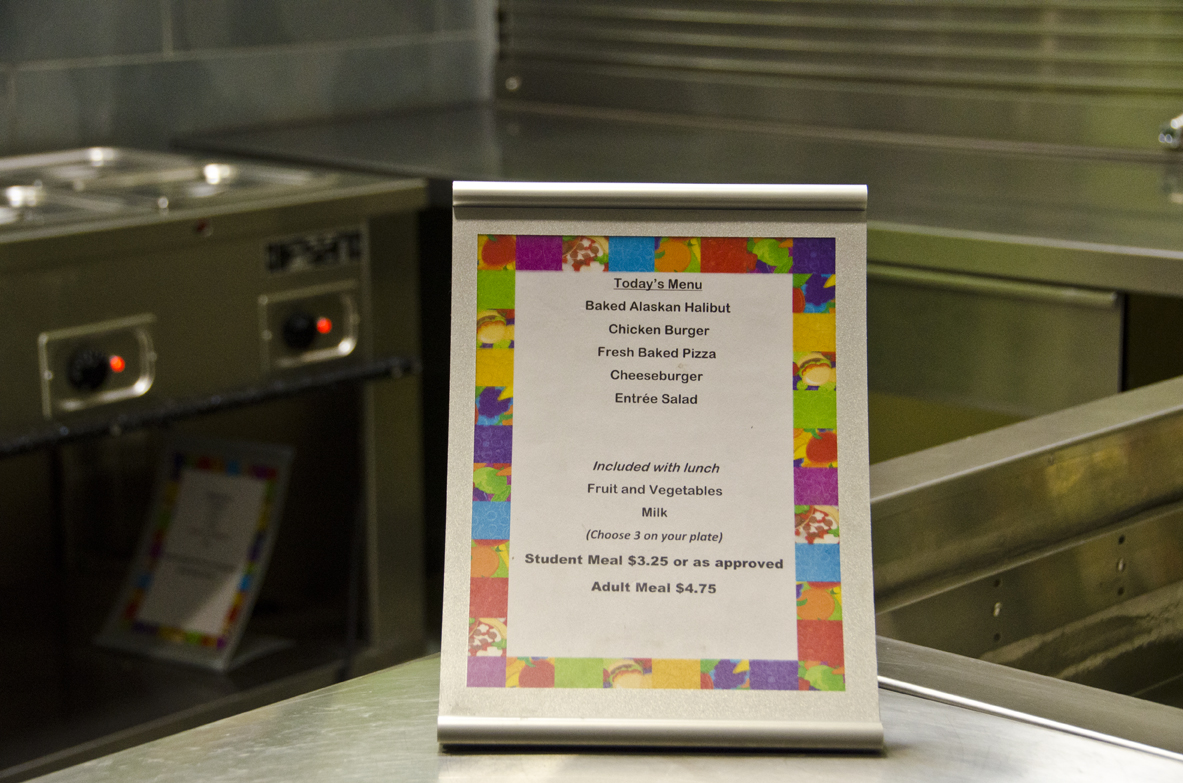
Alaska halibut and salmon were on the menu in Juneau schools this fall, thanks to current year Alaska Grown funding. Photo by Heather Bryant.

Gov. Sean Parnell’s proposed fiscal year 2014 operating budget would continue funding to put Alaska Grown foods on school lunch menus.

The $3 million “Nutritional Alaskan Foods in Schools” program is available to all 54 school districts this year. The grant reimburses participating districts that buy Alaska fish, produce and even honey.

Scott Ruby directs the program in the state Department of Commerce, Community and Economic Development. He says it helps Alaska become more self-sufficient.

“It’s called food security where we can provide our own and not be reliant on shipping in food from outside,” Ruby said. “It’s a good deal.”

Ruby says the Department of Natural Resources’ Farm to Schools program helps connect schools with suppliers.

 “I think that’s been one of the larger benefits of this is that there were products available out there at reasonable costs that the school districts didn’t know were available,” he says.

Juneau School District Food Services Supervisor Adrianne Schwartz says the cost of a meal is the same for students whether they choose local halibut or pizza.

“The issue is that to maintain a meal price that’s affordable for everybody,” Schwartz says. “The majority of the local produce and fish would be too expensive without this funding.”

The Juneau School District received $86,000 for the current year and has served salmon and halibut from Southeast waters as well as fresh produce from the Matanuska-Susitna region.

The governor’s proposal to fund the program next year would allow Juneau and other districts to expand the menu and serve more local foods on a regular basis.


Site notifications
Update notification options
Subscribe to notifications