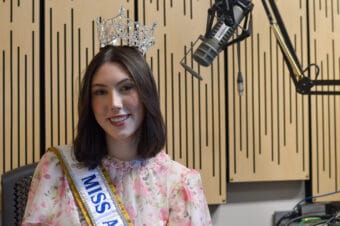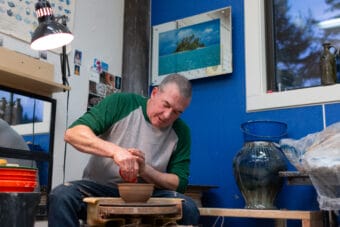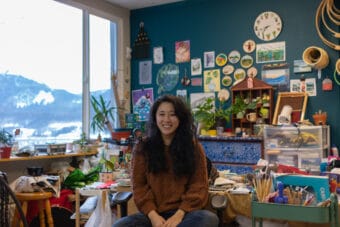
Tongass Voices

Tongass Voices: Shiggoap Alfie Price on the challenges and rewards of learning endangered languages

Shiggoap Alfie Price is a student of three Southeast Alaska Native languages and leads Sm’algyax classes online. (Photo by Yvonne Krumrey/KTOO)

This is Tongass Voices, a series from KTOO sharing weekly perspectives from the homelands of the Áak’w Kwáan and beyond.

Shiggoap Alfie Price is Tsimshian, Lingít and Haida, and he was raised in a Tsimshian household. Today, he’s a language learner and teacher who believes in using the power of community to strengthen the language revitalization movement. 

Price has studied all three Southeast Alaska Native languages, starting with Sm’algyax – the Tsimshian language. 

Listen:

This transcript has been lightly edited for clarity.

Listen to: Shiggoap’s Sm’algyax introduction

Shiggoap Alfie Price: There’s a fellow that you probably know, Lyle James who speaks Lingít, X̱aat Kíl, Sm’algyax , among others. And before I started actively learning, he would greet me at the store or what have you, and in Sm’algyax , and I certainly knew what he was saying, but I could not answer him. And I was a little bit embarrassed that this Lingít man was using my language and I couldn’t converse with him. 

Shiggoap dee waayu. My name is Shiggoap which means wave-maker. 

I started learning Sm’algyax because it’s the one I grew up hearing. And I know people, I know family and friends who want to learn. So that’s why I started. 

Also, I had some prompts from my mom, who, in her last few years, she started learning our language and teaching it to children. She was a guidance counselor at elementary school in Metlakatla. And so I felt encouraged. And, you know, I wish I had started earlier when she was still around so I could talk to her on the phone, or what have you or FaceTime.

I was asked to be a moderator or what have you at Celebration to introduce the groups, and I decided that I wanted to be able to introduce myself in all three languages. And so I set out to do that. 

And they’re very different. You would think, here in Southeast Alaska, where we’re so geographically close, that our languages would be similar, but they’re really not. All three are very, very different. Sentence structure is way different. And most of the sounds are different. 

So there’s a couple of years where I was attending classes in all three languages and tried really hard to be able to at least have the basics down where I could greet somebody in these languages, introduce myself, talk about the weather. 

It’s pretty fun, too, when you find crossover. It’s like, in X̱aat Kíl, when we greet each other, we have a word that means like, “hey” or “hi.” We say “Ja!” So whenever I see my fellow X̱aat Kíl speakers, we say “Ja! Hello my friend!”

And then I was in a headstart classroom fixing computers one day, and they had posters on the wall of Lingít words, and one of them was a lady holding your finger up to her mouth, like saying “shhh.” And it said, “Ja!”, and I just, like cracked up because, you know, maybe Lingít speakers would see us X̱aat Kíl telling each other politely to shut up when we see each other. 

I think one of my very favorite phrases in X̱aat Kíl is — it’s parting greeting, “Díi gwíi hl sdíihl.” And it means return to me. And that’s just a really sweet, sweet way to part with a friend. 

Our Sm’algyax group, we met in person every Saturday. And then when the pandemic hit us, we had to stop meeting in person and switch to zoom. So we invited our social media contacts and followers to join us. And suddenly, we had this huge group of people who wanted to learn.

I’m not a trained teacher or linguist. I never thought I’d ever have to learn the difference between transitive and intransitive verbs, but here we are. 

So we all know that our three languages are kind of in trouble. They might be considered endangered. So we definitely need more people to not just study them, but to use them every day at home, at the grocery store or what have you. 

I think the most powerful reason to keep at it for me and a lot of my friends is how healing it is for us as individuals in our spirits to reconnect with these languages because we learn a lot from them. You get an understanding, an insight into the worldview of our ancestors — of the way they view the world, the way they deal with each other. 

And there are a lot of lessons in our languages, that once you start internalizing them, and being able to use them, they can definitely guide your thinking, your priorities. 

And they really restore, they’ve restored my sense of worth, of value. I know who I am today, where before I learned Sm’algyax, I really didn’t. 

Tongass Voices: Father-daughter production duo Joshua and Harmony Laboca bond through music

Joshua and Harmony Laboca pose in their home studio in February 2024. (Tasha Elizarde/KTOO)

This is Tongass Voices, a series from KTOO sharing weekly perspectives from the homelands of the Áak’w Kwáan and beyond. 

Joshua Laboca, known around Juneau as Jbo, is the music producer and content creator behind dozens of artists in Southeast Alaska. He and his nine-year-old daughter, Harmony, also produce music together. 

You can hear their song “Growing” and others on their YouTube page, Harmony & jboaudioe.

Listen:

This transcript has been lightly edited for clarity.

Joshua Laboca: Full name is Joshua Laboca. I go by JBo Audioe, J-B-O A-U-D-I-O-E. That’s what a lot of people know me as in town. And we are here at our home studio, where a lot of artists and bands come in to record and perform in the booth over here. So, I went to school at the Academy of Art University in San Francisco. 

So we had some family issues back here in Alaska. So I decided to continue going to school here, online. And then I ended up opening up a studio, but I never wanted to do music for artists. And then, so I had to tell myself, “I want to keep doing this. So how do I? How do I merge what I know about sound design, editing, Foley and effects? How do I apply it to music, like for artists?” So as I was mixing artists, like beats and stuff, and their vocals, I would apply it. And then I eventually grew a passion for mixing and producing for artists in town. 

My daughter and I, we do have a YouTube. It’s Harmony & jboaudioe, where we make instrumentals. I’ll have the beat down and I’ll do the mixing, and Harmony will do the guitar and pianos.

Harmony Laboca: Alright, Dad! Play my pre-roll please.

Joshua Laboca: She got inspired by the movie Sing. And there’s this character named Ash that plays the guitar voiced by Scarlett Johansson. And then the only way that I knew for us to continue to work on her playing guitar was that we had to make instrumentals. So every week she would play chords, she would lay chords down on instrumentals that I had. And every week it was just improving on that and that’s how she, she’s four years in now, she plays it pretty good now. 

Harmony Laboca: Um, usually we do a guitar first, and then if we’re making a song, we do guitar, vocals and then piano. 

Joshua Laboca: And she knows like, the basic controls of when to record, when to stop, going at certain bars and stuff, so. 

We usually film this whole process. So even during the mess-ups we still put it in the edit. So because it’s just, you’re never gonna get anything perfect.

But aside from that, once we get it mixed and edited, I’ll put some visuals to it. And then we put it on YouTube. And we just, yeah, that’s our process.

Harmony Laboca: It’s actually really fun. ‘Cuz we do it, he usually like, told me what’s wrong or like, what to improve on. And then he was like, and then sometimes we do games that we made up and like, practice together and sing stuff together, make videos together.

Joshua Laboca: We have a back and forth too, like it’s not always like Brady Bunch or anything. It’s like, ‘No, we should do this. No! No, yeah, no, I know, I know.’ You know, we have this like back-and-forth banter that we always do. But that’s kind of like the relationship that we have. And it makes it so that, you know, if I’m not doing something right, she calls me out, she’s not doing something right, you know, I call her out. 

Joshua and Harmony Laboca: The saying that we go, when right before we end our session is, “It’s never a good day without a challenge. So, fail fast. Fail forward. Fail a lot.”

Joshua Laboca: We say the word failure more than we say success. Because we’ve grown in the knowledge of music. And we’ve grown in making music from all of that.


Tongass Voices: Nimmy Philips and Enrique Cabrera on what makes a restaurant special

Owner Nimmy Philips and chef Ruth Fisher in Spice Restaurant and Cafe. Photo by Tasha Elizarde/KTOO. Feb. 21, 2024.

This is Tongass Voices, a series from KTOO sharing weekly perspectives from the homelands of the Áak’w Kwáan and beyond. 

Nimmy Philips came to Juneau as an engineer, but three years ago, she decided to buy a restaurant. Now, she applies her engineer’s precision to her recipes. One part of that attention to detail: all the spices are ordered whole and then roasted, mixed, and ground by hand. 

Enrique Cabrera is her head chef. He shared how he grinds the spices that go in just about every dish. 

Listen:

This transcript has been lightly edited for clarity.

Nimmy Philips: I’m Nimmy, I own the Spice restaurant and Spice Cafe and art gallery. 

So opening up a restaurant or owning a restaurant has been my dream since I was in, I would say tenth grade or even in high school, mainly because a lot of people don’t understand how food connects each other. It doesn’t matter what culture you’re from, what religion, what color your skin is, it doesn’t matter. Food connects people. That’s the same language that we all speak when we eat the good food. And that’s something I wanted to do. 

And I am one of those restaurant owners that, I’m not going to cut costs or take shortcuts to make a dish happen. I have to follow my grandmother’s recipes. My food feelings come from my grandmother. Going back to my grandmother’s house and spending time with her in the summertime, and she only spoke one language. And all her grandkids are well educated and have traveled all over the world. They all come in the summer to visit her and stay with her. The only language she spoke was food. And she showed care and love — support — through her food. And that’s what I want to do for Juneau.

And most of our family recipes call for like secret ingredients that we cannot get in Juneau, Alaska or anywhere down south. So when I go to India, I have to bring it with me.

And if I’m going to make something that is from my family recipe, I’m not going to put on something just to say that I did it. I have to be proud of it. I have to have my 150% effort into it. 

And again, this is not just me doing it either. I have an amazing team. If I don’t have an amazing team to back me up, who believes in me, who supports me — otherwise I’m nothing. There’s no me without my group of people, without my Spice team. And my spices.

Spices come from the northern part of India. It comes through Seattle. We have a partnership with a store in Seattle that, whenever they do the Indian shipping from India, we put in our orders, too, and we get the spices through them. And they put it on the barge and we get it here. And we get them all whole spices. We grind our own spices.

Head chef Enrique Cabrera pours the garam masala mix into the spice grinder at Spice Restaurant and Cafe. Photo by Tasha Elizarde/KTOO. Feb. 21, 2024.

Garam masala is the mix of masala. Masala just means a mix of spices together — that’s all it is. Garam means warm, it gives the life, the warmth to the dish. 

Enrique Cabrera: I really enjoyed making the garam masala because you get to see all the spices and you put them together, and you roast them. And when you roast them, the smell of the cloves — that’s one of my favorites. 

My name is Enrique ,and everybody calls me Kiké here at Spice. And I’m the head chef in charge in the kitchen and enjoy the work that I do here.

Okay, so let me get my container thing and I’m gonna start getting the recipe together. Coriander seeds, bay leaves, so we’ve got cloves, black pepper, cinnamon. Green cardamom, black cardamom.

One more, we’re gonna one more — Jeera — which is in the kitchen. I’m gonna go get it. Jeera, which is cumin seeds. I’m gonna roast the coriander seeds and the bay leaves and the cloves, and we have star anise to get roasted all over. 

Okay, let’s see what’s next. I’m gonna put them all in there and and then I’m gonna mix it, and then I will grind them.

Now you’re gonna smell all the spice together in one smell. This is the easy part, grinding it. 

Nimmy Philips: As you can see, we store them either in the container that comes in or sealed containers. We believe every spice has a soul. And that’s something Kerala Indian families believe, we believe that every spice has a soul. You leave the window open and the soul will fly out. I always tell Kiké, you know, “Cover it! The soul is running away! Cover it!” 

Enrique Cabrera: At the beginning!

Nimmy Philips: At the beginning. Now Kiké tells me “Cover it!”

Tongass Voices: Jocelyn Clark dedicates her life to studying Korean folk music

Jocelyn Clark was born in Juneau, but now lives in Korea, and plays the gayageum, a Korean folk instrument. (Photo by Yvonne Krumrey/KTOO)

This is Tongass Voices, a series from KTOO sharing weekly perspectives from the homelands of the Áak’w Kwáan and beyond. 

Jocelyn Clark was raised in Juneau, but moved to Asia after high school where she began to study folk music. Now, she’s dedicated her life to playing the gayageum, a string instrument that can be traced back 1,500 years. 

She came back to Juneau for the holidays, and sat down with KTOO to talk about her musical pursuits.  

Listen:

This transcript has been lightly edited for clarity.

Hi, my name is Jocelyn Clark. I grew up in Juneau and graduated from Juneau-Douglas High School in 1987. And became an exchange student pretty immediately after that. I lived in Japan, then in China, then later in Korea. And I started studying instruments of those countries. Here I’d played with the symphony and other music organizations. I’m currently living in South Korea where I studied an instrument called the gayageum. It’s a 12-string, silk-string zither with movable bridges.  

I wanted to work really hard, and you know, show that I was a serious student and all that. And I finally got my first gayageum, when I got a teacher and I was going to work hard. And after playing for about no more than 10 minutes, my fingers were already bleeding. It turned out that you couldn’t practice very hard, even if you wanted to. You know, if you don’t practice, you lose your calluses and then your fingers bleed, so it takes time to build up the calluses and the muscles that you need to play.

You stop each string ringing as you’re playing the next string. So you only hear one note at a time, or one string at a time. And you stop the others vibrating. And that leaves you with just one voice. It’s so it’s almost like singing. It’s almost like singing. There’s no harmony. Just one voice at a time. And very, very rhythmic. 

The piece I’m working on — and I have been working on for 30 years — is over an hour long. In the beginning I thought of it as a Westerner, as a piece. You know, I learned the notes so   I’m done. But you know, it’s not about the notes. It’s about all the subtleties and all the different tone colors and all those sort of nuances within each of those notes each. Each note in a way is its own world that you have to explore. 

Jocelyn Clark is from Juneau, but now lives in Korea, and plays the gayageum, a Korean folk instrument.

I’m a professor at Pai Chai University in Daejeon, South Korea at the moment. I am and have been very interested in the sort of — ethnomusicology is a sort of anthropology plus sound plus music. 

For me, living in Korea is very interesting. You know, to think about music, but also to think about Korea’s colonial past, and its pre colonial past, in terms of Japanese occupation really occurs at the same time as Alaska’s colonial past starts. You know the arrival of missionaries in Korea happens at the same time that arrival of missionaries in Alaska occurs. Missionaries  became connected to the arrival of Western ways just as it was here. And the consequences for Korean music are, in a way similar to consequences for music and dance here.

So it took me some time to understand how narrow my views were having grown up here. 

And to learn how other cultures and instruments and sound systems work with the background in my own ear of, you know, a tempered classical scale, and reading music off a sheet, or something like that. What I’m learning now is an oral tradition that’s orally transmitted through memorization. And uses different notes, different — we don’t even think of them as scales — but different modes than Western music. And it’s been really quite a journey in terms of listening and trying to understand different aesthetics, different tambours, different rhythms, different — everything’s different. Everything’s different.

Tongass Voices: Axel Brouillette-Gillam on the nostalgia that drives Cosmik Debriz

Axel Brouillette-Gillam sits at his embroidery desk in his shop, Cosmik Debriz, on Feb. 14, 2024. He is learning how to use a 1920s model of a chain stitch machine to create clothing inspired by Juneau history. (Photo by Tasha Elizarde/KTOO)

This is Tongass Voices, a series from KTOO sharing weekly perspectives from the homelands of the Áak’w Kwáan and beyond. 

Axel Brouillette-Gillam is a co-owner of Cosmik Debriz, a vintage Alaskana shop that began from his interests in thrifting and fashion, with his wife Khrystl. Brouilette-Gillam grew up in Homer before moving to Juneau in 2015, and it’s life in Alaska that inspires what he sells. 

Listen:

This transcript has been lightly edited for clarity.

My name is Axel Brouillette-Gillam, and I am the owner of Cosmik Debriz. 

We initially started the shop as kind of a pop-up situation. So, markets at the JAHC, the Mendenhall Mall had some Saturday markets — we would go to those and have a pop-up and kind of have our things. And then we kind of spontaneously found the space that we are now.

So yeah, to find us, we’re basically at the corner of North Franklin and Second Street, where High Tide Tattoo is. And then if you go up North Franklin Street a little bit, we’re the first door on that same blue building, and you’ll go up some nice stairs, and then we’re the first door that you see.

And when you come in, it’s basically three rooms that are connected to each other. And so we come to the room that has all of the clothes, we have racks that are just vintage clothing that has fun colors, fun patterns, fun styles. You know, I like these — we have some of these pieces that are from the early ‘90s when there’s this kind of Western thing going on. I enjoy those a lot. I think those are fun. 

And then we keep coming into the space, my favorite part of the store, which is the vintage Alaska clothing. So we have , this is the jacket from an Eagle Quality Centers from when I was a little kid in Homer. It’s now a Safeway, but when I was a kid, it was an Eagle Quality Center. An old Super Bear jacket with the old Super Bear logo on it, you know. So yeah, jackets like that. Super fun. And then we have vintage Alaska sweatshirts, and then t-shirts as well. 

So now we’re kind of in the, I call it the cashier room. It’s where the front counter is. We have our TV with our cassette deck.  

And then yeah, we have these flags here. I got these online from a guy in Ohio. And what’s significant about them is they have the 49 stars from when Alaska joined the United States, and 1959 was the only year that there was a flag that had 49 stars because December of 1959, Hawaii became a state [Editor’s note: Hawaii became a state in August of 1959]. 

And then another thing that we also have that’s vintage Alaska-related is things like postcards, press photos — so yeah, things like that. We have a Patsy Ann postcard from the 1930s.

And when I’m picking out items, when I’m looking at items, I’m often thinking of, there’s probably people out there that would connect to this thing. But like, one good example is, I had a 1990s Anchorage Aces — so, there used to be the Alaska Aces, it’s the hockey team that we used to have up here, and before they were called the Alaska Aces, they were called the Anchorage Aces. And so it was a jersey from the 1990s that had Anchorage Aces on it. And then so, I had a cowbell as well that had, you know, the season ‘97, ‘96 on it. But I had that up and for sale and I had a guy come in, and his dad played on the Anchorage Aces. And so he was just so incredibly excited to see it. He was so excited to get it for his dad, and to have it. 

And then moving into the last room. Currently, it is our halibut coat room. And then the exciting development is, the new exciting development is a chain stitch machine. And so what this is for doing is like custom embroidery, and it’s hand-operated, so there’s a crank underneath that I use to control the direction that the needle is going in. 

And you know, right now we’re running it, you know, this is kind of a slow mode, you know, not going too crazy fast right now. I need to work on my Ts, but it almost says KTOO. 

Going into the future, going to be doing basically vintage jackets, vintage clothing, and then doing direct to garment embroidery on those things related to Juneau’s history.

Yeah, just, I don’t know, these things, they make me really excited. I think they’re really cool. And it’s awesome to get to share them with others.

Tongass Voices: T McInnis on how they make Tyquan’s memorable drag outfits

T McInnis — the person behind drag king Tyquan — with their shelf in the Juneau Drag closet on Feb. 10, 2024. (Tasha Elizarde/KTOO)

This is Tongass Voices, a series from KTOO sharing weekly perspectives from the homelands of the Áak’w Kwáan and beyond. 

One of Juneau’s favorite drag kings, Tyquan, is known for Prince tributes, sci-fi-themed acts, and big platform boots.

T McInnis — the person behind Tyquan — gave KTOO a tour of the Juneau Drag closet for this week’s Tongass Voices and told their drag origin story. 

Listen:

This transcript has been lightly edited for clarity.

I’m T McInnis, and my drag name is Tyquan. So, I decided to do drag for Halloween one year. And I dressed up as the Weeknd. And that was like, seven years ago, and it just stuck. I had been already making costumes before that, so I was like I think I can do this. 

It was like the year Gigi Monroe held a GLITZ and brought in Landon Cider who’s like the drag king of all drag kings. And from that moment, when I saw Pitbull come out on that stage, I was like — I didn’t know that kings were performing drag at that level until I was exposed to that. And that’s what kind of inspired me to start performing in drag. 

Most places, just book queens. We don’t really have so much of that problem here because a majority of the performers here are actually kings. And Gigi Monroe, who runs the Juneau drag family, always keeps space for kings and celebrates kings. So we’re a little bit different in our drag community than other places. But yeah, I’m pretty sure I’m the only black drag king in Alaska. 

So most of my drag, I make all my stuff. These were like a mannequin. And I had to cut them out. And then we painted them and added the silver paint and the rhinestones. It was actually designed after Dr. Funkenstein, who was a character from the P-Funk era. So that was designed after that. So I wanted to have the visual of emerging from a spacecraft and like bringing the funk to Earth. 

 I’ve been sewing since I was eight. I was homeschooled. So my mom taught me how to sew. And my friends would ask me to make clothes and stuff like that. And then after a while, I started doing it professionally.

When people see me sew I’m like “See, you just do this, and then just reverse and go around the corner. Like, you try.” And they’re like, “Ah!”

I think for GLITZ week, we were chomping at the last minute. And there was an idea that came up with costumes, and it was maybe the night before the show. So it was like, “Hey, can you go pick the fabric up at Jo-Ann’s and like whip those up for us?” And like, “Yeah, sure.” So I came up with a pattern, cut everything out and then realized, like I cut it out wrong. Then I had a little moment to cry. And then I sewed the piece back on and put it together, and no one ever knew.

After I performed a number, I hear my name being called back out to the stage. So they bring myself and my husband out on the stage to introduce him to Juneau and to the drag family, in the middle of a show, a drag show at the Red Dog Saloon. I was dressed as Prince — made it even more hilarious. That was a surprise. I was backstage like ripping my stuff off. Like, “I’m done with this wig.” They’re like, “Come back out.” So that was really welcoming — and really nice — from the drag family. 

Correction: An earlier version of this story misspelled Tyquan’s name.

Site notifications
Update notification options
Subscribe to notifications