Tongass Voices

Tongass Voices: Juneau Bike Doctor’s Ken Hill wants to get everybody on a bike

Juneau Bike Doctor owner Ken Hill with a bike that will be donated to a student in need of a bike at Dzantik’i Heeni Middle School. Artist Chloey Cavanaugh and school librarian Luke Fortier painted herrings on the sides in support of the Herring Protectors movement. June 21, 2024. (Photo by Yvonne Krumrey/KTOO)

This is Tongass Voices, a series from KTOO sharing weekly perspectives from the homelands of the Áak’w Kwáan and beyond.

Ken Hill opened Juneau Bike Doctor in 2018, but he’s been part of Juneau’s cycling scene for much longer. Hill wants to get as many people on bikes as possible and values giving back to the community. That includes supporting his favorite local performers from Juneau Drag as much as he can.

Listen:


This transcript has been lightly edited for clarity.

Ken Hill: I’ve been involved in bike stuff, starting back in the late 80s when I moved to town and was just part of the bike community. Started out sweeping floors and changing tires.

Biking here, in general, it’s almost like the community is perfectly made for someone to be a cyclist or to use a bike for transportation. You know, from one point to the next is typically not very far. 

One thing that we’ve been fortunate to have the opportunity to do is we do trade-ins with bikes where somebody has an old bike that they’re not going to do anything with. We may not necessarily put the bike back on the floor. We’ve taken a number of those types of bikes that, during the fall, we have time to kind of refurbish and get them up and running, and we’ve used those to get people on bikes that maybe don’t have the wherewithal to find a bike. 

We had a teacher from [Dzantik’i Heeni Middle School] who wanted to do something to help kids get back engaged with education. She’s a bike person, and we’re certainly bike people, and so we thought that we would do a special bike for them.

And then I thought, it’s cool to have one bike, but there’s a lot of need. There’s a lot of kids in schools that need a bike. So we kind of reached out to our audience and got a bunch of bikes that people donated to us.

And we were able to do — I think it was 17 bikes, is what we got, built up and donated through that program.

One girl received a bike, but, turns out she already had a bike. But she wanted to ride her bike with her mom, and mom didn’t have a bike, so that bike was, you know, transferred over to her mom. And so now we’ve got a family riding bikes together. 

Then we had another young man who had a bike, but his best friend didn’t have a bike. And so now he’s got a riding buddy. 

We work with groups like that — we work with the Juneau Drag crew, and do a lot with that group. NAMI does a Pride Outside event that we’ve been doing for, gosh, since the beginning.

This is where I get emotional. That group when — so when my wife and I started dating, it was totally not something that I was involved in at all. I mean, I had queer friends, I had friends that were performers, but I just didn’t feel like it was a place where I was welcome. And not that any of them wouldn’t be welcoming to me. It was just my own perception. 

And I went to a show with a couple friends, and had just the time of my life. And I told my wife, I’m like, “Now, what do I do? I don’t want to just sit in the crowd,” because I’m not going to, you know — not everybody has a group that wants to go to every show, but I wanted to be in every show. 

So I worked the door there for five or six years, every show. And then when we did the big Glitz programs, I gave myself a title: the head of VIP transportation and security. So when we have out of town guests come. And I just met the most amazing people. 

They’ve been super welcoming to me, and there is kind of a non-traditional family, in a sense, with that group. And so I love them to death.

Tongass Voices: The Evening Star on creating spaces for queer Indigenous people

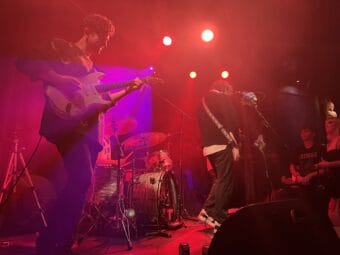
The Evening Star performs at the Crystal Saloon in Juneau on June 11, 2024. (Ḵaachgóon Rochelle Smallwood/Raven’s Tail Studio)

This is Tongass Voices, a series from KTOO sharing weekly perspectives from the homelands of the Áak’w Kwáan and beyond.

The Evening Star is a Pawnee and adopted Athabascan performer who’s known for storytelling, comedy, making music, and DJing. She came to Juneau during Celebration on her Indigequeer  tour. 

She says she wants her shows to be a space for people who often don’t feel like they can be themselves elsewhere. 

A warning: this story contains mentions of violence against transgender people.

Listen:

This transcript has been lightly edited for clarity.

The Evening Star:

Hi everybody. My name is the Evening Star. If you’re at home, you can say, “Hello, Evening Star.” I hope that you did it. Also known as Howie Echo-Hawk.  I’m on the Indigequeer Tour. It’s this thing that I’m doing where I’m going all over the place and just having as good a time as I possibly can with all the people that I like.

Being Native means that at one point, my identity wasn’t put in a little box and separated and kept in a neat little container over here. Before I knew I was Native, I just was. And before I knew I was queer, I just was. And before oppression, that’s what we were.

Nex Benedict was a young trans Choctaw person in Oklahoma who died because of bullying and not being able to be trans. You know, well, being trans and having the world say that that was not okay.

The Evening Star performs at the Crystal Saloon in Juneau on June 11, 2024. (Ḵaachgóon Rochelle Smallwood/Raven’s Tail Studio)

I am from the interior of Alaska. It was a really — and continues to be — a very racist place for Native people. And I left when I was 17, in large part due to being so closeted and had to go somewhere else to find my find out who I was, which was sad, but also a blessing, that I was able to do it. Because people like Nex Benedict — and many, many, many others who we will never know the names of also — don’t get a chance to leave. They don’t make it.

It’s hard to explain, because it’s not — I could say, like, “Yeah, I DJ, I play live music.” I have guest performers. There’s drag. There’s like, burlesque moments, there’s a lot. But I think at the core of it, it’s community. It’s like being able to let go.

It became very clear to me that it wasn’t just a dance party, because people would just often come to me crying, after dancing really hard to Bad Bunny.

Young people of many different ethnicities would come to me and just say, like, “Oh, this is so amazing. This is a place where I feel very normal.”

And that meant a lot. But I also had a boarding school survivor come to all my events and tell me that he literally never thought it’d be possible to be in a room like that. And, you know, this always gets me, because it’s just such an honor, and it still is such an honor to be able to provide something for people who feel like they don’t ever get that chance.

Because I am that person. You know, I grew up extremely conservative in Alaska and didn’t dream that I could ever come back and do anything like this. This was not even close to my wildest dreams. Like my wildest dreams was like, “I hope I get a good job and I don’t die when I’m 30.”

And that’s why when I say, “Go make your own version.” I mean it like, go, do, have fun.  Go enjoy yourself. Go play some music. Why are we out here doing anything? But that every moment that we are talking and worrying about whatever we could be making music. Why do any of this? What is this all for? If we can’t hang out, you know?

Tongass Voices: Nick Alan Foote on coming home for Celebration

G̱at X̱wéech Nick Alan Foote, whose art was chosen to represent Sealaska Heritage Institute’s Celebration 2024, wears a sweater with his piece “Sacred Embrace” at Village Street in Juneau on June 6, 2024. (Tasha Elizarde/KTOO)

This is Tongass Voices, a series from KTOO sharing weekly perspectives from the homelands of the Áak’w Kwáan and beyond. 

Last week was Nick Alan Foote’s first time at Celebration in almost two decades. In the time he’s been away, he’s made a home in Seattle, left a job in corporate graphic design, and become a full-time Lingít artist alongside his sister, Kelsey Mata Foote. His formline piece, “Sacred Embrace,” was chosen to represent this year’s Celebration. The theme was “Together We Live in Balance.”

He performed at Celebration with the Sheet’ka Ḵwáan dancers, who honored the 50 year anniversary of the Sitka Native Education Program, during their performance at Centennial Hall.

Listen:

This transcript has been lightly edited for clarity.

My name is Nick Foote, Nick Alan Foote. My Lingít name is G̱at X̱wéech. I’m kind of from all over Southeast Alaska. I’ve lived in Juneau, Ketchikan, Sitka and Klawock in the summer. And I currently live in Seattle, but I’m up here for Celebration this year. 

My mom is in Arizona, and my sister’s in Texas, and my grandma is in Ketchikan. So everybody’s spread out, and it’s hard to get everybody together. And we are joining a dance group that we used to dance with in Sitka — the Sheet’ka Ḵwáan dancers. 

Yeah, so the piece I created for Sealaska Heritage Institute’s celebration this year is “Sacred Embrace.” On the outside, there’s a spirit embracing a human, and within that is a raven and an eagle. This represents tradition and culture and our connection to it. And then within it, in the very center, at the heart of it, is a salmon, which represents the connection that Alaska Native people have to the environment and the land. 

My parents always kept a lot of Alaska Native artwork around the house. My Aunt Kathy is an artist, and she would give us a lot of artwork. It was always on our walls. So I would just try to mimic and trace the shapes. And just, that was definitely, you know, the starter, the kicking off point into formline. 

But I also was just being exposed to it through the Johnson O’Malley program. I was also part of the Sitka Native Education Program, so I had a lot of exposure to the artwork because we would make our own regalia. So we would sew on, you know, clan crests to our robes. And by the time I got to college, I was learning Adobe Illustrator and Photoshop, and so I kind of took what I knew about formline design and started bringing it over into the digital aspect.  

I think I really started to take formline design seriously as like a career when I moved to Seattle because I kind of got homesick a little bit for, you know, Alaska. And so I started drawing a lot, creating my own designs to kind of cure my homesickness.

It’s something that I feel like I’ve always been pulled to, but it just had to slowly evolve into making that leap from graphic design corporate world to making my own art. 

I would say, just keep drawing. That’s really…if you love it, do it every day, draw what you love. There’s a place for you in the creative world, and your art.

Tongass Voices: Dave Hanson on the cosmos of Marie Drake Planetarium

Dave Hanson photographs the starry, auroral night sky at False Outer Point on Douglas Island in December 2017. (Photo provided by Dave Hanson)

This is Tongass Voices, a series from KTOO sharing weekly perspectives from the homelands of the Áak’w Kwáan and beyond. 

Sandwiched between Juneau-Douglas High School and Harborview Elementary is the Marie Drake building, home to Juneau’s planetarium. Volunteers host free lectures, First Fridays, films, and field trips.

Dave Hanson is an astrophotographer and one of the planetarium’s board members. He says they hope to keep the planetarium open after the city takes over the building from the school district. His most recent lecture was about rogue planets.

Listen:

IC 1396, or Elephant’s Trunk Nebula, photographed by Dave Hanson in 2022. (Photo provided by Dave Hanson)

This transcript has been lightly edited for clarity.

Dave Hanson, speaking to the audience: So, welcome to the Marie Drake Planetarium. If you weren’t planning on being at the planetarium, you’re here now. Enjoy the show. 

Interview transcript: Okay, I’m Dave Hanson. I moved to Juneau seven years ago. And when we were thinking about moving here, we started googling Juneau. And one of the things we found was a planetarium, which just amazed me in a town the size of Juneau. 

Speaking to the audience: So tonight’s show is called “Going Rogue in the Cosmos.” The main thing I think we’re going to be talking about is mostly rogue planets. And we’ll talk a little bit in a bit about what that is. 

I woke up yesterday morning. And there was big news from the Euclid Space Telescope — which is yet another space telescope — that it found a bunch of rogue planets. And how timely is that?

Interview transcript: I’ve always been interested in astronomy. I do astrophotography, I had done that previously. So when I got here, I definitely wanted to check it out. I met the people here and started volunteering, stacking chairs, and eventually started doing presentations and joined the board. And it’s been a great experience. 

Speaking to the audience: Euclid is a little bit different. It’s what they call a survey telescope. So it’s going to be actually mapping the entire sky. So what it saw were 50 rogue planets, kind of in one shot. So what it did was, it looked at Orion. Can you see Orion in this photo? The constellation. We’ve got the head up there, we’ve got the belt, the sword, the feet. 

Interview transcript: To me, one of the most rewarding things are the kids. And the questions they ask are just so on point. And they’re so curious. So we bus in kids from all the schools. I don’t know how many we did this year. Last year, I think we brought 800 kids to the planetarium. 

Speaking to the audience: Up here, we kind of see this dark, dusty area with some glowing stuff up there. This is an object called M78, or Messier 78. And it’s a star-forming region. Well, Euclid took a picture of it, and we finally got some of the first science photos from Euclid. Just in this one image, they found 300,000 new objects that we didn’t know about. So these are new stars, planets, protoplanets. And they found 50, approximately 50, planets that aren’t associated with stars — rogue planets. And this is kind of way more than we thought we would find. 

Interview transcript: Yeah, there was a lot of anxiety among the board members, you know, when we first heard about the consolidation. Our hope is that, you know, if this becomes kind of a community center, this whole facility, that we can be one of the anchors for that, you know, as a long-standing organization. And that’s one of the things we’re trying to do is, you know, work with other nonprofits in the community. 

Speaking to the audience: That’s kind of the shocking thing. We think of, you know, our galaxy and our universe being very ordered in these star systems with planetary systems around them, which was a surprise, even, that so many of those existed. And now we found that there’s all these planets that aren’t even associated with stars. The more we know, the more we don’t know. So there’s plenty — don’t worry, all the discoveries have not been made yet.

Tongass Voices: Seth Williams on what it takes to be a karaoke host

Rouel Dela Cruz performing karaoke at the Alaskan on May 22, 2024. (Photo by Yvonne Krumrey/KTOO)

This is Tongass Voices, a series from KTOO sharing weekly perspectives from the homelands of the Áak’w Kwáan and beyond.

Every Wednesday night, the Alaskan Hotel & Bar in downtown Juneau swarms with hopefuls. One by one, they get the chance to step on the stage, mic in hand, and sing whatever they please. 

The man who hands them the mic is Seth Williams. He’s been hosting karaoke in Juneau for a decade at a few bars around town. For this episode of Tongass Voices, Williams shares how he got into the role and what he loves about seeing people get their moment in the spotlight. 

This transcript has been lightly edited for clarity.

Listen:

Seth Williams: My name is Seth Williams. I grew up in Hoonah. But I’ve been in Juneau now longer than I ever was in Hoonah. I’ve been here 17 years.

I had been going to karaoke forever. And  I had filled in a couple of times when the Karaoke Host would leave in the middle of the shift because it’s really not the easiest job.

The last person quit. I’d taken over. What was funny was it kept going on for months. Like, every time Iʼd come in, I was told this is not permanent, you know, “Don’t get comfortable doing this.” 

And then one night, the owner’s wife came in for the Viking, and she asked me to sing a song with her. And so we’re singing the song, we’re having a lot of fun. It was like the random Wednesday night or something like that at the Viking. And she looks at me, she’s like, “Do you know who I am?” I was like, “I’m sorry. I don’t.” And she’s like, “I want you to know that this is your job now for however long you want it.” 

And, you know, a lot of it came from just me doing what I’ve been doing. Just trying to convince people to sing, if they want to, and then kind of help them as they struggle. And I ended up keeping the position for the most part until the Viking closed. 

I think one of the greatest things that’s happened since I’ve taken over the Alaskan — I call them Gen Z kids, younger people. They’re incredibly supportive. And it doesn’t matter the caliber or level of whoever is singing, if the energy is high, they’ll just be up there singing with them. And you could see the look on the person who was very nervous to sing in the first place. And then you have all these people up front singing and dancing. It makes them feel like a rock star for a moment. It’s a really fun thing to happen. 

And so kind of similar things happened at the Sandbar on Friday nights recently. There’s a company, I won’t give the name. It’s a bunch of 20-somethings coming. And they’re very much the same way. They’re very supportive. And they make it a lot of fun, and bring this high energy. And, you know, a lot of people kind of attribute that to me, I can kind of do certain songs to get people kind of into it. But then they kind of take the energy and run with it. And so my job is actually kind of easy in that sense. 

I kind of joke, you know, is it a karaoke night if there isn’t one person who doesn’t sing What’s Up by Four Non Blondes. Even though it’s a much older song in general, it’s still one that kind of gets the crowd hyped. 

And depending on the mood, and, you know, Man, I Feel Like a Woman. Like, especially the Sandbar, it’s really very interesting to watch because somebody will sing it. And all the women there — and there’s quite a few women there at times. They just dance and have fun, like, age doesn’t matter. It’s just this humongous unifying song that gets everybody hyped and they have a lot of fun and it’s just really fun to watch. 

Yvonne Krumrey: Have you ever sung that song at karaoke?

Seth Williams: I havenʼt. It’s not in my range.

Tongass Voices: Kanik Corinne James on being uplifted by Indigenous women in the art world

Formline artist Kanik Corinne James at KTOO on May 12, 2024. (Yvonne Krumrey/KTOO)

This is Tongass Voices, a series from KTOO sharing weekly perspectives from the homelands of the Áak’w Kwáan and beyond.

Kanik Corinne James is a Juneau-based formline artist who first started selling her designs under the brand Tlingit Aesthetics when she was 18. She learns from traditional formline styles, but adds her own creative twists to them.

Kanik recently designed a piece called “Auntea” and told KTOO what inspired the design.

Listen:

This transcript has been lightly edited for clarity.

Kanik Corinne James:

It’s kind of like a stylized face in the shape of a teapot. So like, the mouth would be the spout. And then on the back of the head would be a claw, almost, or a foot, depending on how you look at it — and that’d be the handle of the teapot.

“Auntea” by Kanik Corinne James.

Something about me is I love tea, in general. And I just became an auntie, so it felt very fitting. And I have so many aunties in my life that just hold me up and support me. And so I felt like it’d be a fun design to dedicate to all my aunties out there. 

Kanik áyá ax̱ saayí. G̱aanax̱.ádi ḵa Gitlaan Ganhada áyá x̱at. Kichx̱áanx’ Metlakatla Ḵwaande. 

My Lingít name is Kanik, and my English name is Corinne. And I’m G̱aanax̱.ádi and Gitlaan Ganhada from Ketchikan and Metlakatla. But I grew up here in Juneau. 

It’s been interesting. I was definitely worried at first I wouldn’t be taken seriously, because sometimes it’s looked down upon wanting to live off of your art, or seen as impossible. But I feel like the community here is so amazing. And everyone’s so accepting, and they’re so encouraging.

But starting a business has been — that has been interesting. There’s lots of growing pains. I think I officially started my business when I was 18, so shortly after I graduated high school. 

I grew up here in Juneau, my whole life. So I’ve always been surrounded by my Lingít culture and heritage. But growing up as a Native in the public school system was kind of hard, to be proud of who I was. So it took me a while to actually get into art. But when the pandemic started, and I felt very disconnected from the world, because everything was online, I couldn’t talk to anyone in person. That’s when I really started connecting to my culture again. And art was what brought me back. 

So for my inspirations, I become such a fangirl when it comes to our women Indigenous artists. And Alison Bremner would be one of the first people I mention. Alison Bremner was the first artist who opened my eyes to the possibilities of what I could do when I grow up. Like when I grow up, I want to be like, Alison, she’s really cool. And growing up, I didn’t really hear about women Indigenous artists, so it never really occurred to me that I could be an artist until I met Alison during middle school Sealaska camp. And ever since then, I’ve just been like a fan girl. 

I feel like lately Juneau has been impressing me with Áak’w Rock and some more traditional classes like weaving and carving. And even like some harvesting classes, which has been pretty cool to see. And Sealaska has also been doing a really good job at offering these classes to the community. And I think UAS is getting there as well. But I feel like, since the Indigenous community is — we’re still learning about our culture as well. And so this is, this is all this has been a learning experience for the community, I think. But it’s been really cool to witness like, I feel so grateful to exist at the same time as all these artists and all these really cool events that are starting.

Site notifications
Update notification options
Subscribe to notifications