Tongass Voices

Tongass Voices: Rebecca Hsieh on intertwining community and art with Head in the Clouds Collective

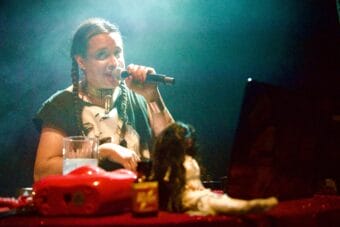
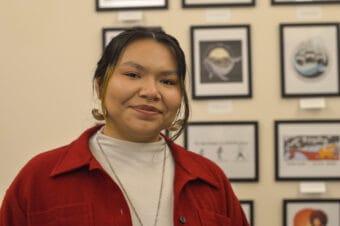
Rebecca Hsieh from ReccaShay Studios sits in her corner of the Heads in the Clouds Collective studio in March 2024.

This is Tongass Voices, a series from KTOO sharing weekly perspectives from the homelands of the Áak’w Kwáan and beyond. 

It’s been over a year since Rebecca Hsieh moved into her new studio space downtown. Since then, she and three other artists have formed Heads in the Clouds Collective, a growing community space for anyone in Juneau to learn a new art medium – or make new friends. 

The four artists work there and also host workshops or camps. As Hsieh explains, community is central to the collective’s ethos.

Listen:

This transcript has been lightly edited for clarity.

Rebecca Hsieh: So, we’re Heads in the Clouds Collective, downtown. There are four artists who share this space. And so there’s Tess Olympia, and she owns Juneau Woolies, she’s back in that corner. And then this is Glo Ramirez of Glo Ink, and she does everything, I think. A lot of things. She illustrates, she has clothing, she’s got earrings. That’s Grace Corrigan from Sundew Print. She’s about to teach the printmaking workshop. 

This beautiful mess is mine. I’m Rebecca Hsieh of ReccaShay Studios. And I do mostly like crocheting, just a lot of fibers.

I, when I was 10, for Christmas I got one of those really typical crochet kits that had a little book. And I remember looking through the book trying to figure it out, and I could not, so my uncle actually figured it out and then pseudo taught me, and it’s just something that I’ve always come back to. And before I moved to Juneau, as a young adult, I kind of picked it up again.

When I first moved to town, I actually worked at Kindred Post, and I don’t think I would have pursued art if I didn’t work there and make the connections I did because everyone was just so supportive. And so I just started making more and getting connected in the art scene. And then like having a market for the first time. And then people bought stuff, and I was like, ‘oh my god.’ And so then, I just keep making stuff that really make me happy and make me smile. 

I just wanted to crochet a hot dog that was like our height. So what’s gonna happen is, in that room in the JAHC, one side is going to be all the eastern foods I grew up with. And so I’m gonna make a dim sum table and all that, and then on the other side will be all the Western foods.

I think Juneau has been the most supportive place, in the sense that sometimes I think people can like gate keep grants, or market opportunities, or show opportunities, like exhibition opportunities. And here, whenever I’ve talked to any other artists, people are just so willing to share that information and be like, ‘Hey, I think you’d be great for this,’ even though they might be aiming for the same thing. But it’s just like, people are here to lift each other up. And so I try to do the same, like promoting other people’s work and all that.

This is what I do full time, so I’m in here the most and everyone kind of comes on their own schedule. This space actually was a nail place beforehand. So I think around a year and a half ago, I actually used to be in a studio across the hall and it flooded. And so we had to move all our stuff — or I had to move all my stuff — in here with another artist, but I’d been kind of eyeing the space just because the views are really nice. 

Just slowly started reaching out to other artists that I was friends with to see if they’d be interested in having a more focused artists space where we can kind of collaborate and you know, make this a community place. We’re trying to open it up and like, collecting other artists to teach in here, because we just want to, you know, make this a big community space where people can learn and create.

You can check out Hsieh’s art show, “Bite Sized”, at the Juneau Arts and Humanities Center now until May 26.

Tongass Voices: Haa Tooch Lichéesh Coalition members find inner strength through ocean dipping

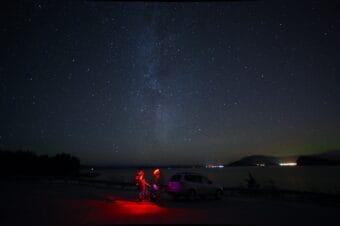
People dipping with Haa Tooch Lichéesh Coalition at Auke Recreation Area on March 24, 2024. (Photo by Yvonne Krumrey/KTOO)

This is Tongass Voices, a series from KTOO sharing weekly perspectives from the homelands of the Áak’w Kwáan and beyond.

Haa Tooch Lichéesh Coalition is a nonprofit that offers Indigenous-based healing practices and reconciliation with the violent history of colonization and its impacts on Juneau’s community today.

One of these traditional practices is a dip in the ocean, for strength and healing. It’s methodical and intentional — participants walk in up to their knees, then stop, then up to their waists, then stop, and so on until they are as far in as they feel comfortable. Afterward, participants warm themselves by the fire.

We spoke to Ḵáaḵ’utx̱éich Kai Monture and organizer Saan Jeen Jennifer Quinto about the clarity they find in the frigid waves. 

This transcript has been edited for length and clarity.

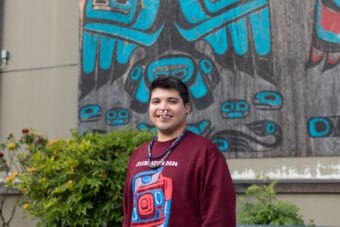
Kai Monture: My names are Ḵáaḵ’utx̱éich and Eeḵ Kahaa Ḵáa. My English name is Kai Monture. I come from Yakutat from Tsísk’w Hít, the Owl House.  

My intention for this dip is to introduce my three nephews here who are Teiḵweidí from Yakutat. They just moved back to Lingít Aaní this December, just started to reconnect to their Lingít side. Now this is their very first dip.

Saan Jeen Jennifer Quinto:  The coldness of the water is like the overwhelming moments when we’re in our daily lives. And because we’re not taught how to process and confront those overwhelming moments, like in school or other places, and we really don’t have guidance in that way, I use the water to help teach me how to navigate those really overwhelming things. 

That overwhelming cold sensation is what I equate to those things that we need to start confronting and learn how to navigate in our daily lives.

Kai Monture: I was very lucky to be raised by my grandparents, Elaine Abraham and George Ramos. And they were very traditional. My grandpa in particular taught me a lot about the training of the X̱’éig̱aa Ḵaa which translates to “a true or authentic person.” And that was the title of our traditional warriors.  

Their training began when a boy was six or seven years old. He would go to live with his maternal uncle, who would raise him from that point on. And one of the core parts of their strength training was going into the ocean at sunrise almost every day of their life.

It was always a practice I was really fascinated by but something I actually didn’t start until my adult years. Just from personal experience, it was just like the way my grandparents were describing it to me, as a way to test and build up your toowú latseen, your inner strength. 

The cold obviously is so hard on the body. But the strength of your heart and your soul can like do wonders, especially when you test it for yourself. 

I think a lot of people that are scared to try and reconnect to this practice would really be surprised by themselves. 

I actually was scared Soriano is too small. But he really really insisted he would try it.

Yvonne Krumrey: How was it?

Soriano: Cold.

Tongass Voices: Malin Babcock on a life intertwined with Juneau history

Malin Babcock, 84, poses outside of KTOO in February, 2024. (Photo by Anna Canny/KTOO)

This is Tongass Voices, a series from KTOO sharing weekly perspectives from the homelands of the Áak’w Kwáan and beyond.

Malin Babcock, treasurer of the Gastineau Historical Society, has lived in Juneau for more than 80 years. Her personal history is deeply intertwined with the history of the city and the state. 

From the traumatic loss of her grandparents in Juneau’s 1936 landslide, to her long career studying salmon across the state, Babcock reflects on her life in Southeast Alaska.

This transcript has been edited for length and clarity.

Malin Babcock:  Well, my name is Malin Babcock, and my grandparents Hugo and Hilja Malin Peterson were both killed in the building. And my mother who was Lillian Peterson Babcock survived.

She was probably one of the first ones that was rescued, because she was on the south end of the slide and right at the very edge when she was hit by the mudslide coming down. And it was the worst disaster that has ever occurred within the City and Borough of Juneau.

My mother was in the hospital for two weeks and then released from the hospital. She talked about it very rarely.

My grandparents were Finnish immigrants. There’s a lot of stoicism that goes throughout that culture. So they emigrated to Juneau late in 1913. My uncle Elmer, and my grandfather were miners, and they both worked for the AJ Mine.

My mother was born on November 9th of 1914, and grew up here, went through high school here. And she obtained a secretarial job with a fella by the name of Frank DuFresne, who was the head of the Alaska Fish Commission at that time. And he did all the arrangement for the funeral and everything else for her parents, which was absolutely amazing.

She later married of fella by the name of Doug Babcock, my dad, who was an early member of the Territorial Sportsmen, plus being one of the first Taku River Rats. And he notably helped in some of the early experimentation for salmon and salmon eggs that led to DIPAC.

Years later – years later – when I went to school at Oregon State and then up to Fairbanks for my master’s degree, where I took ichthyology and fisheries courses, our textbook was by Frank DuFresne. And it was called Alaska Fishes. I mean, it’s absolutely amazing, the webs that we turn that we find out later, you know, and that end up surprising you.

So I went to work at the Auke Bay Lab in 1969. There were not many women biologists, I think there were two when I started to work there. And I spent many, many a summer up in King Salmon in Bristol Bay. And I spent seven years walking the beaches of Prince William Sound working with with the effects of hydrocarbons after the Exxon Valdez oil spill. Anyway, it was just kind of a neat career and I’m very proud of myself.

Tongass Voices: Holly Huber on what it takes to be Miss Alaska Volunteer

Miss Alaska Volunteer Holly Huber in the KTOO studio. March 3, 2024. Photo by Yvonne Krumrey/KTOO.

This is Tongass Voices, a series from KTOO sharing weekly perspectives from the homelands of the Áak’w Kwáan and beyond.

Holly Huber is this year’s Miss Alaska Volunteer. It’s a newer crown within U.S. pageant system, and it focuses on what contestants do to support their communities. 

Huber uses her platform to bring awareness to the mental health crisis in Alaska. Her duties include advocating, representing the pageant brand and the state, and, of course, posting pictures of herself as Miss Alaska on social media. 

And a warning: this interview contains a mention of suicide. 

Listen:

This transcript has been lightly edited for clarity.

Holly Huber: I’ve done pageants absolutely my entire life. If you’ve ever seen Toddlers and Tiaras, that’s basically a biopic of me. My mom was the ultimate pageant mom, she had all five of us doing pageants, including my little brothers. They were adorable. 

But I’d never done a Miss USA or Miss Volunteer America or Miss America Pageant before. You know, those circuits are so glamorized. And they’re so big and well known that they’re kind of intimidating. 

But when I turned 18, I competed for Miss Alaska USA for the first time. And I didn’t win, which if you look at the video, is no surprise. And then I competed again at 19. And again at 20. 

And the reason that this system was created was really to focus more on what it means to be in pageantry and to hold a national title rather than what you look like when you hold that title. 

Every pageant you compete for, you need to have a platform, which is basically something that you stand for. This one, they call it their initiative, and you have to put in work. It’s not just, “I like to donate to St. Jude’s. I like to go pick up trash on the side of the road.” You have to have such a developed and dedicated platform that really shows what you’re doing in your community and how you specifically are making a change. It’s not just “I want to do this,” it’s “I am doing this.” 

My platform is called No Empty Hearts. It’s the platform I’ve been running with since I was about 16 years old. And what I do is I’m very focused on bringing comprehensive and accessible mental health care to my community here in Juneau and across Alaska. 

Mental health has been a big issue in my family personally. My mom really struggled with her mental health growing up. You know, it really, really manifested physically for her. You know, she really always did her best as a mom, and she tried to do everything for her kids. But unfortunately, when I was 15 years old, my mom attempted to take her own life. 

And — sorry — I had come home from my shift at McDonald’s, to the little room that we shared. And she was there completely unresponsive with an empty bottle of pills right near her. And I think in that moment, I just realized that it’s so much of a disease. 

And it’s really unfortunate that children here don’t have the same kind of resources. Adults’ resources are abysmal. And it’s just, it’s something I’m fighting so hard to change. And I’m really excited to go to Nashville and fight for national resources for my community. 

I prepped like crazy going to the gym. I did a lot of mental health work. I did a lot of journaling — everything that kind of made me feel prepared. And I competed for the title back in October and I won. So now I am Miss Alaska Volunteer and I get to go compete for the national title here in June. 

I mean, everybody still calls them beauty pageants. And you know, when you’re so set in your ways, it’s hard to change that because for a long time, they were beauty pageants.

I mean, you look at old time, Miss USA, like back when Donald Trump owned it. It didn’t matter how educated you were, how involved you were. It didn’t matter what you were. If you weren’t a pretty face you weren’t getting on that stage.

And what I love about pageantry now is that beauty has completely changed. Beauty is a spectrum and every girl who gets on that stage is beautiful, because the reasons that she’s there is to make a change. 

So the national competition is in June. It is in Jackson, Tennessee. I’ve already got to connect with so many of the girls who are competing in this pageant, and I’m so impressed.

Women are just so incredible and resilient and intense and just — we know what it’s like to fight. And so these girls are really bringing the fight.

Tongass Voices: Jeremy Kane on the philosophy of bowl-making

University of Alaska Southeast ceramics professor Jeremy Kane demonstrating bowl-making for his intermediate class. (Tasha Elizarde/KTOO)

This is Tongass Voices, a series from KTOO sharing weekly perspectives from the homelands of the Áak’w Kwáan and beyond. 

The University of Alaska Southeast’s ceramics classes in Juneau are hard to get into — because so many people want to take them. 

Jeremy Kane has been teaching ceramics for 20 years. Each year, the ceramics department makes and donates hundreds of bowls to the Empty Bowls fundraiser, which raises money for the Glory Hall shelter in Juneau. This year’s fundraiser is on Sunday. 

KTOO sat in on a bowl-making demonstration in his intermediate class at UAS. 

Listen:

This transcript has been lightly edited for clarity.

Speaking to his class: But we’re going to start with about a couple of pounds of clay, maybe a little bit more — two-and-a-half, two-and-a-quarter. It’s not really so important how you make it was just a matter of being efficient with your operation.  

And when I put this clay on the wheel, there’s no need to show off. Make that nice round ball of clay, getting your hands smacking around a little bit. This clay is going to soften up so much.

Center it, and enter it. If the clay is wedged properly, shouldn’t have to do too much centering, shouldn’t have to do too much work at all. 

Interview transcript: My name is Jeremy Kane. I moved to Fairbanks when I was 18 years old with my friends, and I had taken ceramics classes as a kid, so I’ve been making things for a long time. So I took college ceramics starting when I was 18 in Fairbanks. Then I have a master’s degree from Ohio University. That’s when I finally landed this position here, and I’ve been working here ever since. So it’s my 20th year teaching. 

To class: I encourage you guys to try to set some goals for timing on these pots. We had like a race in grad school one time, I think I made 45 bowls in an hour. All the clay was prepped, not talking to anybody, you just sit there and go knock them out. And then later, you got to trim them.

So I wouldn’t go to that extent, but I think that you guys should all easily be able to make 10 bowls. I mean, easy.

Interview: This particular project, we do it for the homeless shelter in town, and we’ve been doing it for years. We’ve donated thousands of bowls to this particular project over the years. But I don’t want it to be just a donation. I want the students to be able to learn from it.

To class: Part of a nice handmade bowl has to do with the fact that you still have a hand in it. Okay, so some of the nicest pots you’ll buy, that are actually commercial pots, like say from China. They all have reference of hand marks in them, because that’s what people like.

You can see there’s a little undulation in that pot. Undulation means it’s got a little wiggle to it. When I make pots, I like to have that motion in there. Or else I can just buy them at Kmart. You guys probably don’t know what Kmart is anymore. 

Interview: I try to encourage them to do it different ways, different styles of bowls and different techniques. So itʼs not necessarily like one standard bowl you crank out, I want them to really think about it.   

To class: You know, when you think about bowls, like for this particular project, I want you guys to like — we’re not just donating time. I want you guys to think about things — and it sounds selfish, but when you’re making pots, you gotta make them for yourself. If they’re nice enough for you, then they get really evenly distributed throughout the community, essentially. Okay, so you don’t make things for other people, you make them for yourself. Because you’re the artist, you’re the person who spends the time doing it. But you gotta make something that you like.

Interview: I do think that making things in multiples is the only way to learn how to make pottery. You know, it’s kind of the art of repetition. 

To class: But when it comes to making pots, sometimes it’s nice to have a bigger, bigger bowl. You want room in that bowl to be able to put stuff. So if you’re serving somebody dinner and you have this really tiny little bowl that you made, you’re real proud of it. Maybe it’s better to put like jelly or like put some sort of dip in there or something. 

But a real bowl would have enough room that you could serve food and still have like two or three inches on the top of that pot in order to be able to look at the surface on that ceramics, or to be able to see what it is, or it creates a contrast between the food. 

Say you’re eating some sort of crab bisque. Right? Oh my God, that sounds killer. Did anybody bring that tonight for class? I wish you did.

So many cultures have that sort of specialty, different foods and different spices, but it’s all food. People make potatoes, meat and vegetables. That’s the world. It’s not that amazing. But the dishes that the stuff is served in, I think, make it amazing. 

Okay, alright, get to work. 

You can check out work made by Kane’s students at the Juneau Arts & Culture Center Gallery through April 27.

Tongass Voices: Juneau Hostel’s Khrystl Brouillette-Gillam and Joey Scoggins on keeping travel affordable

Khrystl Brouillette-Gillam and Joey Scoggins outside the Juneau Hostel in March 2024. (Tasha Elizarde/KTOO)

This is Tongass Voices, a series from KTOO sharing weekly perspectives from the homelands of the Áak’w Kwáan and beyond. 

Khrystl Brouillette-Gillam and Joey Scoggins are part of the team behind the Juneau Hostel. Their mutual desire to make travel to Juneau affordable is what drives them to keep the nonprofit hostel’s doors open.

Listen:

This transcript has been lightly edited for clarity.

Joey Scoggins: My name is Joseph Scoggins, I go by Joey, and I’m the manager of the Juneau Hostel. 

I’m from Georgia. And I never had an opportunity to really travel outside the state until I was almost 30. And then I just randomly needed a reset. So I moved out to California, because I had a friend with a couch and he said, c’mon over. I loved it out there, worked at Disneyland and all that fun stuff. One day, it just hit me. I was like, it’s March and it’s 100 degrees. I can’t live here anymore. So I went online, and I saw this hostel opportunity. I was like, you know, this is an opportunity to finally make it to Alaska, because I have been applying for jobs up here probably since I was like 19, you know, but it was always like, can you get here? Like, sorry, we can’t hire you. You know, so I finally got here. And that was the hardest part. 

Khrystl Brouillette-Gillam: No, I think yeah, the point of the hostel is to provide people with a low cost place to stay. And the point, the reason why we run it with volunteers like this, is to give people like Joey and others an opportunity to live in Alaska and enjoy everything we have in Juneau, but at a lower cost. 

My name is Khrystl Brouillette-Gillam, and I’m the president of the Juneau Hostel Board of Directors. So we’re the only nonprofit hostel in Alaska, and one of the very few that I can find, nonprofit hostels in the U.S. And that makes us different, makes us keep costs low. So that’s how we’re able to offer like $30 for a bunk versus other hostels that charge a little bit more.

Yeah, so what you’re seeing right now, obviously, we have a private group staying so there’s games around, and books around, and hostel’s full of life right now. In the wintertime, we don’t have that many guests. So the hostel is a very different vibe. But we’re excited to have the energy back in the hostel.

Joey Scoggins and his dog, Saint, play around with hats behind the Juneau Hostel’s front desk in March 2024. (Tasha Elizarde/KTOO)

Joey Scoggins: Compared to summer months, we’ll have like a couple dozen every day, you know what I mean? It’s a lot more fun. Gentleman that came last summer, he’s a big fan of an author that lived around here. And he was actually from somewhere in Eastern Europe. He was writing his own novel, and he had hit of a writer’s block kind of thing. So he was like, I’m gonna go there, I’m gonna go to Juneau, I’m gonna walk those same paths this guy did.

Khrystl Brouillette-Gillam: So like I said, the hostel operates as a nonprofit, which is great because it keeps our costs down for our guests, but has some other problems with it. And the biggest thing is just funding of course, that’s the biggest thing with all nonprofits. We do have a source of funding through renting rooms to people, but it’s definitely not enough to cover all of our expenses.

During COVID, we had to shut down operations almost entirely. I wasn’t on the board at that point. But we had to shut down all operations, and the hostel was actually thinking about closing — was very close to shutting our doors and not being open anymore. 

Joey Scoggins: This is just a few weeks ago, we had a prank call. But it turned into a serious conversation where the gentleman was concerned because all the other hostels he had called in Alaska to try and prank call had already closed down or turned into AirBNBs. And he was like, so, I was just messing with you, but I’m kind of glad you’re still there.

Khrystl Brouillette-Gillam: So if you don’t want the Juneau Hostel to turn into an AirBNB, please join the board. We would love to keep it running.

Correction: An earlier version of this story misspelled Khrystl’s name. 

Site notifications
Update notification options
Subscribe to notifications