Business

Planned fiber-optic cable will add backup for Alaska’s phone and high-speed internet network

A commercial bowpicker is seen headed out of the Cordova harbor for a salmon fishing opener in June 2024
A commercial bowpicker is seen headed out of the Cordova harbor for a salmon fishing opener in June 2024 (Corinne Smith/Alaska Beacon)

One of Alaska’s smallest telecommunications companies is about to provide a critical backup for the entire state.

On Wednesday, Cordova Telecom Cooperative and GCI announced a partnership to lay an undersea fiber optic cable from Juneau to Cordova and a second cable from Cordova to Seward.

When open for service in fall 2027, the two cables will provide high-speed internet to small communities in Prince William Sound and northern Southeast Alaska.

The development matters to the rest of the state as well, because when combined, they will provide a route for internet traffic between the Railbelt and Outside. Currently, four undersea cables through the Gulf of Alaska are the principal routes for internet and phone traffic between Alaska and the rest of the world.

Matanuska Telecom Association opened the state’s first overland fiber connection in 2020 as an alternative, and the new route will give the state another redundant option, said Cordova Telecom CEO Jeremiah Beckett.

“With what we’ve built out, scalability wise, we could put all the current Alaska traffic on our network if needed,” Beckett said.

This map, provided by Cordova Telecom Cooperative, shows the route of the proposed FISH in SEAK cable that will come online in fall 2027. Cordova’s existing fiber route is shown in green. (Image courtesy Cordova Telecom Cooperative)

While satellite internet services like Starlink have transformed life in rural Alaska, ground-based fiber internet remains the backbone of worldwide telecommunications, delivering service faster and in volumes that satellites can’t provide.

“It’s kind of like rural communities that don’t have the ferry,” Beckett said. “Places without fiber don’t have the same access that folks with fiber do. So this is really to help connect those rural areas and give them the same access to the digital economy and marketplace as the rest of the world.”

Despite their advantages, fiber-optic cables can be vulnerable.

“Up north, it’s ice scouring … and in our area, it’s typically ship anchors and earthquakes,” Beckett said.

Alaskans have become intimately familiar with the consequences of broken cables in recent years.

Northern and northwest Alaska are particularly familiar: Quintillion’s fiber-optic cable has been severed three times in two years. The latest break wasn’t fixed for more than seven months because sea ice precluded repairs. That caused widespread problems in areas served by the cable.

In March, a break in a subsea cable left the Alaska Legislature to do business on paper for a day and knocked out both cellphone and internet service for much of Juneau. Juneau had alternatives; a temporary fix was in place within days.

When the cable leading to Sitka broke in 2024, it took weeks to repair. People canceled surgeries and businesses went cash-only until internet service was restored.

Adding a backup fiber route reduces the odds of blackouts like those. Currently, Cordova is served by a single undersea fiber line through Prince William Sound to Valdez.

When the project is complete, internet and phone traffic will have three possible routes: north, west, and east.

The two cables will cost roughly $88 million combined, according to figures provided by Beckett, and the project is principally funded through two federal grants. Cordova Telecom is paying for part of the project, as is GCI, which will be what Beckett calls an “anchor tenant and partner.”

“It was a good matchup for both of our long-term goals,” he said.

In a prepared statement, GCI senior vice president Billy Wailand praised the plan, which is formally known as Fiber Internet Serving Homes in Southeast Alaska, or FISH in SEAK.

“Critical state services require network diversity,” he said. “GCI turned up the first subsea cable to Alaska in 1999 and landed a second diverse fiber in 2008. We are thrilled to partner with CTC on its FISH in SEAK project, which includes a next-generation cable that ensures Alaska and its capital city continue to benefit from the newest technologies and adds another crucial layer of redundancy to the network.”

Communities along the cable route will see huge changes, Beckett said. Residents of Pelican on Chichagof Island in Southeast Alaska, who use boardwalks instead of roads and four-wheelers instead of cars, will be able to get fiber internet access directly to their homes.

The island village of Chenega in Prince William Sound, which has about 50 year-round residents, likewise will have new access to fiber internet.

Alaska’s Lost Coast, between Glacier Bay and Yakutat, could be dotted with cellphone towers.

Beckett, who grew up in Cordova, returned to the town with his spouse 12 years ago, “basically when Cordova got its subsea fiber,” he said. “We were both teleworkers, and that created the opportunity for us to move back to Alaska, essentially.”

Since then, he’s seen internet service improve and has become head of his local telecom, which has just 20 employees.

Because it’s a cooperative, it’s run as a nonprofit, he said. That means the telecom’s goal is to deliver faster service and low rates, not necessarily generate a profit.

In Yakutat, “a few years ago, you couldn’t get cell service anywhere,” Beckett said.

“We’ve upgraded the cell service there to 4G and outside of the fishermen complaining because their wives can get hold of them, it was a huge boost for the community,” he said.

“If someone gets hurt, they can call the paramedics and not have to drive 20 miles before they get to service. … It’s giving people reasons to think about moving home, because it’s one less inhibitor to be back in Alaska,” Beckett said.

“Yakutat actually got a new clinic a couple years ago, and then with this, I think they’re going to see some good growth. Everyone likes core services, right?”

Alaska state utility regulators approve secrecy orders for billionaire’s takeover of GCI

A GCI van parked in Kotzebue. (Wesley Early/KOTZ)

The Regulatory Commission of Alaska has unanimously approved a series of requests for financial secrecy filed by attorneys representing John Malone, the telecom billionaire seeking to take a controlling interest in Alaska’s largest internet firm.

The approval means Malone will not be required to publish his personal finances and that the financial condition of three GCI-related subsidiaries will also remain secret. The finances of GCI Liberty, the parent company, are already public due to required filings with the U.S. Securities and Exchange Commission.

In October, Malone, 84, told the Wall Street Journal that he would be stepping away from day-to-day operations of his various companies but would retain his controlling interests. Bloomberg has estimated his net worth to be approximately $10.6 billion.

The approval was published just before 4 p.m. on Black Friday. The five governor-appointed commissioners said they were granting the requests because they were in line with the commission’s prior practices, because they don’t have the power to regulate much of GCI Liberty’s business, and because “the public interest in disclosure of the financial information of (the three subsidiaries) is outweighed by the potential competitive financial disadvantages demonstrated in the petition.”

The chair of GCI’s parent company, GCI Liberty, Malone holds shares controlling 53.5% of GCI Liberty’s voting power. But Malone’s personal power has been restricted until recently to 49.32% of the company’s voting power, regulatory filings state.

Now, Malone is seeking to increase his voting power above 50%.

The commission’s Friday order does not decide that request; it addressed the combined requests for financial secrecy on behalf of Malone and the three GCI Liberty subsidiaries.

Alaskans submitted a combined 67 comments across three dockets related to Malone’s proposal. Almost all were opposed to the request for secrecy.

In a response to those comments, Malone’s attorneys said “no legitimate public interest will be served by requiring (Malone) to file his personal financial information.”

The response also said that “the acquisition … will be seamless and transparent to customers because the GCI companies will continue to provide the same services to Alaska customers under their same experienced management. There will be no operational or management changes to the GCI companies as a result of the acquisition.”

GCI’s attorneys had argued that the financial statements of the three subsidiaries should stay confidential because GCI’s competitors were not required to reveal their finances, and it would be unfair for them to open their books.

“We find that disclosure … might create a competitive or financial disadvantage,” the regulators concluded.

In addition, unlike the way that water and power utilities’ rates are regulated by the RCA, GCI’s prices are not regulated by state law.

For that reason, plus the fact that GCI Liberty’s combined financial statements are publicly available, regulators concluded, “public interest in disclosure … is outweighed by the potential competitive financial disadvantages demonstrated in the petition.”

On the request for secrecy covering Malone himself, Malone’s attorneys argued that he isn’t legally obligated to provide financial support to GCI Liberty, and thus, “requiring the submission of his personal financial information would not advance a public interest objective.”

They also argued that in 2018, when wealthy telecom entrepreneur Jane Eudy obtained full control of several Interior Alaska telecom companies by taking 100% control of American Broadband, a national firm, the RCA did not require her to publicize her finances.

Members of the public argued that disclosure is in the best interests of Alaskans.

Megan Johnson, one of dozens of people who offered public comments, said, “Telecommunications in Alaska are not just about convenience, they are lifelines for education, healthcare, emergency services, and economic development, especially in rural and Indigenous communities. Decisions made by owners unfamiliar with our terrain, seasonal challenges, and cultural values risk undermining the progress we’ve made in closing the digital divide.”

Kirsa Hughes-Skandijs of Juneau wrote, “I am gravely concerned about the idea of concealing financial information, particularly when it comes to consolidating control of a public good like an ISP, broadcast and telecommunications company.”

Commissioners ultimately sided with Malone.

“We find the circumstances presented in these dockets similar to those we considered (in 2018),” they wrote.

“We find that under the circumstances … no legitimate public interest will be served by requiring Dr. Malone to provide a statement of financial condition.”

Commissioners are scheduled to make a final determination on Malone’s takeover by April 1.

A new technology aims to help ships avoid whale strikes

A whale surfaces in Glacier Bay in July 2023.
A whale surfaces in Glacier Bay in July 2023. (Clarise Larson /KTOO)

Researchers say vessel strikes are a major threat for whales, including in the waters off Alaska. A new technology is aiming to change that by using AI, thermal imagining and marine observers.

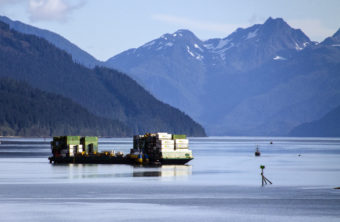
Matson’s container ships bring cargo and cars from Tacoma, Washington to Anchorage, Kodiak and Dutch Harbor. The company has partnered with WhaleSpotter, a new system that helps ships detect whales, said Matson’s CEO Matt Cox.

“Every handful of years, we, unfortunately, do have a strike, and of course, we report that up,” Cox said. “But the hope is, this new technology will make that even more rare of an occurrence in the future.”

WhaleSpotter was introduced commercially about a year ago and is now used by a dozen companies, including some in Alaska, said Shawn Henry, the company’s chief executive officer. He said Matson is their latest partner and the first container ship company to use the system.

Danger of ship strikes

Researchers say ship strikes are one of the leading causes of whale deaths worldwide. In the Juneau area alone, at least nine humpback whales were hit by ships in the last five years, according to a local project called Juneau Whale HEALTH.

“Vessel strikes are a major threat to whales,” said Heidi Pearson, a professor of marine biology at the University of Alaska Southeast and a principal investigator for the project. “Most ship strikes go undocumented. Especially if it’s a large vessel, they could hit a whale and not even know it.”

Andy Szabo, the director of conservation and research organization the Alaska Whale Foundation, said ship strikes are especially prominent in the areas frequented by cruise and cargo ships.

“Whenever you’re running high-speed, large boats through whale waters, that increases the likelihood of strikes,” he said.

Humpback whales are the most prone to strikes because they often swim close to the surface and close to shore, Szabo said.

The harm from the vessel strikes is compounding on top of other challenges whales face, he said. Recently, a marine heatwave in the Pacific known as the Blob disrupted ecosystems along the West Coast of the U.S., causing thousands of humpbacks to starve, Szabo said.

He said the population still has not recovered.

“They’re not doing great at all,” Szabo said. “So when you have that, and then you overlay on top of that vessel strikes, even if it’s not a lot of animals, it can have an impact.”

The new whale-detection system

WhaleSpotter technology is designed to alert ship crews when there is a whale nearby and give them an opportunity to change course or stop.

“We are enabling a vessel to detect a whale well ahead of the amount of time it needs to make a turn or slow down,” said Henry with WhaleSpotter.

Thermal cameras track temperature changes in a four-nautical-mile radius around a ship, Henry said. Then, the technology uses artificial intelligence to determine which images likely captured whales. Remote marine mammal observers – real people watching the data feed from elsewhere – do the last checks. Then the system sends an alert to crews about a possible whale nearby.

WhaleSpotter technology is designed to detect whales by using AI, thermal imagining and marine observers. (Woods Hole Oceanographic Institution)

The Woods Hole Oceanographic Institution in Massachusetts has been developing the technology for the last 15 years, Henry said. The institute granted WhaleSpotter a license to sell the technology, and the company has been working with different clients for about a year.

“We have a number of different other types of vessels that are using the product,” Henry said. “Some of them – vessel strike avoidance, some of them for marine operations like cable laying and pile driving.”

Cox, the CEO of Matson, said the company tested the technology on their ships. He said the trials showed that the system is effective at detecting individual whales and pods, and sometimes even the direction the whale is traveling in.

“We’ve had cases where those whale detections have been spotted, and we’ve been able to navigate around the pod or the individual whale to lessen the chances of a strike,” Cox said. “It’s worked really well.”

Now Cox said Matson plans to have it on all three of its Alaska ships. He said the crews are excited about it.

There’s genuine enthusiasm and excitement on board the vessels,” he said.

Pearson, at the University of Alaska Southeast, said the WhaleSpotter technology can be a game changer for whales, vessels and their crews and passengers.

“Of course, if a whale gets hit, it’s awful for the whale, but it can also damage vessels. Whale strikes have also been known to cause damage to human passengers on the boat,” she said. “So anything we can do to mitigate that protects whales and humans as well.”

Szabo, with the Alaska Whale Foundation, said that outfitting ships with technology to detect whales is a good first step, but he wants to know more about what the crews will do with that information.

He said that if the whale is too close, the ship might not have enough time to turn. And if the whale is too far and is moving, the original location might be irrelevant. Plus, he said, if there are many whales in the area, it can be unclear what the best course of action for the ship might be.

Still, Szabo said he is optimistic about the technology.

“It can’t be a bad thing,” Szabo said. “I just hope that there is sufficient effort put into the whole training and procedures and protocol side of things as well, to make it as useful as it could be.”

University of Alaska projects up to 10% increase in health care costs this fiscal year

One of the outdoor sculptures at the University of Alaska Anchorage campus is integrated into a fountain, pictured here on May 16, 2022. More than half of the University of Alaska system schools attend UAA or one of its satellite campuses.
One of the outdoor sculptures at the University of Alaska Anchorage campus is integrated into a fountain, pictured here on May 16, 2022. More than half of the University of Alaska system schools attend UAA or one of its satellite campuses. (Yereth Rosen/Alaska Beacon)

The University of Alaska is anticipating an increase of up to 10% for health care costs this fiscal year, on par with what employers are anticipating nationally, according to officials presenting to the Board of Regents at their meeting on Nov. 6.

Nikole Conley, chief of human resources for the university system, gave a presentation outlining the university system’s health care costs so far, and projections for the rest of this fiscal year, ending in July 2026. Her presentation included medical, dental and pharmacy care.

“We do see health care costs across the nation going up and increasing, and we’re not necessarily expecting this to decline anytime soon,” she said.

The university is projecting 8% to 10% overall cost increases across the system for this fiscal year. That means health coverage for 3,442 employees is estimated to cost $85.5 million.

A screenshot from a University of Alaska presentation on health care costs on Nov. 6, 2025, shows a rise in costs in recent years. (Alaska Beacon)

“We are seeing trend increases of 8% for medical, 13% for pharmacy and 4% for dental. We’ll do another recast in January of 2026 and hopefully try to firm up that figure and what that’s going to look like,” Conley said.

Nationally, employers are expecting an 8.5% increase in medical costs and an 11% increase in pharmacy costs, she said, so the university’s costs and projections are mirroring that trend.

Health care costs in Alaska are among the highest in the nation, according to state data. Since 2023, the average cost of a health insurance marketplace plan in Alaska rose by more than 16% each year. In 2023 alone, the cost went up by an average of 18.4%.

The university has a cost split for health care with 18% paid by employees in premiums, and 82% paid by the universities. Conley presented total cost projections to the board.

Conley said the number of university employees isn’t growing, but more people are opting into the university’s health care plan. She said system-wide the largest cost increase is in pharmacy claims, but her department is expecting to renegotiate pharmacy costs, which could save the university about $3 million.

Last year, the university saw pharmacy spending increase 11.2% from the year before. Over the last five years, overall pharmacy costs more than doubled from $9.2 million to $19.2 million, she said.

Conley said that’s partly due to a rise in prescriptions for drugs used for weight loss and to treat diabetes, known as GLP-1 drugs like Ozempic. They were the second highest pharmacy claim within the university’s plan, totaling $4.1 million last fiscal year.

“We’re also looking at the potential elimination of GLP-1s, because they are a major cost driver for us,” she added.

University of Alaska Regent Karen Perdue pushed back against that idea, pointing out that weight loss can also improve employees’ health outcomes and result in less health care costs. “It’s not just a plus, there can be a minus on the bottom line as well,” she said.

A screenshot from a University of Alaska presentation on health care costs on Nov. 6, 2025 shows the highest claims for medical and pharmacy care. (Alaska Beacon)

University of Alaska President Pat Pitney also pointed out other high pharmacy costs last year. The largest costs were on inflammatory diseases, with the highest cost at $4.3 million, and cancer treatments at $1.3 million.

The highest medical costs for the university last fiscal year were for muscle, joint and bone claims at $10.7 million, followed by cancer at $7 million, and behavioral health and disorder treatments at $5.3 million.

Last year, the university’s total costs came in at $80.1 million, which was $1.1 million over the university’s projection. Conley said next year’s premiums will go up to recover those costs.

Conley said her department is working to push more education and use of wellness programs and preventative health care.

“Not only are we seeing this growth of 8% to 10% in cost, but we’re also seeing less use, for some reason, of our preventative health care. And so we’re really trying to encourage folks to use preventative health care, because that will help minimize some of our costs in the future,” she said.

According to university data presented by Conley, only half of health care participants used preventative screenings, like annual physical exams or checkups; nearly 38% of emergency room visits could have been avoided with better primary care or urgent care use; and 38% of participants are categorized as pre-obese or obese.

The university is insured through Premera Blue Cross, and Conley said her department discusses health care plan changes with the university’s Joint Health Care Committee, an advisory committee made up of representatives from the faculty union, management and staff.

The university is also expecting a health care rebate, which is a benefit paid back to employees if they utilize the prevention programs throughout the year, like cancer screenings, dental care, and regular check ups.

“We’re estimating about a $1.5 million rebate,” Conley said, for this year, ending in July 2026. “We’re going to see up to a $2.5 million rebate increase in FY27 with new rates. So that’s a good positive.”

The debate around national health care, federal tax credits, and costs for Americans has been at the heart of bitter negotiations around ending the longest government shutdown in U.S. history. This week, the U.S Congress approved a stopgap spending bill ending the shutdown. Democrats have introduced a discharge petition to force a vote to extend tax credits for three years under the Affordable Care Act. White the Senate Majority leader has promised a vote by the end of the year, leaders of the Republican-majority House have remained opposed, and discussions on health care are ongoing.

Alaska station that covered devastating storm cuts jobs

The village of Kwigillingok, Alaska is seen in October. The area was hit by the remnants of Typhoon Halong earlier in the month, which caused major damage to homes and displaced most of the residents. (Claire Harbage/NPR)

KWIGILLINGOK, Alaska – When the remnants of Typhoon Halong hit this Alaska Native village last month, Ryan David was at home with his four children. They felt the house shake in the wind, then as floodwaters came, the building floated away.

“I yelled at my kids to get up and group up here, on the stairs, just in case we tip over,” David said when he talked with public broadcaster KYUK. He and his children were still trapped inside. David says the home stopped floating when it hit a bridge. He talked with a KYUK reporter as he waited for rescuers to arrive.

A month later, as villages across the Yukon-Kuskokwim Delta clean up from the storm and make repairs, hundreds of residents remain evacuated to cities such as Anchorage and Bethel. Now they face another loss. One of the few sources of local news and native language programming — public radio and television station KYUK — has lost federal funding that was up to 70% of its budget and plans to make cuts in January.

Mathew Hunter, 26, works at KYUK in Bethel. Due to the funding cuts his position will drop from full-time to 10-15 hours on call. (Claire Harbage/NPR)

The station plans to severely cut staff and some programming as it tries to raise money to fill the budget gap.

The broader public media landscape is also experiencing a loss of federal funding, including at least some money for improving emergency alert systems, as human-caused climate change from burning fossil fuels is heating the planet and increasing risks from extreme weather.

In remote villages KYUK is “crucial”

KYUK broadcasts out of a small tan building at the base of a tall tower in Bethel, Alaska — about 400 miles west of Anchorage. Bethel is a hub community for 56 tribes spread across 48 communities. The station says its coverage area is about the size of Louisiana.

Darrel John is a lifelong resident of Kwigillingok and he says the news in Yugtun is especially valuable. (Claire Harbage/NPR)

KYUK has been on the air since 1971 and “is a Native American initiated public broadcasting joint licensee” — that means it has both a public radio and television stations. It also has a digital news website and serves a predominantly Yup’ik population of less than 30,000 people in the Yukon-Kuskokwim Delta. Many residents, especially elders, primarily speak the Yup’ik language Yugtun.

“It’s very crucial to have that KYUK network,” says Darrel John, a lifelong resident of Kwigillingok. He says the news in Yugtun is especially valuable. “A lot of great advice we listen to from the elders… Any updates from any other communities — you know what to look out for — and the upcoming events.”

Each weekday, as Morning Edition ends, there’s local news and the weather forecast in Yugtun.

“Weather is definitely one of the things that KYUK focuses on because it’s life or death,” says Sage Smiley, KYUK news director. In a place where there are few roads, residents sometimes drive on frozen rivers and need to know where it’s safe to do that. “Getting from community to community in a boat, on a snow machine, in a bush plane, the weather matters almost more than anything else,” Smiley says.

When it became clear the remnants of Typhoon Halong were headed toward the Yukon-Kuskokwim Delta. Smiley says reporters started including that in their reports to warn residents. She says fall storms and even flooding are common in the region, but Halong was different from most.

“This storm took a track that was unexpected, hit south of where it was expected to and in an area that was less prepared for the storm to hit,” Smiley says. “I think all of those factors went into what made it so devastating.”

Sage Smiley, KYUK news director, stands in the office in Bethel. (Claire Harbage/NPR)

Three people in Kwigillingok died because of the storm. Nearly every building in the village was damaged. Overall more than 1,600 people were displaced, many of them evacuated in helicopters.

Smiley also coaches the high school swim team and was at a meet in another city when the storm arrived.

“I was working remotely from a minivan with the swim team while the rest of the [news] team was working on the ground here,” Smiley says in the news department studio in Bethel. “And we had collaborators in Anchorage who were helping draft scripts and call communities to figure out what was happening.”

That’s part of being a news director at a small station, but soon KYUK will try to report the news with a third less staff, because in January Smiley’s position will be among those cut.

KYUK loses funding and makes cuts

KYUK was already navigating a loss in funding from the state of Alaska when President Trump targeted public media and Congress eliminated funding this summer. It was a big hit to the station’s finances because federal funding has been up the bulk of its budget.

Loading…

The federal money essentially paid for employee salaries and benefits.

“It’s a little over $1 million that we’re receiving each year from the Corporation for Public Broadcasting. Our salaries and benefits in FY 25 [fiscal year 2025] was also a little over $1 million,” says Kristin Hall, KYUK’s general manager.

The station had 10 full- time employees and 13 part-time or on-call workers, says Hall. “Beginning in January, KYUK will transition to four full-time employees and ten part-time and on-call employees.”

In deciding where to make programming cuts, Hall says preserving Yup’ik language programs was a priority. A daily interview program, Coffee at KYUK, will lose three episodes a week in English, but keep its weekly Yugtun episode.

KYUK broadcasts out of a small tan building at the base of a tall tower in Bethel, Alaska — about 400 miles west of Anchorage. (Claire Harbage/NPR)

The station’s technical director’s hours will be cut from 40 to 10 hours a week, something Hall says she’s particularly concerned about because that person trouble shoots engineering problems and helps the station manage power outages.

To bring in more revenue, Hall says the station is applying for grants, trying to sell more underwriting announcements and will hold two pledge drives each year instead of just one. The station also expects to receive one-time funding through a Trump administration promise to provide $9.4 million for tribal broadcasting.

Hall says the station will re-evaluate in March 2026 whether the workload is sustainable for the smaller staff. So, more cuts could still come.

Kristin Hall is KYUK’s general manager says in January the station will have a decrease of full-time and part-time employees. (Claire Harbage/NPR)

“My employment here was hanging on by a hair,” says Sam Berlin, a long-time host of the Yugtun language talk show Yuk to Yuk. “But the people, God bless them, they got together and we raised over $100,000 with our fundraiser.”

Just before Typhoon Halong hit the region, KYUK raised the money during its fall fundraiser. “It was our most successful we have ever seen in the history of KYUK,” Hall says. That helps, but doesn’t fill the funding gap.

Raising money in a region with fewer than 30,000 people and with a poverty rate that’s twice the national average is difficult. Hall says many people live a subsistence lifestyle, which means they may not have money to give.

Sam Berlin is the long-time host of the Yugtun language talk show Yuk to Yuk. (Claire Harbage/NPR)

“The encouragement that we get from local folks aren’t always in dollars,” Hall says. She says one person baked blueberry muffins to support the fundraiser and someone else dropped off salmon strips. Hall says an elder came to the station, and in an act of generosity, poured out her purse on the break room table. “And everything that fell out was less than $3. And she said, ‘I want you to have it.’ And it was literally everything in her purse.”

Hall says the station hopes its funding strategy will be enough to support the smaller team after January. If KYUK doesn’t exist, there’s no one else doing the station’s level of journalism in the Yukon-Kuskokwim Delta. “In terms of local news and information, and especially local news and information in Yup’ik, No, there is no one else,” Hall says.

Disclosure: This story was written and reported by NPR Climate Correspondent Jeff Brady. It was edited by Managing Editors Vickie Walton-James and Gerald Holmes. Under NPR’s protocol for reporting on itself, no corporate official or news executive reviewed this story before it was posted publicly.

A new farm in Haines has grown thousands of pounds of produce for the community

Liz Landes arranges recently harvested onions at Henderson Farm in Haines. (Avery Ellfeldt/KHNS)

Just off Main Street in Haines, a large field sits in the shadow of Mount Ripinski.

For a few years, the land sat empty. Local Liz Landes would look at it and think: “Why isn’t that full of food?”

Now it is. Or at least, it was in September, during a tour of the property at the tail end of the harvest season.

After pulling on her rubber rain gear in the high tunnel, Landes walked into a downpour and weaved through rows of kale, herbs, pumpkins and sunflowers. She pointed out black and red currants, broccoli, cauliflower, brussels sprouts, asparagus and fava beans she said were “desperately ready to harvest.”

“We’ve already surpassed 1,000 pounds for the season,” Landes said. “And honestly, we could easily have another 1,000 more with what’s still left to harvest.”

Local farmers rented the site until 2021. But then it sat unused until a new venture, known as Henderson Farm, started up before the 2024 growing season. The effort is funded by a Portland-based nonprofit called Ecotrust and fueled by the work of volunteers and local contractors, including Landes.

Liz Landes arranges recently harvested onions at Henderson Farm in Haines. (Avery Ellfeldt/KHNS)

The farm is a bright spot for the local food system and southeast Alaska, both of which rely heavily on food that’s shipped in from incredibly far away. That process results in less fresh, less nutritious produce, Landes said, and it leads to extraordinary amounts of waste.

As she sees it, nothing encourages cutting down on waste more than toiling in the soil week after week. She points to some healthy-looking purple cabbages, which she says require a lot of time – and effort – to grow.

“I’m gonna use every freaking leaf of every cabbage that I harvest,” Landes said. “And the pieces that I can’t are gonna go into compost to make my cabbages next year.”

This year was the farm’s first full season. As of early November, seeds planted on about three quarters of an acre had yielded more than 2,800 pounds of food and counting. Landes says there will be greens to glean through the first snowfall.

None of the produce is sold. It’s all shared throughout the community, either in exchange for work or for free.

A significant chunk goes to the farm’s volunteers and contractors. But it also goes to the local senior center, a food pantry in Klukwan, a food hub in Mosquito Lake, and other community groups – like volunteer firefighters.

Helping distribute the food is one of the best parts of the job, Landes said.

“Generally, I get to go around and be the little vegetable fairy and say, ‘Thank you for the time that you give to other people, here’s a bag of peas,'” she said.

Liz Landes arranges recently harvested onions at Henderson Farm in Haines. (Avery Ellfeldt/KHNS)

The operation is far from easy. But the farm is in somewhat of a sweet spot when compared to other parts of the Chilkat Valley and Southeast more broadly.

Taken together, the property’s workable soil, Alaska’s long summer days, and Haines’ relatively dry and warm climate are a big help.

“It’s not perfect,” she said. But “in many, many ways, the daylight itself here, with the right distribution of rain, does the work for you.”

Looking ahead to next year, Landes said she wants to continue recruiting more volunteers and potentially expand the growing area to a full acre. She also has a more specific, personal goal: making an all-Alaska gumbo.

That will hinge in part on how her okra – which grows well in hot, dry conditions – does next year.

Site notifications
Update notification options
Subscribe to notifications