Energy & Mining

Alaska scientists and policymakers look to hydrogen as power source of the future

U.S. Geological Survey geologist Geoffrey Ellis stands on Oct. 29 by a poster diplayed at the University of Alaska Fairbanks that explains how pure hydrogen can be pooled in underground formations. Ellis is the leading USGS expert on geologic hydrogen. He was a featured presenter at a three-day workshop on geologic hydrogen that was held at UAF. (Photo by Yereth Rosen/Alaska Beacon)

The key to decarbonization may be all around us.

Hydrogen, the most abundant element in the universe, is in the ocean, in the sky, in the stars, in the bodies of living beings and – of particular importance to energy developers – in the ground.

And it is getting increasing attention globally.

Governments, industry and scientific institutions are now investigating how they might be able to switch from drilling for petroleum, which produces planet-warming carbon dioxide when burned, to drilling for zero-emissions hydrogen.

There are good reasons for that, said Geoffrey Ellis, the U.S. Geological Survey’s geologic hydrogen research leader.

Ellis, who said he was once “in the wilderness” on the subject but who is now leading a wide-ranging research group, was one of the main speakers at a geologic hydrogen workshop held in late October the University of Alaska Fairbanks. The event was hosted by the U.S. Arctic Research Commission and the University of Alaska Fairbanks Geophysical Institute and co-sponsored by the Office of the Ambassador at Large for Arctic Affairs, Mike Sfraga.

Shifting to renewable sources like solar, wind and geothermal energy is crucial to addressing climate change, but there is no way those types of energy can power big industrial users like manufacturers and agriculture, Ellis told the workshop attendees.

In the future, Ellis said, there will likely be a need for 400 million tons of hydrogen, compared to the approximately 100 million tons currently used. And the hydrogen currently used is not the type that is pulled from the ground. Rather, it is produced through an energy-consuming process that pulls the element out of other compounds, separating it from methane in natural gas or using electricity to separate it from oxygen in water.

In contrast, the hydrogen in the ground accumulates when water encounters iron or radiation. Through a process known as serpentinization, the reaction with those other elements in the earth separates the water’s hydrogen from its oxygen – without human intervention. In contrast with oil and natural gas, which take millions of years to form, geologic hydrogen forms quickly. It can even be stimulated through injection of water.

Initial estimates, Ellis said, are that the earth could hold about 5 million megatons of geologic hydrogen, or 5 billion tons. While much of that is in impossible-to-reach sites like the deep ocean, accessing just 2% of that would meet the anticipated global hydrogen demand for more than 200 years, he told the workshop attendees.

Mark Myers, a member of the U.S. Arctic Research Commission, stands on Oct. by posters explaining how hydrogen can be pooled in underground formations. Myers and others organized a three-day workshop on geologic hydrogen that was held at the University of Alaska Fairbanks. (Photo by Yereth Rosen/Alaska Beacon)

“It’s likely that there are large amounts of hydrogen in the subsurface. And so, the question is not: ‘Is it down there.’ But it’s: ‘Is it in places where we can find and produce it?’” Ellis said.

For Alaska, where traditional fossil fuels can be expensive as well as environmentally burdensome, hydrogen energy could underpin development of other non-fossil-fuel energy. Geologic hydrogen could be an important part of the solution, said Mark Myers, a geologist and member of the U.S. Arctic Research Commission.

“It’s a new resource that could be combined with renewables, but superior in many ways,” said Myers, who served in the past as the commissioner of the Alaska Department of Natural Resources, as director of the USGS and as vice chancellor for research at UAF, among other positions.

As he explains it, the physical characteristics that make Alaska prone to earthquakes and volcanic eruptions and rich with mineral deposits also signal potential for reserves of valuable hydrogen in the ground. There is already one company, for example, that is investigating the potential for hydrogen in the same Southeast Alaska geologic belt that holds the better-known Bokan critical minerals deposits currently being explored.

Alaska is far from the only prospective region. Any spot on the earth where the ocean floors have been pulled apart has the potential to hold geologic hydrogen, Myers said.

One region of keen interest is the Midcontinent Rift, a geologic feature that runs from Lake Superior to Kansas in the U.S. Midwest. Exploratory drilling there has already begun.

Still, Alaska has some characteristics that could make it a key area for hydrogen research and development, Myers said.

Alaska, unlike other parts of the nation and the world that are connected to power grids, has some acute energy needs, he said. And it has permafrost, which could be an advantage because microbes that consume hydrogen are less active in cold environments, he said.

There are myriad challenges to geologic hydrogen beyond finding the resource, said experts at the UAF workshop. One is that hydrogen molecules are small, meaning they are not easily trapped in the pores of underground rocks. Another is that hydrogen molecules tend to attach quickly to those of other elements, potentially making separation ephemeral.

For now, there is only one place in the world being powered by geologic hydrogenBourakebougou, a small village in Mali. There, hydrogen was discovered in 2011, at a site where in 1987 an errant cigarette touched off an explosion at what was intended to be a water well.

Since then, there have been about two dozen hydrogen wells drilled, and the village’s electricity runs off the hydrogen produced from those wells.

U.S. Arctic Research Commission member Mark Myers on Oct. 29 holds a sample of metallic rock from the Bokan formation that could be instrumental in forming geologic hydrogen. The rock samples were displayed at a three-day geologic hydrogen workshop, organized by Myers and others, that was held at the University of Alaska Fairbanks. (Photo by Yereth Rosen/Alaska Beacon)

The idea of replicating anything like that in Alaska is enticing, said a state lawmaker who has been following the subject closely.

Senate Majority Leader Cathy Giessel, R-Anchorage, has immersed herself in the subject of hydrogen. For example, she has been participating in meetings held by the Alaska Hydrogen Working Group, founded in 2022 by UAF’s Alaska Center for Energy and Power and the Department of Energy’s Arctic Energy Office.

Geologic hydrogen could be a new source of state revenue, she said. It could provide energy for communities and economic development, she said. If it is found within Native-owned lands, it can enrich Native corporations around the state through the revenue-sharing provisions in the Alaska Native Claims Settlement Act, she said.

But for now, no one should expect any legislation on it, other than potentially some insertions of the word “hydrogen” into existing resource-related statutes if applicable, Giessel said. The subject is too new and there are too many unknowns, she said.

“I don’t envision the need for legislation at this point, until we know what the potential resource is,” she said.

She does intend to hold at least one informational hearing to help her colleagues and the public get more familiar with the subject, she said.

Providing information is the most important thing the state can do to promote development of geologic hydrogen, Giessel said.

“Probably our biggest help to any industry is if we go out and map what the resource availability is. We are an under-mapped state,” she said,

Other information could come from the state’s Geologic Materials Center, the collection of cores and other geologic samples that are available for the public to peruse and study, she said. The center, located in Anchorage, is operated by the state Division of Geological and Geophysical Surveys.

Myers, speaking to the experts gathered at the workshop, also emphasized the need to build knowledge – and to do so quickly. That will take a new way of doing science, likely a whole new structure involving government, industry and academia.

“The challenge is great. But it’s going to be fun. And you’re on the edge of discovery,” he told the group.

Alaska-owned corporation approves $750,000 for legal fights over Ambler Road and ANWR

The Anchorage headquarters of the Alaska Industrial Development and Export Authority, shares space with a sister agency, the Alaska Energy Authority. (Photo by Nathaniel Herz)

Alaska’s state-owned development corporation is advancing plans to explore for oil in the Arctic National Wildlife Refuge and to build a 300-mile road to a mining district in Northwest Alaska.

The board of the Alaska Industrial Development and Export Authority voted unanimously Thursday to spend up to $750,000 on outside legal help related to both projects.

The Biden administration rejected the proposed Ambler Road earlier this year, a decision that AIDEA is challenging in court. AIDEA is also challenging the administration’s decision to cancel the results of a 2020 oil lease sale in ANWR and is preparing for a new sale to be held later this year.

AIDEA Executive Director Randy Ruaro noted that the results of the November election, sending former President Donald Trump back to the White House, may change the federal government’s policies on both projects, but until that change occurs, the corporation needs to prepare.

“Based on what occurs here coming up in the next few months, there may be little to no need to use those funds,” Ruaro said.

Board members agreed.

“I just applaud you, because I think when history looks back, this will be a definitive moment that we have fought back against federal overreach. So thank you,” said board member Albert Fogle, praising Ruaro and AIDEA staff.

Public testimony before Thursday’s vote was unanimously against both the new legal spending and the projects themselves.

Several commenters said they were angry about the inability to testify verbally in October before an AIDEA board vote that authorized $20 million to prepare bids for an upcoming ANWR oil lease sale.

During that meeting, the public testimony system appeared to malfunction and did not show anyone signed up to testify by phone, though many people later said they were present.

“It’s troubling that AIDEA continues to ignore overwhelming public opposition to their projects like Ambler Road and the refuge oil and gas leasing,” said Sean McDermott, Arctic program coordinator for the Northern Alaska Environmental Center, which is opposing both projects.

Andrea Feniger, Alaska program director for the Sierra Club, joined McDermott in testifying against the legal measure.

“It seems like we’ve wasted enough time and money on a fruitless venture that other people aren’t interested in for a reason. It’s a bad investment, and I just think it’s time for us to turn the page on that fruitless venture,” Feniger said.

Julie Sande, commissioner of the Alaska Department of Commerce and Community Development, sits on the AIDEA board and noted that public commenters oppose both projects. She asked Ruaro to explain why AIDEA is pursuing them anyway.

“Whether to develop Alaska’s natural resources, including developing access to those resources, is an issue that was decided back at statehood. It’s embedded in our constitution. It’s not up for popular vote or revisiting now,” Ruaro said.

He referred to Article VIII of the state constitution, which says that it is state policy “to encourage the settlement of its land and the development of its resources by making them available for maximum use consistent with the public interest.”

“Individuals may think it’s the weight of public comment on one side or the other that should prevail, but the issue of whether to develop resources was made back at statehood,” Ruaro said.

“So we have that mandate. Individuals are certainly able to comment one way or the other. But the mandate is there until it’s not there. We should pursue it aggressively.”

AIDEA’s board is scheduled to meet Dec. 11 to make the final decision on whether or not to bid on new oil leases in ANWR during a planned December sale hosted by the federal government.

Greens Creek receives final Forest Service approval to begin expansion next year

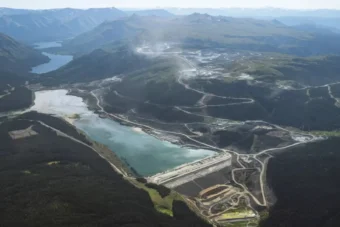
Hecla Greens Creek Mine on Saturday, Oct. 26, 2024. (Clarise Larson/KTOO)

Hecla Greens Creek Mine just got the green light for an expansion that could extend mine operations for up to another 18 years. The U.S. Forest Service officially permitted the project on Admiralty Island on Thursday.

After nearly five years of planning and public review, Greens Creek is now allowed to build more storage for tailings — the ground-up rock that’s leftover after the extraction of valuable metals like gold, zinc and silver. 

Greens Creek is the nation’s largest silver mine and one of Juneau’s most prominent and profitable employers. The expansion approval comes with new requirements for environmental oversight.

According to Forest Service geologist Matthew Reece, a number of individuals and environmentalists have expressed concern about the mine’s potential to contaminate the environment in Admiralty Island National Monument where it operates. 

“One of the things that we heard loud and clear was that folks really wanted to see a concrete plan for mitigation and monitoring of fugitive dust leaving the tailings facility,” he said.

At Greens Creek, waste rock is temporarily stored in large outdoor piles before it is moved underground for long-term storage. That means there’s potential for fine particles containing heavy metals to blow off into the surrounding forest and waterways. That’s known as fugitive dust.

The mine does have measures to mitigate fugitive dust already, but moving forward they have to implement a new plan to do even more about it. 

New ideas proposed in the plan include misting the tailings piles with water to weigh down dust particles and reducing the amount of exposed tailings during the winter months, when blustery conditions might spread dust further. The Forest Service has even committed to measuring the dust to make sure the mine is cutting down on how much spreads.

Another new piece of environmental oversight is the establishment of a collaborative monitoring panel, which will bring together representatives from the Forest Service, Hecla, state and federal environmental agencies and the nearby Tribe and Tribal Corporations of Angoon and Kootznoowoo, Inc.

Reece says the group is meant to introduce more transparency into the mine’s potential environmental impacts, especially near sensitive environments that communities like Angoon rely on for subsistence. 

“The idea is to have a collaborative working group reviewing and making recommendations for potentially additional monitoring. This is going to be a pretty heavy lift,” he said.

Reece said the Forest Service will be working over the next couple of months to bring stakeholders together and come up with a more specific plan about what the panel will work on. In the meantime, Greens Creek is working to acquire the necessary permits to break ground sometime next year.

Biden administration plans new limits on oil leasing in Alaska’s Arctic National Wildlife Refuge

The Canning River, which flows on the western edge of the Arctic National Wildlife Refuge into the Beaufort Sea, is seen from the air on Aug. 23, 2015. The coastal plain of the refuge, through which the river flows, is the subject of new rules proposed by the Biden administration to minimize the environmental impact of legally mandated oil leasing there. (Photo by Katrina Liebich/U.S. Fish and Wildlife Service)

Oil companies could buy oil leases in the Arctic National Wildlife Refuge, but with new restrictions, under a plan released Wednesday.

At least 400,000 acres in the refuge’s coastal plain would be available for oil and gas leasing, but only in areas deemed to have high potential for holding hydrocarbons and only under some new environmental restrictions to protect wildlife and other resources, according to the preferred plan released by President Joe Biden’s administration.

The plan, detailed in a supplemental environmental impact statement led by the U.S. Bureau of Land Management, proposes much more limited oil development than what was authorized by the administration of former President and now President-elect Donald Trump.

The fate of the refuge’s coastal plain has been subject of hot debate for decades, pitting desires for oil development in a new part of Arctic Alaska against desires for environmental protection, including protection of the calving grounds of the huge Porcupine caribou herd.

With Trump set to return to the White House, the area is back in the spotlight. He has declared intentions to reopen the area to drilling. He has claimed, falsely, that it holds potential for more oil than what is in Saudi Arabia.

He referred to the refuge in a September town hall event in Michigan, though he confused it with Bagram air base in Afghanistan. “We have Bagram in Alaska, they say it might be bigger than all of Saudi Arabia,” he said at the time.

Environmentalists are expecting a tough fight over the refuge in the coming years.

“The coastal plain is clearly something in the crosshairs of the Trump administration,” said Cooper Freeman, Alaska director of the Center for Biological Diversity.

Freeman noted that the 2021 lease sale drew little industry interest. Nonetheless, “It’s going to be the fight of our lives to keep the Arctic Refuge protected from development,” he said.

The Biden administration’s new environmental study was launched in response to legal challenges against the Trump plan, and it is intended to correct what the Biden administration characterized as deficiencies in studies done by the Trump administration that led to a January 2021 auction that sold nine leases.

No major oil companies submitted bids, and no exploration work took place on the leases that were sold. The main bidder was the Alaska Industrial Development and Export Authority, a state development agency, which picked up seven leases. An Anchorage real-estate company bought another, and a small oil company bought one. The latter bidders relinquished their leases voluntarily, and the Biden administration canceled the AIDEA leases, citing the need for better environmental analysis.

Although Biden, Interior Secretary Deb Haaland and others in the administration oppose oil development in the refuge, a second lease sale is required by law.

The Tax Cut and Jobs Act of 2017, signed by Trump, mandates two lease sales offering at least 400,000 acres be held before the end of 2024.

The main differences between the Biden administration’s chosen alternative for leasing and that pursued by the Trump administration concern protections for caribou, polar bears, marine and freshwater areas and ice-rich permafrost.

One major difference is the limit on the areas within the coastal plain that may be leased. Under the new preferred plan, tracts offered for leasing would be concentrated in the northern and western part of the 1.5 million-acre coastal plain; much of the eastern and southern area is withheld from leasing because of use by the Porcupine Caribou Herd.

Another difference is a new limit of 995 acres for surface disturbance, down from the 2,000 acres allowed under the Trump plan.

Caribou graze on July 9, 2019, on tundra plants growing on the coastal plain of the Arctic National Wildlife Refuge. The animals are in the Porcupine Caribou Herd. A new environmental study released by the Biden administration recommends more protections for the Porcupine herd, which packs into the refuge coastal plain during calving season. (Photo by Andrea Medeiros/U.S. Fish and Wildlife Service)

A third notable difference is the preferred alternative’s restriction on seismic exploration, which employs heavy equipment on the surface to send soundwaves into the earth to help map out geologic structures. Under the new preferred alternative, seismic exploration would be limited to leased tracts; under the previous Trump administration plan, seismic exploration was to be allowed throughout the entirety of the coastal plain. Although seismic exploration was proposed, none was carried out.

The exact date of the lease sale to be held is yet to be determined. It would follow the next step in the administrative process, which is the issuance of a formal document called a “record of decision” that makes the choice final. The record of decision will come no earlier than 30 days after the notice of the supplemental environmental impact statement is published in the Federal Register. Publication is scheduled for Friday, the BLM said.

The Biden administration’s move toward new restrictions on refuge leasing drew sharp criticism from some ardent supporters of oil development there.

Voice of the Arctic Iñupiat, a regional group that has generally advocated for oil development across the North Slope, said in a statement that local leaders are unified in their opposition to the new plan, singling out the effect on the village of Kaktovik.

“It seems that once again the people of the North Slope are being told that our voices and lived experience are insufficient, and that federal laws passed by Congress mean little in the eyes of the Biden administration’s Department of the Interior (DOI),” North Slope Borough Mayor Josiah Patkotak said in the statement. “The federal government’s latest actions are shameful and will have serious consequences for Kaktovik and the North Slope. With this latest development, DOI has soundly rejected the opportunity to partner in our effort to aptly balance development and preservation in our region.”

Rex Rock Sr., president of the Arctic Slope Regional Corp., also criticized the new restrictions.

“There is a majority consensus of elected leadership across the North Slope, including Kaktovik, that responsible resource development is essential to maintaining our economic security and way of life,” he said in the Voice of the Arctic Iñupiat statement. “We remain united against any attack on our self-determination.”

Kaktovik, which has about 270 residents, is the easternmost Alaska North Slope community and close to much of the caribou-calving area that the new plan has designated for protection. It is also a center of ardent support for drilling in the refuge coastal plain, as its village for-profit corporation owns land that could be developed. Arctic Slope Regional Corp., the regional Native corporation for the North Slope, has the mineral rights on that Native-owned land, and it also generates much of its income from North Slope oil operations.

In Tuesday’s election, 78% of Kaktovik’s presidential vote went to Trump, according to preliminary results from the Alaska Division of Elections.

Alaska Natives who oppose oil development in the refuge said Wednesday they will continue their fight.

In a statement, the Neets’ąįį Gwich’in Tribal governments of Arctic Village and Venetie, Gwich’in Athabascan communities near the southern edge of the refuge, renewed their call to permanently ban oil development in the refuge.

“As people connected to the Arctic Refuge for our cultural, spiritual, and subsistence purposes, we will never accept any disruption of this land,” RaeAnn Garnett, first chief of Native Village of Venetie Tribal Government, said in the statement. “Though the FSEIS is an improvement on the previous EIS, we continue to urge Congress to create permanent protections for this land that our people have lived in concert with for countless generations.”

“It is inarguable that the Arctic Refuge EIS released by the Trump Administration was inadequate and completely disregarded the impact any oil and gas activities would have on our Tribal communities who rely on that land,” Galen Gilbert, first chief of Arctic Village Council, said in the statement. “The recently released FSEIS is an improvement on the initial assessment. However, this is only a step towards protecting our Sovereignty and right to continue our traditional way of life that depends on this sacred place.”

In Tuesday’s election, over 90% of Arctic Village voters supported the Democratic ticket of Kamala Harris and Tim Walz, and 72.5% of Venetie voters also supported the Harriz-Walz ticket, according to preliminary results from the Division of Elections.

Sen. Lisa Murkowski, R-Alaska, was the lead author of the legislative language that requires the lease sale. Speaking to reporters Wednesday, she said she fears that the plan “effectively crippled and made it not viable for anybody to bid on with the conditions that they have put in place.”

She also said potential bidders may look elsewhere as Trump opens up federal land where development is less costly. She wants oil companies to come to Alaska, she said “But I think we need to also recognize that perhaps we’re not the only game in town,” she said.

The Center for Biological Diversity’s Freeman said the Arctic National Wildlife Refuge coastal plain is likely to be only one area over which environmentalists will be battling with the incoming Trump administration.

“We are definitely going to be playing some serious defense to protect what’s left and all we love and cherish across Alaska,” he said.

Reporter James Brooks contributed to this article.

This article was republished with permission from Alaska Beacon.

New road for Canadian mine worries Wrangell residents downstream

Up the Stikine River near Shakes Glacier on July 19, 2024. (Colette Czarnecki/KSTK)

The Canadian government said in September that it will spend approximately $15 million on a 27-mile road in support of critical minerals at Galore Creek Mine. The road will stretch between two different work camps on the Galore Creek Mine’s property and will bring the copper, silver and gold mine closer to operation.

This news is hard to hear across the border, since the site is very close to the Stikine River headwaters in Southeast Alaska. Some Wrangellites are very concerned about this development near a waterway they depend on.

Tlingit and Tahltan tribal member Christie Dascawah Jamieson was born and raised in Wrangell, located at the mouth of the Stikine River. She said she and her husband fish and hunt as much as they can.

“If this copper and gold mining project comes into play, it’s going to be a huge threat to our way of living,” she said. “Not only to Wrangell, but Petersburg (too), we both share the Stikine River.”

She said she has fond childhood memories going up and down the Stikine.

“It was one of the best times of my life,” Jamieson said. “I just cannot imagine the river being totally devastated by this copper and gold mining project.”

Jamieson said she worries that the mine will destroy the river and surrounding land and that the mine’s owner, Galore Creek Mining Corporation, won’t clean up after extraction.

“(If) they don’t clean up what they have ruined and they leave it for somebody else, it’s just left behind,” she said. “The land and the beauty and the wildlife and the fish are all gone; and it’s so, so sad, because that’s our way of life.”

Galore Creek Mine has been in the planning stages for almost 20 years.

It’s changed investors, been put on hold due to capital costs skyrocketing and has been waiting on negotiations between British Columbia and the Tahltan Nation – the tribe who owns nearby land on the B.C. side of the border.

KSTK contacted Galore Creek Mine by phone and email. An interview was pending at publication time.

Alanah Connie with the B.C.’s Ministry of Energy, Mines and Low Carbon Innovation said the road funding is coming from the federal government and to call the country’s natural resources department.

Marie Martin, senior communications advisor with Natural Resources Canada, also responded the day of publication and said the agency is looking into KSTK’s request.

The Southeast Alaska Indigenous Transboundary Commission is a coalition of 15 tribes on the Alaska side of the border advocating for having a voice in the mining.

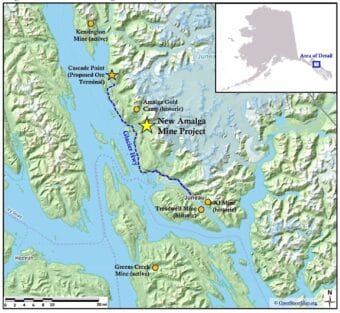
The Galore Creek Mine in Canada is 25 miles from the Alaskan border northeast of Wrangell. (Courtesy Galore Creek Mining Corp.)

President Esther Aaltséen Reese said Wrangell will be directly impacted by the mining project. Galore Creek is 25 miles from the border and the entire project drains into the Stikine River.

“We consider that border to be a colonial border,” she said. “It did not exist in the time of our ancestors and we were allowed to care for our lands on both sides of the border. Now, because of that border, the tribes downstream are restricted and we aren’t given rights to have a say in what happens to projects that will directly impact us.”

She said the Stikine is literally the lifeblood for Wrangell, in terms of subsistence foods and recreation.

Reese said for them not to have a voice in the decision-making is equivalent to a human rights violation. The tribal organization is asking the Inter-American Commission on Human Rights to pause another mining project up the Unuk River near Ketchikan for similar reasons. Reese said they – the Tlingit, Haida and Tsimshian – are salmon people and she doesn’t want her culture only to know salmon as a myth.

“There was a young woman at one of the conferences that said in their streams that had been polluted, salmon now only exists in their myths,” Reese said. “That is what we’re fighting against. We want to make sure that we’re protecting our salmon.”

The coalition’s Executive Director Guy Archibald said it’s important to protect salmon because it not only feeds the culture and people, but also the forest. He said that nature is good at balancing itself after an occasional catastrophic impact. But the Galore Creek mine would put consistent stress on the environment.

“Salmon and ecosystems cannot tolerate constant, low-level stress,” he said. “I mean, we know what that does to our immune system, digestive, nervous system. But that’s what’s happening here and we’re losing our salmon. We’re watching an extinction event.”

He said that the British Columbia government is aware of the detrimental outcome the mine would produce.

“The B.C. government has basically declared these upper head waters as a sacrifice zone,” Archibald said. “They know they’re going to be environmentally damaging. They’re willing to take that damage in order to pump up their economy.”

Alanah Connie, communications manager for B.C.’s Ministry of Energy, Mines and Low Carbon Innovation, said the B.C. government does not use the term “sacrifice zone.”

Archibald said the amount of gold, copper and silver that the mine will produce is minimal compared to the waste that will threaten the area.

“The mine talks about it being a copper mine, gold mine, silver mine, critical minerals,” he said. “All the mines are critical minerals. Now it’s just a talking point, but you know, looking at when we talk about a low grade mine, their copper concentration is 0.72% per ton of copper.”

That means the company will get nine pounds of copper when they mine one ton of rock. The amount of gold and silver would be even less. He said this minimal amount doesn’t make it a copper or gold mine, but a hazardous waste mine.

Though Canada is funding the new 27-mile road, Archibald said other roads already exist to access the mine property. He said the company has been actively building the road and bridges over the last three years.

He said that a major concern is the mine waste or tailings that the mine will produce.

“The mines are going to build the tailings’ dams or the tailings’ pile or the water treatment is going to have to exist in perpetuity, forever, and given a forever amount of time, every thing will happen: the world’s largest flood, the world’s largest earthquake,” Archibald said. “It’s all going to happen and Wrangell is directly downstream from this.”

But there could be some hope for sharing these concerns. He said the mine’s plans are changing because the owners want to move the tailings management facility to another location.

Archibald said this change would allow tribal members, Wrangellites and other communities to voice their opinions.

“The good news is it’s considered a major amendment to their mine plan,” he said. “So it will open the environmental assessment back up for public scrutiny and that should give an opportunity for Wrangell and the Southeast tribes to make their voices heard.”

He said the tribal coalition speaks with the British Columbia Environmental Assessment office on a bi-monthly basis and they have been expecting the amendment any day.

As of right now, there’s no definite timeline for when the mine will open.

KSTK attempted to contact the Tahltan Nation but it hasn’t responded.

Several key steps toward drilling in Alaska’s Arctic refuge are due before year’s end

Fall colors are seen on Aug. 24, 2015, along the Canning River on the western edge of the Arctic National Wildlife Refuge. (Photo by Katrina Liebich/U.S. Fish and Wildlife Service)

It is the season of ANWR.

On Wednesday, the board of directors for the state-owned Alaska Industrial Development and Export authority approved spending $20 million to pursue legal claims and oil leases in the Arctic National Wildlife Refuge, a stretch of potentially oil-rich North Slope land that has been protected from development for decades.

As soon as Friday, a federal judge in Anchorage is expected to rule whether the Biden administration’s decision to cancel oil leases in the refuge is legal.

On Nov. 5, Americans will decide between Kamala Harris and Donald Trump for president. Trump has repeatedly vowed to pursue drilling in the refuge, while Harris is expected to continue the Biden administration’s opposition.

And in December, the federal government faces a congressionally imposed deadline to hold a second oil lease sale covering land within the refuge.

“I think the next two months are important for the short term, and what type of resource opportunities may be under consideration, as companies make long-term plans and future plans,” said Kara Moriarty, president and CEO of the Alaska Oil and Gas Association.

A long time coming

The Arctic National Wildlife Refuge sits between Prudhoe Bay’s oil fields and the Canadian border. Its coastal plain has long been eyed for oil potential, but the 1980 law that created the refuge states that no exploratory drilling or development can take place without congressional action.

The state of Alaska, through its congressional delegation, repeatedly tried to pass legislation opening the refuge to drilling, but it didn’t find success until 2017, when the delegation — led by Sen. Lisa Murkowski, R-Alaska, inserted critical language into a tax bill.

“I’m actually very proud of what we were able to do and how we were able to draft that,” Murkowski said in an interview this week.

That language requires the federal government to hold at least two lease sales covering land on the coastal plain. One sale has already taken place, and a second is legally required.

Oil development could generate billions of dollars in economic activity, creating jobs and revenue for the state treasury.

For that reason, drilling in ANWR continues to be a top priority of the state’s elected officials, with Democrats, Republicans and independents all voting to endorse the pursuit.

The North Slope’s local government also supports the effort, as do many people living in and near the refuge. Oil revenue and oil jobs make up a key part of the North Slope’s economy.

Voice of Arctic Iñupiat, a nonprofit formed in 2015 and representing local residents, has repeatedly supported leases in ANWR.

“It’s important from a sovereignty perspective,” Murkowski said, explaining that local residents should be able to make the decision on the issue. “It’s important to the state of Alaska from a resource perspective, and the state’s determination. It is part of the promise to us by our federal government that these lands that were set aside up there were to be reserved for oil and gas development.”

She said that even though the world is shifting away from fossil fuel energy, it still needs oil for other things.

“Why would we not wish to be able to access this resource that is needed, in a place that has the highest environmental standards and safety safeguards, with attention not only towards the environment, but to the worker and and create a base of strength, economic strength for our own country?”

But drilling poses environmental risks — to polar bears, caribou, birds and other wildlife — and environmental groups nationwide have made opposition to ANWR drilling one of their top issues.

The Gwich’in Steering Committee, which represents some people living outside the refuge, has long opposed drilling there. Subsistence hunting of caribou is a central part of Gwich’in culture.

“I think we’re all looking — from conservation organizations to the Gwich’in people and chiefs — everyone is looking for a way to find permanent, long-term protections for the refuge, so there will never be development in there,” said Peter Winsor, the committee’s interim director.

Alaska pushes the issue forward

In the last months of the Trump administration, shortly before the first ANWR lease sale, some state officials became worried that environmental opposition would deter oil companies from participating in the sale.

Former Gov. Frank Murkowski — Lisa Murkowski’s father — was among those who suggested that the state itself should bid on the sale as a backstop.

The Alaska Industrial Development and Export Authority, a state-owned corporation with directors appointed by the governor, stepped up, appropriating $20 million for bid preparation and bidding.

As it turned out, the AIDEA backstop was critical — only one oil company submitted any bids, and AIDEA was one of only three bidders overall.

After the Biden administration assumed control of the federal government, it first suspended, then canceled the leases won by AIDEA.

The other two bidders willingly surrendered their leases, but AIDEA fought on, suing the federal government to challenge the suspension and the cancellation. The state of Alaska supports AIDEA’s positions, as do the North Slope Borough, Arctic Slope Regional Corp. and Kaktovik Inupiat Corp.

Opposing them are Indigenous people who live south of the refuge, outside the borough, as well as local and national environmental groups, Canadians who rely on caribou that live for part of the year in the refuge, and Canadian environmental groups.

“This is a critical time for the Arctic and Alaska. AIDEA’s push to develop the Refuge doesn’t make financial sense, and it goes against decades of community opposition. Community health on both sides of the Alaska-Canada border is at stake,” said Sean McDermott of the Northern Alaska Environmental Center, a group that opposes ANWR drilling.

Some opponents who live outside the refuge have asked to have the coastal plain protected as important for religious and cultural reasons.

That’s been opposed by North Slope residents, including the borough mayor, Josiah Patkotak.

“We will not allow our lands to be co-opted for purposes that serve neither our people nor our future,” he wrote in an opinion column about the issue.

That argument is continuing, and AIDEA’s board voted this week to prepare bids for the second lease sale, but a final go/no-go decision is likely in December, at the board’s next scheduled meeting.

Its support for ANWR drilling and various other projects in Alaska has turned AIDEA into a target for environmental and social campaigns that question the agency’s effectiveness.

“We’re definitely planning a larger campaign against AIDEA,” Winsor said.

Through ads, talking to Alaskans, and lobbying legislators, the goal is “basically try to work towards dismantling this whole colossus of a mistake that AIDEA is,” he said.

Critical court decision could come by Friday

Even as AIDEA and others prepare for the second lease sale, U.S. District Court Judge Sharon Gleason is expected to release a key legal decision about the legality of the Biden administration’s suspension of the first sale’s results.

Attorneys representing AIDEA and the federal government have agreed that a decision by Friday is important because if the first lease sale is canceled, that land could be put up for lease again during the second sale.

If Gleason’s ruling doesn’t cancel the first sale, it could clear the way for AIDEA to begin seismic surveying and other preliminary work on its leases in the refuge.

To date, only a single exploratory well has been drilled in the refuge, and the results from that work weren’t promising, the New York Times said in 2019.

Seismic data could remove the veil of uncertainty, showing where — and how much — oil exists within the coastal plain. That could attract oil companies’ interest in the area.

But regardless of how Gleason rules and who wins the upcoming decision, an appeal to the 9th Circuit U.S. Court of Appeals — and possibly to the U.S. Supreme Court — is expected, and the legal issues likely will take years to resolve.

In the meantime, the march toward a second lease sale will continue.

Second sale, required by federal law

When the Biden administration suspended the first ANWR leases, it began a new environmental study, a first step toward the second lease sale required by the 2017 law.

Initially, the Interior Department said that supplemental study would be done at the start of 2024. It’s now been delayed twice, with officials now saying in legal documents that it won’t be done until the “fourth quarter” of the year.

As a result, the next two months are likely to be filled with a series of incremental steps: the final version of the environmental study, a 30-day waiting period, a final record of decision, then official notice of the sale and the sale itself.

The timelines for all of this put the federal government right up against the legal deadline for the second lease sale.

“My real fear is, they will, quote, follow the law, but they will have so fouled up this process toward the end, that they may technically be able to say they met the requirements of the law, but they’ve run out the clock,” Murkowski said.

“I’m not feeling optimistic about where we are despite the clear intent of the law. And that’s where I get so frustrated,” she said.

An Interior official told the Anchorage Daily News this week that it still intends to hold the second sale. Drilling proponents think the second sale will happen, but they expect rules that make development almost impossible.

“We’re not really putting a lot past them, but we think there will be a sale. The conditions of the sale, we’ll have to keep a real close eye on,” Ruaro told AIDEA’s board on Wednesday.

“We’re hoping that it’ll be as restrictive as possible,” said Winsor of the Gwich’in Steering Committee.

As in the first sale, there’s a key unanswered question: Amid the restrictions and uncertainty, who will bid?

AIDEA is almost certain to make offers, but it isn’t clear whether anyone else will agree to shoulder the economic, legal and political unknowns that accompany a successful bid.

One of the biggest uncertainties is likely to be resolved by the time of the sale — this year’s presidential election.

Presidential election’s consequences are big for ANWR

If Kamala Harris wins the presidential election next month, observers expect her to continue the Biden administration’s approach to ANWR.

“If Harris gets in there, I think we’ll be in position to do much more protection for the Arctic and work on things that we honestly need to work on, like tourism and the blue economy, and things that go away from not just oil and gas,” Winsor said. The “blue economy” is a term for the sustainable use of ocean resources.

Speaking to the AIDEA board on Wednesday, Ruaro said, “If it’s a continuation of the current administration, they oppose development in ANWR. They’ve made that very clear. … So that sets up a very, probably protracted litigation scenario.”

Donald Trump, conversely, has repeatedly said he wants to keep ANWR open for drilling. He’s made the issue one of the refrains of his campaign stump speech and reiterated his support this week in a phone call with Nick Begich, Alaska’s Republican candidate for U.S. House.

“We’re gonna tap the liquid gold that’s under there, and we’re gonna drill, baby, drill. We’re going to make Alaska rich and prosperous with jobs all over the place,” Trump said.

Even if Trump wins and presses ahead with ANWR leasing, a successful oil development would take years, if not decades, to begin production.

And that’s only after a lot of “ifs”  are answered — if there’s oil to be drilled, if the cost of drilling is low enough to make it economically viable, if the legal issues can be resolved, if the state and federal governments stay supportive.

Given those uncertainties, will ANWR ever be developed?

“It is hard, but I can guarantee you that one way it will not ever be developed is if there are no leases that are made available,” Murkowski said.

“No,” said Windsor. “(Oil companies are) not interested, and there are no banks or insurance companies left that will finance or insure anything in the refuge. They think it’s too risky. They don’t want to have bad publicity.”

Moriarty said it’s too soon to tell. During the Obama administration, it seemed far-fetched that there would be oil development in the National Petroleum Reserve, but work continued and it eventually happened, she said.

“I don’t know that you want to take what we believe to be, at a minimum, 10 billion barrels of recoverable oil off the table for discussion indefinitely,” she said, citing a figure that’s close to the average estimate in federal studies.

“Do I think that ANWR is going to be developed overnight, when the companies are currently focused on state land and the Pikka project and the Willow project and things to the west? Probably not. But do we want to take the potential off the table indefinitely? I don’t think so.”

Site notifications
Update notification options
Subscribe to notifications