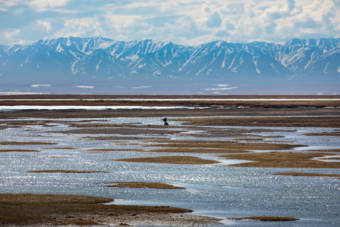
Research biologists pause among the wetlands of the coastal plain, with the Brooks Range in the background. (Lisa Hupp/USFWS)
The board of the state-owned Alaska Industrial Development and Export Authority voted unanimously Wednesday to spend up to $20 million to prepare and possibly submit bids in an upcoming oil lease sale in the Arctic National Wildlife Refuge.
The Bureau of Land Management, which will administer the sale, is required to hold it in December under provisions of a 2017 law signed by former President Donald Trump.
President Joe Biden and his administration oppose that sale and canceled its results. The corporation is challenging that cancellation in court while it prepares for a second round of bidding. Thus far, the BLM has not published details for the upcoming sale.
While Wednesday’s vote allows AIDEA staff to prepare bids, board chair Dana Pruhs told AIDEA executive director Randy Ruaro that he expects a presentation to the board at its December meeting “before actually pulling the triggers.”
Other board members did not speak before the vote, which followed a three-hour, closed-door executive session.
Drilling in the refuge is strongly opposed by environmental groups and residents of Arctic Village, who live south of the refuge but hunt caribou that inhabit the area.
No public testimony preceded Wednesday’s vote, but several opponents said afterward that they were listening by phone and unable to offer testimony because of a problem with AIDEA’s phone line. Many submitted written comments in opposition.
Drilling is supported by residents of Kaktovik, the community within the refuge, as well as the government of the North Slope Borough, the Alaska Legislature and Gov. Mike Dunleavy.
Ruaro told the board that even though the Biden administration clearly opposes drilling as well, the law requires a sale, and the Interior Department has said it will hold one.
“We would not be surprised, given the actions of BLM and the Department of Interior to date, if there were some conditions placed into the sale that would make it virtually impossible to develop ANWR. It wouldn’t surprise us,” Ruaro told the board. “We’re hoping they don’t do that, but we have valid leases that they arbitrarily canceled. So we’re not really putting a lot past them, but we think there will be a sale.”
Before the 2021 lease sale, former Gov. Frank Murkowski urged AIDEA to act as a backstop in case oil companies were uninterested in drilling within ANWR.
After Wednesday’s meeting, Ruaro said it’s too soon to say whether AIDEA will play that role again. It may find a business partner to do a cooperative bid on some tracts, he said.
ANWR is worth pursuing because of its oil potential, Ruaro said.
“We think there are basically large reservoirs over there that make sense to develop. They’re economic to develop, and they would provide jobs and revenue for the state,” he said.
A successful bid could allow AIDEA to conduct surveys that would reveal the area’s oil potential, encouraging development. Even if no oil companies are interested in ANWR right now, a successful find could change that.
Development in ANWR could also encourage similar drilling on nearby state lands by extending the network of petroleum pipelines across the North Slope.
“We would be preserving the ability to develop what we think is a very highly potential area for billions of barrels of development,” Ruaro said. “Development in ANWR could be part of a larger series of developments on both state land and in state offshore waters.”
The lower Stikine River is seen in British Columbia, Canada, in an undated photo. (Photo by Marek Stefunko/Getty Images Plus)
A major copper-and-gold mining project in the rugged mountains of northwestern British Columbia — upstream from a Southeast Alaska fishing town — is poised for a boost from the Canadian government.
Canada’s department of natural resources last month announced that it plans to inject about $15 million U.S. into a massive copper and gold development just 25 miles from the Alaska border. The project is perched above tributaries of the Stikine River — a major salmon-bearing waterway that flows into Alaska’s Inside Passage between the small towns of Wrangell and Petersburg.
The public funds would pay to build a key 27-mile stretch of road at Galore Creek, which is evenly owned by two major mining corporations, Teck and Newmont. The project is located within the traditional territory of the Tahltan First Nation.
Galore Creek sits on more than 600 square miles of mineral claims, including areas directly alongside the glacially fed Stikine.
The new government-funded road, providing access to a proposed processing site, “will help unlock the project and the broader region’s substantial critical mineral potential,” Bernard Wessels, an executive at Newmont, said in a prepared statement last month.
Canada’s push to help Teck and Newmont unearth some 12 billion pounds of copper and 9 million ounces of gold at Galore Creek is part of a bigger effort by the country’s federal government and British Columbia’s provincial government to promote mining in the remote, largely roadless mountains near the Alaska border.
In the past three months, Canada and B.C. have announced that they’re directing roughly $185 million toward mining-related infrastructure in the area. A good chunk of that money comes from a national $1 billion fund intended to boost production of minerals that Canadian officials have deemed critical for energy and national security.
The investments have added to concerns long held by Alaska Native leaders and conservationists who live and fish downstream of Galore Creek and other projects that are under development.
“Rather than honoring Indigenous sovereignty and its treaty obligations, Canada is staging our traditional homelands and waters to be the sacrifice zone to benefit the British Columbia mining industry and its shareholders,” Richard Chalyee Éesh Peterson, president of Southeast Alaska’s largest tribal government, the Central Council of the Tlingit and Haida Indian Tribes of Alaska, said in a statement to Northern Journal.
Multiple rivers in the region span the U.S.-Canada border, and tribal governments and environmental groups on Alaska’s coast fear that new mines in northwest B.C. could pollute those rivers and harm lucrative and culturally vital fisheries. Concerns mounted over the summer after a cyanide spill at a major Canadian gold mine in the watershed of the Yukon River, Alaska’s biggest transboundary waterway.
Following that spill, Alaska’s congressional delegation sent a letter to the Biden administration urging the president to support “binding and enforceable international protections and financial assurances for any potential impacts in transboundary watersheds,” including the Stikine.
But the letter stopped short of calling for some of the measures requested by Southeast Alaska tribes and advocates.
Those include a permanent ban on dams holding back mining waste above transboundary salmon-bearing rivers. They also include a temporary pause on mineral exploration, development, and permitting on the Canadian side of those watersheds until Canada and the U.S. reach an agreement on protections developed with Indigenous governments. .
The tribally led Southeast Alaska Indigenous Transboundary Commission has said that Canada and B.C.’s regulatory systems don’t adequately protect transboundary rivers and traditional lands — and that those governments have failed to obtain consent from Alaska tribes.
“This isn’t something that they’re building in some far-off area. It’s literally in our backyard,” Esther Aaltséen Reese said of Galore Creek. Reese is the commission’s president and the administrator of the tribal government in Wrangell, the Wrangell Cooperative Association.
In addition to the Galore Creek road, Canada’s federal government intends to spend money on highway upgrades and a study of power transmission lines linking northern B.C. and the Yukon Territory. That infrastructure is intended to support copper, molybdenum, nickel, cobalt, tungsten and zinc mining projects, according to Natural Resources Canada.
In particular, according to a spokesperson for the federal agency, the highway upgrades could aid seven mining projects in B.C. Those include Galore Creek; another big copper and gold project near the Stikine River called Schaft Creek; and KSM, an enormous proposed gold and copper mine in the transboundary Unuk River watershed, south of the Stikine.
The power line project, meanwhile, could support eight mining projects in various stages of development in the Yukon Territory, including a few in the transboundary Yukon River watershed. It could also benefit two more mineral developments in northern B.C., according to the agency.
Natural Resources Canada says the highway project would also boost public safety by widening shoulders, creating new pullouts and expanding Wi-Fi access on three roads in northwest B.C.
A transmission line runs along Highway 37 in northwest British Columbia. To boost the mining industry, Canada’s federal government and the B.C. provincial government are funding upgrades to the highway and assessing whether to extend the power line. (Max Graham/Northern Journal)
Those improvements have been endorsed by representatives of several First Nations in the region — including the Tahltan, whose traditional land covers a large swath of northwest B.C.
But the Tahltan Nation also wants to “control the pace and scale of development in our territory,” said Beverly Slater, president of the Tahltan Central Government.
The mining industry has provided jobs for many Tahltan citizens, Slater said in a phone interview, though she also emphasized the need to protect water and animals like moose, elk, and salmon.
“We’re not unlike other nations having to respond to the encroachment of the mining industry and demand for critical minerals,” Slater said. “Yet we’re trying to protect as much as we possibly can for future generations.”
The Tahltan government is currently negotiating with the B.C. government to establish a joint framework for reviewing proposed changes to the Galore Creek project. That would be the third in a series of joint decision-making agreements between the provincial and First Nation governments on mining projects in Tahltan territory.
In 2006, Tahltan leaders signed an agreement with NovaGold, a company with offices in Salt Lake City and Vancouver that owned half of Galore Creek at the time.
The agreement, which the project’s owners say is still in effect, guaranteed minimum annual payments of $1 million to a Tahltan trust fund, or as much as a 1% royalty on mineral sales revenue once the mine is operating. It also calls for cooperation between the First Nation and the company during the environmental review and permitting process.
Galore Creek received a key environmental approval in 2007, paving the way for construction of an open-pit mine. But development stopped by the end of that same year, owing to higher-than-anticipated costs.
At the time, Teck and NovaGold predicted that building the mine could cost $5 billion.
NovaGold, which also owns half of the Donlin Gold project in Southwest Alaska, agreed in 2018 to sell its stake in Galore Creek to Newmont, an American company, for up to $275 million.
Teck, which owns the other half of Galore Creek, is headquartered in Canada but also operates the huge Red Dog mine in Northwest Alaska, in a partnership with the Alaska Native-owned corporation NANA.
Galore Creek Mining Corp. — the joint venture between Teck and Newmont — is now working on a new study of the project’s potential. It’s due to be completed next year, according to the company’s website.
The company also says it intends, by the end of this year, to seek regulatory approval for a number of changes to the original project, including increased production and a new location for storing waste.
A Galore Creek spokesperson did not respond to requests for comment.
A spokesperson for British Columbia’s Ministry of Environment and Climate Change Strategy declined to comment, citing a policy in the run-up to the province’s Oct. 19 election.
That agency oversees environmental assessments for major mining projects in the province.
“I can see where Canada has a lot to gain,” said Brenda Schwartz-Yeager, a lifelong Wrangell resident who runs riverboat tours on the Stikine River. “But we stand everything to lose here.”
The Stikine is “one of the last great really wild rivers left on the planet,” she added. “So it’s a bit of a conundrum, right?”
Northern Journal contributor Max Graham can be reached at max@northernjournal.com. He’s interested in any and all mining related stories, as well as introductory meetings with people in and around the industry.
This article was originally published in Northern Journal, a newsletter from Nathaniel Herz. Subscribe at this link.
Rep. Tom McKay, R-Anchorage, speaks Wednesday, May 15, 2024, on the floor of the Alaska House of Representatives. (Photo by James Brooks/Alaska Beacon)
Anchorage Republican Rep. Tom McKay submitted a letter of resignation Friday, a step toward taking a job with the Alaska Oil and Gas Conservation Commission, then reversed himself after being alerted to a possible constitutional conflict that would forbid the move.
McKay, a former ConocoPhillips petroleum engineer with extensive oil and gas experience, is now waiting for a legal determination that will decide whether or not he can become one of three commissioners in charge of the body that regulates oil and gas issues in the state.
McKay said Monday that Gov. Mike Dunleavy was prepared to name him to the commission, filling a seat vacated by the resignation of Brett Huber.
Shortly after McKay resigned to take the position, he was alerted to a possible problem. Article II, Section 5, of the Alaska Constitution says that during their term, “no legislator may be nominated, elected, or appointed to any other office or position of profit which has been created, or the salary or emoluments of which have been increased, while he was a member.”
In May, the Legislature voted to pass Senate Bill 259, which increases the pay of select state employees. It wasn’t immediately clear whether that bill would also affect the AOGCC.
If it does, McKay would be ineligible for the job until a year after he leaves the Legislature. If it doesn’t, he could take the job immediately.
“The Department of Law and the governor and staff are aware of this, and so we put a hold on everything. I rescinded my resignation,” McKay said Monday.
In coming years, the AOGCC is expected to play a critical role in the regulation of the state’s new carbon sequestration program, which will involve the injection of carbon dioxide into underground oil and gas reservoirs. The AOGCC also must monitor the North Slope’s aging pipeline infrastructure for corrosion.
“Partisan politics aside, I think I could do a really good job in there with the commission,” he said. “I think I check all the boxes. I think I would be excited about the challenge. And I was really looking forward to it. And then we hit this speed bump.”
A spokesperson for the governor’s office said only that they will make an announcement when an appointment is officially made. The leader of the state House said McKay’s resignation never took effect.
“Tom did do a letter of resignation, but … within an hour, he rescinded that, so it wasn’t accepted,” said Speaker of the House Cathy Tilton, R-Wasilla.
Under state law, a resignation is effective on the date listed in the resignation letter. McKay listed Friday as the date of his resignation, but because it was rescinded that same date, Tilton said, it didn’t take effect.
Had it been valid, McKay’s resignation would have mostly been a matter of procedure; the Legislature is not scheduled to meet before new lawmakers are seated in January, and because of the impending November election, Dunleavy is not permitted to name a temporary replacement.
“There wouldn’t be anybody taking the seat, because it’s too close to an election, unless there were special circumstances, if there was a special session,” Tilton said.
Tilton said she expects attorneys from the Alaska Department of Law and the Legislative Affairs Agency will determine in the next few days whether SB 259 applies to the AOGCC commissioners.
McKay said that if he has to wait a year for the AOGCC position, he’ll likely have to find another job instead. He can’t afford to wait a year.
“Alaska is not an easy place to live if you’re not making a decent living,” he said.
One of the dead fish, a Dolly Varden, discovered by state biologists near a Juneau area gold mine in August. The biologists noted hemorrhaging near the head. (Alaska Department of Fish and Game photo)
On the morning of Aug. 9, state biologists discovered dozens of dead fish in a creek near the Kensington gold mine in Southeast Alaska.
Scientists from the Alaska Department of Fish and Game say their observations — and the fact that the die-off occurred downstream of a wastewater treatment plant at the large mine — suggest that the event stemmed from a water quality problem. Mine workers also used an unapproved explosive at Kensington a day before the dead fish were found, according to federal officials.
But nearly two months later, state regulators at the Department of Environmental Conservation say they still haven’t determined what killed the fish, including Dolly Varden char, a small freshwater species called slimy sculpin, and one pink salmon.
DEC, which regulates mining wastewater and investigates chemical spills, is still waiting for water quality data from the mine’s operator, according to Gene McCabe, the director of the agency’s water division.
“Of course, everybody involved has hunches,” McCabe said. “They have thoughts. They have likely causes. But none of that is substantiated yet.”
An aerial view of part of Southeast Alaska’s Kensington gold mine. (Photo by James Brooks)
Coeur, the multinational company that operates Kensington Mine about 40 miles north of Juneau, is “still awaiting results from multiple independent laboratories with varying timelines,” company spokesperson Rochelle Lindley said in an email this week.
She would not say exactly when Coeur expects to receive results from the different labs.
Tribal governments and other observers in the area of the mine, meanwhile, say that they’ve received little information from state regulators.
A few days after the incident, the U.S. Forest Service, a federal agency that manages the land around Kensington, notified leaders of the region’s largest tribal government, the Central Council of Tlingit and Haida Indian Tribes of Alaska. The agency also, a few days later, provided them with some preliminary information, according to Jill Weitz, who works in government affairs for Tlingit and Haida.
While Weitz said she appreciated the federal notification, she has been frustrated by what she described as a lack of communication from state agencies. Officials from Chilkoot Indian Association, another tribal government in the area, also said the state did not formally alert them to the spill.
It’s the second time this year that tribal officials have raised concerns about their access to information after an incident in the vicinity of Kensington.
In March, Tlingit and Haida’s president, Richard Peterson, urged state and federal regulators to improve communication after the tribe was not notified — for a month — about a January tailings spill at the mine, which appears to be unrelated to the August fish kill.
“The lack of timely communication and transparency in such matters undermines our ability to effectively respond and protect our tribal citizens and ancestral lands,” Peterson wrote.
The idea that the state hasn’t kept local tribes apprised is “problematic,” said state Sen. Jesse Kiehl, a Democrat from Juneau — though he added that state agencies have provided information to his own office. He also applauded Coeur for being the first to notify him and for being responsive to questions.
The biologists from the Department of Fish and Game discovered the dead fish during a routine salmon survey in Sherman Creek, which flows into the Inside Passage between Juneau and the towns of Haines and Skagway to the north.
Kensington mine’s wastewater discharge into Sherman Creek. (Alaska Department of Fish and Game photo)
Coeur discharges treated mine water directly into Sherman Creek, at a point above where the fish appear to have died. Other Dolly Varden were found alive above the mine’s discharge, the biologists wrote in a Sept. 6 report.
Of the dead fish the scientists collected, there was “no obvious body composition or cloudiness in the eyes, suggesting recent death,” wrote one of them, Erika King. They also saw hemorrhaging on multiple Dolly Varden.
Immediately, King wrote, the biologists notified a Coeur official and asked the company to take water samples. The official reported no unusual operations at the water treatment plant, and company staff collected more dead fish samples.
The circumstances — multiple species of fish dead below the treatment plant outfall and none dead above — “strongly suggest water quality or toxic issues delivered by the treatment plant effluent,” according to a state pathologist, Ted Meyers, whose findings are appended to King’s report. Meyers ruled out infection as the cause of death.
The department’s lab work did not involve water quality or fish tissue testing for toxic chemicals, according to Department of Fish and Game spokesman Joe Felkl.
Whatever killed the fish appeared to be a short, isolated episode, Coeur and state biologists said.
In August, Lindley, from Coeur, told Northern Journal that the company immediately notified regulators when the fish were discovered, coordinated with agencies to send samples to third-party labs for testing and was continuing to monitor the stream.
McCabe, from the state Department of Environmental Conservation, said it’s standard practice across the state for mining companies to collect and self-report water quality data. Their monitoring and testing plans must be approved by state regulators, he added.
“All routine water quality testing has been within permit parameters,” Lindley said in an August email.
Coeur did not respond to follow-up questions this week about an unapproved explosive that was reportedly used underground at Kensington on Aug. 8, the day before the biologists’ discovery. The explosive was noted in an August email from the Forest Service to tribal officials.
A Forest Service spokesperson this week referred requests for information to Coeur.
McCabe said the agency did not have enough information to say whether use of the explosive could be tied to the dead fish.
“At this point, without any water quality data, it’s pure speculation,” McCabe said. “We want to avoid speculating about any potential link or cause until we have some data to evaluate.”
Northern Journal contributor Max Graham can be reached at max@northernjournal.com. He’s interested in any and all mining related stories, as well as introductory meetings with people in and around the industry.
This article was originally published in Northern Journal, a newsletter from Nathaniel Herz. Subscribe at this link.
The proposed Donlin Gold mine site on Aug. 19, 2017. (Katie Basile/KYUK)
Six tribes from the Yukon-Kuskokwim Delta have won a partial victory in federal court in their suit against the environmental analysis underpinning the permitting of the proposed Donlin Gold mine.
The coalition of tribes from the region filed suit in Alaska District Court last year over the proposed gold mine, which would be located around 10 miles from the village of Crooked Creek on the Kuskokwim River.
In a decision issued Sept. 30, U.S. District Court Judge Sharon Gleason found that the federal environmental impact statement put together by the Army Corps of Engineers for the proposed Donlin Gold project violates two federal laws: the National Environmental Policy Act and Alaska National Interest Lands Conservation Act.
Gleason wrote in her decision that the violations occurred because the Army Corps failed to consider a large enough tailings dam spill in its analysis of potential impacts from the proposed gold mine. Similarly, the court found that the Bureau of Land Management also failed to consider a large enough tailings dam spill in its consideration of the potential impact the mine could have on the use of public lands.
But Gleason also denied two other claims put forward by the tribes, which are represented by environmental law firm Earthjustice.
The court denied the claim that the federal government did not properly consider the potential health impacts of the mine as outlined in a draft Health Impact Analysis compiled by the state of Alaska.
And Gleason also sided with intervenor-defendants Donlin Gold, Calista Corporation, and the state of Alaska, finding that the mine’s proposed barging plan does not violate the federal Clean Water Act. That’s despite its potential impact on rainbow smelt, an important subsistence species on the Kuskokwim River.
Gleason’s decision does not propose a remedy for the federal government’s violation of the law in its environmental analysis of Donlin Gold. The tribes and federal, state, and private defendants will have 24 days to propose a remedy, with an additional two weeks to respond.
Rep. Mary Peltola, Sen. Dan Sullivan and, Sen. Lisa Murkowski. (Brian Venua/KMXT)
The three members of Alaska’s Congressional delegation are calling for action from President Joe Biden on transboundary mining in British Columbia upstream of several Southeast Alaska rivers.
In a joint letter sent to the president last week, U.S. Sens. Lisa Murkowski and Dan Sullivan and Rep. Mary Peltola expressed concern over the impacts mining projects in the Canadian province are having on U.S. communities and resources downstream.
The letter said that without federal recourse, Canadian mining activity could increasingly damage salmon runs in Alaska and the environment. The letter cc’d the Secretary of State, the head of the U.S. Environmental Protection Agency, and multiple members of the International Joint Commission, which oversees issues affecting waterways along the Canada–U.S. border.
The bipartisan delegation wrote that they have pushed three different presidents at this point for financial and environmental protections of the Taku, Stikine, and Unuk rivers in Southeast Alaska, each of which they said have been adversely affected by Canadian mining projects at their headwaters.
The Delegation is renewing the call for action after a recent infrastructure failure at a gold mine in the Yukon led to a landslide which leaked mine waste, including cyanide, into a nearby creek that is part of the transboundary Yukon River system. The Yukon government found in a water quality report that, in some areas, the cyanide levels were enough to wreak significant damage on aquatic life.
“The failure was caused by poor design and negligence,” the letter states. It said: “We are only now beginning to understand the true scale of the environmental impacts, and each update is more discouraging than the last.”
Murkowski, Peltola, and Sullivan said that they “recognize that the minerals that come from Canadian mines are a key part of U.S. and allied national security and an important part of resource development.” But they said sacrificing our environment for energy and national security isn’t a necessary trade-off.
And so, they are asking Biden to publicly demand that Canada clean up an abandoned mine in British Columbia that the delegation said has been polluting international waters for decades and that all stakeholders – meaning Alaska, British Columbia, the U.S., Canada, and Indigenous groups – establish a binding, enforceable international framework under the international commission to prevent disputes like this in the future.
Close
Update notification options
Subscribe to notifications
Subscribe
Get notifications about news related to the topics you care about. You can unsubscribe anytime.