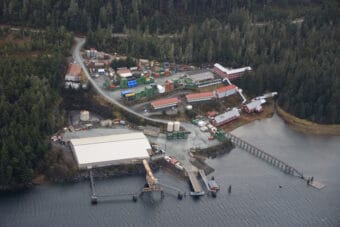
Hilcorp’s Dillon platform in Cook Inlet (foreground) photographed last year. (Nathaniel Herz for Alaska Public Media)
Leaders in both the state House and Senate have listed energy legislation as a primary focus of this session. That’s as gas producers warn that Cook Inlet natural gas supplies are dwindling, threatening higher prices.
But there’s only about a week left for lawmakers to pass bills that address a number of energy issues. So it’s a good time to check in with Alaska Public Media’s Capitol reporter, Eric Stone.
Listen:
This interview has been lightly edited for length and clarity.
Casey Grove: So, remind us, what sorts of proposals are on the table?
Eric Stone: Well, there are a lot. Lots of them have to do with boosting natural gas drilling in Cook Inlet outside of Anchorage.
Hilcorp, the biggest producer in Cook Inlet, can’t commit to supplying enough gas to automatically renew utility contracts over the next few years.. That’s a problem because people use it to heat their homes and power plants use it to make electricity. That’s threatening to push prices up.
So there’s all kinds of stuff on that front. Two bills have already passed out of the House. One would provide wide access to older seismic surveys, which drillers use to find oil and gas deposits. The idea is it would save explorers money, and thus make drilling more economical. Another would expand natural gas storage, which is supposed to also make gas cheaper in the long run.
And then there’s royalty relief. Some quick background — companies pay royalties on oil and gas produced on state land. Those are generally about 12% to 16%. And there are a variety of bills out there that would reduce or eliminate those royalties, basically making it cheaper to produce gas.
They’re still working out the details in the House and Senate on those — and there’s some skepticism about whether reducing royalties would actually lead to more drilling. A royalty-free lease sale last year attracted about as many bids as in past years.
Casey Grove: So lots of focus on gas, which is understandable. How about other energy bills?
Eric Stone: There are a couple others that are interesting — House Bill 50 is a carbon storage bill that’s a big priority for the governor.
It would set up a system where carbon dioxide is pumped underground rather than going into the atmosphere. Most of Alaska’s carbon emissions come from operations on the North Slope, and conveniently, there are plenty of underground areas that are good for storage.
And there’s also the possibility of sequestering carbon imported from places like Japan. That’s a little theoretical at this point, though — carbon dioxide exports are a very young market and nobody’s quite sure what the future holds. And there’s also a concern that the way the bill is currently structured, it could wind up costing the state money rather than making money.
That bill picked up some interesting amendments in the Senate Resources Committee, including one that would essentially result in Hilcorp paying a lot more money in taxes. And a few of the gas bills I mentioned earlier were rolled in, as well. But those got stripped out in the Senate Finance Committee, and we’ll see if they get added back. They are still actively working on this.
And they’re working on another energy bill important to the governor — it would create an integrated transmission system for the Railbelt. It would basically make it cheaper to move electricity from point A to point B on the Railbelt, and make it cheaper to produce renewable energy.
Casey Grove: That’s quite a bit to get through with a week to go.
Eric Stone: Yes, it is. And it’s not entirely clear that’s enough time to get things over the finish line. Like, on the royalty relief bill, it’s not clear if there’s enough time for analysts to say what effect it would have on drilling. Some of this has to do with the timeline for getting the legislature’s consultant under contract — there’s a great Anchorage Daily News article that goes into it in a lot more detail, but more or less, some behind-the-scenes stuff wound up delaying the contract.
But as I said a moment ago, there is some pretty intensive work happening on the carbon storage bill, the Railbelt transmission system bill and another I haven’t talked about, which would create a “green bank” to finance sustainable energy projects. Sen. Bert Stedman, a Sitka Republican and co-chair of the Finance Committee says those are big targets to get passed. But we’ll have to wait and see.
Members of the Alaska House Finance Committee, at left, listen to budget aide Remond Henderson during a break in amendment discussions on Monday, March 27, 2023. (Photo by James Brooks/Alaska Beacon)
Members of the Alaska House have refused a request by the Alaska Industrial Development and Export Authority for permission to borrow up to $300 million for unspecified mining-related projects.
On Friday night, the House Finance Committee removed the requested bonding authority from House Bill 122, which was originally written to allow the Alaska Railroad to borrow money.
AIDEA’s request for up to $300 million in bonding authority was subsequently amended into the bill by the House Transportation Committee at the urging of Rep. Tom McKay, R-Anchorage, but the finance committee was critical of the idea.
Over the past two years, the conservation group SalmonState has funded a series of economic analyses that found AIDEA ineffective in terms of job creation and revenue generation.
AIDEA officials have disputed those findings and have commissioned an as-yet-unfinished alternative analysis, but the SalmonState-funded analyses have encouraged public skepticism of AIDEA actions, and lawmakers heard significant public testimony against AIDEA’s bonding request.
“AIDEA has definitely run into a public image problem,” said Rep. Neal Foster, D-Nome and co-chair of the House Finance Committee.
Contacted after the vote, AIDEA officials said they “supported the amendment as part of a strategy to be ready to leverage Department of Energy funds and loan guarantees for critical mineral projects under Title 17,” a federal program through which Congress authorized as much as $290 billion to finance energy and infrastructure projects nationally.
“AIDEA qualified as a State Energy Financing Institution or SEFI to gain easier access to these federal funds and a more advantageous matching rate which could run as high as 95% Fed to 5% SEFI,” AIDEA said in a statement provided by a spokesperson.
Some legislators, including Rep. Frank Tomaszewski, R-Fairbanks and author of HB 122, said they didn’t oppose the AIDEA amendment, but they were outvoted by members of the committee who said they needed more certainty about what the AIDEA money would buy.
The investment bank has not presented a plan to lawmakers that indicates which of the state’s many mining and mining-related projects might receive state funding.
“I get a little testy when, as a separate branch of government, we see our appropriation powers being taken from us, being abrogated,” said Rep. Bryce Edgmon, I-Dillingham. “And I have no idea what’s behind this. Three hundred million dollars! Wow. That is wild. No plan, nothing.”
The final vote to remove the AIDEA funding was 7-4, and HB 122 advanced to a vote of the full House with just the railroad’s request included.
Hilcorp’s Spurr platform, photographed last year, has not produced any oil or gas since 1992. (Nathaniel Herz for Alaska Public Media)
The Spurr oil platform stopped pumping crude from beneath the silty ocean water outside Anchorage in 1992.
The platform, built in Cook Inlet during Alaska’s first oil boom in the 1960s, was losing money, officials from owner Marathon Oil wrote in a letter to the state. Oil production was expected to decline, and a review of seismic data showed that “no further economic development potential exists,” the letter said.
A top Alaska oil and gas official, Ken Boyd, agreed. He informed Marathon that in less than two years the company would need to start the process of demolishing and hauling away the hulking structure, as required under its lease with the state.
When oil companies build offshore platforms and other infrastructure, they must also agree to restore the public property to the state’s satisfaction once they’ve finished extracting oil and gas.
But more than 30 years later, the platform is still there. It has not produced a drop of oil since George H.W. Bush was president. And it’s set to remain in the inlet for years more.
Boyd backed down, and since then, Cook Inlet oil and gas companies have been fending off state regulators’ repeated attempts to advance the costly process of dismantling their unused platforms — beating back those efforts and minimizing their obligations.
Today, the multi-level structure, complete with a helicopter landing pad and crane, sits unused, “rusting away,” as a state inspector wrote in a 2021 report. Signs warn of an asbestos hazard, and most rooms are in an “advanced state of disrepair,” with “paint peeling from the walls, standing water on the floor, and severely corroded piping and machinery,” other state inspectors wrote after a visit in October.
This photo, from a report written by Alaska Department of Natural Resources inspectors, shows the deck of Hilcorp’s Spurr platform in October. (Courtesy of Alaska Department of Natural Resources)
In a picturesque basin surrounded by glaciated volcanoes and teeming with salmon, Spurr has deteriorated into an eyesore. It now stands as a symbol of a pliant state policy that will be tested increasingly in the coming years, as more of Cook Inlet’s platforms deplete their petroleum deposits.
Of the 17 platforms, 15 are now owned by Hilcorp, a company that specializes in managing “mature” oil fields. Six no longer produce oil and gas, and four have been offline for a decade or more. None have ever been removed.
(Courtesy of Anchorage Daily News)
Their continued presence in the inlet could foreshadow looming problems on Alaska’s North Slope. There, regulators will oversee a far more sprawling removal process when the massive Prudhoe Bay field and other developments eventually reach the ends of their useful lives.
State regulators are giving Hilcorp five more years to draft plans to repurpose some of its dormant infrastructure, such as for wind or other renewable power generation — options that federal regulators have dismissed as “not reasonably foreseeable” for oil platforms off the coast of California. At another defunct platform-like oil shipping terminal in Cook Inlet, Hilcorp is studying if it could simply allow underwater portions to erode away into the ocean — or even somehow accelerate that process “to force early structural failure.”
Richard Charter, a California-based ocean protection advocate, said it’s a playbook oil companies have used repeatedly — one he described as “delay, deny and diddle around.”
“The hope is you’ll never have to do it,” said Charter, who’s lobbied for platform removal off California and in the Gulf of Mexico. “The reality is that if you can delay it, you’re making money somewhere else.”
Derek Nottingham, director of the Alaska Division of Oil and Gas, said he’s aware of the industry’s incentives.
“It’s financially a benefit, the longer they can defer it,” Nottingham said. “And we understand that’s going to be the company’s motivation.”
Removing all 17 platforms from the inlet, along with associated pipelines, could cost on the order of $1 billion, according to industry and watchdog groups’ estimates.
For two decades, Alaska oil companies have argued that the expensive process of removal should wait until many Cook Inlet platforms are ready for decommissioning all at once. That way, heavy-lift ships and other equipment from outside the state don’t have to be rented multiple times. It’s an argument that state officials agree has some merit.
Another reason state regulators have been hesitant to press the issue of platform removal is that they would prefer to see the oil and gas industry invest in what they describe as an urgent state priority: drilling for more natural gas in Cook Inlet.
A specialized unit called a jackup rig, at left, drilled a natural gas well last year at Hilcorp’s Tyonek platform, right, in Cook Inlet. (Nathaniel Herz for Alaska Public Media)
Anchorage-area heating and electrical utilities have warned of an impending shortage of locally produced gas that’s likely to force them to import higher-priced supplies from outside the region.
Compelling companies to spend money on removing old infrastructure could “detract from some of their investment in natural gas production,” Nottingham said. Those companies, he added, have not indicated that removing platforms would come at the expense of gas production, but Nottingham said he suspects that taking a tougher line is not “in the state’s best interest at this point.”
Both state regulators and watchdogs agree that there’s not much danger of major structural failure that would threaten the environment.
Some of the pipelines connecting the platforms to shore have sprung leaks in the past — including a high-profile incident in 2017 that forced the temporary shutdown of two platforms. But no major structural problems have arisen with the platforms themselves.
State officials also say that the infrastructure poses little financial risk to taxpayers, because oil companies have signed agreements with the state designed to ensure they have money available to remove the platforms when the time comes.
But watchdogs have questioned whether those agreements are sufficient.
Hilcorp officials declined an interview request.
In response to written questions, a spokesman, Luke Miller, sent a statement saying the company has shared confidential decommissioning studies with state regulators and “strives to be a best-in-class operator of mature oil and gas assets.”
That includes making “significant investments” to decommission old infrastructure, Miller said, and to seal old wells, which prevents them from leaking into the environment.
Existing infrastructure in Cook Inlet, including the platforms, Miller said, will play a “critical role” in ensuring Hilcorp can meet its natural gas commitments to urban Alaska utilities.
“We are also exploring opportunities to repurpose existing infrastructure, such as offshore platforms, for renewable energy and carbon sequestration,” Miller said. “The future utility of these platforms is constantly evolving as repurposing opportunities expand alongside technological advancements.”
Offshore oil platforms in Cook Inlet, photographed in 2012. (Loren Holmes/Anchorage Daily News)
In other states, the oil industry has been wrangling for decades with marine advocates and government agencies over infrastructure cleanup.
In California, the Biden administration announced last year that it would require full removal of 23 remaining offshore platforms.
In the Gulf of Mexico, operators are allowed to leave some platform equipment in the ocean as artificial reefs that, according to some scientists, boost marine life.
But even with those industry-friendly policies in place in the Gulf, the U.S. Government Accountability Office recently documented lax enforcement by federal regulators that has resulted in a “substantial” backlog of idle infrastructure — with more than 500 platforms overdue for decommissioning under federal deadlines.
Delay tactics date back decades
The Cook Inlet area is Alaska’s oldest producing oil and gas basin, with its first petroleum discovery in 1957.
The platforms, scattered along a 25-mile stretch of the inlet, are engineering marvels: man-made islands with space for drilling rigs and living quarters.
Designed to withstand enormous tides and winter ice floes, the infrastructure was manufactured outside Alaska, thentowed to drilling sites.
The Monopod platform was built in Washington state during the 1960s for oil companies Marathon and Unocal. It then had to be floated down the Columbia River to the Pacific Ocean and nearly 2,000 miles to Alaska. Once in Cook Inlet, its pontoons were flooded and it was sunk into place. (Courtesy of Alaska State Library, Ackroyd Photography Inc., left photo; right photo uncredited.)
In some cases, the four legs were built together in a single module, floated on their sides to Alaska, then tipped over and sunk as the legs filled with water.
At their peak, in the 1970s, Cook Inlet’s offshore and nearshore fields pumped some 230,000 barrels of oil a day — about 2.5% of U.S. production at the time.
But after the discovery of the massive Prudhoe Bay field, industry interest shifted to Alaska’s North Slope. And by the early 1980s, oil companies had initiated discussions with state regulators about shutting platforms down and removing them.
Regulators say that the state’s leases with the companies give them broad authority to compel infrastructure removal.
But officials have never exercised that authority over the platforms.
Instead, a succession of administrations have left a trail of false starts and reversals, while the oil industry has successfully parried efforts to nudge the removal process forward.
The decades-long dance between the state and the industry is laid out in hundreds of pages of archived correspondence at the Alaska Department of Natural Resources — some of it still stored on paper, in manila folders with handwritten meeting registers.
After dropping demands for Marathon to swiftly dismantle its Spurr platform in the early 1990s, records show that it took more than a decade for state officials to formally raise the issue again.
In 2007, 15 years after Spurr switched off, Marathon finally shared the findings of what it called a “decommissioning study” for Spurr and its companion platform, Spark, which had also reached the end of its productive life.
But it was clear that the company still viewed removal as a distant prospect. Even deciding how, exactly, to remove the platforms would require “significant planning and state agency interaction,” Marathon said.
Unocal took a similarly unhurried approach with its Dillon platform, which shut off in 2002.
In 2003, Unocal suggested that the platform could potentially be repurposed for radar tracking, a rescue helicopter base or perhaps research — though none of those ideas ever came to fruition. A few years later, it told regulators that it was “impossible to predict with any accuracy” when removal might happen.
By 2011, state officials appeared to be taking a tougher line with the company, telling Unocal to draft plans to either reestablish oil or gas production from the platform within two years — or to remove it by 2015.
Hilcorp’s Dillon platform in Cook Inlet (foreground) photographed last year. (Nathaniel Herz for Alaska Public Media)
But just as the natural resources department was issuing that demand, Unocal’s parent company announced that it was selling its Cook Inlet assets, including its stake in 10 platforms. The buyer was a privately owned Texas oil company that specialized in wringing more oil out of aging infrastructure: Hilcorp. A year later, Marathon announced that it, too, was selling its Alaska assets to Hilcorp.
That change in ownership put the state’s efforts to get rid of the platforms on hold.
Co-founded by billionaire Jeffery Hildebrand, Hilcorp is famed for its lean, efficient operations.
The company has succeeded in reviving declining fields that previous owners — typically bigger, more bureaucratic oil companies — had starved of investment. Its maintenance of older assets, however, has sometimes drawn attention from regulators, nonprofit watchdogs and conservation groups, as Hilcorp and its affiliate companies have contended with leaks, spills and other problems.
The aging infrastructure in and around Cook Inlet fit Hilcorp’s business model perfectly. And in an early public appearance, the company’s president, Greg Lalicker, said it planned to invest $500 million in the area during the next three years.
An inspector from the state agency that regulates oil wells later wrote that two of the offline platforms Hilcorp had purchased, Spurr and Spark, were in “terrible condition” even before their sale. But in its formal correspondence with the natural resources department, Hilcorp said it wanted to take a “fresh look” at its new properties and suggested that all four of its shuttered platforms — Spurr, Spark, Baker and Dillon — could be reactivated.
At the time, Lalicker told business leaders that urgency was one of the company’s values. “We don’t have the luxury of studying things for two to four years,” Lalicker said.
But in 2014, Hilcorp told the natural resources department that it needed three years to finish its studies of Spurr and Spark. Once those three years had passed, the company said it still was “not economically viable or technical[ly] feasible to return either platform to production” — echoing the conclusion that Marathon and previous regulators had reached about Spurr two decades before.
Nonetheless, Hilcorp said it wasn’t ready to tear the platforms down. It said that there was still value in leaving Spurr and Spark in place to “support ongoing evaluation and analysis of potential development and production.”
Hilcorp’s Spark platform in Cook Inlet, photographed last year. (Nathaniel Herz for Alaska Public Media)
Two years after that, the state oil and gas division director, James Beckham, tried to prod Hilcorp to take action.
He took the aggressive step of trying to terminate the lease unit that encompassed those two Hilcorp platforms. In his letter to the company, he said state regulations require ongoing “diligent operations” to restore oil and gas production, and that they don’t allow an operator “to merely promise” work in the future.
That could have been a first move toward compelling the company to begin removing Spurr and Spark.
But Hilcorp appealed, and Beckham’s boss, Natural Resources Commissioner Corri Feige, sided with Hilcorp and reversed the termination.
It wasn’t until three years later, in 2023, that Hilcorp finally acknowledged the platforms were “no longer suitable for drilling or production operations.”
Nonetheless, Hilcorp, in its latest yearly plan shared with the state, said that the platform infrastructure — things like helicopter pads, workspaces, legs — still has “future utility,” and it included no plans to remove them.
Hilcorp has also had little success in finding uses for the Baker and Dillon platforms, which were both offline when the company acquired them.
It managed to briefly restore gas production at Baker, but then a 2014 fire destroyed the platform’s living quarters and knocked it back offline. It has not produced any petroleum since, according to state records, and Dillon was never revived after Hilcorp’s purchase.
Hilcorp’s Baker platform caught fire in 2014, after it had been revived to produce natural gas. (Courtesy of Nikiski Fire Department)
State downplays risk
Some oil industry watchdogs warn that the state’s accommodating approach could stick taxpayers with the bill.
In 2009, Pacific Energy Resources, a small oil and gas company that owned a relatively new Cook Inlet platform, Osprey, filed for bankruptcy. Another company eventually agreed to take over the platform, but if one hadn’t, “the state faced the very real specter of expending tens of millions of dollars in state funds” on decommissioning, the Department of Natural Resources wrote in a report four years later.
Hilcorp is far larger than Pacific Energy Resources. But some experts say that a single catastrophic event, like a major oil spill, could quickly deplete the company’s balance sheet.
“When oil hits the water, damages can become really enormous. The Deepwater Horizon well blowout almost bankrupted BP,” said Antony Scott, a former natural resources department analyst and former state utility regulator. “Industrial accidents can happen in the oil and gas industry, and we’ve seen it over and over again.”
Alaska oil and gas officials say that multiple layers of safeguards protect the state’s financial interests — including deals negotiated with each operating company known as financial assurances agreements.
Hilcorp’s agreement requires it to guarantee that money is set aside to cover a specific fraction of its estimated costs of removing oil and gas infrastructure from state land.
The fraction goes up if Hilcorp’s finances worsen, but the precise amount is secret.
A previous iteration of the state-Hilcorp agreement, referenced in 2015 by a University of Alaska student in an academic paper, required the company to have 17.5% of its estimated costs for removing the platforms budgeted in advance. At the time, those overall obligations were estimated at $700 million for Hilcorp’s Cook Inlet platforms and related infrastructure, the paper said.
Offshore oil platforms in Cook Inlet, photographed in 2012. (Loren Holmes/Anchorage Daily News)
The Department of Natural Resources said that the student — now the deputy director of the oil and gas division — only had access to the full document because of an “oversight,” and wouldn’t confirm the accuracy of the numbers, citing confidentiality. When the agency released the current version of Hilcorp’s assurances agreement in response to a public records request from Alaska Public Media and APM Reports, the agency redacted the exact amount of the company’s financial commitment.
The department denied an appeal of the redactions under the state’s public records law. It also withheld third-party estimates of Hilcorp’s cleanup costs that the company is required to submit every three years.
The release of the information, the agency said, was barred by a separate state law that provides for the confidentiality of certain “cost data and financial information” submitted by companies.
Hilcorp also opposed the release, saying that public exposure of its commitments would harm its competitive position.
State officials say there’s a backstop in the event Hilcorp or another company can’t cover their full cleanup costs: Those obligations are passed on to prior owners, said Nottingham, the state oil and gas director.
“We feel like we’re well covered,” he said. “And that the risk to the state is very low.”
But Scott said that contention is “legally untested.”
Predecessor companies “may not have the balance sheet you want,” he said. “And the further up the chain that you have to go, the more tenuous all of this protection might hope to be.”
He added: “The longer you wait, the riskier it is.”
Could platforms pump out green energy?
As Hilcorp offers alternatives to tearing the platforms down, it has touted their potential to harness renewable energy.
In the next 18 months, a Maine-based business, Ocean Renewable Power Company, plans to use Cook Inlet as a testing ground for equipment that generates electricity from tidal forces.
Federal studies suggest that Cook Inlet has some of the highest tidal generation potential in the world, and Hilcorp has been working with the state university system to gather data in the vicinity of its platforms.
Using the platforms to support tidal power infrastructure could reduce expenses for permitting and new maritime construction, according to Nathan Johnson, Ocean Renewable Power Company’s vice president of development.
“There’s still some studying that needs to be done to look at the applicability at each location, how they’re strategically located to the tidal energy resource in the broader Cook Inlet,” he said. “But there’s high potential.”
But Charter, the ocean protection advocate, is skeptical.
“You would have to completely redesign and re-engineer most oil rigs to put a wind generator on them,” he said. “You don’t do it with spent oil rigs. You do purpose-built wind farms.”
Wind turbines spin on Fire Island in Cook Inlet. (Nathaniel Herz for Alaska Public Media)
In September, Hilcorp asked state regulators for permission to leave four dormant platforms in the water through as late as 2048.
It cited the potential for wind and tidal power, along with other repurposing ideas such as carbon storage or even marine mammal research. Two of the platforms could still be useful for future petroleum development, the company said.
The department gave Hilcorp approval — but for 10 years, significantly less time than the company requested.
The state also required Hilcorp to make a decision on the viability of the alternative uses at the five-year mark. If it can’t find one by then, Hilcorp is required to share its decommissioning plans within the following year and to start the process before the approval expires in 2033.
The state circulated Hilcorp’s proposal for public comment and received none, according to a natural resources department spokesman. But Mark Foster, a former utility regulator and finance executive who’s scrutinized oil companies’ cleanup obligations, said he thinks that a public discussion about the future of Cook Inlet infrastructure — with transparency around corporate commitments and obligations — is overdue.
Leaving some infrastructure in place, as regulators have allowed elsewhere to preserve fishing habitat around platforms, could be worth considering in Alaska, Foster said.
But he wants Republican Gov. Mike Dunleavy’s administration to make sure that the state gets its fair share of any savings if companies don’t have to do full cleanup. In the Gulf of Mexico, for example, the “rigs to reefs” program allows businesses to keep half of the avoided cost of platform removal, with the rest going to the government.
“The state has not been willing to bite down and go, ‘We have allowed this to go on for far too long. Let’s begin an adult conversation about what we’re going to do with these platforms,’” Foster said. “It really comes down to: What’s the obligation? And how are we going to hold the developers to that obligation?”
This story was a collaboration between Alaska Public Media and APM Reports as part of the Public Media Accountability Initiative, which supports investigative reporting at local media outlets around the country.
A camera crew documents Mary Peltola fishing. (Photo by Liz Ruskin/Alaska Public Media)
Congresswoman Mary Peltola has joined Alaska’s U.S senators on a legal brief in support of the proposed Donlin Creek Mine in Peltola’s home region of the Kuskokwim Delta.
Tribal and subsistence advocates in the region are shocked that Peltola, whose campaign slogan was “Fish, Family and Freedom,” would take this position. Sophie Swope, executive director of a Bethel-based tribal coalition called Mother Kuskokwim, described herself as heartbroken.
“I do feel slightly betrayed right now,” she said. “My heart — it’s like, I don’t think I’ve felt this heavy in a little while,” Swope said.
Peltola was against the mine when she ran for Congress in 2022.
She’d been a community manager for Donlin Gold for six years. But in 2014, after a dam at the Mt. Polley mine in British Columbia burst and sent millions of gallons of contaminated material into lakes and rivers, Peltola quit Donlin Gold and became a fish advocate. She was executive director of the Kuskokwim River Inter-Tribal Fish Commission until just before she ran for Congress. Her campaign staff told reporters in 2022 that the Mt. Polley disaster was her turning point.
In the amicus —or “friend of the court” — brief filed late Tuesday, Peltola and the U.S. senators said the mine “will be an economic engine for the region and provide significant employment opportunities in one of the most impoverished regions of Alaska.”
Peltola’s office hasn’t released a statement yet to explain her change of position and her staffers were not available for an interview.
Donlin would be an open-pit gold mine 10 miles north of Crooked Creek, on lands owned by Alaska Native Corporations. Calista, the regional corporation for the delta, owns the subsurface rights. The mine is projected to produce a million ounces of gold a year and be productive for 27 years. Among its components is a 470-foot high dam to hold back tailings, chemical-laced mining byproducts that would look like silt or wet clay.
Six tribes in the region filed a lawsuit last year against federal agencies, claiming the environmental studies underpinning permission for the mine were inadequate. Among other things, they claim that the agencies only considered the impact of a small leak of contaminated materials from the dam. The tribes say a mining disaster like the Mt. Polley dam breach would contaminate the Kuskokwim, where salmon runs are already diminished.
The congressional delegation’s brief says the tribes are trying to stop development on land Congress intended to be developed for the economic wellbeing of people in the region. Congress, they said, set other lands aside for conservation.
“Respect for this balance is necessary for Alaska to exist,” the brief says, “and to allow the Alaska Natives living in the Yukon-Kuskokwim region to continue their traditional way of life and pursue both beneficial development and self-determination, as promised to them” in the 1971 Native land claims settlement law.
Donlin maintains that its dam would be safe and withstand all environmental conditions of the area. When the mining is done, the company also says it would cover the tailings with soil and vegetation to blend in with the surrounding terrain.
Alaska’s Republican U.S. senators often weigh in with amicus briefs, to support Alaska’s resource development projects in environmental lawsuits. But word that Peltola was considering adding her name to the brief has alarmed mine opponents in the Yukon-Kuskokwim Delta for days.
Swope and a contingent from Mother Kuskokwim flew to Washington, D.C. last week to try to persuade Peltola not to side with the mine.
This is a developing story. Please check back for updates.
The Kobuk River runs through the Ambler Mining district, where a new road would be built to connect the Northwest Arctic with the Dalton Highway to Fairbanks. (Berett Wilber/Alaska Public Media)
The U.S. Interior Department on Friday essentially rejected the Alaska Industrial Development and Export Authority’s proposal to build the Ambler Road, a 211-mile industrial road that would have cut through Gates of the Arctic National Park and Preserve to access copper and zinc deposits in Northwest Alaska.
The Interior’s Bureau of Land Management chose a “no action” option in its environmental analysis, effectively ensuring AIDEA would not receive a right-of-way to build the road across federal lands. The Biden administration said the road, also known as the Ambler Access Project, would cause irreparable damage to wildlife including caribou, which many local people rely on for food.
The administration also announced stronger protections for 13 million acres inside the National Petroleum Reserve-Alaska, a vast swath of oil-rich — but environmentally sensitive — federal land in the Arctic.
Both of Alaska’s U.S. senators, Republicans Dan Sullivan and Lisa Murkowski, expressed outrage even before the decisions were formally announced. They said the decisions hamper the state’s economy and domestic resource development.
“It’s more than a one-two punch to Alaska. When you take off access to our resources, when you say you cannot drill, you cannot produce, you cannot explore,” said Murkowski in a press conference on Thursday. “This is the energy insecurity that we’re talking about.”
Voice of the Arctic Iñupiat, a pro-development advocacy group comprised of Indigenous leaders and funded in part by the Arctic Slope Regional Corporation and North Slope Borough, called the NPR-A decision “insulting.”
“We deserve the same right to economic prosperity and essential services as the rest of this country and are being denied the opportunity to take care of our residents and community with this decision,” North Slope Borough Mayor Josiah Patkotak said in a statement.
But other Indigenous people applauded the decisions, as did environmental groups.
“That caribou were heard over cash is a really big deal,” said China Kantner, an activist from an anti-road group called Protect the Kobuk.
Evansville Chief Frank Thompson said his tribe has been fighting the Ambler Road proposal for a decade. He thanked the Bureau of Land Management and the Interior Department for listening to them and protecting traditional hunting and fishing.
“Today is a great day,” he said. “Our future looks bright without the threat of 168 trucks driving by per day. Without increased pressures on our subsistence resources.”
The proposed Pebble Mine site, pictured in 2014. (Photo by Jason Sear/KDLG)
The U.S. Army Corps of Engineers has upheld its denial of a permit for the proposed Pebble Mine, upstream from Bristol Bay.
The decision issued Monday is the latest in a long string of legal and administrative rulings against the project.
But opponents of the gold mine say their fight isn’t over.
“Pebble will not be over until we have federal legislation, basically saying Bristol Bay is protected forever, and it’s permanent,” said Lindsey Bloom, a strategist with SalmonState, part of the coalition of tribes, Native corporations, fishermen and lodge owners that has fought the mine for decades.
More than a year ago, the Environmental Protection Agency issued a final determination that a mine in that area of the Bristol Bay watershed would damage or destroy miles of salmon streams and more than 2,000 acres of wetlands. The decision is referred to as a veto.
In its decision Monday, the Corps said as long as the veto is in place, it can’t issue a permit.
Pebble Vice President Mike Heatwole said the company is focused on a lawsuit seeking to overturn the veto. He points out that the Corps’ decision is based on the veto and it didn’t address Pebble’s points on appeal.
The Corps specified that its decision is made “without prejudice,” suggesting that Pebble can request a reconsideration if the EPA veto disappears.
For mine opponents like Bloom, the seemingly endless administrative appeals and lawsuits point to the need for Congress to pass a law putting a stop to the project.
“History shows us that the mining industry doesn’t take no for an answer,” she said. “And so they will continue to litigate, most likely, and keep this going for generations to come until we have those permanent protections for Bristol Bay that are so needed.”
Meanwhile, the New York Times reports that the Biden administration is about to deal a blow to a different mining proposal in northwest Alaska, the Ambler Mine. The Times says that the Interior Department is going to recommend against a 200-mile road to the copper deposit, finding it would “significantly and irrevocably” hurt the environment and more than 30 tribal communities that fish and hunt in the area. The report is based on anonymous sources. The Interior Department didn’t confirm or deny the story.
Ambler Metals, issued a statement urging the federal agency to reconsider. Kaleb Froehlich the company’s managing director said if the Times report is true, the agency would be making a political decision that ignores local support for the mine and denies jobs to Alaskans.
Close
Update notification options
Subscribe to notifications
Subscribe
Get notifications about news related to the topics you care about. You can unsubscribe anytime.