Energy & Mining

40 years in the making, Angoon hydroelectric project wins $27M in federal funding

The Thayer Creek Hydro project would use a 40-foot high dam to impound water over an area of 7 acres. (Kootznoowoo, Inc. image)

A hydroelectric project on Admiralty Island over 40 years in the making has won federal funding for construction.

Alaska Senators Murkowski and Sullivan announced on Tuesday that almost $27 million from the bipartisan infrastructure bill is headed toward the community of Angoon for the construction of a run-of-river hydro plant on Thayer Creek.

The plans for a hydroelectric project in Angoon go all the way back to the passage of the Alaska National Interest Lands Conservation Act in 1980, and the creation of the Admiralty Island National Monument on the ancestral lands of the Angoon Lingít. Angoon’s village corporation, Kootznoowoo Inc., was subsequently granted the right to develop Thayer Creek, but no funding came with it. Angoon’s 500 residents have relied on diesel generation ever since, paying somewhere between four and eight times more for electricity than the national average.

Over the years, Kootznoowoo has pulled together other grants to design Thayer Creek until finally, last year, the corporation received a special use permit from the U.S. Forest Service to build it.

But the millions of dollars needed to construct the project were still not there. The passage of the bipartisan infrastructure law in 2021 included $1 billion for energy improvements in rural areas — called ERA — and this looked like Kootnoowoo’s chance.

Kootznoowoo’s director of natural resources, Jon Wunrow, spoke to KCAW last August.

“This is really the first, and potentially the only funding of this size, specifically for rural areas to do renewable energy,” Wunrow said. “So it’s kind of got Thayer written all over it. We’re hopeful.”

Funding brings Thayer Creek project close to final amount needed for construction

In an email to KCAW, Kootznoowoo’s Jon Wunrow explains that the new funding brings Thayer Creek very close to full funding:

“The overall project cost for Thayer Hydro is currently estimated to be $33,650,000,” Wundrow’s email said. “We have secured other funding from the Alaska Energy Authority and Denali Commission, that brings the funding gap to $500,000 — $1.5 million, depending on a pending proposal we have in the works.”

Thayer Lake is a run-of-river project — that is, there won’t be a huge dam built and reservoir created. It will produce 850 kilowatts of power, roughly three-times Angoon’s current needs. Wundrow said that will allow Angoon “to usher in an era of electric motors: electric cars, electric boats, and heat pumps.”

The project will be operated by the Inside Passage Electric Cooperative.

The funding announced for Angoon is part of  $125 million package of ERA infrastructure money for clean energy projects in four other areas in Alaska: Chignik Bay, the Northwest Arctic Borough, the Yukon River and Old Harbor.

Alaska received the largest share of ERA funding in the infrastructure bill. In a news release, Sen. Lisa Murkowski thanked Secretary of Energy Jennifer Granholm for “choosing more projects and awarding more funding to Alaska than any other state. These investments will create jobs, reduce emissions, and increase the use of renewable resources while decreasing electricity bills.”

Alaska tribes accuse Canada of human rights violations, request international hearing on mining

A petroglyph at the mouth of the Unuk River. (Photo by Lee Wagner/SEITC)

At the mouth of the Unuk River near Ketchikan, there is a very old petroglyph. According to Lee Wagner of Metlakatla, the rising sun painted onto a rock above the river is thousands of years old and it’s a family crest.

“And you will also see remnants of more of them along the river as you go up into Canada,” Wagner said.

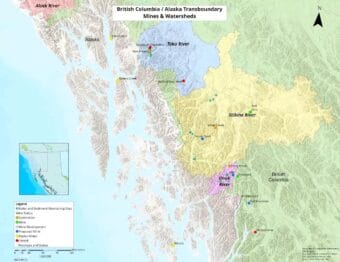
Further up the river, over the Canadian border, there is a site proposed for an open pit gold mine. It’s one of multiple large-scale mining projects proposed on Canadian soil that Alaska tribes say would directly impact watersheds that run across the border into Alaska. And the tribes have long demanded a seat at the table in how Canada manages those projects.

The tribal coalition is known as the Southeast Alaska Indigenous Transboundary Commission, or SEITC. The tribes submitted a brief on Feb. 19 to the Inter-American Commission for Human Rights accusing Canada of violating their human rights, including their right to a healthy environment.

Guy Archibald is the SEITC executive director. He says the Unuk River case is interesting because the line he has heard from mining companies – that if they build a mine, they can minimize its impact on the watershed – doesn’t work here. There already was a mine at Eskay Creek along the Unuk River in the 1990’s. And Archibald says the watershed is still feeling the effects, over a decade after the mine shuttered.

“Mining is known to impact water quality and salmon. They always do. Modern mines actually fail at a higher frequency and with more catastrophic consequences than mines did 40, 50 years ago – and some of these are the largest mines that will ever be built in the world so far,” Archibald said. “The people using that river, such as Lee’s family, noticed a very distinctive drop off in the hooligan coming in. Hooligan are not like salmon, they will go somewhere else if there’s adverse conditions.”

When the mine closed in 2007, Archibald saw the populations of hooligan, a beloved subsistence fish also known as oligan and eulachon, begin to rebound. But the once productive hooligan fishery in the Unuk River has remained closed to non-subsistence users by the state Department of Fish and Game since the population collapse in 2005.

For Archibald, gold mines mean only two things.

“Jewelry, and its investment,” he said. “Ninety-three percent of all gold is vanity or it is a backup to your investments in the dollar in the stock market in case something goes wrong. It’s vanity and fear. It needs to just stay in the ground.”

“Sacrificing salmon and cultures – and all the language and art that go with them – the economics never pencil out. If ecology is the price that you pay, the economics will never pencil out,” said Archibald.

The SEITC, in partnership with legal advocacy organization Earthjustice, have taken their concerns to the Inter-American Commission for Human Rights, which presides over the defense of human rights across North and South America.

In 2020, the SEITC submitted a petition to the Inter-American Commision regarding Canada’s alleged human rights violations and in September of 2023, the commission accepted it. That started the clock for the tribal group and Canada to both make their cases. This brief is the first official filing of SEITC outlining their argument to the commission since the original petition.

According to Mae Manupipatpong, an Earthjustice attorney, their argument is twofold: that Canada is violating the tribes’ federally recognized right to a healthy environment, as well as violating their own obligation to meaningfully consult with tribal stakeholders.

“They also have an obligation to obtain the free prior and informed consent of SEITC tribal members and make sure that they are participating in the decision making processes and have a voice in whether these mines are authorized or not,” Manupipatpong said. “Toxic water pollution doesn’t stop at the Canadian border. And human rights obligations don’t either.”

Archibald stated that SEITC has attempted to contact the Canada and British Columbia governments multiple times, which is evidenced in the brief. Archibald said the only reply has been from the mining companies. He recalled receiving a letter from one of the mining companies in which they offered to “guide them through” the process.

“Not once in the letter did they say they’d listen to us, or anything along that line,” he remembered.

The mining companies listed in the brief have not responded to KRBD’s multiple requests for comment.

The Canadian and British Columbia governments are required to submit a similar brief in the coming weeks. Afterwards, the Inter-American Commission will decide if there will be a hearing.

Get in touch with the author at jack@krbd.org.

Unalaska pulls plug on Makushin geothermal project

The Makushin Geothermal Project began building a corridor to the site of the proposed power plant in 2021. (Courtesy Of Ounalashka Corp./Chena Power LLC)

The City of Unalaska is pulling out of the Makushin geothermal project after the city council on Tuesday rejected new terms requested by the company building the project. The project’s goal was to harness energy from an active volcano to power the community, which has relied on diesel since World War II.

It was the fourth time that the joint venture between the Ounalashka Corp. and Chena Power, called OCCP, asked to amend its terms for the roughly $200 million project. This time they wanted to raise the rate they would charge the city for electricity.

City Manager Bil Homka said in a memo last week that he encouraged city council not to agree to the rate hike and to let the power purchase agreement expire.

While council members all voiced general support for the project, the consensus was that they had lost confidence that the project would be completed on a reasonable timeline.

“I’ve been in full support of this and I want to see this thing go through, but at the same time, we’ve done more than enough,” said Councilmember Alejandro “Bong” Tungul. “We’ve done three resolution amendments to extend it, and I still don’t see anything that will get it moved forward.”

Representatives of the project pushed back against some of the claims made in the council packet, including that the project would be unable to secure funding.

“We acknowledge the frustration that all parties have and are experiencing due to the project delivery timelines,” said Program Manager Dave Mathhews in a memo to city council. “OCCP does have financing and is proceeding with project development.”

Local resident Travis Swangel was among several community members who spoke out in favor of the geothermal project. He called the project “one of the most important and pivotal projects in the community’s history” and urged the city to be patient.

Councilmember Shari Coleman made a request to the city to allow a six-month extension for the geothermal project to find funding, but she was unable to find support and the motion was denied, effectively ending the city’s participation in the project.

Federal appeals court revokes Obama-era ban on coal leasing

A mechanized shovel loads a haul truck that can carry up to 250 tons of coal at the Spring Creek coal mine, April 4, 2013, near Decker, Mont. On Wednesday, Feb. 21, 2024, a U.S. appeals court struck down a judge’s 2022 order that imposed a moratorium on coal leasing from federal lands. (AP Photo/Matthew Brown, File)

A federal appeals court has lifted a moratorium on new coal leasing on federal land that dates back to the Obama administration.

A three judge panel in the 9th Circuit Court of Appeals Wednesday tossed the moratorium saying it was now moot. It’s the latest decision in a series of legal back-and-forths that date back to 2016 when then-Interior Secretary Sally Jewell moved to halt all new coal leasing on federal land as part of a strategy to address climate change.

President Trump’s Interior Secretary Ryan Zinke ended the Obama moratorium, a move that was challenged by environmental groups and tribes. A court then reinstated the ban on new leases in 2022.

Wednesday’s latest ruling tossing that out appears to be largely on a technicality. The judges noted that the original challenge was to a Trump-era policy that is no longer in place as President Biden’s Interior Secretary Deb Haaland had revoked it already.

Rich Nolan, president and CEO of the National Mining Association called the ruling a victory. “Important projects can once again advance and support the production of affordable, reliable power to the grid, while creating jobs and economic development,” Nolan said in a written statement.

Even as demand for coal has slumped nationwide, mining companies have pushed federal land managers to open up more land for exploration particularly in the western United States, citing its location as a possible continued export market to countries such as China.

It’s not yet clear how President Biden will respond to Wednesday’s ruling or how soon new leasing could resume on federal public land.

Environmentalists and tribes are pressing the Biden administration to intervene again and launch a new federal review of the coal leasing program.

In a statement, William Walksalong of the Northern Cheyenne Tribe in the coal-rich Powder River Basin in Montana said the administration needs to “step up” and live up to its promises to protect the climate.

“We will fight tirelessly to protect our reservation and its air and waters and the Cheyenne way of life,” Walksalong said.

Copyright 2024 NPR. To see more, visit https://www.npr.org.

Cook Inlet gas crunch likely to push up prices as lawmakers search for solutions

Hilcorp Senior Vice President Luke Saugier testifies to a joint meeting of the House and Senate Energy Committees on Feb. 7, 2024. (Eric Stone/Alaska Public Media)

Alaska lawmakers are searching for solutions to a looming shortage of natural gas that threatens power and heating for much of the state’s population. The state’s largest gas utility is warning that shortfalls could come as soon as next year – and imports are years off.

Throughout Southcentral Alaska, heaters, stoves, and, notably, electric power plants rely on gas.

“70% of the population live along the Railbelt and depend on Cook Inlet gas,” said Sen. Cathy Giessel, R-Anchorage, who chairs the Senate Energy Committee.

Lots of the state’s gas is up on the North Slope, but it’s more or less stuck there until or unless the state builds a pipeline south – which would take longer than the state has time to wait, according to Sen. Bert Stedman, R-Sitka.

“We can’t wait 10 years,” he said. “So we need to move forward.”

That means continuing to rely on gas from Cook Inlet, most of which comes from Hilcorp, the Texas-based oil and gas company that dominates gas production in the Cook Inlet basin.

And though the company says it plans to keep drilling, Hilcorp Senior Vice President Luke Saugier told a joint meeting of the House and Senate Resource Committees that they’re expecting production to decline.

“Part of the reason we’re all here is because the gas under Hilcorp’s leasehold cannot meet 100% of the demand that there is today in the Cook Inlet market,” he told the committee on Wednesday. “So we need other sources of energy.”

Not everybody buys that – Sen. Bill Wielechowski, D-Anchorage, and Rep. Donna Mears, D-Anchorage, asked a series of questions suggesting the company can and should produce more – but Hilcorp says it’s investing hundreds of millions of dollars in drilling each year.

“We’re the only company that’s drilled any wells since 2019. And I would submit to you that that’s a problem,” Hilcorp’s Saugier said. “That’s not a good situation for us to be in as a community.”

Saugier told the committee that sustained drilling is essential, since production starts to decline immediately after a new gas well is tapped.

Hilcorp warned utilities in 2022 that it could not keep supplying gas at existing levels. Saugier says that’s because it’s only allowed to write contracts based on its proven reserves of gas, and it’s expecting production to fall by nearly half over the next five years.

Hilcorp expects to provide roughly 55 billion cubic feet of gas this year, nearly 80% of total demand. But the company warns that it’s expecting production to fall to 32 billion cubic feet of gas per year starting in 2029.

A slide presented by Hilcorp illustrating its anticipated decline in production. (Hilcorp)

Enstar, the Southcentral gas utility, told lawmakers that most electric utilities’ contracts with Hilcorp expire in 2027 and 2028. And it’s unclear where gas will come from once they expire.

“The more we slip on this, the worse this problem gets,” said Enstar President John Sims.

Sims told the committee he’s not confident there will be enough gas to meet demand next year. And Sims said gearing up to import liquefied natural gas from Outside will take until at least 2030 – and that’s if “everything goes absolutely correct,” he said.

“That was a big gulp, and not something we had considered in the past and places more emphasis on the discussion that we have today,” Sims said.

Sims says smaller-scale backup plans would triple current gas prices. And even once imports are online, he estimated prices would be 60% higher than they are now.

“There’s no unsubsidized energy solution that will reduce the cost of power or space heating in the next 10 years,” he said. “If the market provides it, it’s going to be more expensive. That is the bottom line.”

So, in the short term, the focus is on boosting production in Cook Inlet. And two smaller gas producers told the committee that they’re facing significant hurdles in bringing new gas online.

“We know the gas is there. The question is a matter of getting the funding to develop that gas,” said Benjamin Johnson, the CEO of BlueCrest Energy, an oil and gas company focused on developing deposits three miles off the coast of the southern Kenai Peninsula.

Right now, BlueCrest operates a shore-based drilling and production rig that tunnels miles underground to reach the Cosmopolitan Unit. And Johnson says surveys and test wells have confirmed that there’s a large gas deposit above the oil.

To get at the gas, Johnson says BlueCrest would have to invest some $400 million in an offshore platform and drilling program, and Johnson says the company has struggled to find investors. He suggested the state could invest in the company or provide a loan.

Lawmakers are considering several bills that would reduce various state royalties and taxes on gas in an effort to juice production. And Johnson says that would be helpful – to an extent.

“Certainly, royalty relief improves the economics of the project. In this case, it’s not a make or break as to whether an investor will come in or not,” Johnson told the committee.

Another Cook Inlet gas driller, HEX, told the committee that royalty cuts would have a much more significant impact. Chief Commercial Officer Mark Slaughter says royalty relief would allow its subsidiary Furie to drill two new wells this summer.

But fundamentally, the Railbelt is a small market with limited prospects for growth. Slaughter said long-term threats to the gas market, including gas imports, rising renewable energy generation and North Slope gas, make it difficult to justify larger investments in Cook Inlet.

But would royalty relief go far enough towards increasing gas supplies from the region’s overwhelmingly predominant producer? Hilcorp’s Saugier says he’s not sure if any of the circulating bills would do enough to push the company to drill more in the short term.

Lawmakers are still exploring the best ways forward. But House Energy Committee Chair Rep. Tom McKay, R-Anchorage, said he’s confident they’ll find a solution.

“I think the public needs to realize that this is not a time to panic. This is not a time to get emotional. This is not a time to become irrational,” he said at the close of the hearing. “We have lots of assets. We have lots of reserves. We have the capability to solve this problem in this building, and I believe we very well do we’ll do so.”

Alaska commission fines Hilcorp $452,100 for violations at North Slope oil sites

Hilcorp’s Alaska headquarters in Midtown Anchorage seen on Wednesday. The Alaska Oil and Gas Conservation Commision assessed penalties totaling $452,100 on the company for unauthorized injections of miscible gas into some oil pools. (Photo by Yereth Rosen/Alaska Beacon)

The agency that regulates oil and gas wells in Alaska has assessed a $452,100 fine on Hilcorp for rule violations on the North Slope.

The Alaska Oil and Gas Conservation Commission, in an enforcement order issued on Tuesday, cited Hilcorp for unauthorized injections into various parts of the Prudhoe Bay Unit, which encompasses several satellites. The company has operated Prudhoe Bay, including its satellites, since 2020, when it acquired BP’s remaining Alaska assets as the latter company exited the state.

The violations concern injections of miscible gas, a substance that blends with oil to enhance oil recovery. Violations date from mid-2021 to mid-2023, according to the enforcement order issued by the AOGCC.

The order issued Tuesday makes final a fine that was proposed in December.

In the past, the commission has criticized the company for a series of lapses and violations. A 2021 order assessing a $267,500 fine for violations at the Milne Point Unit cited Hilcorp’s “lack of good faith” and “track record of regulatory non-compliance,” and it noted that it had already issued more than 60 enforcement actions against the privately held company for violations in both the Cook Inlet basin and on the North Slope.

This time, however, the AOGCC said Hilcorp has made some changes and taken steps to improve its performance. The downward trend in violations was discussed in meetings between Hilcorp and the AOGCC in December and January, the enforcement order said.

“While it is always AOGCC’s goal to have zero violations, and consequently zero repeat violations, AOGCC does acknowledge the overall downward trend in Hilcorp’s violations as Hilcorp noted during the informal review. It is encouraging to see that Hilcorp is monitoring its compliance history and seeing improving performance in this area,” the order said.

Hilcorp did not dispute the violations, though it questioned the assessed penalty, the order said. The commission opted against lowering the penalty from what was proposed in December, but it dropped a requirement that Hilcorp submit a report on the events, the order said. Hilcorp has already conducted an internal investigation into the causes and ways to prevent future recurrences and shared the results with the commission, the order said.

Along with paying the penalty, Hilcorp must carry out the corrective actions identified in its internal investigation, the order said.

In a statement, Hilcorp spokesperson Luke Miller referred to the company’s improved performance.

“We are pleased to see a downward trend in compliance issues, as noted by AOGCC in its Order, and look forward to continuing to work closely with AOGCC to ensure compliant, safe and responsible operations,” Miller said in the statement.

This story originally appeared in the Alaska Beacon and is republished here with permission.

Site notifications
Update notification options
Subscribe to notifications