Energy & Mining

Angoon celebrates launch of long-awaited hydroelectric project

Members of Aangóon Yátx’i, Angoon’s youth dance group, perform during a celebration to launch the Thayer Creek hydroelectric project in the elementary school gym. (Mary Catharine Martin/2024)

It’s taken 44 years, but a hydroelectric project in Angoon finally has all of the funding, and most of the permits, to launch. And while construction on the Thayer Creek Project is still a few months out, organizers say they’re ready to celebrate.

Angoon mayor Peter Duncan remembers first hearing about a proposal to develop Thayer Creek when Jimmy Carter was president.

“When I first heard about all this, I was still in high school — back in 1980, but it could have been earlier than that, that they were talking about it,” Duncan said. “But back in 1980, I know for a fact. So for sure that was the serious talks with the corporation and everybody about the possibility of a hydro.”

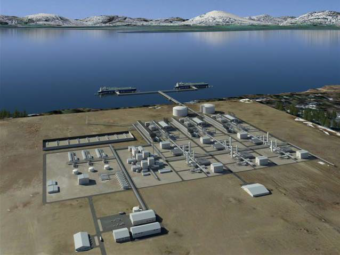
The hydroelectric project on Thayer Creek will include a hydroelectric facility, barge landing, service road, and underground cable system. (Photo provided by Jon Wunrow)

In December 1980, Congress passed the Alaska National Interest Lands Conservation Act and established the Admiralty Island National Monument on the ancestral lands of the Angoon Lingít. In the process, Angoon’s village corporation, Kootznoowoo, negotiated the right to develop hydroelectric resources in the area.

But, those rights didn’t come with funding. Jon Wunrow, director of tourism and natural resources for Kootznoowoo, said that stopped the project from ever getting off the ground.

“We’ve had lots and lots and lots of attempts at getting funding in a community the size of about 400 people, in rural remote Alaska, where everybody has needs,” Wunrow said.

For the past four decades, residents of Angoon have relied on diesel to heat their homes, power their freezers, and keep their lights on. And that fuel gets expensive — up to eight times the national average.

A few years ago, spurred by rising fuel prices, Kootznoowoo decided to move forward without federal funding, using a $7 million grant from the Alaska Energy Authority. They started designing a run-of-river hydroelectric facility on Thayer Creek, a few miles north of town. The project they envisioned would generate more than enough electricity for the community of Angoon – if they could find another $30 million or so.

Earlier this year, Wunrow was ready to give up.

“Several of us were about ready to just sort of toss in the towel there,” he said. “We just had had one funding denial after another, after another, after another.”

Then, this February, Senators Lisa Murkowski and Dan Sullivan announced that Angoon would receive $27 million in federal funding to develop the Thayer Creek Project as part of a bipartisan federal infrastructure bill that funneled 125 million dollars to clean energy projects in Alaska. Combined with smaller grants, that means the $34 million project is fully funded.

Although they’re still waiting on some final reports, Wunrow considers the project fully permitted – another hard-fought success.

“Not only is it federal land, it’s National Monument land,” Wunrow said. “And so it’s a tough place to get permission to build, even though Thayer was granted, the right to develop Thayer, to the community and to Kootznoowoo 40 years ago through legislation, that doesn’t mean that it was an easy project.”

There are a couple more boxes to check off before construction begins. A Forest Service team is drafting a report to confirm that the project won’t damage historic or cultural artifacts. And a team of engineers will bore down into the seafloor, where the underground cable will sit, to make sure the rock composition is suitable.

Once construction begins in spring 2025, Wunrow estimates that it will take three years to complete the hydroelectric facility, plus a barge landing, service road, and underground cable system. When the project is complete, it is expected to stabilize or reduce electric costs for residents for at least 50 years — and provide a lot of extra power.

“Probably up to 70% of the hydro will be excess,” he said. “So we’re looking to be able to work to establish reduced rates for that excess hydro to incentivize heat pumps in homes, someday maybe electric vehicles, electric boat motors, and attracting business to the community that maybe isn’t here in part because of the high cost of energy.”

Mayor Duncan said that collaboration between the city, tribe, and village corporation helped make this project a reality. And he said the hydroelectric project is just one way that Angoon is moving into the future.

“This is the result of working together,” he said. “Good things can happen. And that’s what we’re seeing right now today is, you know, everybody working together to make something happen. And I haven’t seen something like this for Angoon in quite some time, so we’re all excited.”

The community held a celebration to officially launch the project — and to look back on its 44-year history — on Friday afternoon in the elementary school gym. The agenda included speeches from local leaders, as well as stories of Angoon elders testifying in front of Congress and adopting President Carter into a clan.

Demolition of Fort Greely’s old nuclear plant to begin this year

Many of the nuclear-power components of the old SM-1A are encased in concrete in the building that still stands at Fort Greely. (U.S. Army photo)

The Army Corps of Engineers has decided to begin demolition of Fort Greely’s long-mothballed nuclear power plant this summer, a year earlier than planned. That means trucks will begin hauling construction debris off-site this fall.

The SM-1A nuclear power plant was taken off-line back in 1972, and the most radioactive reactor components were removed. More than 50 years later, the building that housed the reactor is scheduled for demolition.

On Tuesday, the head of a Corps of Engineers team in charge of the dismantling and decommissioning project gave a tour of the old power plant for a group of state and federal elected officials’ staff.

Program Manager Brenda Barber provided a project update, including Corps of Engineers decision to delay enclosing the building in a big tent to facilitate year-round work.

“We’ve had some challenges with respect to getting that up and running,” she told staff from U.S. Sen. Lisa Murkowski’s office and from state Rep. Ashley Carrick and state Sen. Robert Myers. Rep. Mike Cronk also participated in the tour.

Barber said the original plan was to erect a large weatherproof enclosure on top of shipping containers, but that raised concerns about potential earthquake, snow and wind damage, “and whether or not that weather enclosure would stay stable on top of those conexes during some of the severe weather that occurs here.”

That led the Corps’ team to reconsider how to cover the plant with the enclosure, and the vapor containment or VC structure that towers over facility.

“That means we have to eliminate some of the height concerns, particularly with the vapor containment structure,” she said, “so that the tent can completely encompass the site, the way we intended it to do.”

Barber says the Corps’ team now proposes to partially dismantle the VC structure and remove an old quonset hut next to the plant this summer and set up the enclosure over the site next year. Demolition work would then continue through the winter. Barber says the “re-sequencing” of the work includes moving up asbestos removal to this year.

“So this means that the community on base will see some demolition activity that we originally hadn’t planned to do this year,” she said in an interview after the tour.

The work requires the Corps to monitor the demolition waste for asbestos and low-level radiation sooner than initially planned.

“That will include all of our environmental monitoring and all of our radiological monitoring on very early, in August,” she said.

The materials being removed and taken off-site are classified as low-level radioactive waste. But initially, some of the waste will be inert, she added.

“All the debris that’ll be leaving now will be just metal from the demolition, some wood debris – basically construction debris.”

Barber says the Corps needs approval from the Army Reactor Office before work under the new schedule can begin. If they get the go-ahead, demolition will start this summer with trucks hauling away debris starting in the fall.

“So it’ll be a truck carrying what we call an intermodal container,” she said. “It’s very similar in size and look to a SeaLand container that you’d typically see on a barge.”

An average of two trucks per week will transport containers to Fairbanks, where they’ll be transferred to Alaska Railroad cars for delivery to Anchorage or Whittier. From there, they’ll be barged to Seattle, then railroaded to a hazardous waste facility in Texas.

Barber says the re-sequencing of work should enable the Corps to complete the dismantling and decommissioning of the power plant by the end of 2029, the previously set goal.

She says the agency will hold public meetings on the new schedule in July or August to let the public know about the new plan for dismantling the old SM-1A.

An Alaska energy blogger breaks down the looming, much-nuanced Cook Inlet gas shortfall

A specialized unit called a jackup rig, at left, drilled a natural gas well last year at Hilcorp’s Tyonek platform, right, in Cook Inlet. (Nathaniel Herz for Alaska Public Media)

Alaskans who depend on natural gas for heat or electricity are confronting a looming shortfall in Cook Inlet, and many of them have questions about how soon utilities might need to start more expensive gas imports.

There are a few proposals to lessen the blow to ratepayers’ pocketbooks, but some are wondering if enough progress has been made on any of them to at least put off higher bills further into the future.

One of those people is energy blogger Erin McKittrick, a self-proclaimed data geek, who writes at Alaskaenergy.org.

In a recent post, McKittrick looked at a few different timelines related to the gas shortfall and says it’s not surprising that the whole issue has been confusing.

Listen:

This interview has been lightly edited for length and clarity.

Erin McKittrick: There’s so many bits and pieces of information coming out at different times with different quotes from different people. And there’s just a whole lot there, but it’s never just put together in one place to try to tell the bigger story. And so that’s what I tried to do.

Casey Grove: Gotcha. Yeah. Just that. That’s all.

Erin McKittrick: It did take quite a while.

Casey Grove: So, I guess there’s quite a few different dates that we could look at and prices that we could look at. But what is kind of the earliest that we would see a gas shortfall? And I think the nuance there is, it’s not that there isn’t gas, it’s just that it’s been described as “available gas,” right? When might that happen? And I guess we’ll go from there.

Erin McKittrick: To answer that question, you’re going to put together a bunch of uncertain things. So one of the things that is somewhat uncertain is how much gas are we going to use? Now, that does vary year to year, with a number of factors, mostly cold, right? Most gas is used for heating. So if it’s really cold, you use more. If it’s less cold, you use less. On the electricity side, it varies how much the utility up in Fairbanks buys gas power from the utilities in the south. Otherwise, they don’t have gas. And there’s some variation based on how much hydropower is produced in any given year. And then you have the forecasts of how much gas is going to be available that the state put together with these different oil and gas pools and the expected decline in production.

So if you put those things together, you get to 2027 or 2028. Now, if there’s some reduction in gas use, which is could be efficiency on the heat side, luck as far as weather, some renewable electricity on the electric side or the (gas) pool decline forecast is not as bad, that could shift out, you know, past 2028 and start getting closer to 2029 or 2030. So that’s kind of the picture.

Casey Grove: You know, it’s been a couple of years since we heard that Hilcorp was not going to be able to sign new contracts going forward, to be able to guarantee that gas. But has there really been much in the meantime, in those two years, you know, in whatever direction we need to go, that’s been done?

Erin McKittrick: I mean, no, is really the simple answer there. A lot of people have studied things, right? And I don’t want to dismiss that as an unimportant step, right? We’ve had reports by the state, we’ve had reports by the utilities, but nobody has officially committed to do any large thing that would change the picture of, like, officially committed to, you know, made an investment decision on a gas import facility, or on a major new gas drilling operation, or on a major renewable energy project, or any combination thereof.

So we’re pretty much still doing exactly the same thing. Now, exactly the same thing does include gas drilling. Like Hilcorp has said, and, you know, the data backs them up, is that they do drill quite a few gas wells. They haven’t actually slowed down their drilling of wells. They just claim that, you know, the amount that they keep drilling is what’s necessary for them to offset the natural decline and keep up with the contracts they already have.

Casey Grove: So part of this whole equation, it seems like, correct me if I’m wrong, but it seems like some kind of gas imports are going to happen. The question is sort of when that’s going to be and then within that, there’s different versions of that, right? So there’s the version where we build an import facility for, like, my understanding is, sort of large scale, importation of gas. But then there’s kind of this other stopgap measure, where sort of like container size tanks of gas get brought up to Alaska. And I wonder if you could tell me kind of what the difference is there.

Erin McKittrick: Yeah. And so what I’m going with here is like this is basically coming from Enstar, and I think this is something they’ve been saying but that people haven’t picked up on, which seems strange to me, because it seems like a really big deal, is that, you’re right, that the main gas imports would be a large scale facility. Gas comes in on liquefied natural gas tankers, goes into the system.

But what Enstar said during this past legislative session is that their initial consultant report said that, you know, they could get something like this running by, you know, 2027, 2028. And now they don’t think they could until at least 2030, which leaves a few years where it’s possible that we will have a shortfall but not possible to have a large scale import facility.

And if that happens, then what Enstar has said they would do or what they said the option is, is those like little shipping container-size tanks, which presumably come on a container ship, and they’ve stated prices of $25 or $30 (per) 1,000 cubic feet for that kind of gas, which would be, you know, more than triple what we have now at about $8. And so it seems like whether that happens or not, and how much it happens is, you know, the chances of that happening is, you know, increasing the more we delay getting anything done.

Casey Grove: Which, I mean, that reminds me of, kind of, I thought, a funny part of that blog post where it says like, “In conclusion, somebody should probably do something.”

Erin McKittrick: Yeah, because we’ve been talking about this a long time. And it’s not just since Hilcorp came up with their, “We don’t want to do new contracts,” in 2022. The state has been putting out reports about Cook Inlet gas every few years since forever, laying out this basic problem. Like we kind of have known this was coming for a long time and haven’t done anything about it.

Casey Grove:Yeah. Well, so another thing you wrote about was, it kind of sounded like part of the problem, part of the delays, is that there are a number of options. That, you know, we could bring on big renewable projects, we could encourage people to make their homes more energy efficient, we could build an import facility for natural gas, I mean, heck, we could build a gas line, right? We’ve been talking about that for decades. But that kind of the problem there is that there were so many options that people were kind of waiting for one of those things to come through and not maybe taking care of the piece that was under their control. Is that accurate?

Erin McKittrick: I mean, I think that’s… Do I really know the motivations of why people haven’t done anything? Of course, I don’t know. But it’s been brought up and in multiple ways, because, you know, part of the thing anybody needs to do to develop something is certainty. So people who produce gas have said that, like, they see potential renewable energy and potential gas lines and potential gas imports as, you know, competitive threats, right?

So that’s makes it harder for them to make a decision to invest and, you know, Enstar or the utilities, whoever might invest in an import facility, well, what if the state really does build a gas pipeline, you know? Then you would be putting the money into the import facility for nothing. And then, you know, renewable energy developers, well, if somebody gets a big, you know, gas contract that doesn’t allow room to reduce their consumption, then they can’t buy any renewable energy. And so you have all these things. It’s not even so much that we have different options. Like, we could just pick one and be good with it. But we have all of these things, to some extent, compete with the others.

Royalty-free terms draw only three oil and gas lease bids in Alaska’s Cook Inlet

A view from Skilak Lake Road across Cook Inlet to Mount Redoubt, an active stratovolcano in the Aleutian Range. (Credit: Lisa Hupp/USFWS)

A state oil and gas auction that offered royalty-free leases in the Cook Inlet basin as an incentive for new exploration drew only three bids, according to results released Wednesday by the Alaska Division of Oil and Gas.

The annual areawide Cook Inlet sale featured special terms for the 725 tracts covering 3 million offshore and onshore acres in the basin: A set $40-per-acre price and a requirement that buyers share the profits from any future production in exchange for a complete elimination of state royalties that are typically set at 12.5%.

Hilcorp Alaska, LLC, the dominant operator in the inlet, was the sole bidder in the lease sale. The three bids submitted by the company totaled $177,636.40, according to the division.

It was the second attempt by the Division of Oil and Gas to lure Cook Inlet lease sale bidding by eliminating royalties. A sale held in December of 2023 with the same terms drew six bids.

The head of the Department of Natural Resources conceded in a statement that this year’s sale fell flat.

“While the State of Alaska is disappointed by the low level of interest in this sale, it is encouraging to see Hilcorp continuing to invest in oil and gas leases in Southcentral Alaska,” Department of Natural Resources Commissioner John Boyle said in the statement.

Gov. Mike Dunleavy and some members of the Legislature have pushed for royalty reductions or eliminations to encourage more oil and natural gas production in Cook Inlet. The idea is one of the responses to a looming shortfall of deliverable natural gas to Anchorage and the surrounding Southcentral region. The region has for decades depended on natural gas for heat and generation of electricity.

A bill that would reduce royalties for both oil and gas passed the Alaska House in May but failed to reach the Senate floor before adjournment. Key senators said they saw little evidence that slashing royalties would make a difference for Cook Inlet natural gas production.

Senate Majority Leader Cathy Giessel, R-Anchorage, was among the skeptics during the session. On Wednesday, she said the Cook Inlet lease sale results add to evidence supporting that skepticism.

“I’m not convinced that royalty relief is the answer,” she said during a brief interview at the Resource Development Council for Alaska annual luncheon in Anchorage.

Giessel pointed to the analysis of a hired consulting firm, GaffneyCline, that listed numerous factors as disincentives to Cook Inlet oil and gas investment. Among the factors GaffneyCline cited are the isolated and relatively small market, the aged infrastructure, the lack of support service and some difficult environmental conditions.

“There’s a lot of other factors that keep people from seeing Cook Inlet as economic,” Giessel said.

But Boyle said he still believes in royalty reductions for Cook Inlet and that the administration continues to support the idea.

“I think Cook Inlet royalty relief is absolutely essential to making Cook Inlet economic and seeing more Cook Inlet oil and gas production,” he said in a brief interview at the RDC event.

The administration’s push for royalty cuts on existing leases and units is different from the royalty elimination used in the annual lease sale, and thus would have more impact, Boyle said.

“We already have existing leases and existing units where there’s known resources but there’s not development or the required amount of investment to bring that into development,” he said.

A lesson from the latest lease sale, he said, is that there is “little to no appetite for exploration or leasing that goes well beyond what’s known in the Cook Inlet at this time.”

Of the three tracts that drew Hilcorp bids, the largest is located on the west side of the inlet, near existing onshore natural gas units. The other two tracts are also onshore, near what used to be the federally administered Sterling Unit, also an historic gas producer.

The state also held a concurrent lease sale that offered 1,004 tracts covering 5 million acres on the Alaska Peninsula. That lease sale drew no bids, extending a long streak for oil and gas auctions in that part of the state.

The Alaska Peninsula was added to the state’s areawide leasing program in 2005, and the sale that year drew 37 bids, mostly from Shell. The only other years in which companies bid for Alaska Peninsula leases were 2007, when a single bid was submitted, and 2014, when three bids were submitted.

The Division of Oil and Gas will continue to evaluate all available areas, including the Alaska Peninsula, for annual lease sales, said Lorraine Henry, a spokesperson for the Department of Natural Resources.

This story originally appeared in the Alaska Beacon and is republished here with permission.

Environmental groups ask feds to reconsider the trans-Alaska pipeline and plan for its removal

An above-ground section of the Trans-Alaska Pipeline System near the Toolik Lake Research Station in the North Slope Borough. (Photo by Rashah McChesney/Alaska's Energy Desk)
A stretch of the Trans-Alaska Pipeline System near the Toolik Field Station in the North Slope Borough. (Rashah McChesney/Alaska’s Energy Desk)

A coalition of environmental groups has filed a legal petition with the federal government to reconsider how the Trans-Alaska Pipeline System contributes to climate change and to begin phasing the 800-mile line out of existence.

The government first authorized the pipeline right-of-way across federal land in the 1970s, sparking an economic boom that transformed the state. The government reauthorized the pipeline in 2002. But a lot of new information about climate change has come to light in the past two decades that merits a reconsideration, the groups say.

“The federal government has a lot of both responsibility and authority to address the climate crisis, and that’s what we’re asking that they do,” Kay Brown, Arctic policy director for Pacific Environment, said in a phone interview.

The other groups making the petition are Center for Biological Diversity, Sovereign Iñupiat for a Living Arctic, Alaska Community Action on Toxics, Fairbanks Climate Action Coalition and Public Employees for Environmental Responsibility.

They’re asking the Department of Interior to begin scoping a new environmental analysis for the pipeline, which isn’t due for a renewal until 2034, and to draft a plan to dismantle the pipeline and restore the land corridor.

The pipeline has transported 18 billion barrels of North Slope crude since 1977. Brown said the earlier studies of the pipeline didn’t consider the greenhouse gas emissions that resulted once the oil was refined into fuel and burned.

“There’s a lot that we need to be doing, and this is one of the tools in the toolbox to look at the impacts, figure out remedial actions and start a phasedown so that we can transition the state off of fossil fuels,” said.

Brown is a former director of the state’s Division of Oil and Gas. In the 1980s, she supervised leasing and development of North Slope oilfields. She says little was known then about what was driving climate change.

“I’ve changed my perspective a great deal over the years on the need for — the necessity of getting off fossil fuels,” she said.

The petition also says that thawing permafrost is undermining the integrity of the pipeline, which the government should evaluate.

The Alyeska Pipeline Service Co. issued a written response saying the pipeline is in excellent operational condition. The company says it ensures safety by monitoring, maintaining and modifying the infrastructure in an unending cycle.

Gov. Mike Dunleavy responded with derision on social media. He called the petitioners “nuts” and accused them of wanting to destroy Alaska more than they want to protect the environment.

Brown said Alaska could be rich with renewable energy, but the transition has to begin soon.

Pipeline proposed to power Donlin mine could have impacts from Y-K Delta to Cook Inlet

The proposed Donlin Gold mine site on Aug. 19, 2017. (Katie Basile/KYUK)

If it’s built, the Donlin Gold mine project on the Yukon-Kuskokwim Delta would be one of the largest open-pit gold mines in the world, powered by a gas pipeline that would stretch hundreds of miles across the state to Cook Inlet.

KYUK’s Sage Smiley and KDLL’s Riley Board teamed up from both ends of that potential pipeline to tell this story.

Mile 315 – Crooked Creek

There’s gold in the hills outside of the middle-Kuskokwim River village of Crooked Creek – an estimated 34 million ounces of gold, the weight of five large blue whales.

It’ll take a lot of work to get it out of the ground.

Kristina Woolston is the vice president of external affairs for Donlin Gold, which is trying to develop the mine. She explained the mining process during an Alaska State Senate Resources Committee meeting in early April.

“Donlin Gold is a refractory ore, meaning that microscopic particles are held within arsenopyrite and some pyrite. And so it requires a very energy-intensive process to extract the gold,” Woolston explained. “We will be milling roughly 59,000 tons per day; (that) requires an awful lot of power.”

The Donlin Gold project site sits on land owned by Alaska Native corporations formed under the 1971 Alaska Native Claims Settlement Act. The surface rights are held by the Kuskokwim Corporation, and the subsurface rights are held by the regional Calista Corporation.

Thom Leonard is the vice president of corporate affairs for Calista. He said that the project has gone through a few different ideas of how to power such a hard-to-access site.

“One of the early ideas for the project being so remote, obviously Donlin would have to ship everything in barges. Not just materials for buildings, but also fuel, diesel fuel for all the equipment, and power, and heat,” Leonard said.

But concerns over that potential increase in barge traffic caused pushback from communities on the Kuskokwim.

“We heard from shareholders and residents up and down the Kusko(kwim), ‘Hey, that’s a lot of barges. We’re concerned about that.’ So we reminded Donlin of those comments,” Leonard said. “They went back to the drawing board and said, ‘Hey, we can look at building a natural gas pipeline. And that’ll cut the number of barges on the river by half.’ So we’ve taken in, we’ve learned from the comments of people who have concerns or are opposed to the project.”

The proposed path of the natural gas pipeline that would power Donlin Gold mine, as submitted to the State of Alaska in late 2013. (From Alaska Division Of Oil And Gas)

The project is backed by many in the village of Crooked Creek, less than a dozen miles from the proposed mine site, as well as Calista Corporation.

But plenty of other people on the Y-K Delta are still not entirely happy with the plan, even with the proposed barge traffic reduced. Over recent years, many traditional Native councils and organizations have rescinded support for the project over a variety of environmental concerns.

“It’s skewing our traditional values to fit a mold of corporate infrastructure,” said Sophie Swope, the executive director for Mother Kuskokwim, a nonprofit tribal consortium formed in 2022 in opposition to the Donlin project.

“The fact that there’s going to be a (315)-mile pipeline from Cook Inlet all the way to Crooked Creek, it’s going to be passing so many streams. And of those many streams, we don’t know how many actually are bearing fish,” Swope said. “And I think that is heavily lacking.”

Mile 0 – Cook Inlet

In the Cook Inlet region, more of the conversation revolves around the price of natural gas. Specifically, what happens to residential utility costs if Donlin starts buying up the gas.

Donlin says its pipeline will use about 20 billion cubic feet of natural gas every year. To put that number into perspective, it’s about equal to the amount of gas consumed by every single residential user in the state combined in a year.

Energy consultant Mark Foster is worried about that demand. Foster wrote a report for the Homer-based environmental nonprofit Cook Inletkeeper about Donlin’s potential impact on utility rates.

His conclusion? Donlin’s proposed energy use could increase rates for Southcentral customers by $265 a year.

That’s because Donlin would be buying gas from Cook Inlet, already a hot topic as utilities warn of their gas contracts ending and lawmakers scramble to propose policy solutions.

“The Donlin Mine has a large natural gas demand, based on the documentation it’s provided to prospective investors, and that demand, if it came from local Cook Inlet gas, would be a significant block of demand,” Foster said. “Given the limited reserves we see on the horizon, you can see where their demand would push the price up significantly.”

Not everyone agrees with Foster’s report. Alaska Department of Natural Resources Commissioner John Boyle said that it’s premature to worry about Donlin’s demand when utilities can’t fill contracts in the short term.

“The fact that the existing demand is forecasted to not be met by future supply — absent new investment, new drilling, and new production — it’s fanciful, or I guess illogical, to think that somehow Donlin Mine is going to be able to come in, contract out for somewhere north of 20 billion cubic feet worth of gas, and just exacerbate the overall energy supply imbalance.”

Boyle agrees that Donlin would use a lotof gas, but he actually thinks it would drive prices downHe said that industrial customers like mines tend to provide stability for local utilities.

“The more demand they have from industrial, as well as residential consumers, it enables them to defray those costs out, to spread the cost out,” Boyle said. “So the more cost these industrial consumers bear, the lower the cost, then, for each individual consumer.”

DNR said in Fairbanks, Golden Valley Electric Association members saw a 7% reduction in bills after the Fort Knox Mine came online. And it said that ratepayers in Juneau have saved $70 million since 2009 thanks to Hecla Greens Creek Mine’s investment in hydropower. Those numbers come from the Alaska Miners Association.

During the April Senate Resources Committee, Woolston with Donlin said that she thinks the mine would have a positive impact on the gas market, but said that Donlin has the same worries about Cook Inlet gas as utilities and the state.

“So we’re anxiously watching everybody else, like everyone else, the supply in Cook Inlet and what the solution will be,” Woolston said.

The lawsuit

The pipeline is not a done deal. Its permit is challenged in a civil lawsuit that’s currently before the Alaska Supreme Court.

The state approved a right-of-way permit for the pipeline in 2021, which crosses around 200 miles of state lands.

But four tribes from the Yukon-Kuskokwim Delta region: Orutsararmiut Native Council, Chevak Native Village, Native Village of Eek, Native Village of Kwigillingok, and conservation group Cook Inletkeeper are legally pushing back.

“Unless you look at the whole project, you’re not actually going to understand the impacts on the public interest,” said Olivia Glasscock, an attorney for Earthjustice, which represents the four tribes and environmental nonprofit.

The basic argument of the suit is that the state only considered the pipeline itself, not the impact of the whole project when it permitted the pipeline. Glasscock said that the two are inextricably linked.

“What they missed is the fact that the pipeline, the use of state lands, is for this big project at the end,” Glasscock said. “The pipeline doesn’t have any other planned uses. It’s only planned to be maintained for the life of the mine. It would not be built unless the mine was happening. There’s no other planned projects related to that pipeline, even though it does have additional capacity.”

Oral argument for the case before the Alaska Supreme Court is scheduled for the end of July.

Site notifications
Update notification options
Subscribe to notifications