Energy & Mining

Interior department finalizes NPR-A plan, creates pipeline corridor

Map of Northern Alaska and Northwestern Canada Showing the Locations of the National Petroleum Reserve-Alaska (NPR-A), Arctic National Wildlife Refuge (ANWR), 1002 Area, Current Productive Area, and Trans-Alaska Pipeline System (TAPS)
Map of Northern Alaska and Northwestern Canada Showing the Locations of the National Petroleum Reserve-Alaska (NPR-A), Arctic National Wildlife Refuge (ANWR), 1002 Area, Current Productive Area, and Trans-Alaska Pipeline System (TAPS) Source: Edited from U.S. Geological Survey, “The Oil and Gas Resource Potential of the Arctic National Wildlife Refuge 1002 Area, Alaska,” Open File Report 98-34, 1999.

The development plan could be one of the last decisions for Ken Salazar; he’ll leave office as soon as the Senate confirms his successor.

To many Alaskans, he’s leaving the controversial decisions until the exit door is within reach. The final NPR-A plan allows for oil and gas development on 11.8 million acres.

Senator Begich called the creation of a pipeline corridor the most exciting development. Oil and gas producers in the Chukchi and Beaufort Seas can apply for permits to construct pipelines through NPR-A into the Trans-Alaska Pipeline.

“It has to be not only environmentally sound, but economically it needs to be able to be built,” he said Friday morning. “Meaning you can’t have so much regulation that you can’t economically build it. So I think that’s important to have that piece of the puzzle laid down.”

His Alaskan colleagues in Washington disagreed. Both Senator Lisa Murkowski and Representative Don Young said the pipeline won’t be feasible. Senator Murkowski, in a statement, warned that any proposed route will be targeted for environmental lawsuits. Neither she nor Young were able to comment.

The plan expands the protected area around Teshekpuk Lake. Senator Begich said that could be pared back in the future, because the development decision creates a working group of villages, tribal organizations and Native corporations.

Senator Begich said the pipeline could be developed while oil companies drill in the Arctic Ocean. But he cautioned, any project is at least seven to ten years away.

“The developments of the Outer Continental Shelf are longer term. But as those get developed, you’ve got to simultaneously develop this pipeline. And the thing about that pipeline, once you start developing that pipeline and have a route, then some of those existing leases and wells become economical because now they have a pipeline they can attach to it,” he said.

ConocoPhillips has aimed to further its development in the NPR-A. A spokesperson with the company did not return a request for comment. It remains unclear whether a pipeline through NPR-A is worthwhile without off-shore drilling.

Conservation groups heralded the decision, saying the plan rightly protects habitat for waterfowl and caribou herds.

Senate Resources offers changed oil tax plan

The first changes have been made to Gov. Sean Parnell’s oil tax proposal.

The Senate resources committee offered their substitute on Friday, and it would bring the current base tax rate up from 25 to 35 percent. It also includes a $5 per barrel production tax credit and exempts 30 percent of new oil production from taxes. Like the governor’s bill, the committee substitute gets rid of progressivity, a mechanism that raises taxes when oil prices are high.

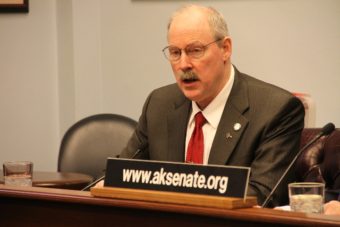
Sen. Peter Micciche, a Republican from Soldotna, explains that the goal of the substitute is to level out the government take at different oil prices. He says the substitute incorporates recommendations issued during earlier hearings of the governor’s bill.

“We heard complaints that the take was too high of a tax increase at the low end. We heard that people, including many senators, didn’t like the slightly regressive nature of the original SB21,” Micciche says.

The substitute also would give a tax break to Alaska manufacturers that make products that can be used for oil exploration, and it would also create a “Competitiveness Review Board” tasked with looking at how Alaska compares with other oil-producing provinces.

The Department of Revenue is still analyzing what effect the committee substitute would have on state coffers.

Both the Senate and House resources committees have multiple hearings on oil taxes scheduled this week. Ninety percent of the state’s revenue is tied to oil production.


Can wave energy get Yakutat off diesel?

Waves crash onto Yakutat’s Cannon Beach. A New England company was recently awarded a preliminary permit for work toward a community wave-energy project here. Photo by Ed Schoenfeld/CoastAlaska.

Surfers from around the world travel to Yakutat’s remote beaches to catch big waves.

Now, the community, hundreds of miles away from the nearest grid, wants to make another use of that power.

“If we’re able to convert that energy that’s pounding on our shores and displace diesel, the state’s going to save a lot of money,” says Chris Rose, founder and executive director of REAP, the Renewable Energy Alaska Project.

“We’re a place that makes sense to test this stuff, because we have higher energy costs than a lot of other places,” says Rose, who’s been watching the project’s progress.

Yakutat Borough Manager Skip Ryman says the bottom line is to get away from diesel.

He says the municipal power plant sells electricity for about 57 cents a kilowatt hour. The state’s Power Cost Equalization Program halves the residential price. But still …

“People are finding that anywhere from 45 to 60 percent of their disposable income has been going for utilities and home heating,” Ryman says. “This in turn is hurting retailers. We’ve been losing families, losing kids in the school system and essentially sending the community into a bit of a death spiral.”

Yakutat, about halfway between Juneau and Cordova, has been interested in wave energy for some time.

A study completed in 2009 recommended devices installed near the shore, rather than father out into the ocean.

“The device that we’re working on is called an oscillating wave surge converter,” says Cliff Goudey is senior engineer for Massachusetts-based Resolute Marine Energy.

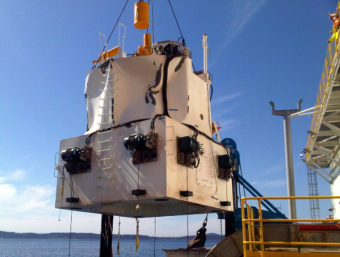
A diagram of Resolute Marine Energy’s Surge wave energy converter and how it works. Image courtesy RME.

“That’s sort of a fancy word for a paddle that sits on the bottom, that’s hinged at the bottom, the hinge being parallel to the shoreline,” Goudey says. “So as the surge of the waves pass over the top, the paddle gets pushed toward the beach and then back and forth.”

The company is working with federal, state and local officials to research and fund the Yakutat project.

It will use Resolute’s Surge Wave Energy Converter, which powers hydraulic pumps, which drive a generator. (Read more about the Surge.)

The device has been tested off the North Carolina coast. But it doesn’t have a track record.

Northwest National Marine Renewable Energy Center Director Belinda Batten says its competitors don’t either.

“In terms of commercial arrays of wave-energy devices, they currently don’t exist anywhere in the world,” Batten says.

She says Scotland has taken the lead, testing a number of different devices and systems at a major research facility in Orkney.

“Until we really get the first arrays of small devices in and producing energy over some time where we learn operating and maintenance costs, reliability, sustainability and those kind of those kinds of things, it’ll be tough to call the winners,” she says.

Resolute Marine Energy was recently granted a preliminary permit allowing more research and planning. But it still must clear other regulatory hurdles.

The company and its partners also need to address environmental impacts and conflicts with other users of the area.

There’s the surfers, of course. (Watch a video of Yakutat surfers in action.)

Borough Manager Ryman says that’s not all.

Yakutat’s Cannon Beach.

“It is an area used by trollers. You have whale migration off shore. There’s some concern about the noise these may be making and how that might interfere with whale migrations,” he says.

An Oregon wave-energy proposal has drawn opposition from crabbers and recreational boaters.

Yakutat’s project is being designed to meet the community’s power needs for much of the year.

Ryman says diesel generators would fill the gap when needed, especially when the local fish processor operates.

Rose, of the Renewable Energy Alaska Project, says hybrid systems are common.

“We now have 26 wind-diesel projects out there that are using sophisticated control technology to marry the wind and the diesel. Wave power’s actually a lot more predictable than wind power,” he says.

Experts say wave patterns can be forecast a day or two in advance.

Goudey, of Resolute Marine Energy, says the project could have statewide implications.

“If we can make this work in Yakutat, there will be other opportunities to do similar things in other locations around coastal Alaska,” Goudey says.

Research and construction could take years, possibly a decade.

In the short term, Yakutat is considering a biomass energy plant to fill the gap. But Ryman says that’s expensive too.

Kulluk cleared to leave Kiliuda Bay

An Army CH-47 Chinook helicopter delivers heavy equipment to the conical drilling unit Kulluk in Kiliuda Bay, Alaska, about 25 miles south of Kodiak City, Monday, Jan. 7, 2013. The Chinook helicopters delivered three loads of equipment to the Kulluk including two generators and a compressor. U.S. Coast Guard photo by Petty Officer 3rd Jonathan Klingenberg.

The Coast Guard lifted an order restricting movement of Shell’s Kulluk drill rig Thursday morning. Petty Officer David Moseley says the company had to provide information about assessments of the rig and their tow plan to the Coast Guard for review.

“The inspection, its seaworthiness, was done by industry class certification. They are the experts on those type of vessels. They inspected, they gave us their inspection for review, so we could understand what they found, if there were any concerns, or not, that needed to be addressed prior to its being transferred, or transported, from Kiliuda Bay,” Moseley says.

Now that the Captain of the Port order has been lifted, Shell is free to start towing the rig whenever it sees fit. It’s not clear when that will be, but Moseley says that the Coast Guard will be notified.

“We will know once they start that transit and we will monitor it as they make their transit to Unalaska,” Moseley says.

For now, the rig is anchored in Kiliuda Bay, on the south side of Kodiak Island.

That’s where two of the tugs that will be towing the Kulluk to Unalaska collided on Friday afternoon, as the Anchorage Daily News first reported. While working in close proximity, the Corbin Foss ran into the port side of the Ocean Wave. Petty Officer Moseley says there were no injuries and that the damage was minimal, but that the Marine Safety Detachment in Kodiak inspected both vessels.

“When we have an incident with reported damage that could impact the vessel, we, as the Coast Guard, want to ensure the safety of that vessel and the crew onboard so we will provide an inspection and an investigation into the incident to include things like drug testing of the crew, taking down statements of what was going on at the time, so we get a clear understanding of what was going on to see if there’s anything that needs to be addressed in the future with similar operations,” Mosely says.

The Ocean Wave is still tied up at the dock in Kodiak. The Corbin Foss is with the rig in Kiliuda Bay.

You can find more information about the Kulluk’s tow plan here.

Murkowski looks at bill for revenue sharing from off-shore energy

U.S. Senator Lisa Murkowski says she’ll soon introduce a revenue sharing bill for off-shore energy production.

Speaking to the Alaska state legislature this morning, Murkowski said she’s still working out final details of the bill with Louisiana Democrat Mary Landrieu.

“We realize that an Alaska only bill isn’t going to pass Congress. What we wanted to do was focus on the national prospective. What our legislation will do is direct 27.5% of the revenues from all forms of off shore energy production to our coastal states,” Murkowski says.

She says the plan goes beyond offshore oil and gas projects. And that could help sway skeptical lawmakers in Washington.

“If you have offshore wind, if you have ocean energy, these would also be part of a revenue sharing proposal. We offer an additional ten percent of revenues if states establish funds for clean energy and conservation projects,” Murkowski says.

Her plan, as she outlined today, differs from other revenue-sharing bills.

Senator Mark Begich introduced his own earlier this month that would give the state 37 and a half percent of off-shore oil and gas revenues.

Murkowski says if the plan were implemented, it could lead to billions of dollars in new revenue for the state.


Murkowski calls Kulluk grounding a ‘marine incident’

The anchor-handling vessel, the Aiviq, tows the drilling unit Kulluk to a safe harbor location in Kiliuda Bay, Alaska on Jan. 7, 2013. Photo by U.S. Coast Guard Petty Officer 3rd Class Jonathan Klingenberg.

U.S. Senator Lisa Murkowski says in light of the Kulluk’s grounding, the government needs to look at all aspects of Shell’s Arctic drilling operations.

“It’s not just the drilling operation itself. It’s the whole initiative. You gotta move the assets up north and then back. All aspects of the operation need to be tended to,” Murkowski says.

Speaking on Talk of Alaska today, Senator Murkowski called the grounding a “marine incident.”

The oil and gas industry, and its supporters in Washington D.C., have labeled the grounding a transportation issue. But today, Senator Murkowski said it’s more than just that.

“I share the concerns of many, that all areas were not fully attended to, to a level of assuredness to us as Alaskans, to us as Americans,” Murkowski says.

Both the Department of Interior and the Coast Guard are conducting separate reviews. The Interior study is due out in a couple of weeks.


Site notifications
Update notification options
Subscribe to notifications