Energy & Mining

Senate Energy Committee debates LNG Exporting

The Senate Energy Committee held its first meeting of the new Congress. It wasted no time in discussing one of the most controversial issues the committee will tackle this session – exporting liquefied natural gas.

Some hope exports from the Lower 48 could lead to more exports from Alaska.

The new chairman of the Senate Energy Committee, Oregon Democrat Ron Wyden, has been skeptical of exports … fearing what may happen to domestic prices … and what that means for major consumers.

“Instead of a manufacturing renaissance, major gas consumers could find themselves hit hard with energy price hikes to enforced, to sideline job-creating efforts,” Wyden says.

Wyden wasn’t appeased by a Department of Energy study that found exporting LNG would lead to a net-benefit for the U.S. economy.

That’s a view echoed by Dow Chemical CEO Andrew Liveris, who testified before the committee.

“One study does not make a strategy. One study does make the decision. I think we have lots of import decisions, not the least of which is to make sure we have responsible supply,” Liveris says.

A costly supply matters to Liveris – he says his company buys more gas than many countries. And his chemicals end up in all sorts of products. He says they add value to every facet of the economy.

“Natural gas liquids should not be shipped overseas and burnt in Japanese cooking ovens. It should be kept home,” Liveris says.

The Department of Energy is weighing about a dozen export applications from the Lower 48. Nobody at the hearing would guess how many would win approval.

Senator Lisa Murkowski, the committee’s top Republican, asked the panel – and all demurred.

Senator Wyden says it’s time to reexamine the nation’s natural gas laws … they’ve been on the books for decades – since well before exports were being considered. But Senator Murkowski says any new process cannot impose too many burdens on industry.

She noted the long-standing regulatory process through the Department of Energy.

“The debate on this issue has been on the impacts of domestic prices and supply, but I think we also need to include within this discussion an understanding of the role the market forces will play, not only domestic prices, but on the number of projects that may be built,” Murkowski says.

Those projects could produce a glimmer of hope for Alaska’s producers, says Larry Persily. He’s the federal coordinator the Alaska natural gas pipeline.

“The approval of lower 48 export projects is going to give you reason to believe that if and when the time comes that an Alaskan project applies for export authority, it too would be granted approval by the Department of Energy,” Persily says.

Because, Persily says, it’s only fair if every state can export.

But he urges caution.

“The export approval is one piece of the package. You need U.S. Department of Energy approval. You need a Federal Energy Regulatory Commission certificate for the liquefaction plant. And if there’s a pipeline connected to it, you certainly need financing. You need buyers. This is just one piece of it,” Persily says.

And the largest hurdle to more exports from Alaska is the sixty-five billion dollars it could take to build a pipeline from the North Slope to the non-existent liquefaction plants at tidewater.


Alaska Democrats debut their own oil tax legislation

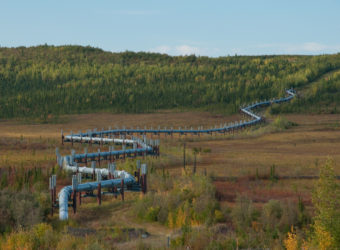
The Alaska pipeline.
The Alaska pipeline. (Photo by David Mark/Pixabay)

House and Senate Democrats have rolled out oil tax legislation they say will put more oil in Alaska’s pipeline without throwing the state off a fiscal cliff.

In a news conference yesterday (Monday), Democrats said the legislation would reward new production with some tax breaks, while protecting the state’s share of revenue from its oil fields.

Anchorage Senator Johnny Ellis said the state must gain from what it gives:

“Alaskans must get something in return if we reduce taxes on the oil industry,” Ellis says.

Since Governor Sean Parnell three years ago proposed oil-tax reductions to encourage investment, Democrats have rejected the idea as a “giveaway.”

The governor’s current plan would cost the state more than a billion dollars a year at projected oil prices, but bring in more revenue when prices fall.

The Democrats’ bill is more a modification than an overhaul of the state’s current tax system — commonly known as Alaska’s Clear and Equitable Share, or ACES. It would cap the windfall profits tax at 55 percent, and create credits for heavy oil research and development and the construction of new processing facilities on the North Slope. It also would provide a tax exemption for 20 percent of oil from new fields for the first seven years in production.

Democrats hope the bill – introduced in the House and Senate – will compete with the governor’s, which is already on the move and is being heard in House and Senate Resources committees this week.

While both have the goal of increasing petroleum industry investment in Alaska, Anchorage Representative Les Gara says the Democrats’ bottom line is:

“If you develop in Alaska, if you produce more oil in Alaska, we’ll give you a reasonable tax break. If you want a two billion dollar check to take to Libya or Iraq, you’re not getting that from our bill. You have to produce to get a reduction,” Gara says.

Anchorage Senator Bill Wielechowski says the Democrats’ aim to require companies to present exploration and development plans to the state before bidding on an oil field lease.

“Then the state must go ahead and review those plans and make sure they’re in the best interest of the state. This is done all throughout the world,” Wielechowski says.

The Democrats’ bill also would allow the state to partner with oil companies on investment.

Parnell’s office is currently reviewing the minority’s bill. They offered a brief statement, saying that the governor is pleased that Democrats “agree there is a problem with production under the current system.” About 90 percent of Alaska’s tax revenue comes from oil production.

Seeking comprehensive energy solutions in rural Southeast

It’s no secret that the high cost of energy in rural Alaska is a barrier to economic development and one of the primary reasons many residents are leaving village life behind.

Wind power is one of the ideas being considered by Kake officials as a way of mitigating high energy costs.
Wind power is one of the ideas being considered by Kake officials as a way of mitigating high energy costs. (Wind turbine photo via Pixabay)

In some rural Southeast communities, electric bills are up to 275 percent higher than the national average, and some households spend as much as 50 percent of their income on home heating fuel.

Experts say there’s no magic bullet solution to the problem. So, some communities are embracing a comprehensive approach.

With 800 homes in 12 communities, the nonprofit Tlingit and Haida Regional Housing Authority is the largest provider of low and fixed income housing in Southeast Alaska. President and CEO Ricardo Worl says the agency also is among the largest non-government consumers of electricity and heating fuel in the region.

“The cost of heating alone for our organization consumes about one-third of our operating budget,” Worl says. “So, we’re paying more than a million dollars a year just to heat the homes that we do own and operate.”

In 2011, Kake officials asked the housing authority to sponsor a free energy education workshop in the community. The workshop touched on topics such as alternative energy, conservation and Alaska’s place in the global and national energy pictures.

“It was really neat to see the city, the tribe, the local corporation, the school district, all come together so they can look at and evaluate different technologies that are available to them, consider what is most feasible for them, long-term and short-term energy goals for the community,” says Worl.

Gary Williams is executive director of the Organized Village of Kake, the tribal government for the small, Kupreanof Island community of about 600. He says residents pay about 65 cents per kilowatt hour for electricity, generated by burning diesel fuel at between $5.50 and $6 per gallon.

Officials from Kake are pursing an electrical intertie with Petersburg.

The community has long desired a 40-mile electrical intertie with Petersburg, which is on less expensive hydro power.

While that project is in the permitting stage, Williams says Kake has used the workshops to focus on comprehensive energy solutions. That includes alternatives like wind and wood biomass, as well as conservation and weatherization.

“That’s been part of the mix,” Williams says. “And a very important one, because it’s probably the best bang for the buck to tighten up homes and just make your BTUs more effective.”

As a result of Kake’s energy workshops, the village was selected last year as one of five Alaska communities to participate in the federal Department of Energy’s START program.

START stands for Strategic Technical Assistance Response Team – essentially experts who work with local communities on energy planning. One of those experts is Brian Hirsch with the National Renewable Energy Laboratory in Anchorage.

“It’s really not one size fits all,” Hirsch says. “We’re developing an approach that is very community centric and team based and replicable for lots of agencies and communities.”

In Kake, the START program helped improve an existing wind energy project. It also provided technical assistance for the installation of solar panels at the Kake Village office building. Williams says the panels could provide up to a third of the building’s energy needs.

“I could see the potential where something the size of our installation could take care of a typical Kake home,” Williams says.

Tlingit and Haida’s Worl says the housing authority is also pursuing alternative energy solutions in Kake. The agency will soon be trying out wood pellet heating systems at some of its properties in the village, thanks to a $500,000 dollar grant from the Alaska legislature last year.

If successful, Worl says it could be used in other communities and perhaps someday spark a wood pellet industry in rural Southeast.

“The market in Southeast may not quite be big enough for the cost that it takes to manufacture wood pellets at this time,” Worl says. “But I know that a lot of folks are really watching and waiting and this will sort of be the first step.”

Other communities are following Kake’s lead. Angoon, Hoonah and Yakutat held similar energy education workshops in the past two weeks. Hirsch says the deadline to apply for participation in the next round of the START program is coming up next month.

Williams says he’d encourage those other communities to go for it, and says Kake is willing to partner with other villages on regional initiatives.

“We’ve been on the receiving end a lot,” Williams says. “So, I’d just as soon have us on the return end too.”

TAPS committee advances oil tax bill

A special Senate committee on oil production has advanced Gov. Sean Parnell’s bill to lower taxes on oil companies without any amendments. But that does not mean the committee is in total agreement with the bill.

Here’s Peter Micciche, co-chair of the TAPS Throughput Committee and a Republican from Soldotna:

“The Committee’s intent to pass the bill to the Senate Resources Committee in the original form for further processing is in no way an expression of support by Committee members for B 21 in current form. In fact, most members have expressed concern for key concepts that would require revision prior to supporting the bill as it moves through the legislative process,” Micciche says.

The committee included a number of recommendations for improving the governor’s plan in their letter of intent. In its current form, the bill would get rid of a mechanism that increases taxes on oil companies when profits are high. While the committee supports changing the current oil tax structure, they do want the legislature to see if there’s a way of keeping some element of progressivity in the system. They would also like to see incentives for Alaska hire included in the bill.

Four amendments to the bill were considered in Thursday’s hearing, all introduced by Berta Gardner of Anchorage — the lone Democrat on the committee. One aimed to put in place an alternative minimum tax that would put a 15 percent floor on oil companies’ tax rate. Each of the amendments failed four to one, on party line.

Since the beginning of the legislative session, Democrats have promised a rival plan to Gov. Parnell’s oil tax proposal but it has not yet been introduced.

Alaska’s Congressional delegation reacts to Jewell’s nomination as Interior Secretary

Sally Jewell
President Barack Obama and Sally Jewell applaud outgoing Interior Secretary Ken Salazar after President Obama announced Jewell as his nominee to replace Salazar, in the State Dining Room of the White House, Feb. 6, 2013. (Official White House Photo by Pete Souza)

President Barack Obama nominated REI chief executive Sally Jewell to lead the Department of the Interior Wednesday. It’s a Cabinet position with incredible influence over Alaska.

And by virtually every account, the pick surprised everyone.

The Department of Interior oversees critical programs in Alaska – the Bureaus of Indian Affairs and Land Management, the National Park Service, and the offices that promote and regulate off-shore drilling.

In his announcement, Mr. Obama rattled off a long list of accomplishments outgoing Secretary Ken Salazar has achieved, including opening more land and water to energy production.

And now the president turns to another westerner, Sally Jewell, to continue on that path. She comes from the private sector and the Seattle region.

“I’m willing to bet she will be the first Secretary of the Interior who frequently hikes mailbox peak in her native Washington State, and who once spent a month climbing mountains in Antarctica, which is just not something I’d think of doing,” Obama joked. “It seems like it’d be cold, and I was born in Hawaii.”

Jewell’s name had not been publicly floated. Most of the names circulating for the post came from within the Interior Department or other parts of government.

Senator Lisa Murkowski says Jewell’s private sector background would lend a healthy perspective to the department, but the transition to a massive government bureaucracy could be hard.

“When you’re coming from outside the government, dealing within the government confines can be very, very difficult,” Murkowski said. “[Energy] Secretary [Steven] Chu is a perfect case in point: Brilliant man, great credentials, but not a lot of background when it came to operating a department like Energy. And I think he’s been subjected to a lot of criticism for that.”

Senator Murkowski says she’s met Jewell before at a cocktail party.

“We talked about going hiking together,” Murkowski said. “She strikes me as that kind of person, somebody that is very easy going, very unpretentious.”

But that doesn’t mean a yes vote is guaranteed. Murkowski worries Jewell could be too sympathetic to the environmental community.

Before the full Senate can vote on the nomination, Jewell needs to pass a vote in the Energy Committee. If that happens, Senator Mark Begich does not know how he’d vote.

“I am not just going to blankly support her because the president wants someone in that position,” Begich said.

Begich is withholding judgment until he gets to know where Jewell stands on key issues like Arctic drilling.

“The president has already said that is a policy they’re moving forward on, development of the Arctic,” said Begich. “But if the Interior Secretary isn’t supportive or slows down the process, that would be very problematic.”

Senator Begich also appreciates that Jewell has been in the private sector. Before REI, she worked in commercial banking, and out of college, in the oil fields of Oklahoma and Colorado for Mobil.

She’s been active in elections, giving money to many candidates. She’s mostly donated to Democrats, including a $250 contribution to Senator Begich in his 2008 Senate run. She also gave $500 to Senator Murkowski in 2009.

Absent from her donor list is Congressman Don Young. He says he’s disappointed in the pick because he does not think she has an understanding of public lands issues.

“I do believe her interests lie in recreational purposes and not multiple use of the lands,” Young said.

The oil and gas industry is keeping relatively quiet. John Felmy is the chief economist at the American Petroleum Institute. He says he welcomes a fresh start at Interior.

“We’ve had some differences with Secretary Salazar,” Felmy said. “We’ve had some onshore leases that have been pulled back. We’re disappointed in that because we think we have an enormous amount of oil and gas that we can develop. We’d like to move forward as fast as possible.”

Felmy would not say whether API would intervene in the confirmation process with an ad campaign or publicly oppose the nomination.

Some environmental groups are excited about the pick. Cindy Shogan directs the Alaska Wilderness League. She says Jewell’s hardest task will be fighting against strong support for Arctic drilling.

“If she wants to make her mark, she’s going to have to make sure she has the support of the delegation, or is willing to make decisions that will disappoint them,” Shogan said.

There is no date set for the confirmation hearings. It could be as early as next week, though that’s unlikely. After that, the Senate is on recess until the last week of February.

Oil companies weigh in on Parnell’s oil tax proposal

Last week, the public got its first chance to comment on Gov. Sean Parnell’s plan to cut taxes on oil companies and restructure the way credits are given out. Opinion was split. Supporters said that scrapping a mechanism that raises taxes when oil prices are high could increase oil production in the state, while critics argued that the getting rid of progressivity would be a “giveaway” to oil companies.

On Tuesday, representatives from the oil and support service industries got a crack at the proposal, and the testimony was not so polarized.

Bob Heinrich is the vice president of finance for Conoco Phillips, and he says that his company is happy with the bill as a starting point.

“We believe it’s a good step forward to set the stage for an improved investment climate. By eliminating progressivity it solves the problem of high marginal tax rates. And it certainly makes Alaska more competitive in a higher price environment,” Heinrich says.

But there are still some things about the bill that Conoco Phillips would like changed.

“The flip side of that, though, is that at today’s prices and lower, as it’s drafted, it represents a tax increase to producers that will discourage investments if your perspective is downward or you’re in a downward-trending market,” Heinrich says.

The Alaska Oil and Gas Association also favored of getting rid of progressivity, but didn’t like what the plan did to tax incentives. As it’s written, the bill would tie credits to production instead of exploration.

Right now, the bill is being heard by a special Senate committee on oil production. They expect to move the bill on to the finance committee by the end of the week.

Site notifications
Update notification options
Subscribe to notifications