The number of non-residents working on Alaska’s North Slope continues to increase, according to state Labor Commissioner Dianne Blumer.
She told the Senate Labor and Commerce Committee yesterday (Tuesday) that training programs are in place for Alaska hire, but a forthcoming report shows more workers hired from outside the state.
Blumer said an update on nonresidents working in Alaska is due out Thursday. It tracks the percentage of nonresident workers in Alaska by industry, occupation, and geographic area.
The annual resident-hire report showed nearly 31 percent of workers in Alaska oil and gas industry came from outside the state in 2010. It showed the percentage of nonresident workers in the oil and gas industry has historically been higher than the statewide average for all industries.
The Senate Labor and Commerce hearing was the first in the confirmation process for Blumer, who was appointed by the governor in May to replace Click Bishop, when he resigned to run for the Senate.
Many of the questions focused on Alaska hire, especially the North Slope. Blumer said the Alaska Workforce Investment Board has developed an oil and gas pipeline plan and believes the petroleum industry will provide a lot of future employment opportunity in Alaska.
“We’ve identified 113 occupational job classes that would be needed if and when – I would like to say when – pipeline construction occurs. So any company that comes and has a program that would meet any of those 113 occupational codes, we work with them to get people either in on the job training, registered apprenticeships, or just training programs,” shd said.
Blumer has worked 22 years in state service, in the Transportation and Administration departments as well as the governor’s office. She’s a former director of the state Division of Personnel and has been a negotiator for the state in public employee union contract agreements.
The Senate Labor and Commerce Committee recommended Blumer be confirmed. That must be taken up by the full legislature.
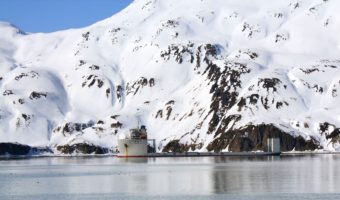
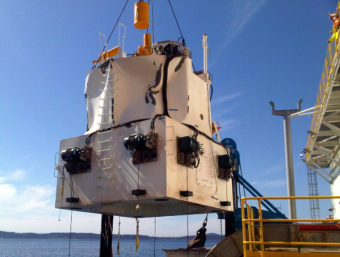
Kulluk in the Beafort Sea. (Image courtesy Shell Oil)
Environmentalists from Alaska are hoping to persuade Congressional staffers Shell Oil should not continue its drilling operation in the Arctic this summer.
The groups held a Congressional briefing on Friday.
Congressional briefings are free of the formalities and TV cameras of Congressional hearings. And they lack the members of Congress themselves.
And many in this town think that’s a good thing, because it’s the staffers who attend the briefings. And it’s the staffers who have the policy expertise. The briefing was organized by the office of California Democrat Barbara Boxer – she chairs the Senate Environment and Public Works Committee.
Verner Wilson traveled from Anchorage to tell the room about how important fishing is to his native Bristol Bay.
“I know that the oil is declining up in the North Slope, but I come from a region where we depend on our wildlife. We depend on the ocean for our livelihood. It’s been our livelihood for thousands of years,” Wilson says.
Wilson, who dons a spotted seal fur vest and neck tie, works for the World Wildlife Fund. He says he’s not opposed to drilling in the future…but the company and government need to ensure the infrastructure will be put in place first.
“What’s the rush? Why are we doing this exploratory drilling when we don’t have hardly any infrastructure up in this remote and harsh area,” Wilson asks.
That’s a sentiment echoed by Kiley Kroh. She works with the D.C. based Center for American Progress – or CAP, a left leaning think tank that has a lot of sway with Democrats in Washington.
“Our initial stance was that we were open to Arctic offshore drilling if companies could prove they were fully prepared,” Kroh says.
Last week CAP rescinded its support. Kroh says Shell proved it was unable to move forward just yet.
She says CAP may come back around to support Arctic drilling. The ongoing, sixty day study at the Department of Interior will provide some guidance.
Kroh says that expedited review will need to address Shell’s shortcomings.
“In terms of infrastructure, in terms of response preparedness, in terms of scientific knowledge of the region, so if those things are met, then there is a potential we could be open to it,” Kroh says.
Shell Alaska’s spokesperson was not available for an interview. In an email, Curtis Smith says the company is still assessing the Kulluk’s condition, and how its grounding will affect future exploration in Alaska. He says the company is committed to operating safely off Alaska’s shores.
Michael LeVine is Pacific senior council at Oceana. He’s in D.C. from Juneau and is meeting with Department of Interior officials to discuss the ongoing reviewing.
He says Interior never changed any criteria determining which sites are suitable for off-shore drilling after the Deepwater Horizon spill in the Gulf of Mexico.
“The Department of the Interior granted these approvals, defended them publicly and in court, and has stated its commitment to exploration in the Arctic. We need a review that goes beyond those commitments and those defenses and it’s our hope Congress may play a role in making that happen,” LeVine says.
Congress has yet to do anything. Senator Mark Begich has said he’ll hold hearings on the grounding … but no dates or witnesses have been announced.
Governor Sean Parnell talks to high school students in Juneau and around Alaska via videoconference as part of an “Introduction to Mining Occupations” class at UAS. Photo by Casey Kelly/KTOO.
More than 50 high school students taking an “Introduction to Mining Occupations” course through the University of Alaska Southeast had quite the guest speaker on the first day of class Tuesday.
Governor Sean Parnell urged the students to follow their passions, whether they end up working in the mining industry or not.
“This class is a path of opportunity for you, and you’re going to get out of it what you put into it,” Parnell said.
The governor was the first of many guest speakers the class will hear from this semester. Instructor Mike Bell worked at Hecla Greens Creek Mine before becoming director of the Center for Mine Training at UAS. He says he’s identified more than 140 mining-related careers, everything from cooks to truck drivers to waste water treatment engineers.
“I’m not going to instruct in all of these fields, because I don’t have that kind of expertise,” Bell said. “I’ve worked at Greens Creek Mine for five years and been a professor here for six or seven. But there are a lot of jobs that I don’t know about. So, what I do is I call up a Mine Engineer, maybe at Greens Creek or at Coeur [Kensington Gold Mine] and they come and talk to the students about how they got their job, the education required and how they might take a path to get there.”
This is the second year Bell has taught the class, which is designed for high school juniors and seniors. Last year, enrollment was limited to 20 students, all from Juneau. But this year, with the help of video conferencing equipment, there are 55 students statewide, from the Northwest Arctic Borough to remote parts of Southeast.
“I went down to Prince of Wales to talk to all the schools there, because there are two big mines that are starting up down there and they want a local workforce,” said Bell. “So, we’re trying to show the kids what happens at those mines.”
Isaac Rumfelt is a 17-year-old senior at Juneau’s Thunder Mountain High School, who’s interested in a career as a mechanic.
“I kind of got into diesel mechanics and figured out I could get into diesel mechanics at the mine,” said Rumfelt. “So, I thought it would be good to learn what goes on at the mine on a daily basis and basics of everything kind of.”
Students in an “Introduction to Mining Occupations” class at UAS listen to professor Mike Bell as Governor Sean Parnell and UAS Chancellor John Pugh listen from the back of the room. Photo by Casey Kelly/KTOO.
In his remarks Governor Parnell talked about the importance of keeping mining jobs in Alaska. He praised programs like the Center for Mine Training, and classes like “Intro to Mining Occupations” for teaching Alaska students the skills needed to perform those jobs.
The students pay $44 tuition and receive three college credits, according to Roxanne Mourant with the state Department of Education and Early Development.
The department is one of several partners that provided support to make the class possible. That includes mining companies like Hecla Greens Creek, which donated $300,000 to the University of Alaska Foundation in 2011 to help create the mine training program at UAS.
Last week, Gov. Sean Parnell rolled out his latest proposal to revamp the state’s oil tax structure. It’s the third time he’s tried to do this, and the last two attempts resulted in a stalemate.
Another session, another oil tax debate, and the rhetoric? Well, it’s mostly the same.
“While Alaskans haven’t always seen eye to eye on these issues, we can all see the obvious: Unless we restore balance to our tax system, our oil fields will become obsolete. We must make reforms – and we must make them now,” Parnell says.
And here’s House Minority Leader Beth Kerttula, a Democrat from Juneau.
“The Governor’s new bill would mean that when the oil industry rakes in record profits, Alaskans will lose troopers and teachers and not be building roads and ferries. This new bill is still a giveaway,” Kerttula says.
About 90 percent of the state’s revenue comes from oil production. Right now, it’s taxed in a variety of ways. Companies like Exxon and ConocoPhillips pay royalties on the oil they drill and they pay a base production tax on their profits. They also pay out a progressivity tax that operates sort of like a sliding scale, where they get taxed at a higher rate as the price of oil goes up.
Last year, the governor’s bill focused on bracketing that progressivity tax. Michael Pawlowski works with the Alaska Department of Revenue and specializes on oil taxes.
“And so what bracketing did was try to apply progressivity much like your personal income tax,” Pawlowski says.
Just like top income earners don’t pay the top rate on *all* of their money, oil companies would get to pay lower percentages on the first $30 they get per barrel and then their taxes could go up incrementally.
This time around, Parnell is proposing getting rid of progressivity altogether, so that all oil would be taxed at the same rate no matter what the price is.
“So, it flattens the tax system to a 25 percent base tax rate,” Parnell says.
Pawlowski explains that the bill has a few other provisions. He worked on the team that helped create it, and he crunched the numbers for the Revenue Department’s analysis of what it would do.
He says the governor’s bill would get rid of a 20 percent capital expenditure credit that the state gives to companies who are spending money to extract oil.
So, they would lose a tax break while they’re trying to produce oil but get their taxes cut once they start putting barrels through the pipeline.
Additionally, the governor’s bill would change the way a 25 percent operating loss credit is paid out. Right now, if a company that’s pretty new to Alaska puts a million dollars a year into exploration but they aren’t producing anything, it can get $450,000 from the state each year to help them cover their losses. Under the governor’s bill, they would only get a quarter million from the state and that would only be paid out once the company actually starts producing oil.
So what does all that would do to revenue?
“We get rid of the progressivity; which leads to a reduction in state revenues at this projected oil price. And I think that’s important to remember is that across the range of oil prices, this will look different,” Pawlowski says.
According to the fiscal note that Pawlowski helped draft, the governor’s bill would give oil companies a tax cut of about a billion dollars *a year* if oil prices and production turn out to be as forecasted. But of course, there’s a lot of uncertainty when it comes to the economics of oil.
“And just, just remember that looking five years into the future about what exactly a company is going to spend or what exactly oil production is going to be — these are forecasts around which the legislature, the governor, the public all base their decision. But they’re still a forecast,” Pawlowski says.
Over the next few weeks, legislators, staffers, and anyone watching the oil tax debate from afar is expecting a lot back-and-forth over what changing the oil tax structure could actually do to the state’s coffers.
That debate starts in earnest on Tuesday, when the governor’s oil tax bill will get its first committee hearing.
World Trade Center Alaska Executive Director Greg Wolf speaks at the 2013 Statewide Economic Forecast Luncheon in Juneau, the sixth time the event has been held in the Capital City. Photo by Casey Kelly/KTOO.
Alaska’s economy weathered the Great Recession better than most states, and should hold steady for the foreseeable future. But depending on who you ask, there could be gloom on the horizon.
World Trade Center Alaska brought its annual Statewide Economic Forecast Luncheon to Juneau on Thursday, where two economists offered differing predictions for the state’s fiscal future.
Northern Economics Vice President and Senior Economist Marcus Hartley says he’s a pessimist when it comes to Alaska’s long term economy. But he admits the state has done pretty well in recent years, even as other parts of the country struggled.
“Alaska is kind of an object in motion that stays in motion,” he says. “It keeps kind of chugging along like a freight train.”
In 2012 Alaska’s gross state product was $53 billion, which beat Hartley’s forecast and represents a four percent increase from 2011. Job growth also outpaced last year’s expectations, led by the health care and financial services sectors.
But Hartley says 2013 could be one of the last years in which the state fails to achieve even a small growth. He’s predicting the gross state product will remain flat this year, and he worries $53 billion may be as good as it gets.
“I don’t know if we’re capped out,” he says. “But there’s the beginnings of a trend there.”
The first factor he cites is declining oil production. Alaska currently ranks behind Texas, North Dakota and California on the list of top oil producing states. The price of Alaska North Slope crude is still higher than oil produced in other parts of the country, but Hartley says even that might not be sustainable.
“There’s a pipeline being planned from Texas to California. We also know that there’s plans for shipping oil via rail up to the refineries in western Washington,” he says. “So, there is some concern that oil that’s being produced from the middle of the country will get to the west coast and start to undermine the price that we have.”
Those projects are still several years away, but Hartley says state spending is a concern right now.
He points to a study from the University of Alaska’s Institute of Social and Economic Research that shows the state may need to use savings to maintain services in next year’s budget. The same study predicts a significant deficit by 2023 and recommends immediately cutting the state budget by $2 billion.
“A lot will depend on the taxes, and the budgets, and tax changes, and what goes on,” says Hartley. “But this can be a pretty scary picture.”
If Hartley is a pessimist, Greg Wolf is an optimist.
The Executive Director of World Trade Center Alaska says the state is exporting more goods to other countries than it has at any point in history – an estimated $4.5 billion in 2012.
“That is somewhat down from the previous year, where we were just over $5 billion. It’s about a 10 percent decline,” says Wolf. “But at this level it’s the second highest in our history. So, it’s still a very, very strong performance, near record levels. Not every year can be a record year.”
Wolf thinks the trend of increased exports will continue. He says Alaska has an abundance of natural resources, is located along strategic shipping channels, and is already doing business with emerging markets like China that are buying a lot of goods.
“We have what the world needs, and it’s a world that’s increasingly able to afford what we have,” Wolf says.
China is currently the largest buyer of Alaska exports, followed by Japan, South Korea and Canada.
Part of the reason Wolf is bullish on the state’s future is a belief that China will soon be an investor in Alaska in addition to a buyer of its goods.
“We don’t have any crystal ball, or any inside information about this. All we do is look around to the rest of the world,” he says. “We look at any other natural resource jurisdiction in the world, and you’ll see the Chinese as buyers, and you increasingly, if they’re not there already, you’ll see them as investors, partners. And that’s likely to be a next step for Alaska.”
Wolf says oil, natural gas, and minerals are among the goods emerging countries will need from Alaska, though seafood remains at the top of the state’s export list for now. He says the big question will be if the state can produce those goods.
“If we’re allowed to responsibly develop these resources,” Wolf says, “we’ve got an incredibly bright future.”
This is the sixth year the World Trade Center Economic Forecast Luncheon has come to Juneau. It’s also held every year in Fairbanks and Anchorage.
The event usually attracts a number of legislators in the Capital City. But this year the only elected state official in attendance was Lieutenant Governor Mead Treadwell, who gave opening remarks.
Alaskans are joining the Canadian First Nations’ Idle No More movement.
Often compared to the “Occupy” protests, the grassroots movement has moved across Canada and is gaining traction among Native groups in the U.S.
Canadian First Nations are protesting legislation that removes environmental protections on tribal lands. As several First Nations’ chiefs were meeting with Canadian Prime Minister Stephen Harper on Friday, they got support in Juneau and Anchorage.
About a hundred people turned out for a noon rally in Anchorage, compared to about ten in Juneau, but the message and the signs were the same: Sustainability now; sovereignty for indigenous people.
At the Anchorage rally, Allison Warden, of Kaktovik, called the issues emotional.
“I hope something is awakened within you. Something inside your DNA, like this is where I’m supposed to be, this is what I’m supposed to do, this is how I stand up for my people,” Warden said.
Vi Waghiyi, of St. Lawrence Island, said the military bases built there during the 1950s have contaminated the land and waters where the Siberian Yupik residents of the island gather food:”
“We have 10 times more PCB levels in the blood of our people than the average American in the Lower 48. But we’re also some of the most highly contaminated population on the planet because of our reliance on our subsistence foods,” Waghiyi said. “Our very foods that have sustained our people for many, many generations are killing our people.”
A rally that started at Juneau’s Marine Park on Friday finished at the Alaska State Capitol. Rallies were held in Juneau and Anchorage in support of the Canadian First Nations’ movement Idle No More. Photo by Annie Bartholomew/KTOO.
In Juneau, Ishmael Hope called the Idle No More movement wholesome, simple and healing. Of Tlingit and Inupiat descent, Hope said the local rallies are not meant to antagonize.
“What we’re here to do is show who we are and that can translate into the politics of our time, and that can translate into the big issues of our time,” Hope said. “We could see how the clan, the language, our culture, our identity can connect with political issues, with ideas of sovereignty. “
Hope said the border between Alaska and Canada is invisible for Native people. And when it comes to major industrial development – like that proposed in the British Columbia wilderness – it could impact all Alaskans.
Guy Archibald is Mining and Clean Water Coordinator for the Southeast Alaska Conservation Council, which supports the Idle No More Movement.
“Up the Unik River, the Stikine River, the Sacred Headwaters, there’s huge open pit mines proposed mines proposed for up there,” he said. “The environmental review process of the Canadian federal government has been deregulated and defunded. It’s scary what could happen, and so much of our economy here in Southeast is dependent on these rivers. It’s a billion dollar fishing industry.”
While conservation groups share many of the values expressed in the Idle No More movement, Archibald said the cause should not be “co-opted by conservation groups.” He said Idle No More needs to remain an indigenous movement.