Energy & Mining

Parnell administration preps new bill for oil tax reform

The Parnell administration is poised to introduce oil tax reform legislation. Previous attempts have failed to gain enough support to pass the state legislature. The new bill was previewed for the Fairbanks Chamber of Commerce Tuesday, and it incorporates some ideas raised in recent year’s discussions.

Alaska’s current oil tax system allows companies to buy down their liability with infrastructure investment, but it also ups taxes at high oil prices, something the governor argues is stalling new production. Deputy Revenue Commissioner Bruce Tangeman says a bill planned for release next week by the governor doesn’t throw out the current ACES system but tweaks it to up oil output.

“How do we tie those tax credits to production? And that’s really what the bill is going to be focused on, is bringing down the progressivity to realign that. But also realigning the tax credits so they’re not harmful to the state up front, realizing that we have to give something back on the higher end in the out years,” Tangeman says.

Tangeman says the bill has not been finalized, so he cannot provide any specifics. He says it taps input from the last couple years oil tax debate as well as from other state’s like North Dakota, that have begun out producing Alaska due to a boom in shale oil production. Shale oil is being investigated on the North Slope, and it’s pointed to by some as the way to stem a long trending production decline, but Tangeman says the drilling intensive development will be tougher in Alaska.

“In North Dakota, you can drive to every square block of the state, back a truck up, and start drilling. The regions that they’re looking at on the North Slope, there’s no roads at all. So, if you look at North Dakota and Texas, it’s like a checkerboard almost, and you can see drill rigs off on the horizon,” Tangeman says. “So, the first challenge is, how are we physically going to get this checkerboard of drill rigs out into the tundra?”

Tangeman says shale oil development may not happen with Alaska’s production tax and credit system, but that doesn’t mean he’s down on the potential for new oil production. He says the state has massive undeveloped and undiscovered oil sources, many conventional, and that warrants a tax model that allows high crude prices and big industry profits to drive production at the sacrifice of a shorter term revenue bonanza.

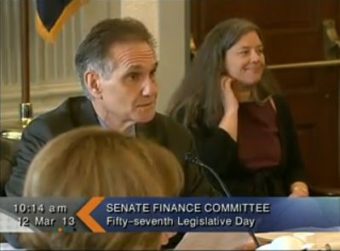
Democrats in the legislature’s minority haven’t offered a counter proposal, but they have introduced bills that handle some of their concerns about oil tax reform in a piecemeal fashion.

One item would require oil companies to provide detailed information on how much they’re spending on their leases. Another bill would require the state to look at how much business a tax credit is actually bringing the state.

Reviews of tax credits would occur after they’ve been in place for seven years. According to a report done by the New York Times in December, Alaska spends over $700 million on tax incentive programs each year.

Sen. Bill Wielechowski is the bill’s sponsor.

“We have no idea whether they’re working, we have no idea what they’re going for. The administration has testified that we just don’t know whether they’re working or not,” Wielechowski says.

That bill would apply not just to oil tax credits, but subsidies to the mining, construction, and film industries.

Wielechowski also still thinks there may be some skepticism toward the governor’s oil tax reform program in the Senate, even with a new solidly Republican majority.

“I know that everyone’s saying there’s a drastic change in the structure, and there is certainly is in the structure of the majority, but what people need to remember is you still need 11 votes. And when you look at the votes that are out there, I’m not sure there’s 11 votes to make a radical change like the governor is proposing on ACES. I’m just not sure there’s 11 votes there to do that,” Wielechowski says.

A 16-person coalition of Democrats and Republicans in the Senate blocked the governor’s oil tax proposal last year. That coalition was effectively broken up after six members of that coalition lost their seats last election.


American Petroleum Institute says Shell should move forward with arctic drilling

The top oil lobbyist in Washington DC says Shell Oil should not be hampered by the grounding of the Kulluk.

The American Petroleum Institute says Shell Oil should move forward with its Arctic Ocean plans this year.

Speaking at API’s State of American Energy, President and CEO Jack Gerard echoed Shell Oil’s comments on the grounding of the Kulluk.

“The most important thing is to distinguish that the issue was a transportation, a movement situation,” Gerard said.

Gerard says the incident it has nothing to do with oil drilling. The Kulluk has been successfully anchored near Kodiak Island.

Gerard says that federal regulators are closely watching Shell as it drills and moves its fleet of rigs and vessels. So, in his eyes, it’s safe for the company to proceed with its Arctic drilling plans this summer.

“I think they’re not only highly regulated, but also highly monitored and scrutinized at what they’re doing,” Gerard said. “So I think that clearly needs to move forward.”

Gerard’s comments come on the same day that Interior Secretary Ken Salazar announced an expedited review of Shell’s Arctic ambitions.

The review will be completed within 60 days, and will give considerable attention to the Kulluk and the failed containment dome test this past summer.

Juneau Assembly OKs drinking water supply plan

Last Chance Basin water treatment plant

The Juneau Assembly has adopted a Municipal Drinking Water Supply Plan that grew out of discussions about reopening the AJ Mine near downtown.

The centerpiece of the plan is an effort to build redundancy into the Capital City’s water supply, the bulk of which comes from Last Chance Basin, where the old AJ Mine is located. Salmon Creek is the secondary source, but is interruptible due to seasonal turbidity, or cloudiness in the water. A filtration plant would allow Salmon Creek to operate year round, giving Juneau two full-time water supplies.

In October, Juneau voters approved more than $1.5 million in sales tax revenue for Salmon Creek filtration. The drinking water plan identifies five actions that would trigger a decision to construct a plant, including growth in Juneau, increased demand for city water from cruise ships, regulatory requirements, declining well field production, and increased turbidity.

Tom Brice with the Juneau Building Trades Council urged the Assembly to adopt the plan.

“The Juneau Building Trades is very concerned that the Assembly take the responsible action to ensure that our community has a safe, viable water source that meets the needs of Juneau, not just now, but into the future,” Brice said.

In 2011, the Assembly appointed the AJ Mine Advisory Committee to look at the feasibility of reopening the old mine near downtown, which the city co-owns along with a sister company of Alaska Electric Light and Power. The committee recommended the drinking water supply plan, saying the threat posed to Last Chance Basin’s well field by mining activity was a significant barrier to mine redevelopment.

The Assembly has not yet decided whether to pursue reopening the AJ, and it remains a controversial issue that divides Juneau residents.

Guy Archibald with the Southeast Alaska Conservation Council told the Assembly it will be impossible to divorce the plan from efforts to restart the mine.

“This rather quick push to get the funding and get this resolution through to build a secondary water system or a redundant water system seems to be primarily pushed towards the promoting of the AJ Mine,” Archibald said. “If indeed there are millions of dollars worth of gold down there, I would ask that maybe the potential mining company pay for these threats to the infrastructure.”

Others questioned the plan’s accuracy, or why it doesn’t address other alternatives for adding redundancy to Juneau’s water supply.

Assembly member Karen Crane said the discussion made it clear to her that the plan needed more work.

“We would save ourselves a lot of time and a lot of grief, if we would put a little more time into this on the front end,” Crane said.

But Assembly member Jesse Kiehl said while it’s not perfect, the plan is at least a start.

“The future growth over the long term is better served by beginning to develop a filtration system for that massive reservoir at Salmon Creek than the aquifer we’re already tapping pretty near its capacity I believe in the Last Chance Basin,” said Kiehl.

The resolution passed 7-2, with Crane and Assembly member Loren Jones voting against it.

Assembly takes up another appeal

The Juneau Assembly has accepted yet another appeal of a Planning Commission decision.

At its meeting on Monday the Assembly agreed to hear an appeal filed by Juneau Veterans for Peace of a condition use permit for an indoor shooting range at a proposed gun shop near the airport. Assembly member Loren Jones will be the presiding officer for the appeal.

The Assembly also went into executive session to finalize a recent ruling in another appeal. In a draft written decision released last month, the Assembly upheld permits issued for an expansion of the city’s cruise ship docks.

Before the executive session, Assembly member Carlton Smith announced he would recuse himself from the final cruise ship dock vote. Smith last week came under fire from the couple that appealed the permits for not disclosing that he was the real estate broker for a property that could benefit from dock expansion.

Also during the executive session, the Assembly was set to discuss a personnel issue with City Manager Kim Kiefer, Deputy Manager Rob Steedle and City Attorney John Hartle.

The Assembly is allowed to discuss personnel matters behind closed doors so as not to risk disparaging an employee’s reputation.

Crew assesses inside of Kulluk rig

A salvage team aboard the conical drilling unit Kulluk moves an emergency towing system delivered the Kulluk by a Coast Guard MH-60 Jayhawk helicopter Wednesday, Jan. 2, 2013. The Kulluk is located 40 miles southwest of Kodiak City, Alaska, on the shore of Sitkalidak Island. U.S. Coast Guard photo by Petty Officer 1st Class Travis Marsh

A five-person assessment team spent about three hours aboard the grounded Shell drilling rig Kulluk yesterday (Wednesday) afternoon. Weather conditions around Sitkalidak Island improved enough that a Coast Guard helicopter was able to lower the men and an emergency towing package by hoist to the deck of the rig.

Shell’s Alaska Venture Operations Manager Shawn Churchfield said the preliminary report from the crew showed a mostly intact interior.

“The salvage team was able to get to some areas below the decks. They were time limited, so they did not do the full assessment. They were able to check into some of the voids and some of the tanks. They looked into the fuel,” he said. “The full report and the full assessment is being worked at the moment. Most of the tanks were mostly intact, but they did see one that was sucking and blowing a little bit one of the void spaces.”

That would indicate a breech into the void, or empty, space where wave action was causing air to rush in and out. There was no indication it was a fuel tank.

Steve Russell of the Alaska Department of Environmental Conservation was on an overflight of the rig on Wednesday afternoon.

“The Kulluk was drawing approximately 30 feet of water when it went aground, so it is in a deeper water there,” he said. “The beach behind the Kulluk I would say is a large cobble beach, with mixed sand and gravel. In that area there’s not huge rocks, at least that were visible, on the beach.”

He said on the overflight that no fuel spill was spotted and the only wildlife seen was a few birds:

Rear Adm. Thomas Ostebo, commander, 17th Coast Guard District, and D17 Incident Management Team commander, peers out the window of a Coast Guard Air Station Kodiak, Alaska, HC-130 Hercules airplane as the crew flies over the grounded conical drilling unit Kulluk on the southeast side of Sitkalidak Island Jan. 1, 2013. Ostebo, the first senior federal official to visit the site, flew aboard two Coast Guard aircraft to ensure he had full situational awareness of the incident, which occurred in his area of responsibility. U.S. Coast Guard photo by Petty Officer 3rd Class Jonathan Klingenberg.

“We did not observe on our flight anyway, any wildlife in that area at all,” he said. “And then approximately one mile, one-and-a-half north of the platform we got pretty close to the beach to try and identify anything that would give us a sign of any environmental impact, whether that was debris from the platform, as the captain has spoken [of]. We did see the lifeboats there. We did not see any other debris that we could identify back to the rig.”

Russell said the lifeboats from the Kulluk gave him a good idea of currents in the area, and where any potential pollution might travel.

Captain Paul Mahler, the federal on-scene coordinator, said it was too early to speculate on a time frame for getting the Kulluk off the beach or even how that might be accomplished.

The Unified Command yesterday named Smit Salvage as the company that will attempt to free the Kulluk. Smit worked on the salvage of the Selendang Ayu on Unalaska Island in 2004, and assisted in the Costa Concordia cruise ship salvage off the coast of Italy last year.

A second evaluation team will be landed on the Kulluk today, weather permitting.

Tug towing Shell’s Kulluk drill rig experiences engine problems

Shell's Kulluk drill rig
Shell Oil’s Kulluk drill rig in Dutch Harbor. Photo courtesy Shell Oil.

Problems continue for Shell Oil’s mobile drilling rigs in Alaska waters. This time it’s the Kulluk, which left Dutch Harbor last Friday.

The tug towing the drilling rig is having engine trouble about 50 miles south of Kodiak Island.

Coast Guard Spokesman David Mosley in Anchorage says the tug Aiviq began experiencing engine problems late last night. Mosley says it has enough power to maintain its current position, about 48 hours from landfall.

The Kodiak-based cutter Alex Haley arrived on scene early this morning and is standing by to assist if the situation deteriorates. Mosley says two tugs – the Guardsman and the Nanuk – are on their way from Seward, and should arrive by early afternoon.

Current weather on scene includes 40 mile per hour winds and 20 foot seas.

Engine troubles haven’t been the only issue on this voyage. Earlier Thursday the tow line between the Aiviq and Kulluk snapped in rough seas, but Mosley says the crew was able to re-establish the tow.

The other drill rig leased by Shell this year, the Noble Discoverer, was held by the Coast Guard in Seward until last week because of safety and pollution control issues. It was released on December 19th, but remains in Seward.

Coast Guard finds safety violations on Shell rig

The oil drilling ship Noble Discoverer, seen April 5, 2012 in the Port of Seattle before its trip to Alaska for the summer Arctic drilling season.
The oil drilling ship Noble Discoverer, seen April 5, 2012 in the Port of Seattle before its trip to Alaska for the summer Arctic drilling season. (Photo by James Brooks)

Shell’s Noble Discoverer drill rig has had several high-profile mishaps in 2012. Now, the Coast Guard says it found problems with the rig’s on-board systems during an emergency inspection in Seward.

Chief Petty Officer Kip Wadlow says the vessel was on the Coast Guard’s radar because of a stack fire that broke out while the rig was tied up in Unalaska in November. Then the Noble Discoverer headed for Seward, where Wadlow says it had problems with its propulsion system. Those two incidents, in such close proximity, prompted the Coast Guard to send safety inspectors aboard.

The inspectors flagged 16 items, including threats to crew safety and the marine environment.

“There were two main issues,” Wadlow says. “Number one, they had several issues concerning the safety of the crew being able to conduct their duties on board the vessel. And then, the second issue was discrepancies with the pollution prevention equipment on board the vessel. That also had to be addressed.”

Wadlow says the violations are still under investigation, so he couldn’t give any more details.

The Coast Guard ordered a “port state control detention” for the Noble Discoverer, meaning that the vessel wasn’t allowed to leave Seward until it was repaired. Wadlow says the crew brought the rig up to code, and the detention was lifted on December 19, after three weeks.

The Noble Discoverer is still in Seward, getting ready to head to a Seattle-area shipyard for the rest of the winter.

Shell spokesman Curtis Smith says that ten safety problems are still outstanding, and they’ll be fixed before the vessel heads back to the Arctic again. Smith says Shell is taking the violations seriously, but he stresses that they all concern the rig’s marine systems, and not Shell’s drilling activity.

The Swiss-based Noble Corporation, which owns the Discoverer rig, says it’s started an internal investigation. The company says it will work with Shell and the Coast Guard to upgrade its vessel management procedures before the start of the next drilling season.

Shell has reserved the Noble Discoverer through February 2014, renting it at a rate of $240,000 a day.

Site notifications
Update notification options
Subscribe to notifications