Energy & Mining

Report predicts windfall for Alaska if federal lands, water opened to drilling

Caribou graze on the coastal plain of the Arctic National Wildlife Refuge, with the Brooks Range as a backdrop. (USFWS)

A new report from an oil and gas trade association is predicting a windfall for Alaska if the government opened federally owned lands and water to drilling.

The Institute for Energy Research estimates as many as sixty-one-thousand new jobs could be created from opening the Arctic National Wildlife Refuge alone.

That’s a number that could catch the eyes of lawmakers who hold the fate of drilling in ANWR.

Tom Pyle is the president of IER. He says his group is counting spill over jobs too.

“In manufacturing, in health care, in real estate construction, arts and entertainment, food services. When you look at this stuff, you have to look at the big economic picture, not just the jobs created from drilling a well or from putting it in the Trans Alaska Pipeline,” Pyle says.

His group’s report looks beyond the added revenue from lease sales.

The nonpartisan Congressional Budget Office looked into potential lease sales in August. And the CBO estimated future royalties as high as fifty billion dollars from opening ANWR.

But IER did not want to stop with lease sales … so it introduced potential new jobs and increased wages. Pyle estimates opening ANWR would lead to an extra three million dollars in wages each year.

The report comes on the same day President Obama called on Congress to pass a small package of spending cuts and tax increases to stave off harsh, across-the-board cuts slated for March first.

“These modest reforms in our social insurance programs have to go hand in hand with a process of tax reform so that the wealthiest individuals and corporations can’t take advantage of loopholes that aren’t available to most Americans,” Pyle says.

The president did not single out preferable tax treatment for oil and gas companies this time … but he has in the past.

Pyle says federal leasing for the oil and gas industry is the strongest way to close the burgeoning deficit.

“The only bright spot in this economy has been energy production. And there’s no reason other than political will that we can’t see that benefit in other states like Alaska,” Pyle says.

While there have been huge increases in shale drilling in places like North Dakota, Pennsylvania and Texas, they all took time. Energy economist Ed Hirs cautions about rosy outlooks for a quick windfall if the federal government started leasing ANWR or the Outer Continental Shelf.

“It’s going to take seven to fifteen years to finish the seismic review, the geological review, and then begin to develop the technological aspects of building the play,” Hirs says.

Hirs, who is also the managing director of Hillhouse Resources, an independent oil and gas company in Houston, says Alaska should look to deepwater examples in the Gulf of Mexico.

“Thunder Horse from start to production was a 12 year run. And it wasn’t nearly as difficult as the conditions you’re going to find in off-shore Alaska,” Hirs says.

Tom Pyle concedes an ANWR bill is unlikely to make it through Congress this term. But that doesn’t mean you won’t hear many Republicans, and pro-oil Democrats, tout the new study.


Begich introduces bill granting state a share of offshore drilling revenue

Mark Begich
Mark Begich. Official photo.

Senator Mark Begich is introducing a bill that would grant the state a share of revenues from offshore drilling.

The concept is nothing new. The Alaska delegation has long sought the chance to reap royalty payments from oil producers drilling off Alaska’s shore.

Senator Begich’s bill would grant the state 37.5 percent of the royalty bids. Right now, the federal government collects the entire sum.

He says the state needs to be rewarded for assuming some of the liability.

“We know already after this first season, season and a half of exploratory drilling in the Arctic, there is impact,” Begich said. “Housing costs have gone up, water and sewer is reaching capacity in some of the communities along the coast because there are so many new people there.”

“There’s a lot of impact, and we get not one penny from outer continental shelf development.”

Of the money the state would collect, 40 percent would go to the state, 25 percent to local governments, another quarter to Alaska Native corporations and 10 percent directly to tribes.

The numbers vary from past revenue sharing bills, but Senator Begich says he’s willing to change numbers to assure the delegation presents one plan.

Gaslines and guns among the legislative efforts slated for this week

Alaska Standalone Pipeline route proposed by the Alaska Gasline Development Corporation. (Image courtesy The Alaska Gasline Development Corporation (AGDC) )

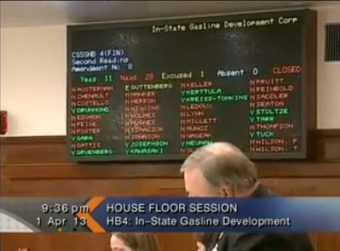
For the past couple of weeks, the legislature has been moving forward on the governor’s proposal to cut taxes on oil companies. Now, it’s scheduled to take up the issue of an in-state gasline.

Here’s the legislative outlook for the week.

In his State of the State address, Gov. Sean Parnell put his support behind an in-state gasline that would move natural gas from the North Slope through the Interior and then down to Southcentral Alaska. Today, a bill that would advance that project gets its first committee hearing.

The bill would give the Alaska Gasline Development Corporation more autonomy, sets out what pipeline information would be confidential, and establishes some financing mechanisms for the project. A similar bill passed in the House last year, but stalled in the Senate.

Also on Monday, a bill that would relax regulations on cruise ship discharge is scheduled for the House floor. On Tuesday, bills that would extend the Suicide Prevention Council for another six years and would create a fund for responding to invasive species will get their first committee hearings.

Later in the week, resolutions that express displeasure with President Barack Obama’s gun policy will be taken up by the judiciary committees in both chambers. The House Judiciary committee will also hear a version of the Stand Your Ground Law, which allows a person to react to a threat with deadly force without first trying to retreat. A number of states already have a similar policy in place, and the law received national attention after the shooting death of teenager Trayvon Martin in Florida.

The governor’s oil tax proposal continues to move through the Senate. A special committee on oil production plans to wrap up its hearings on the bill by the end of the week.

Kulluk grounding costs run upwards of $90M

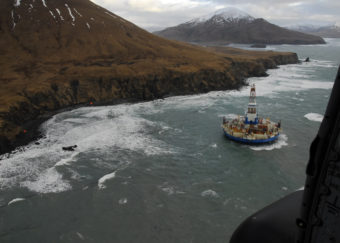
The conical drilling unit Kulluk sits grounded 40 miles southwest of Kodiak City, Thursday, Jan. 3, 2012. The Kulluk grounded after many efforts by tug vessel crews and Coast Guard crews to move the vessel to safe harbor during a winter storm. PETTY OFFICER 2ND CLASS ZACHARY PAINTER — U.S. Coast Guard

Shell’s chief executives responded to questions about the January grounding of the Kulluk drill rig during the company’s annual results conference in London Thursday.

In a prepared presentation, Shell’s Chief Executive Officer, Peter Voser, played down the company’s many mishaps in Alaska last year.

“Despite making some progress we have run into problems in the last few months. Our rigs will need more work if they are going to be ready for the 2013 drilling season. One, the Noble Discoverer needs a series of upgrades, and the other, the Kulluk, ran aground in a heavy storm on New Year’s Eve and has been damaged.”

Voser reiterated that the company considers the Kulluk grounding a marine shipping incident, completely separate from its drilling operations in the Beaufort and Chukchi Seas. But he wouldn’t elaborate on whether the grounding could impact drilling plans for this summer.

“We need to wait for the investigations, which some external bodies are doing, but which we are also doing internally, assess the risks and the learnings and then lay out our plans for the years to come.”

Voser emphasized that the company is viewing the grounding as learning opportunity.

“I cannot say what the learning is at this stage. But let me also say, and I know this is always dangerous to say because it will generate the headlines, but I have not seen in the world any business, not just the energy business, but all businesses — they have risks at the end of the day. And you need to manage those risks, and we do it is as good as we can. We learn when it doesn’t work and we will manage these risks going forward. But I cannot say there will never be an incident — that just isn’t going to work.”

Following up on that statement, Tim Webb, the energy editor at The Times in London, asked Voser if Shell was moving the rig from Unalaska to Seattle in order to evade Alaska’s oil and gas property tax.

“Assuming you say that’s true, because I think that came from Shell, would you say that’s an example of Shell not managing risks correctly, or making a poor decision in terms of managing risk in Alaska?”

In response, Voser denied that the decision to move the rig had anything to do with taxes, saying that the $5-6 million they would have had to pay is nothing in the grand scheme of things.

“There was a statement made by a Shell person, but in a completely different context, in a completely different meeting. That was then taken out of that context and then someone made a story out it. Just to be very clear on this one.”

The original story was written by Dutch Harbor Fisherman reporter Jim Paulin. In it, he quoted an email from Shell spokesperson Curtis Smith that was sent before the grounding. Paulin says he stands by his reporting.

“And I don’t think Shell would be backing away from that comment had it not gone aground. I think they would have been sending lobbyists to Juneau to try to repeal that tax. And I think that would be, in my opinion, the motivation for making that comment that it influenced their decision to move it.”

If the company was moving the rig for tax purposes, the cost of the incident has definitely exceeded what they would have saved. Chief Financial Officer Simon Henry said they anticipate spending at least $90 million on the incident in the first quarter of 2013.

“The $40 million I mentioned is the pure salvage cost to salvage operators. The $50 million is everything else — the Coast Guard, our own vessels etc.”

Henry added that those figures don’t include the cost of repairing the rig — he said that information won’t be available until there are more details about the extent of the damage.

The only information the Unified Command has released is that the rig is in sufficiently stable condition to remain anchored in Kiliuda Bay, on the south side of Kodiak Island.

Murkowski introduces bill to run pipeline in Denali Park

The Alaska pipeline near Fox, Alaska.
The Alaska pipeline near Fox, Alaska. (Photo courtesy James Brooks/Flickr Creative Commons)

U.S. Senator Lisa Murkowski is trying to make a natural gas pipeline from the North Slope more feasible.

Environmentalists are welcoming a stretch of pipeline through Denali National Park.

Senator Murkowski introduced a bill that would allow a seven mile stretch of pipeline to run through the National Park. For that to happen, Congress needs to pass a law granting approval.

She says it creates an equal playing field for proposed routes along the Richardson and Parks highways.

“Once the decision was made which way to go, we wanted there to be a clear path forward,” Murkowski says.

The pipeline would be buried through the park’s industrial corridor. Jim Stratford says the plan presents the best possible option. He’s the regional director for the National Parks Conservation Association.

“Bearing it along the highway through Denali National Park makes way more sense to us than going to the east and putting a new road or putting a new pipeline in what is essentially virgin wilderness right now,” Stratford says.

And there’s an added boost, says Larry Persily. He’s the federal coordinator for the Alaska Gas Pipeline. He says that in addition to making it easier for producers, this legislation could add to the health of the park’s economy, because it would allow park operators to access some of the cleaner-burning fuel.

“It’s been talked about for years. If there’s a pipeline nearby there are a lot of environmental and cost advantages to using natural gas for the hotels, for the vehicles, for the businesses, instead of continuing to burn diesel,” Persily says.

Of course, granting the go-ahead to a seven mile stretch of what would be a route that extends hundreds of miles is not the major barrier to construction.

That’s something Senator Murkowski readily concedes.

“This did nothing to resolve whether or not we even do it. When you’re looking at alternate routes, if one route is complicated because of the proposed path, if you can correct that ahead of time so that’s not an issue, it doesn’t take away the big issue, which of course, is the price tag,” Murkowski says.

And that price tag could total as much as sixty billion dollars.

This bill passed out of the Senate last Congress on a voice vote – meaning there wasn’t any opposition. But it didn’t receive a vote in the House.

So the process begins a new … with votes required in both chambers.


Public testimony on oil taxes brings up familiar points

The public got its first chance to comment on Gov. Sean Parnell’s proposal to cut taxes on oil companies on Tuesday, and most of the testimony broke along familiar lines.

Representatives from mining, timber, and trucking groups showed up at the Capitol in person, and they spoke before the Senate’s pipeline throughput committee first. They offered support for the governor’s bill, saying that it would discourage oil companies from leaving Alaska for states with lower tax rates.

Aves Thompson represents the Alaska Trucking Association.

“We’re not the tax experts. We don’t know how to do. But we do know that something is wrong. There is something out of balance that needs to be fixed. And it is our firm belief that it needs to be fixed now,” Aves says.

Once the committee started taking testimony over the phone from legislative information offices across the state, opinion diversified. About half of those callers criticized the governor’s plan to do away with a windfall profits tax and overhaul the way credits are awarded.

One of those comments came from a voice that was very involved in last year’s oil tax debate. For two-and-a-half minutes, former legislator Joe Paskvan testified that oil companies could take advantage of the tax cut to ramp up production without reinvesting in new infrastructure and exploration — something he described as “super harvest mode.” He also suggested that the argument that the current tax structure is behind the drop in oil production is a red herring.

“The throughput decline started in 1989 and has nothing to do with tax policy,” Paskvan says.

Paskvan was one the senators who opposed Parnell’s previous attempts to lower taxes on oil companies, and he lost his seat in November.

The TAPS Throughput Committee is scheduled to hear more public testimony on Thursday.


Site notifications
Update notification options
Subscribe to notifications