Tourism

Search underway for missing cruise passenger

The Coast Guard is continuing its search for a passenger missing from the cruise ship Norwegian Pearl.

The 25-year-old woman, identified only as a Columbian national, disappeared from the vessel about 1:40 a.m. Thursday while it was in Lynn Canal between Funter Bay and Point Retreat. It’s not clear if the woman jumped or simply fell overboard.

The woman was not discovered as missing until 5 a.m. Thursday morning as the Norwegian Pearl was approaching Glacier Bay.

Alaska State Troopers are investigating the incident.

Vince Grochowski, who is a search and rescue controller with Coast Guard Sector Juneau, said they’ve conducted at least seven searches in the area with a H-60 helicopter from Sitka and a 45-foot rescue boat.

The cutter Liberty also is on scene looking for the woman.

Based on the vessel’s security camera footage, the woman may have been wearing grey pants and a red knee-length jacket when she disappeared.

Alaska’s most-visited national park puts little-known Buffalo Soldiers story in the spotlight

When you think of Buffalo Soldiers, does Alaska come to mind?

Probably not.

But the units of black soldiers formed in the 19th century before the U.S. military was de-segregated are a part of Alaska’s history – specifically, Skagway’s history – during the days of the Klondike Gold Rush.

It’s a seldom-told story that’s now in the spotlight.

Alaska’s most-visited national park is part of nationwide effort to make the parks relevant to an increasingly diverse America.

Park ranger Charlotte Henson leads a group of visitors on a walking tour of Skagway focused on the story of Company L. (Photo by Emily Files/KHNS)

“Skagway in 1898 was a pretty rough place,” said park ranger Charlotte Henson on a recent walking tour.

Henson displayed black-and-white photos of Gold-Rush-era Skagway for a couple dozen tourists.

She told the story of Alaska territorial Gov. John Brady writing a plea to the capital.

“He said to Washington, ‘the Lynn Canal is full of gamblers, thugs and loose women. Send help.’”

And help was sent.

“Company L of the 24th United States Infantry was stationed here for three years, from 1899 to 1901,” said Ben Hayes, chief of interpretation for Klondike Gold Rush National Historical Park.

Company L was an all-black regiment sent from San Francisco to the booming mining settlement of Dyea.

A few weeks later they moved to the nearby town of Skagway.

“They lived their lives here and in many cases we found that they were not only serving their country and completing that mission as soldiers of the United States, but they were also fighting on a second front,” Hayes said. “And that was a war of discrimination and bigotry.”

Back on the walking tour, Henson leads the group to a busy street across from the historical YMCA building to tell one of those stories of discrimination.

She reads from a newspaper clipping from 1900 “It said ‘Line Drawn: Objections Arise to Colored Men in YMCA. Withdrawals Made.’”

Racial discrimination is a constant thread throughout American history.

Until this summer, that piece of Skagway’s history was mostly unexamined and untold.

Why is the story being brought to forefront now?

The National Park Service is concerned about the disparity between the people who visit parks and the American population as a whole.

Park visitors are overwhelmingly older and white.

“If we have a large segment of the country that’s growing that does not feel that national parks are important or special or for them, then that really can endanger our mission and make it difficult for us to achieve stewardship and preservation of these places for future generations,” Hayes said.

The park service has decided that to remain relevant, they have to find a way to appeal to a more diverse audience. That’s what prompted the Klondike Park to apply for a federal grant aimed at preservation of the Civil Rights Movement.

The park was the only one in Alaska to receive such a grant this year.

The $22,000 appropriation motivated Hayes to do something unusual.

Normally, the rangers who give tours get to choose what they focus on.

But this year, he required them to research and give talks about Company L – Skagway’s Buffalo Soldiers.

“I hated the idea. I didn’t feel like I had enough information,” Henson said. “And so I was kicking and screaming, I might’ve been one of the last ones to get my walk done.”

But now, Henson said she’s realized how important it is to tell this story — one that’s been relegated to background for so long.

“They helped to make our society the way it is today,” she said. “And we need to be aware that it’s just not white people that have done everything in this country.”

Unlike the Soapy Smiths of Skagway, there’s not a lot of information available about the men of Company L. Henson describes it as a puzzle the rangers are slowly piecing together.

“We don’t know what they thought about Skagway, we really don’t know what Skagway thought about them.”

Michigan resident Sharon Williams is one of about 30 people who followed along on Henson’s tour.

“I knew about the Buffalo Soldiers, I didn’t know they came as far north as Alaska,” she said at the end of the walk.

Williams is on a high school reunion cruise. She said her Virginia school was segregated until her senior year.

Williams did not expect to hear tales of Civil Rights on her cruise to the 49th state.

“I thought it was very well done and I just appreciate, she said they have to try to put the pieces of this puzzle together,” Williams said. “It’s a start.”

It’s a start: a sentiment Ben Hayes echoes.

“I think we’ve just scratched the surface,” he said.

The rangers have been working this summer to track down a living descendant of Company L in hopes that family stories will shed light on these men.

Additionally, the Klondike Park hopes to keep Skagway’s Buffalo Soldiers in the spotlight beyond this summer.

Hayes plans to apply for the same grant funding next year to continue telling visitors about this little-known piece of history.

Skagway shop owner found not guilty of misrepresenting Native art

A Skagway shop owner was found not guilty of misrepresenting Native produced art in federal court on Friday.

Rosemary Libert owns Lynch and Kennedy Dry Goods and was the subject of an investigation by the U.S. Fish and Wildlife Service over the past couple of years.

She was charged this spring after selling a piece of art to an undercover agent in 2015.

In Juneau court last week, federal prosecutors tried unsuccessfully to prove that Libert knowingly deceived the agent, who was posing as a customer.

Libert was one of five store owners or employees in Southeast to have federal charges laid this year for misrepresenting Native produced goods.

She is the only one to go to trial.

“The irony of this case is that Ms. Libert believes very strongly in the law and she doesn’t want anyone representing non-Native art as Native art,” said Libert’s attorney Michael Satin.

“She has Native employees, she cares about Native artists, so she’ll continue to run her business and continue to sell both Native and non-Native art and to represent it properly, as she has in the past”

Under the Indian Arts and Crafts Act, it is illegal to offer, display or sell goods that misleadingly suggest they were made by a Native person.

The artist has to be a member of a tribe or “certified” by a Native tribe as a non-member artisan.

Libert’s employee Judy Gengler also was charged, but the misdemeanor was dismissed because prosecutors thought they would be better off focusing their efforts on Libert.

Using recorded exchanges between a Fish and Wildlife agent and Libert in June, 2015, the prosecution tried to show that Libert knowingly deceived what she thought was a customer.

U.S. Assistant Attorney Jack Schmidt said the agent used the words Native, Eskimo and Indian when inquiring about a piece of art and Libert never clarified that the sculpture was not crafted by an Alaska Native artist.

“I thought that that short transaction, and those statements that were adopted by her, basically, indicated that she was … falsely suggesting that the item was in fact a true Alaska Native art piece, or an Indian piece,” Schmidt said. “The jury just didn’t see it that way.”

After an hour of deliberation, the 12-member jury unanimously came to the not guilty conclusion.

The trial lasted less than a full day.

Satin argued in court the recording of the conversation wasn’t reliable enough to warrant a conviction.

Perhaps more importantly, he says an email exchange between the undercover agent and Libert nine months prior to the in-person interaction in the store was proof that she was being up front about the piece of art.

“In that email, the agent pretended to be a costumer and asked her specifically if the artist was or was not Native, and Ms. Libert very clearly and explicitly said that the artist was not Native,” Satin said. “This is the same artist about whom the agent sought to purchase a piece of art nine months later.”

The agent bought the piece for just more than $1,100.

Libert had plenty of opportunities on the day of the transaction to “clarify or correct” that the piece was not made by a Native artist, Schmidt said.

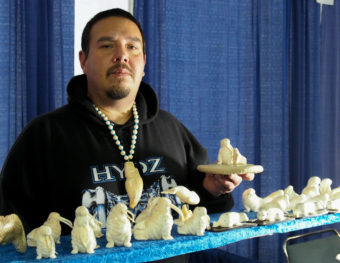
The art in question was a sculpture of the Native blanket toss done by a Cambodian artist who lives in Juneau.

Pawning art off as the work of a Native artist is a bigger problem in Southeast than elsewhere in the state, Schmidt said, because of the abundance of cruise ship visitors.

“Just because we lost one case, I don’t think we did it in vain,” Schmidt said. “I think that there was a purpose behind it and that is to get business owners in this type of industry to comply with the law and be truthful with customers about what they’re selling.”

Satin said it’s “a shame” that Libert’s reputation might have taken a hit over this.

“Hopefully people will realize that she has been vindicated, that she is not trying to misrepresent artists at all, that she’s a good person trying to just run a small business the right way.”

Two Juneau gift shop owners took plea deals and agreed to pay fines, while a third store owner in Ketchikan is in the process of making a plea deal to avoid a trial.

State biologists investigate green bears in Haines

A sow and her cub showed up at the Chilkoot River on Wednesday doused in green paint. Biologists are trying to figure out what happened. (Tom Ganner/T. Ganner Photography -Time & Space)
A sow and her cub showed up at the Chilkoot River on Wednesday doused in what appears to be green paint. Biologists are trying to figure out what happened. (Tom Ganner/T. Ganner Photography -Time & Space)

Social media sites were atwitter in Haines on Thursday morning after photos surfaced of green bears in the Chilkoot River.

The bears — a sow and her spring cub — had somehow been doused in what appears to be green paint.

State biologists were examining the photos and making calls to try and find out more.

There are a lot of theories floating around the web about how and why the bears are painted green: one Facebook commenter suggested the green-paint explosion was an effort to thwart trophy hunters; another asked if it was an early homage to St. Patrick’s Day; and several suggested the bruins are showing their Haines Glacier Bear pride – the high school mascot is a green bear.

Alaska Department of Fish and Game wildlife biologist Carl Koch said it’s most likely just a case of nosey bears getting into unsecured trash.

The photos show the bears’ heads and necks coated in bright green paint.

“You see the sow’s muzzle is clean, and the cub’s is not and the cub’s ear is completely covered,” Koch said. “Total guess, but maybe the cub bit into a spray can and it exploded. And if the sow had her face in something else, and it covered the muzzle and protected it. I just don’t know, it’s hard to say. I’ve been sending out emails to see if anybody knows how or where it occurred.”

Koch was emailed the photos and has been fielding calls Thursday about the painted bears, which were first noticed Wednesday.

It’s possible the bears were soaked in paint by someone as a method of self-defense, but he’s never heard of that happening before, he said.

Bear spray is far more effective,  he said.

As far as the trophy hunting theory goes, he said it would be foolish of a person to test that method for a couple of different reasons. First, it’s illegal to hunt sows with cubs. And, it’s illegal to interfere with a legal hunt. The good news, Koch says, is that the bears don’t appear to be in distress.

“What looks good to me is that the photos look like their eyes look good,” he said. “So, if they didn’t drink it … so far, I haven’t heard any signs that they’re in ill health, but I’ve asked folks to keep an eye on that and let me know.”

Tom Ganner, a local professional photographer and volunteer bear monitor out at Chilkoot, posted the photos on Wednesday evening.

In his caption, he joked that perhaps the bears were greenies or “tree huggers.” He said he was cruising out the Chilkoot State Park road when he saw traffic had backed up and a crowd was gathered on the riverbank.

“I pulled over to see what was going on and people said ‘There are some very strange bears over there,’” Ganner said. “I had a look and sure enough, they appeared to be half green, or green heads. So I got out my camera to document it. They were just fishing along the far side of the river.”

Ganner has been observing and photographing the bears on the Chilkoot River for about a decade.

He said crowds of people and their “bear viewing on a beer budget” are not unusual along the Chilkoot River, especially at this time of year when the salmon are running, and the bears are trying to fatten up for winter.

this year has been pretty calm, compared with seasons past, he said.

the green bears were concentrating on a salmon feast, and weren’t pawing at their eyes or mouth, Ganner said.

“They appeared to be behaving normally, fishing as normal, swimming,” he said. “They appeared to be engaging in normal behavior. What was odd to be was just the extent of the green paint.”

The Department of Fish and Game won’t step in to clean them off, Koch said.

“If they’re not in ill health because of it, even if they are, there’s not a whole lot we can do unless they became so ill that they needed to be euthanized,” he said. “If it’s dried on there, you’d probably have to use some chemical to remove it and that could make matters worse. What will happen, I hope, is that they’ll stay in good health and it’ll shed out, or at least most of it will shed out.”

Koch said this is an excellent reminder that bears are out in force right now, and people should be especially aware of what they’re leaving in their yards. Bears, especially cubs, are curious creatures and will get into just about anything, he said.

“I would tell everyone to secure their attractants, especially trash, and any kind of food attractant. And then, if they have bear issues, let us know.”

As the photos continue to circulate, and the guesses get more outlandish, Koch says they’ll keep on investigating the case of the green bears in Haines.

Anyone with information should call Koch at 465-4329 or email carl.koch@alaska.gov

As Anan’s season closes, Forest Service to continue use of temporary float

Temporary mooring float tied to float house at Anan Wildlife Observatory. (Photo by Aaron Bolton/KSTK News)

As the Wrangell ranger district moves forward with improvements to the Anan Bear Observatory trailhead and observation deck, some may have noticed one change within the Anan master plan already happening.

“We placed a larger float in Anan Bay this summer in mid-season for use of any of the visitors going there,” Wrangell District Ranger Bob Darymple said. “It’s constructed from other floats that we had around that weren’t being used at the time.”

Darymple said the temporary float was placed between the trailhead and administrative float house.

The 20-by-24-foot float will likely stay in Anan Bay for the next couple of seasons before the Forest Service makes a decision on implementing a larger 90-by-28-foot constructed float, he said.

“With this new asset out there, we want to see how it’s working out for the visitors and get their feedback,” Darymple said. “I wouldn’t want to put a time frame on it, but I think we need to evaluate the use of this float before we would make a substantial financial commitment to a different floating structure.”

The preliminary plan shows the larger float supporting four larger boats and two beaver planes, as well as a ramp for a small skiff.

This mooring float plan comes after a controversial dock project was put off in 2015. Darymple said that project may still be on table after all options are evaluated.

“I wouldn’t say it’s totally scraped,” he said. “The regional forester wanted us to evaluate these other options. I think this is a continuation of that.”

If the larger float is implemented, then the Forest Service would put contracts out to bid for both the final design and construction, Darymple said. An evaluation of the seafloor would also need to be done to design the anchor system.

The float’s location would likely be farther out than the existing float house.

Darymple said the Forest Service will get feedback from guests at Anan and at its annual meeting this fall with Wrangell tour operators.

The official viewing season, which requires visitors to purchase permits, came to a close Aug. 25, but Anan is still open to visitors.

Skagway raptor tour will move forward

A hawk at the American Bald Eagle Foundation in Haines, which is partnering with Alaska Mountain Guides in hopes of starting a Skagway raptor tour. (Photo by Emily Files/KTOO)
A hawk at the American Bald Eagle Foundation in Haines, which is partnering with Alaska Mountain Guides in hopes of starting a Skagway raptor tour. (Photo by Emily Files/KHNS)

It appears a proposed Skagway raptor tour that has drawn resistance from some in the community will be able to move forward.

Alaska Mountain Guides is partnering with the American Bald Eagle Foundation in Haines to bring a raptor tour to the Liarsville neighborhood in Skagway.

In 2014, the Skagway planning commission rejected the permit, as did the local board of appeals.

AMG appealed those denials, taking the case to Juneau Superior Court. A judge sided with AMG and remanded the application back to the planners who rejected it.

In July, the planning commission reconsidered the raptor tour conditional use permit. It was approved in a 3-1 vote. But that wasn’t the final step. Skagway’s borough attorney advised the commission to vote on a resolution formalizing the permit’s approval. But when it came time to vote on the resolution at a meeting this month, it failed in a 2-1 vote. A resolution needs three affirmative votes to pass.

Since the commission had never included the extra step of a resolution before, it wasn’t clear if the failure to adopt the resolution overruled their prior approval or not. This week, borough clerk Emily Deach said it doesn’t. The approval from the commission’s July meeting still stands.

To make a long story short, AMG does have permission to build and operate its Skagway raptor tour. The commission imposed a few conditions on the permit to help ease some public health and safety concerns expressed by residents. They include a DEC-approved restroom, a high chain-link fence, and person on-site at all times when birds are present.

AMG owner Sean Gaffney previously told KHNS the company hopes to have the raptor tour in place by summer of 2017.

Site notifications
Update notification options
Subscribe to notifications