Tourism

Southeast Conference brainstorms a fix for Alaska’s ferries

Robert Venables is the former city manager of Haines. He says that the legislature understands that “there’s a true sense of crisis” in the system. (Robert Woolsey, KCAW)

Gov. Bill Walker is serious about finding a fix for Alaska’s struggling ferry system.

He signed earlier this year a Memorandum of Understanding with Sitka’s Garry White, who chairs the Southeast Conference, empowering the conference to look for solutions to the Alaska Marine Highway’s ongoing problems.

Robert Venables, the energy coordinator of the Southeast Conference and also chairman of the Marine Transportation Advisory Board, told the Sitka Chamber of Commerce on Wednesday, Aug. 10, 2016, how the Southeast Conference plans to tackle its new mission.

It’s called the Alaska Marine Highway Reform project, and it begins August 20 with a statewide ferry summit in Anchorage.

That’s right. The ferry summit is going to be in Anchorage.

The irony wasn’t lost on audience member Pat Alexander.

“Who chose Anchorage for the site of that summit when the stakeholders are not in Anchorage?” Alexander asked.

Because the majority of the passengers are going into the interior and that a number of communities around Alaska use ferries that the organizations need a centralized location to meet, Venables said.

There would be more discussion on the ferry system next month, he said, when the Southeast Conference convenes for its annual meeting September 20 in Petersburg. The goal is to have draft recommendations in place which can then be forwarded to the legislature.

Venables didn’t hint at what those recommendations might look like. But he did say that there are viable, publicly-funded ferry systems working in the U.S. and Europe, and they could be a model — of sorts.

“We want to find out what will work for Alaska. It’s not going to reinvent the wheel, but it’s going to be a different-sized lug wrench once we get done figuring it out.”

Although having the support of the governor is a new twist, reforming the ferry system itself is not a new idea.

The Marine Transportation Advisory Board was formed in 2009 with an eye toward redesigning the system with more efficient sailings as fuel prices skyrocketed. At the time, there was some hope that the board would be more than simply advisory, in order to effect real change.

“I think there’s a true sense of desperation, and an acknowledgement that the system is in crisis,” Venables said. “The Marine Transportation Advisory Board is a community liaison network that is available for advising the Department (of Transportation) should they choose to. This is kind of a strategic task force to create a business and operational plan.”

With the state expecting another year unprecedented budget deficits, the legislature likely will not look favorably on a plan that appears costly — no matter how efficient it is.

Venables nevertheless expects lawmakers to be responsive.

“The legislature’s looking for answers as much as anybody,” he said. “They’re not looking for additional requests for funding, but they’re looking for solutions that will make the state’s transportation system truly viable — and at a lower cost.”

“So I think they are very anxious to see this type of effort happen. The ones that we’ve spoken to have shown support and are glad to see the users of the system really at the helm — so Alaskans are driving the process — rather than politicians.”

Compared to some other state agencies, the Marine Highway System survived last year’s budget process relatively unscathed. It took a 10 percent cut during budget negotiations, and the governor did not veto the cut in favor of something larger.

Nevertheless, the system is considering taking one ferry offline completely — the Taku — and looking into putting it up for sale.

Alaska restaurant serving elk fined for calling it reindeer

This might be an only-in-Alaska problem: A restaurant in Fairbanks that has told customers since 2013 it was serving reindeer tenderloin was actually giving them elk.

The Pump House has been fined $50,000 by the state for mislabeling the meat.

The parent company of the restaurant agreed to pay the criminal fine, donate $10,532 to three non-profit food groups and publically apologize.

Restaurant co-owner Vivian Bubbel said an advertisement with the apology ran Saturday in the Fairbanks Daily News-Miner.

The restaurant would have no additional comment, she said.

The state Department of Environmental Conservation investigated.

An employee reported the restaurant had not served reindeer in the years he worked there and the restaurant manager confirmed the use of elk.

The menu described reindeer tenderloin as “similar to caribou and raised in Western Alaska where they are harvested by the Native people.”

The meat actually came from elk in New Zealand.

Floatplane crash injures 4 people

Four people were seriously injured after a de Havilland Beaver float plane crashed Monday afternoon on Mirror Lake, south of Kokhanok, 35 miles south of Iliamna.

There were no fatalities.

The Beaver had six passengers and a pilot and taking off after a day’s fishing on Moraine Creek.

The crash “occurred during the airplane’s takeoff run,” said Mitchell Gallo, a senior air safety investigator with the National Transportation Safety Board. “It ended up on shore, that’s where it impacted, not too far in. We’re going to be talking to the pilot and passengers at some later point.”

The Beaver crashed upright, Gallo said

“We’re going to be looking at the wreckage and hopefully we’ll get some good data if any, if there was a GPS available on board, so we can use that for any performance calculations,” he said.

The Rescue Coordination Center launched an HH 60 Pave Hawk helicopter and an HC-130 fixed wing aircraft out of Joint Base Elmendorf-Richardson, which arrived on scene a little after 8 p.m., about four hours after the crash.

One of the four injured passengers was flown directly to Providence Hospital in Anchorage, and the other three taken back to the joint base.

A representative of Rapids Creek Lodge in King Salmon said the crash happened after guests were being picked up from a standard day of sport fishing on Moraine Creek.

The lodge said they believed one of the four injured had already been released, and the others were listed in stable or better condition.

Mirror Lake is in a remote area of Katmai on the Alaska Peninsula in between Iliamna Lake and King Salmon.


Earlier story: ILIAMNA — A floatplane crash 35 miles south of Iliamna left four people seriously injured.

Staff Sgt. Ed Eagerton of the Alaska Air National Guard says the airplane with seven on board crashed as it attempted to take off from a body of water near Mirror Lake.

The airplane was a de Havilland Beaver owned by Rapids Camp Lodge Inc. of King Salmon.

The Air Guard sent a helicopter and airplane to assist the injured. The airplane refueled the helicopter in the air and the aircraft reached Iliamna at 8:20 p.m.

The helicopter transported the injured people to Iliamna. Three were transferred to the Air Guard’s HC130 King airplane and flown to Anchorage. The helicopter flew the fourth directly to Providence Hospital in Anchorage.

Iliamna is 225 miles southwest of Anchorage.

Associated Press

Company makes a business out of playing in nature

Two adventurers have turned a hobby into a career and now spend their time traveling the country and recording trails via video so that other people can hike, bike, run and ride them.

This summer, Discover Kodiak hired Trail Genius to record real-time video and collect information about roughly 28 trails in Kodiak, including Termination Point, Pyramid, and Barometer, using ATVs, their own two legs and their equipment.

Jason Manders and his partner, Amanda Campbell, are based in Wisconsin and began the Kodiak project in mid-June.

“We had a really great time,” Manders said. “We were surprised by the rainforest-type environment. The lush plants – that was a surprise and really cool. All the berries and the moss all over the ground. We kept thinking we were in some sort of enchanted forest or something.”

Manders has been biking his entire life and he started recording trails to help other bikers decide whether they wanted to explore that trail or not, he said. He did that as a hobby for two or three years, then he was “discovered.”

“And then we got a call from a large trail entity that has trails all over the world and they asked us to build this interactive experience of their bike trails as far as New Zealand, and that’s when we realized we could actually make money doing this,” Manders said.

Manders and Campbell received business from races, triathlons and other event-holders that cover activities from driving snowmobiles to ATVs.

Campbell, who’s also a graphic designer, said Manders introduced her to biking prior to starting the business.

While on the island, they decided to get married, a ceremony which Discover Kodiak executive director Chastity McCarthy said she officiated.

“They were like, ‘we’ll just come into your office tomorrow and we can do it’ and ‘I’m like, okay, that’ll work,'” McCarthy said. “But once they got in there, I was like well our office is this old wood paneling and it’s not that awesome. Let me go talk to the construction workers outside and see if they’ll us do it on the new pier.”

“So I ran out there, the construction workers walked us through safely because there were still some little spots going on,” she said. “It was funny because I married them within about 10 minutes and then afterwards the construction workers were cheering and we didn’t even know they had been watching.”

McCarthy says Trail Genius might be back next summer to map more trails, but the current progress will be available online in December.

Adventurers will be able to click through the trails, see real-time videos and learn about trails’ heights, elevations and terrains.

13 injured in RV crash on Richardson Highway

A recreational vehicle crashed into the back of a tour bus Sunday on the Richardson Highway, or Alaska Route 4, injuring more than a dozen people.

The northbound bus was making a left turn off the highway to the Princess Lodge in Copper Center, when the RV hit it, according to Alaska State Troopers.

The accident occurred at mile 101 on the Richardson.

13 bus passengers were taken to hospitals by ground or air ambulance, Trooper spokesman Tim Despain said. Two Life Flight airplanes and a helicopter assisted in the transport. Despain said there is no word yet on the severity of the injuries.

The driver of the RV was Jesse Johnson, 47, of Anchorage. It wasn’t clear whether Johnson will face citations.

Three passengers were in the RV. The bus, operated by North Pole Tours of Fairbanks, carried 32 passengers.

Skagway ferry service during dock repair hinges on Coast Guard waiver

OLYMPUS DIGITAL CAMERA
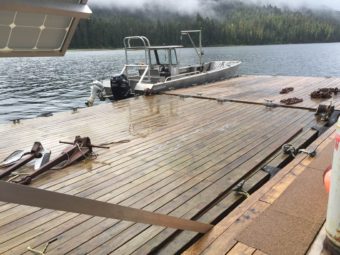
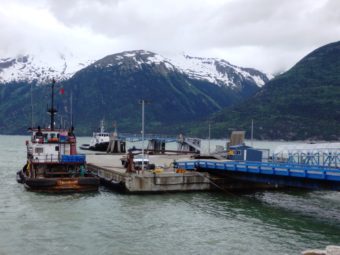
The Skagway ferry dock. (Emily Files, KHNS)

Skagway borough officials wondered aloud what was happening with the planned Skagway ferry dock refurbishment, at a meeting last week.

The project could cut off local ferry service for months.

Whether Skagway retains any service during the dock project depends on a Coast Guard waiver the Alaska Marine Highway hopes to acquire.

Earlier this year, the Department of Transportation said if the ferry dock project were to happen this winter, then it would probably mean a two- to three-month disruption in service for Skagway.

But, they said if the project were delayed until next winter, the Kennicott ferry might be able to offer some limited service using one of Skagway’s other docks.

The Matanuska usually provides winter ferry service to Skagway, but that vessel is due for engine replacement next year, taking the boat out of service for most of the fall and winter of 2017.

That’s where the Kennicott might come in.

It has to do with a certification that only some ferries hold, called the Safety of Life at Sea, or SOLAS, certification. SOLAS is required for vessels that run in international waters.

The Matanuska has it, because its route includes Prince Rupert, British Columbia. The Kennicott is also SOLAS-approved.

Swapping in the Kennicott would be good for Skagway.

Sailings would be less frequent, but they would accommodate both passengers and vehicles.

DOT spokesman Jeremy Woodrow says that’s because the ship is adaptable to different kinds of dock.

“Because it has the ability to service docks that don’t have floating ramps,” Woodrow said. “It can go to fixed docks where it uses this vehicle elevator lift to allow cars to go on and off the ferry.”

Woodrow’s department doesn’t want to use the Kennicott as the Matanuska’s replacement, he said. It’s an expensive ship to run on a low-volume route.

“It’s a larger ship than we need in Southeast especially on the Price Rupert run in the winter time.”

The DOT would prefer to run the smaller, cheaper Malaspina while the Matanuska is out of commission, but there’s just one problem: The Malaspina doesn’t have a SOLAS certification because it usually sails the Bellingham, Washington, to Southeast route.

DOT applied for a waiver with the Coast Guard to allow the Malaspina to operate without the certification on a short-term basis.

Woodrow isn’t sure when they’ll get an answer from the Coast Guard.

“We think that we will be able to receive that waiver especially since it’s just for a specific window,” he said. “But it’s really something that’s in the air and we’re waiting to hear back from the Coast Guard.”

The service that might be available to Skagway hinges on the waiver.

The interestes of DOT and Skagway are conflicted: It would be better for DOT to get the waiver and not have to use the Kennicott; It would better for Skagway if the waiver were denied, the project was put off until 2017, and the Kennicott sailed the Lynn Canal.

If the Malaspina replaced the Matanuska instead, Skagway could lose ferry service for a few months. DOT is looking into other possibilities, Woodrow said.

“To see if there is a way, at the very minimum, to provide passenger-only service. A determination on that has not been made.”

Without ferries, Skagway residents would lose their most reliable form of transportation out of town.

Flights from small airlines are often grounded because of inclement winter weather. Driving out of Skagway is contingent on the US-Canada border being open and road conditions, which are also at the mercy of winter weather.


Site notifications
Update notification options
Subscribe to notifications