Voting is Monday and Tuesday for the two small mountains, which beat a number of large, well-known resorts in their region to get to the Final 4 of Powder Magazine’s March Madness-style popularity contest.
Juneau’s city-owned ski area became the Great White North champion after getting more votes in various rounds than four major British Columbia resorts; while Mount Bohemia – in Michigan’s Upper Peninsula — just knocked out Mad River Glen, Vermont to become the Big East champion, previously taking down other major eastern ski resorts in the first rounds.
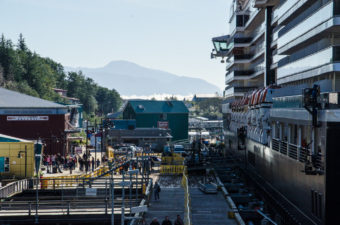
A Princess cruise ship in Juneau. (Photo by Heather Bryant/KTOO)
Salmon Creek Reservoir. (Photo by Lisa Phu/KTOO)
The Salmon Creek Reservoir dam. (Photo by Lisa Phu/KTOO)
Salmon Creek Reservoir can be accessed by a trail at the water treatment buildings off Egan Drive. (Photo by Lisa Phu/KTOO)
Last Chance Basin water treatment plant
Juneau’s water utility is not meeting peak demand during the summer cruise ship season. That caused the city to drastically reduce the amount of water it could sell to the cruise industry this year.
The city says the problem is due to aging wells at its main water source, Last Chance Basin – a problem that both the city and the cruise industry want to see fixed.
Six cruise ships docked in Juneau at once can guzzle about 1 million gallons of water a day. That’s 20 percent of Juneau’s daily water usage in the summer.
Cruise ships like to hook up two hoses when in port and buy as much water as they need. But the ships were limited to a total of 200,000 gallons a day this past summer due to unusually hot temperatures and an aging well system.
“There were many days where four ships in port had to basically share one hose over the course of a day,” says Kirby Day, director of shore operations for Princess Cruises. “So somebody would get the hose for a couple hours in the morning, somebody would get it a couple hours in the afternoon, a couple hours in the evening, which really cuts down the amount of water that we can purchase from the city.”
Cruise ships can get water from other ports, like Ketchikan, Skagway, Whittier, Seward, and Vancouver, but Day says ships prefer to buy water in Juneau because it’s right in the middle of a voyage. “If it was the first call or the last call, it might not be as crucial to buy water, but you’re basically about halfway through your itinerary,” he says. “Plus this is typically the longer of the port calls, so they’d like to be able to take as much water as we could without obviously creating a detriment to the city.”
David Crabtree, Juneau’s water utility superintendent, says, “We limited their use a bit but in previous years we let them take as much as they could take and it really put the hurt on our system.”
Juneau’s water supply comes from five wells in Last Chance Basin as well as from Salmon Creek Reservoir. On average, the utility distributes 3.5 million gallons of water a day. In the summer, that number can spike to five million gallons a day.
This recent summer saw those peaks, even with the ships taking a lot less. Crabtree says Juneau’s water needs come first; the cruise industry’s is a close second.
“It was balancing the struggle between keeping our reservoirs full and keeping the town adequately supplied versus having the ability to sell water,” he explains.
The wells at Last Chance Basin aren’t keeping up with demand. Production rates have declined so, as Crabtree explains, the utility keeps the wells running for up to 23 hours a day.
“Just because you design a water system that has the capacity of doing five million gallons a day doesn’t mean you do five million gallons a day every day,” he says. “That hurts your wells. They need to be able to relax.”
Some of the wells are 42 years old. Juneau’s engineering director Rorie Watt says the best thing would be to replace one or two of them, “Our wells essentially are reaching the end of their useful life and so the most rational thing to do is just drill a new well 20 or 30 feet away in the same part of the aquifer.”
This could cost as much as $3 million. Juneau has requested a state grant to upgrade Last Chance Basin, but Watt says it’ll be at least another couple of years before the cruise ship industry can take as much water as they want.
Even though limits are difficult, the industry will be patient, according to Day.
“That’s part of the business, I guess,” he says. “We come to Juneau for a lot of reasons, and it’s not just to come here to take water. And so we understand if the city is having an issue with the system, and if we shouldn’t take water or have to limit the water we take so they can get their water system back on line, we’re happy to work with them.”
With limits in place this past summer, Juneau sold about 25 million gallons to cruise ships, translating into about $78,000 to the city.
Over the past ten years, cruise ships consumed the most water in 2006 – almost 98 million gallons – bringing the city roughly $273,000.
On average, cruise ships consume about 61 million gallons of Juneau’s water per year, about 11 percent of the city’s total summer production.
Juneau could begin work on the wells as soon as this summer if funding is secured. At a recent Public Works meeting, the committee approved appropriating $300,000 toward project planning – half would come from utility reserves and the other half from marine passenger fees.
A consultant’s drawing of Juneau’s proposed floating cruise ship docks. Image courtesy CBJ Docks and Harbors Department.
The City and Borough of Juneau’s Docks and Harbors Department announced Friday evening that it will delay opening bids for a $54 million floating cruise ship berth project until the city is granted ownership of submerged tidelands by the State of Alaska.
Bids had been scheduled to be opened on Tuesday, November 19th. But now they will remain sealed until at least January, according to Port Director Carl Uchytil.
“The new bid opening date will be announced following the Final Finding and Decision of the Alaska Department of Natural Resources to convey tidelands to the City & Borough of Juneau,” Uchytil said in a press release.
DNR’s preliminary decision recommends transfer of the nearly 18 acre parcel to the city. But Uchytil said the bid opening will be delayed out of “an abundance of caution.”
The city this week received four bids for the project. However, they were to remain sealed until next Tuesday’s opening.
The Port Director could not be reached for comment late Friday. He and Port Engineer Gary Gillette came under fire this week by the Juneau Assembly and concerned citizens for their decision to move forward with the project despite the unresolved land conveyance and for not revealing the matter before a state public comment period started last week.
Interested parties have until December 9th to comment on DNR’s preliminary decision approving the land transfer. After that there will be a review period before the final decision is issued. DNR officials say the review period could take several weeks.
Holland America’s Westerdam anchored up in Gastineau Channel. Photo by Casey Kelly/KTOO.Juneau Port Director Carl Uchytil says he was surprised the State of Alaska needed to have a public comment period in order to transfer nearly 18 acres of submerged tideland to the city for its new cruise ship docks.
Uchytil says he was led to believe by DNR that the decision would be an administrative action.
“Mea culpa. I should have understood the state process better,” Uchytil told the Juneau Assembly on Wednesday. “I didn’t realize that there was a public notice required.”
The Assembly grilled Uchytil and Port Engineer Gary Gillette over the Docks and Harbors Department’s decision to proceed with the project despite the city not owning the submerged lands.
On Tuesday, Docks and Harbors accepted bids to build the two floating cruise ship berths at an estimated cost of $54 million dollars.
Some Assembly members threatened to delay a financing measure until the city gained ownership of the tidelands. Assemblyman Jesse Kiehl argued it was too risky.
“I’m concerned about the financials of the project if we end up not owning that land,” Kiehl said. “And I’m concerned about our exposure if we sign a contract that says we will pay you to build and install these and we don’t know for sure that we’re going to be able to install.”
Other Assembly members commented that Docks and Harbors should have disclosed the land ownership issue sooner. Some wanted written assurances from the state that the land transfer was imminent. Uchytil quoted DNR’s preliminary decision, which he argued was good enough.
“Unless it’s found that the public interest in retaining the land in state clearly outweighs CBJ’s interest, it requires the Division of Mining, Lands, and Waters to convey the tideland and submerged lands, suitable for occupation and development, when requested by CBJ,” he said.
Assemblyman Randy Wanamaker wanted to know if Docks and Harbors did anything illegal by bidding the project without ownership of the land. City Attorney Amy Mead said she didn’t think so.
“I don’t think they were in violation of the statute proceeding in good faith,” Mead said. “The state’s not going to care if we decide to put ourselves out there and sign a contract that ultimately we can’t honor, because we don’t have the land. That’s our problem.”
On Tuesday, State Natural Resources Manager Anne Johnson said DNR did not have a position on Docks and Harbors moving forward with the project before the final decision is issued.
“It’s a business decision that they made,” Johnson said. “It doesn’t really have anything to do with the work that we’re doing on the preliminary decision.”
Ultimately, the Assembly voted 5-3 to proceed with the funding ordinance for the new docks, as long as city officials seek written assurances from the state that the land transfer is imminent. The no votes came from Kiehl and Assembly members Randy Wanamaker and Karen Crane.
The City and Borough of Juneau plans to open bids next week for a project to replace its existing cruise ship docks with two floating berths. But the city has yet to gain title to the submerged tideland it wants to build above. Photo by Casey Kelly/KTOO.
Juneau’s Docks and Harbors Department is moving forward with plans to build two floating cruise ship docks on the downtown waterfront even though the city does not own the underwater tidelands above which the project will be built.
Port officials say the issue is not a major concern, and they expect the submerged land to be deeded to the city by its current owner, the State of Alaska, before construction gets underway next year. But critics say it’s another example of what’s wrong with the project.
Juneau Port Engineer Gary Gillette says the state has worked with the city throughout the planning, design and permitting of the floating cruise ship docks, and the Department of Natural Resources supports transferring nearly 18 acres of submerged land to the city.
“They are recommending it,” Gillette says. “So they are convinced this is a good project, this is a good use of state land to be conveyed to the city. But the process isn’t done until it is done.”
DNR last week issued a preliminary decision approving the land conveyance. A 30 day public comment period is required, after which there will be a review period before the department issues a final decision.
Port Director Carl Uchytil speaks to the Juneau Chamber of Commerce in 2011. Photo by Casey Kelly/KTOO.
Port Director Carl Uchytil defended Docks and Harbors’ decision to move forward with the project before the city officially owns the submerged tidelands.
“We think the risk is diminutive,” Uchytil says. “That we’re going to get it, and it’s not unlike other tideland projects we’ve pursued previously.”
Five years ago the city requested state tidelands to satisfy a conservation requirement in an Army Corp of Engineers permit issued for the Auke Bay Loading Facility. DNR officials originally told the city the land transfer would be approved, before not allowing it. The city ended up resolving the matter by going to the legislature, but only after the loading facility had been completed.
Juneau Assembly member Jesse Kiehl worked on the legislation as part of his day job as a staffer for Senator Dennis Egan.
“At one point the city was getting trespass notices from the state for a dock that we’d built based on some staff assurances,” Kiehl says.
Gillette says the Auke Bay scenario is totally different than the land conveyance being proposed now.
“They had made the decision. The people that made those decisions had moved on. One had retired and one moved out of state,” Gillette says. “The new people came in and said ‘No, our state statutes don’t allow us to do that. We don’t agree with our predecessors’ decision.'” Totally different than this. DNR is recommending this conveyance.”
Kiehl acknowledges the agency’s preliminary decision bodes well for the eventual approval of the transfer. But he says Docks and Harbors’ should learn from its past mistakes.
“Docks and Harbors needs to think twice before contracting to build something on land it doesn’t own yet,” says Kiehl.
Alaska Commercial Fishermen’s Memorial President Bruce Weyhrauch is a critic of the proposed dock expansion, because of the impact it will have on the annual Blessing of the Fleet. Weyhrauch says the city is holding itself to a different standard than private developers. And he has another complaint.
“None of what Docks and Harbors is seeking now was ever disclosed to the public,” Weyhrauch says.
The city applied for the land conveyance almost two years ago. Gillette says the application was put on hold while the city resolved an appeal of a conditional use permit issued by the Juneau Planning Commission. That appeal was filed by commercial fishermen Arthur and Linnea Osborne, with the Fishermen’s Memorial intervening on their behalf. The Assembly ultimately upheld the permit and has consistently supported Docks and Harbors’ plans for the project.
The Assembly Finance Committee will discuss financing for the cruise ship dock project at its meeting Wednesday night.
At 12:30 p.m. Pacific time, Powder Magazine’s count showed 4,024 votes for Eaglecrest, and 3,894 votes for Mount Washington, B.C. Voting stopped at midnight. That means Juneau’s ski area moves on to the Sweet 16 in the Ski Town Throwdown.
Original story:
Beautiful Day at Eaglecrest. Photo by Rosemarie Alexander
It’s time for the second round of Ski Town Throwdown. Juneau’s ski area is paired with British Columbia’s Mount Washington, a ski resort on Vancouver Island.
In the first round of the Powder Magazine competition, Eaglecrest beat Whistler/Blackcomb Ski Resort near Vancouver, B.C.
Second round voting is Thursday only. If Eaglecrest gets more votes than Mount Washington, it will be entered in the Sweet 16. The Powder Magazine contest is a bit like March Madness basketball, with U.S. and Canadian ski areas lumped into four regions, battling from Sweet 16 to Elite 8, Final 4 and at the end the Great White North champion will go against the Big East.
Eaglecrest is in the Great White North region. Voting ends at 11 p.m. Alaska time. Vote on the Powder Magazine or Eaglecrest Facebook pages.
Close
Update notification options
Subscribe to notifications
Subscribe
Get notifications about news related to the topics you care about. You can unsubscribe anytime.