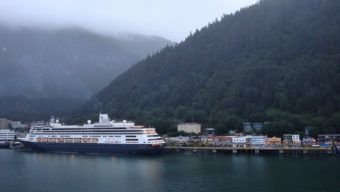
Site plan for Juneau’s proposed $54 million floating cruise ship berths. Image courtesy City and Borough of Juneau.
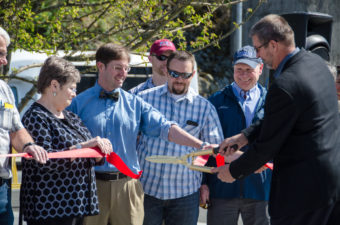
Juneau’s Docks and Harbors Department can proceed with a project to build two new floating cruise ship berths on the downtown waterfront after the State of Alaska last week approved a transfer of submerged tidelands to the city.
“If one reads the Alaska statute, DNR is required in statute to transfer the property when certain conditions are met, and clearly CBJ met all those requirements for conveyance,” Uchytil said. “And we’re pleased with the decision and we’re ready to move on.”
The Department of Natural Resources received one comment on the land conveyance. Alaska Commercial Fisherman’s Memorial President Bruce Weyhrauch submitted a letter and documents opposing the transfer. The nonprofit memorial opposes the floating cruise ship berths because of how they will impact the annual Blessing of the Fleet.
In November, Uchytil and Port Engineer Gary Gillette came under fire from Juneau Assembly members for moving forward with the $54 million project without ownership of the nearly 18 acres of submerged land in Gastineau Channel, where the new docks will be built.
The department was forced to delay opening bids for the project until the land transfer gained final approval. Uchytil raised concerns about increased costs resulting from the delay, but says the companies that bid on the project agreed to maintain their bids.
“We’re in the process of reviewing the qualification packages,” said Uchytil. “Once that is done we will have a bid opening in the next two to three weeks and make a determination of who the apparent low bidder is. That will go to the Docks and Harbors Board for approval and then to the Assembly, hopefully as soon as the 27th of January for award.”
The city received bids from four companies: Pacific Pile & Marine, Manson Construction, Kiewit, and Orion Marine Contractors, all from Washington state.
Uchytil says Kiewit and Orion Marine failed to meet the minimum qualifications for the project. Orion is currently protesting that determination by the city.
Juneau District Ranger Marti Marshall is retiring after 35 years with the Forest Service. Photo courtesy Marti Marshall.
After 35 years with the U.S. Forest Service, Juneau District Ranger Marti Marshall is retiring Friday.
She says January is a good time to step down and embark on other adventures from the work that has encompassed “all my dream factors in a job, including wilderness, outfitter guide issues, tourism, recreation.”
Marshall began her adventures with the U.S. Forest Service as a firefighter in Fish Lake National Forest in Utah.
“This was the late ’70s and it was a really interesting job because they weren’t really ready to have women in the workforce, but they were doing it,” she says.
She went on to Columbia River Gorge National Scenic Area as a backcountry ranger. Marshall says she grew up in that job and over the next 30-plus years bounced between the Pacific Northwest Region and the Tongass National Forest. She’s worked in regional offices and out in the field.
“And I think that’s worked really well for me, because I know what they do upstairs now,” she says, with a laugh.
Marshall’s Forest Service career included 13 years in the Sitka Ranger district, but her first job in Alaska was in Juneau as a recreation technician “in charge of campgrounds, cabins, trails, roads, facilities, just kind of the do-all recreation person.”
About four years ago, she came back to Juneau as ranger for Admiralty Island National Monument. When long-time district ranger Pete Griffin retired, she applied for that job.
She calls it the hardest and best of her Forest Service career.
Marshall has shared the district with Chad Van Ormer, now Admiralty Monument ranger, who will be interim district ranger until Brad Orr takes over on February 24th. Orr comes from the Sulphur Ranger District in Colorado’s Arapaho-Roosevelt National Forest.
According to Marshall, Orr’s experience will fit well in the Juneau Ranger District.
“He’s got a great background in a really big recreation district with marinas, concession campgrounds, a ski area, four wildernesses, a lot of recreation, special use permits,” she says. “I’m curious to see what he’ll think coming to Juneau Ranger District, because we think we’re overwhelmed with use and recreation issues.”
Like all Forest Service budgets, the district is facing major cuts. Marshall says 2014 will be a telling year for the Juneau Ranger District:.
“This coming year, recreation is down 14 percent, our facilities money is, I think, down 24 percent, trails is down slightly, maybe 5 or 7 percent. But the demands don’t stop just because our budget goes down,” she says. “We’re all a little stunned with the budget.”
Orr will face other revenue issues, including managing fees. For example, entrance fees to the Mendenhall Glacier Visitors Center have not gone up since 1999, when they were first established. Marshall says fees also need to increase for district cabin use.
While the budget is going down, with all its ramifications, the commitment by the district staff hasn’t, Marshall says. She is leaving a group of people she calls “amazing, phenomenal.” She says her successor will benefit from all their experience and their ability to work together to manage the largest ranger district in the nation.
A new District Ranger has been selected by the U.S. Forest Service for the Juneau area.Photo of new Juneau District Ranger Brad Orr courtesy of the U.S. Forest Service.
Brad Orr, currently the recreation program manager in the Sulphur Ranger District of the Arapaho-Roosevelt National Forest in Colorado, will start his new job in February.
Orr succeeds the retiring Marti Marshall whose job as the Forest Service’s Juneau District Ranger includes supervising the popular Mendenhall Glacier Visitor Center and surrounding trails and cabins.
According to a biography provided by the Forest Service, Orr studied silviculture, then went into seasonal firefighting before the spending most of his 34-year career in the Forest Service in timber management and recreation. Orr’s current job in Arapaho includes overseeing use of a major ski area, four wilderness areas, and one recreation area. The Forest Service says more than a million visitors flock to the Sulphur Ranger District each year because of its proximity to Denver.
Orr’s wife is a former Sitka resident and, according to a statement issued by the Forest Service, she’s looking forward to returning to Southeast with “a lot of excitement.”Photo of retiring Juneau District Ranger Marti Marshall courtesy of the U.S. Forest Service.
Marshall retires after three and a half years as head of the 3.5 million acre Juneau District. She previously served as ranger for the Admiralty Island National Monument.
The Juneau Assembly has declined a request to reconsider its nearly year old decision upholding a Planning Commission permit issued for two floating cruise ship berths on the downtown waterfront.
In 2012, the nonprofit memorial intervened in an appeal of a conditional use permit issued for the project by the Juneau Planning Commission. The memorial’s board of directors believes the floating docks will impact the annual Blessing of the Fleet.
City Attorney Amy Mead says conditional use permits are issued for planning purposes, and the city’s Docks and Harbors Department was not required to show ownership of the tidelands before applying for one.
“I don’t believe that there was anything related to the tideland conveyance issue that could have changed or would have changed what the ultimate decision from the Planning Commission was,” Mead said.
She says Docks and Harbors will have to show proof of ownership or get an agreement from the property owner before applying for a construction permit.
The State of Alaska issued a preliminary decision last month approving the transfer of nearly 18 acres of submerged tidelands to the city. Juneau Port Director Carl Uchytil has said he expects a final decision this month or next (click here to read Uchytil’s response to the fishermen’s memorial). The Docks and Harbors Department delayed opening bids for the $54 million project until the matter is settled.
Fishermen’s memorial President Bruce Weyhrauch said via email that the nonprofit will not formally pursue reconsideration of the Assembly’s decision.
Skiers and boarders line up for a ride on Porcupine chairlift on Saturday. Only the beginning area opened this weekend. The rest of the mountain needs more snow.
Juneau’s Eaglecrest is poised to be the most popular ski area in North America – at least according to the thousands of people who have voted in Powder Magazine’s Ski Town Throwdown.
Now the small city-owned area is up against the destination resort of Crested Butte, Colorado. This is the final round in the contest, which started in October.
Beginning today, you can vote once every 24 hours through Friday on Powder Magazine’s Facebook page. Voting ends at 4 p.m. Alaska time on Friday.
Map based on the latest climate change research shows a projected average annual temperature increase of 6.1 degrees Fahrenheit by 2080 which could mean more rain and less snowfall for Southeast Alaska and western British Columbia (Click to enlarge). Data map courtesy of Colin Shanley of The Nature Conservancy.
Researchers expect that salmon productivity could shift in Southeast Alaska streams over the next seventy years as temperatures rise and rainfall increases because of climate change.
Projections suggest that the average annual temperature for Southeast Alaska and western British Columbia coast would increase 6.1 degrees to just under 44 degrees Fahrenheit in the year 2080. Precipitation in the form of rain could increase over twenty inches to a total of 145 inches, while snowfall could drop about 30% to about 30 inches a year.
“There could be some serious differences,” said Michael Goldstein, a wildlife ecologist with the U.S. Forest Service in Juneau.
Goldstein was among a group of researchers who briefed attendees on the unpublished research at the recent Southeast Alaska Watershed Symposium in Juneau. A similar presentation on the impacts of climate change was made during the recent Al-Can Summit organized by the Juneau World Affairs Council.
Goldstein said the changes in temperature and precipitation would not be uniform throughout the entire Southeast Alaska and western British Columbia area.
So, temperature and precipitation had the greatest change in the northern mainland and the least change in the southern island provinces. Precipitation as snow had the greatest change in the southern mainland and the least change in the outer coast.”
It could mean warmer and drier extended summers, and warmer and wetter winters.
By 2080, Juneau could be like Prince Rupert. Projected average of 45 degrees Fahrenheit or thereabouts is similar to the average temperature of May 2013. I was looking around the internet and Alabama has an average winter temperature of 45 degrees as well.”
Returning spawning salmon near Salmon Creek in 2013. Photo by Greg Culley
The projections were presented in conjunction with separate research and modeling done by Colin Shanley, a planner and analyst with The Nature Conservancy in Juneau, in his effort to identify salmon habitat ranging from the most vulnerable to the most resilient.
This is watershed-based analysis. Not a cell-based analysis or estuary-based analysis. Basically, watershed area, monthly precipitation both present and predicted from the present climate model, same thing for monthly temperature, watershed elevation, percent lakes, and percent glaciers as well.”
Dr. Sanjay Pyare, associate professor of geography and environmental science at University of Alaska Southeast, said that climate change could play a crucial role in altering stream temperatures and episodic discharges from nearby glaciers and the ice field.
If you look at the overall discharge coming out of an area like Southeast Alaska and northern British Columbia annually compared to a place like the Mississippi River Basin, it’s actually something like two times the overall freshwater discharge. Obviously, it has a lower land mass overall. So, there’s a lot of water coming down the pipes in a place like Southeast Alaska.”
Watersheds that are predominately glacial-fed may, for example, have their peak discharge in mid-summer with colder water. Snow- or rain-fed watersheds may have two discharge peaks in the spring and early fall.
Diagram showing differences in discharge timing and temperature over a calendar year among three main types of watersheds in Southeast Alaska. Latest climate change modeling and research suggests that rising temperatures and increasing rainfall in Southeast Alaska could eventually alter the discharge flows and temperatures of some salmon streams. Excerpt of data chart from North Pacific Temperate Rainforests: Ecology and Conservation, University of Washington Press, 2013, used with permission from co-author Rick T. Edwards.
So what does all this mean for Southeast Alaska?
Nugget Falls as it empties into Mendenhall Lake. Photo by Matt Miller/KTOO News
The research suggests that an increase in temperature and rainfall levels brought on by climate change could alter the discharge timing and raise the summer water temperature of formerly glacial-fed watersheds.
The Forest Service’s Michael Goldstein expects that alpine temperatures will eventually exceed current sub-alpine temperatures. Along with a decrease by a third of accumulated snowfall, he said that elevation of the tree line could rise by as much 600 feet, and – referring to research by others – raise the lower sub-alpine boundary by 1200 feet.
Goldstein suggests that there would not be a significant increase in the fire danger. But there may be an increase in number and severity of insects and disease.
Projected increases in temperatures could expand lowland forest habitats in the winter. Ungulates, for example, could have reduce energetic costs if there is no deep, deep snow to go through. So, there’s a lot of different implications out there. A longer growing season may increase food availability for wildlife in the spring. So, that’s on one hand. But on the other hand, we clearly understand that could be some timing issues. Right? Rusty blackbirds eating dragonflies, dragonflies coming out later, rusty blackbirds not having higher nest success because there’s no food source when the chicks are being reared.”
Goldstein points to other research demonstrating that Auke Creek salmon runs have already occurred two weeks earlier than runs of thirty years ago. UAS’s Dr. Sanjay Pyare said a few degree change in water temperature could alter the growth and development of salmon at various points of its life cycle.
It’s critically important, in particular, to younger stages, juvenile stages. So, we know that incubation times are well known to be inversely related to stream temperature, and stream temperature through its affects on development, accelerating or slowing down basically the size of juveniles, can impact out-migration times. So, warmer temperatures influences out-migration or can accelerate out-migration. We have some initial thinking that at a regional level the stream temperature could be pretty important in terms of adult migration. So, we started to look at watersheds that are exhibiting some evidence of run timing shifts in adults.”
Icebergs on pre-freeze Mendenhall Lake in October 2013. Photo by Matt Miller/KTOO News
The Nature Conservancy’s Colin Shanley said another big worry among fisheries biologists includes changes in discharge flows.
With this transition from snow-fed watersheds to rain-fed watersheds, we’re going to see more rain on snow events, higher flows, (and) more scouring of salmon roe. So, salmon roe getting kicked up out of the gravel before they have time to incubate.”
While some streams would ‘blink off’ as productive salmon habitat because of climate change, others could very well ‘blink on’. Steams that currently do not have any salmon runs could someday become productive with subtle changes in temperature or discharge flow.
Besides the possible implications on salmon productivity and management, the researchers acknowledge that they are only now touching the surface of potential climate change impacts in Southeast Alaska and western British Columbia. There are a variety of other implications to explore that range from municipal planning of streamside setbacks to managing hydroelectric facilities and tourism operations.
Close
Update notification options
Subscribe to notifications
Subscribe
Get notifications about news related to the topics you care about. You can unsubscribe anytime.