Tourism

Volunteers and staff continue to give life to the Shrine

The Shrine of St. Therese has gone through various stages of use and deterioration in its 75-year history. It even closed in 1985 but a small group of Juneau residents gave it another life. Since then, the Shrine has remained open to the public for various activities while undergoing small and large renovations.

The Shrine has only survived and thrived through the hard work of Shrine staff, the generosity of volunteers, and the spirit of St. Therese.

The Shrine of St. Therese is rooted in community support.

Shortly after the cornerstone of the chapel was laid 75 years ago, 83-year-old Albert Shaw attended summer camp at the Shrine. “I remember we helped get the rocks for the causeway, throw them in the dump truck,” he says.

Help came from other groups as well.

“During the depression, during the 30s, fellows would show up here and go up to the church looking for a handout and Father LaVasseur would say, ‘I’ve got something for you to do,’ and ship them out to the Shrine and put them to work,” Shaw recalls.

Over the decades, the Shrine has gone through cycles of high use and deterioration, until 1985 when Thomas Fitterer got involved.

“It was basically closed down for use. There were many buildings that were falling apart. It was in a real slump. It really needed a lot of love and tender care,” he remembers.

Fitterer says he had an inner calling to help the Shrine, “The diocese was even talking about possibly selling it because it was such an expense, but God had another plan.”

Fitterer along with a small group of Juneau residents were passionate about getting the Shrine back to being a place of spiritual retreat.

A board of directors formed in 1986 and Fitterer and his wife Mary were asked to be Shrine directors. “When we took it over, it was in the red,” he says.

With the help of a dedicated board and other volunteers, the Shrine slowly got back on its feet. Within ten years, the Shrine was bringing in its own money.

Throughout his 25-year career as Shrine director, Fitterer says his main job was figuring out how to bring about new infrastructure and new facilities, “A lot of times it was just getting out of the way and allowing the people who had the gifts to bring them forth.”

Improvements included a new road, a bridge, a new water system, new sculptures of the Stations of the Cross, the Columbarium, and the construction of the Jubilee and Little Flower retreat cabins.

“So often I would scratch my head and say, ‘Lord how are we going to do that?’ and somehow or another I could ask somebody or somebody would volunteer,” say Fitterer.

In recent years, that somebody has often been Sam Bertoni. Almost every day for the past 13 years, Bertoni is volunteering at the Shrine doing one job or another.

“We have our own water system, our own septic system, so that takes some attention. Minor carpentry work and electrical work and plumbing work and plowing,” lists Bertoni. “We do our own plowing and sanding, so pretty much, it’s kind of like a little village.”

Bertoni’s hours depend on what project he’s working on.

“I’ve never spent a night here in 13 years, but I’ve been out here in the middle of the night thawing out pipes,” Bertoni says.

The Shrine has a couple dozen volunteers throughout the year. If there’s a bigger project, more will show up. Past work days have brought out more than a hundred people.

The Shrine is named after St. Therese. Born and raised in France, St. Therese became a nun when she was only 15. In 1897, at the age of 24, she died of tuberculosis. Alaska Bishop Joseph Crimont knew her family and when she was canonized, he declared St. Therese Queen and Patroness of Alaska.

St. Therese is also called ‘The Little Flower’ because she knew the importance of small contributions.

Diocese of Juneau Bishop Edward Burns says that’s like the Shrine’s history.

“[St. Therese] spoke in her journal about how even a small smile to a passerby means so much. It’s a connection. So with the little things that we offer, it helps transform society,” says Bishop Burns.

Now, Shrine director Deirdre Darr is introducing the Shrine to a younger generation.

“The whole history of the Shrine is just everyday people in Juneau and outside of Juneau who have just loved it and I think it’d be great to introduce it to another generation so that they can start to step in and take over for those who are getting older who have been loving and caring for the Shrine,” Darr says.

At times, Darr is overwhelmed with being in charge of the Shrine’s future, but knows she’s not alone.

“We can’t forget that we’re not the ones ultimately who are responsible, that hopefully there will be some divine inspiration to help us figure out what the future will be,” she says.

The combination of divine inspiration and human ingenuity is likely to guarantee the Shrine will be around for decades to come.

Shrine celebrates 75 years of retreats and reflection

The Shrine of St. Therese  kicked off a year-long 75th anniversary celebration on Saturday. The cornerstone of the chapel was laid and blessed by Alaska Bishop Joseph Crimont on October 30, 1938.

The Shrine was originally built as a place to inspire devotion to God. At the time, there were no other spiritual retreat houses in Alaska and Father William LeVasseur saw the need to build one.

But throughout its 75 year life, the Shrine has welcomed people of all beliefs. Residents of Juneau, Southeast Alaskans, and visitors go to the Shrine for all kinds of reasons.

As you drive out Glacier Highway from downtown Juneau, you eventually start winding along the coast with intermittent views of the Chilkat Mountains. Past Tee Harbor, you start driving up. Soon, you descend through a hemlock forest.

Turn left at mile 23 and find “a lot of trees, streams. As you walk down, you see log structures, you see the ocean,” describes Thomas Fitterer, director of the Shrine of St. Therese for almost 25 years. “You see a causeway. On the other side of the causeway is an island, Shrine Island. So you walk over to Shrine Island and suddenly you see a church made out of rock.”

Surrounding the church are the Stations of the Cross, each station depicting a scene of Christ’s final hours on earth and the resurrection.

“Then you look out and the ocean waves are hitting against the rocks, so you have God and nature so prevalent there that you cannot help but be influenced – whether you’re a believer or non-believer – somehow or another, one is touched by the peace, by the gift of natural beauty, and by the spirit,” Fitterer says.

From the beginning, the Shrine has been a place where everyone is welcome, even in the 1940s, Fitterer says, when religious groups tended to stay separate.

“Back then even, people of all denominations or no denomination felt comfortable coming to the Shrine and that’s been the flavor ever since and that’s something that I would never want to see lost,” he says.

The Shrine was built as a place to hold religious retreats, escape normal activities and be with God through prayer and reflection. It’s still a place to retreat, but in many different ways.

“The good thing about the Shrine,” Fitterer says, “is you can do everything from have a picnic on the beach to fish to rock climb to rock find to walk the labyrinth. It fulfills the needs of so many people in so many ways.”

The Shrine has always been seen as a place to escape this busy world full of distractions. “You’ve got your iPhone and you’ve got your tweets and you’ve got whatever else, a lot of people just get caught up into that pattern,” says Fitterer.

Over the years, visitors have told Fitterer about how much they enjoy being at the Shrine. People have talked of experiencing miracles and feeling close to God, even when they didn’t have one.

Fitterer recalls one visitor who have traveled all over the world, but felt a special presence at the Shrine, “She just could feel it, and she said I’ve never seen and felt a more beautiful place on earth.”

At the Shrine, volunteer Sam Bertoni walks to the outdoor columbarium where the ashes of his mother and another 200 individuals are laid to rest.

“Some people come and visit all the time,” says Bertoni. “I know people that come out here on a regular basis every week to put flowers or to communicate with their loved ones. Some folks come out here many times a week.”

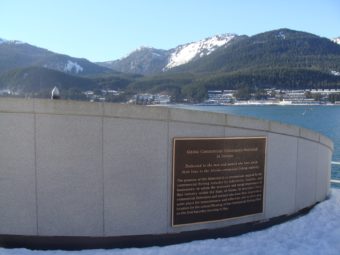
A semi-circle of six black granite walls, each about seven feet tall and 11 feet long face the ocean.

“And it’s a fantastic view. You know I can’t afford beachfront in this life, but maybe in the next life,” Bertoni laughs.

The Shrine offers church services during the summer and other holidays throughout the year. Bertoni remembers one Easter service. “There must have been 100 people and there must have been 150 sea lions out here yelping because of the killer whales, and there was so much commotion, you couldn’t even talk. It was like a hundred dogs barking. It was really something,” Bertoni says.

Over the decades, the Shrine has grown beyond the original structures of the chapel, lodge, caretaker’s house, and the post office. It now offers five separate rental cabins which are used regularly for day use, overnights, weekends, and longer stays.

Caretakers Jack and Jeanne Jordan are in charge of the daily happenings at the Shrine. Besides being used by the Catholic Diocese of Juneau, the units are rented out by many other groups.

“We have other churches, the state of Alaska, the school district, the Coast Guard, different businesses utilize it, we have yoga groups sometimes, women’s retreats and sewing groups, scrapbooking groups, anniversary celebrations, birthday celebrations, family reunions,” says Jeanne Jordan.

It could be as simple as wanting a quiet place to walk around or as complicated as pondering the meaning of life. Jordan says people in search of something often visit the Shrine of St. Therese and find what they’re looking for.

Eaglecrest moves on to second round

Powder turns in Eaglecrest’s West Bowl, 2013. Photo by Rosemarie Alexander.

Juneau’s Eaglecrest is on to the second round of the Ski Town Throwdown.

The tiny ski area Monday proved to be more popular in the competition than Whistler/Blackcomb Ski Resort near Vancouver, British Columbia.

Whistler/Blackcomb is huge by comparison, but throughout the day Eaglecrest was a couple hundred votes ahead in the contest, conducted on Powder Magazine’s Facebook page. The magazine paired the areas.

Eaglecrest is the only Alaska ski area in the competition.  Girdwood’s Alyeska Resort lost to Panorama Mountain Village in B.C. earlier this month.

The magazine divides the ski areas into geographic regions, the Great White North, Far West, Rocky Mountain West and the Big East.

Eaglecrest snow sports director Jeffra Clough says the Ski Town Throwdown has six rounds, just like the March Madness basketball championship.

“There’s the second round and then they call it the Sweet 16, the Elite 8, the Final 4 and then the finals,” Clough says.  “And so the Great White North champion goes against the Big East champion on December 2nd and 3rd.”

The second round is Nov. 7th, when Eaglecrest will be paired against Mount Washington in British Columbia.  The  Vancouver Island ski area is the winner of Tuesday’s Powder Magazine competition against Kicking Horse Mountain Resort, also in B.C.


Vote for Eaglecrest in Ski Town Throwdown

View from the top of Eaglecrest, off the backside. April 2013 photo by Rosemarie Alexander.

A special election on Monday could put Eaglecrest Ski Area on the map outside Alaska.

Eaglecrest is included in Powder Magazine’s Ski Town Throwdown, competing against Whistler/Blackcomb Ski Resort, near Vancouver, British Columbia.

Whistler/Blackcomb is many, many times larger than Juneau’s city-owned ski and snowboard area.  But if enough people vote for Eaglecrest, not only will there be bragging rights, but Powder Magazine will feature Eaglecrest and Juneau in one of its monthly editions.

General Manager Matt Lillard says the international magazine reached out to Eaglecrest to include it in the competition, which has several rounds.

Right now we’re just focusing on beating out Whistler/Blackcomb. They’re obviously a much bigger area with definitely a much bigger following than us.  So we’re going to try to get everybody out there and win this round then we’ll start focusing on the next one after that,” Lillard says.

Ski Town Throwdown is a competition among a variety of ski towns and resorts across the U.S. and Canada.

“If we can keep going it just shows that we’ve got passionate skiers, a great area and it just gets our name out there more and more,” Lillard says. 

Fans vote through Powder Magazine’s Facebook page one day only.  For Eaglecrest, voting will be open for 24 hours on Monday, Oct. 28.


Ketchikan airport called one of the most ‘thrilling’

People love top-ten lists, and just recently, USA Today posted a list of the world’s ten most thrilling airports. That list was put together by Airfarewatchdog.com. On the list is an ice runway in Antarctica, which could potentially crack under the weight of a plane; a landing strip in Africa where planes taxi off a cliff and fall a little ways before catching air; and Ketchikan International Airport.

While it’s not surprising that an Alaska airport made the list, some Ketchikan residents, including the mayor, are not sure whether the local airport really deserves the honor.

The airport is operated by the Ketchikan Gateway Borough. And Borough Mayor Dave Kiffer said that, of course, he’s always thrilled when he flies in to Ketchikan.

That said, though, it seems unlikely that Ketchikan truly is one of the top-ten most thrilling airports in the world.

“I’m not even sure we’re in the top-ten of thrilling airports in Alaska,” he said. “Certainly, there’s no question, I’ve had a lot more thrilling landings in places like Juneau and Sitka over the years, even Wrangell now and again, than I have had in Ketchikan.”

The short description that states why Ketchikan was chosen for the list simply states that, “The awfully short runway is close to mountains and the ocean, which drops to freezing temperatures.”

The runway at Ketchikan’s airport was lengthened a few years ago, and has an extension in case of emergency over-runs. In addition, while the ocean does get quite cold, it doesn’t ever freeze. One truly thrilling aspect of flying in or out of Ketchikan wasn’t mentioned: Wind.

“There have been times flying in here when it’s been right at the limit for allowing you to land, and you get that lovely little bucking bronco approach to landing,” Kiffer said. “Certainly, the fog is an issue. Certainly there are issues besides just the fact that there’s a mountain nearby and the ocean is nearby.”

Before Ketchikan had an airport, Kiffer said, it was truly thrilling to fly here. People coming to Ketchikan flew larger planes to Annette Island, and then transferred to the old-fashioned float-planes, like the Grumman Goose, which then would bring them to Ketchikan.

“And those float planes landed on their bellies, and the water would splash up by the windows, and invariably, someone who never landed in Ketchikan before would scream,” he said.

Kiffer does have one theory as to why Ketchikan’s airport does count as one of the top most thrilling airports in the world:

“We have the best popcorn in the State of Alaska at our airport,” he said. “I know that because you’ll see flight crews get off the plane, go over, get popcorn and then get back on the plane again.”

Kiffer wrote a column on this topic for the site Sitnews.

See the original story and hear the audio at KRBD: Ketchikan airport called one of the most ‘thrilling’

Seward getting bronzed

Assemblymember Mary Becker (left in red sweater) and architect Wayne Jensen (right in white coat) take turns breaking ground along with John Venables (center) on Thursday in the Dimond Court Building Plaza. Photo by Matt Miller/KTOO News

A ceremonial groundbreaking was held on Thursday on the Dimond Court Building Plaza across the street from the Alaska State Capitol for a proposed statue of William H. Seward, the Secretary of State under President Lincoln.

Members of the community, wearing hard hats and nametags designating their position within a proposed Seward Cabinet, used shovels to pitch dirt in a plywood planter.

The statue project is the brainchild of historic re-enactor John Venables who frequently brings Seward and James Wickersham to life.

“A great day for Juneau, Alaska. We are here as a committed group made up of committed individuals,” said Venables during the groundbreaking.

Juneau architect Wayne Jensen is one of many people helping with the project. He said statues of Seward exist elsewhere in the country, but such a pivotal figure in Alaska history should have a statue in the state.

The groundbreaking kicks off the fundraising and design of the Seward statue.

Jensen said that it’s hoped that the project will be completed by 2017, or the 150th anniversary of the United States’ $7.2 million dollar purchase of Russian America from Russia.

Photo by Matt Miller/KTOO News
Site notifications
Update notification options
Subscribe to notifications