Tourism

Juneau expects to see more cruise passengers than ever this year

Two cruise ships towering over buildings along Juneau's waterfront
Cruise ships line the Juneau waterfront on Wednesday, June 8, 2022. (Photo by James Brooks/Alaska Beacon)


Juneau’s 2023 cruise season will kick off next week when the Norwegian Bliss arrives on Monday. 

Tourism nearly halted during the first two years of the COVID-19 pandemic, and most of the ships that visited town last year were operating at limited capacity. That makes this year Juneau’s first full-scale cruise season since the pandemic began.

Alexandra Pierce, the city’s tourism manager, says it’s expected to be bigger than ever, with 30% more visitors than in 2019.

“We’ve never seen an increase like this before,” she said. “And I don’t think any of us who are close to the industry really know whether it’s going to just be completely crazy or whether it’ll be okay.” 

Pierce says the city expects 1.67 million passengers. The increase mostly reflects growth of the cruise industry as a whole, she says — ships are getting larger and cruise schedules are getting more packed. 

Elizabeth Arnett of Travel Juneau leads Tourism Best Management Practices, a city program that works to address tourism concerns for both residents and the local tour industry. She said the expected record season could bring welcome economic opportunities along with new concerns and complaints from residents. 

“It’s so exciting to have a thriving tourism community again,” Arnett said. “But that’s not necessarily the case with people who aren’t involved in it.” 

The challenge, for both city officials and tourism advocates, will be finding a volume of tourists that’s sustainable — for both residents and visitors. But Arnett says nobody knows where that number falls, and limiting tourism growth can be challenging. 

“Where’s the stopping point? And how do you even make a stopping point?” Arnett said. “If we start trying to put our foot down with the cruise industry, you know, when do we, you know, step too hard and they just back away?”

The city Assembly has come up with at least one way to manage the ever-expanding industry — a five-ship daily limit, which passed earlier this winter. 

That limit won’t take effect until 2024. In the meantime, tour managers, downtown businesses and city officials will have to figure out new ways to manage crowds and entertain visitors. 

But Pierce says many of the most popular tourist attractions are already overwhelmed. 

“We’re feeling like we’re kind of busting at the seams on whale watching right now. And it feels that way on helicopters,” Pierce said.

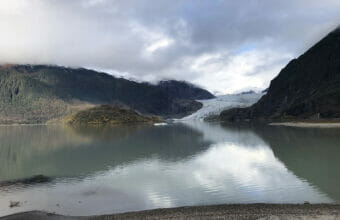
And the Mendenhall Glacier, Juneau’s most popular tourist attraction, has been struggling to manage growing crowds for years. The U.S. Forest Service has been working on a plan to upgrade visitor facilities at the glacier since 2019, but it will be several seasons before construction begins. 

Arnett believes more visitors could present opportunities for businesses to expand or explore new kinds of tourism, but they may not be able to take on new visitors right away.

“We’ll be tested this summer for sure. We all pray that it comes down on the plus side,” Arnett said. “Because if visitors stop having a good experience here, the ships will take notice.”

Meanwhile, Pierce says the city hopes to use 2023 as a test run, to understand where crowds have become too much to handle and where new opportunities for high-volume tourist excursions exist.

“To look at the community and where we’re already seeing pain points,” she said. “And to kind of give our local businesses or local tour operators a sense of where and how they can grow.”

Pierce says part of her proposal for the use of marine passenger fees collected from cruise ship passengers will include more money for collecting data on those topics.

And as tourism ramps up for the summer, residents can submit complaints and concerns to the city’s tourism hotline.

Large rock throws wrench into Skagway’s cruise ship schedule

A mass of rocks on mountain slope with a cruise ship docked below.
A view of a large rock mass above the Skagway railroad dock in 2022. (Photo by Mike Swasey/KHNS)

Some cruise lines have misgivings about tying onto part of a Skagway dock because of the danger posed by a large rock high above it. One solution would still allow all scheduled ships to come to town this season, but it would mean shorter visits for some passengers.

Last summer, rockslides from the hill above the railroad dock in Skagway caused cruise lines to cancel some dockings there through the end of the season. Borough Manager Brad Ryan says the cruise companies seem mostly satisfied with new mitigation measures in place to catch falling rocks. But one large rock, known locally as ship rock, could fall — and that scenario has cruise lines reconsidering their docking schedules.

“We have dual monitors we are going to have on it so we are comfortable,” Ryan said. “But some of the cruise lines are not.”

The large rock looms over a short section of dock close to town. The remainder of the dock is long enough to accommodate two cruise ships, provided one of them is relatively small. But on some days, both scheduled ships are too large to fit together. Ryan says the cruise lines have decided that on those days, each ship will spend half a day in port.

“The cruise lines have indicated that there are certain days that they are going to hot berth,” Ryan said. “Which means one ship will come in early, be here for about six hours or so, it will pull off, and then the second ship will come in and  be here from about two o clock until the evening.”

This arrangement might be necessary about fifty times this season, but Ryan says the cruise lines are looking at ways to fit the longer ships into the shorter space.

“They are ordering more bollards, trying to slide the ships back,” Ryan said. “They are talking about coming in and flipping around so that the port side goes to the dock. There is a whole bunch of conversations trying to cut those hot berths down — nobody wants it.”

The borough administration says the slopes above the docks will be monitored closely. The municipality is hiring people spend the summer living in wall tents east of the slide area, where they’ll spend eight to ten hours a day watching for rockslides. They’ll be equipped with radios so they can alert traffic handlers below if they see or hear rocks starting to move.

“There is about twelve to twenty seconds from the time you notice a rockslide up there before it would reach the docks,” Ryan said. “And so that would be enough time for a bus to pass through, and obviously, if we started to hear one we’d stop the busses beforehand.”

Ryan says these measures are redundant, as a series of nets and barriers are being set up on the slope to slow down and catch any falling rock. He says those systems are on track to be ready by next Tuesday, when the first cruise ship of the season will dock.

Conservation groups sue EPA seeking rules for discharges from cruise ships and other vessels

A small group of environmental demonstrators gather near the Capitol in downtown Juneau on April 26, 2022 to protest pollution from large cruise ships. (Photo by Paige Sparks/KTOO)

Two conservation groups are suing the Environmental Protection Agency over its alleged failure to finalize standards to protect U.S. waterways from harmful vessel discharges, including those from cruise ships.

In a complaint filed in February, Friends of the Earth and the Center for Biological Diversity say that the 2018 Vessel Incidental Discharge Act required the EPA to develop standards for discharges from ships.

The lawsuit seeks an injunction that would require the EPA to issue those rules.

Much of the lawsuit focuses on the ballast water that ships take on to provide stability. Friends of the Earth Oceans and Vessels Program Director Marcie Keever says that when ships take on water in one place and discharge it in another, that can help spread invasive species and diseases.

“Unless you have treatment to a level which gets rid of these invasive species, when your ship exchanges ballast water, … it’s an incredible risk just from invasive species alone, let alone the pathogens you might encounter from ships coming from all over the world into our waters,” Keever said.

An EPA spokesperson declined to comment on the pending litigation.

In their lawsuit, the conservation groups say invasive species alone cause more than $9 billion in damage each year to infrastructure for public water supplies, industry and power plants.

But ballast water is only one focus of the lawsuit. Keever says the groups are also concerned about discharges from scrubbers that reduce ships’ air pollution.

“The biggest rise in wastewater pollution that we’ve seen over the last several years is exhaust gas scrubber wastewater, which is, basically, the wastewater generated when you use a wet scrubber to scrub your smokestack to comply with international rules for cleaner fuel,” Keever said.

CoastAlaska investigation published last year uncovered dozens of reports from independent cruise ship monitors alerting state authorities to foamy discharges from ships operated by Carnival Corp. and subsidiaries like Holland America and Princess. Keever says those discharges can harm marine life and those that depend on it for sustenance.

“Essentially, what they’ve done is converted air pollution into water pollution,” Keever said.

Lawyers for the conservation groups and the EPA are due to appear before U.S. District Judge William Orrick in the Northern District of California in mid-May.

Juneau’s Basin Road trestle will close, even for pedestrians, in May for repairs

The Basin Road Trestle has been closed to vehicles since a rockslide damaged it in January 2023 (Photo by Anna canny/KTOO)

The trestle on Basin Road has been closed to vehicle traffic since January, when a mid-winter rockslide caused cosmetic and structural damage. When the city begins repairs next month, the trestle will close to foot traffic, too.

Katie Koester, Juneau’s director of engineering and public works, says the closure — which should last from early May through around mid-June — will disrupt some recreation and tour activities for the start of Juneau’s visitor season.

“It’s a huge inconvenience. Not just for those of us who walk up there on a daily basis, but I know there’s also at least one company that works in that area,” she said.

The trestle is a key access point for the popular Perseverance Trail system. It’s been open to pedestrians since the slide, but that will change when construction begins.

It’s also the only access point for the Last Chance Mining Museum, which typically opens in late May.

The closure will also affect at least one tour company, Alaska Travel Adventures. They run a gold mining and panning excursion in the area. The city’s Department of Parks and Recreation is working with the company to find alternatives during the trestle’s closure.

The trestle, a relic of the AJ Mine, is located in an area that’s prone to both avalanches and landslides. Both have caused temporary closures in recent years.

The state Department of Transportation found that January’s slide caused significant structural damage to the trestle. Stabilizing it to support vehicle traffic is the priority for next month’s repairs, which are expected to cost around $100,000.

“We’re really returning it to the state that it was in before the rock fell,” Koester said. “We’re not doing anything in this repair to further beef up the trestle.”

Hikers who hope to access the Perseverance Trail can still do so via the Flume Trail.

Seattle journalist describes impacts of Alaska’s ‘cruise ship invasion’

The first cruise ship of the season arrives in Juneau on April 23, 2022. (Photo by Paige Sparks/KTOO)

April brings the start of Alaska’s cruise ship season. Juneau will welcome hundreds of cruise ships in the coming months. In a recent interactive feature for Hakai magazine called ‘Cruise Ship Invasion’, freelance investigative journalist Andrew Engelson looked at the impact the cruise industry has on the environment and quality of life in Southeast Alaska.

Engelson talked with KTOO’s Anna Canny about his findings.

This interview has been edited for length and clarity.

Anna Canny: You’re based in Seattle. And that’s sort of the hub where a lot of these Alaskan cruise ships set sail. So I’m sure you’re used to just seeing the presence of the industry, but as a reporter, what motivated you to take a deep dive into their environmental impacts?

Andrew Engelson: You can’t help but see those ships here. And I was aware that, you know, there were a lot of impacts, and I’ve seen reporting on it — you know, the carbon impacts, the emissions. And then, you know, these are floating hotels that have up to 4,000 people on them. And so those people are, you know, brushing their teeth and using showers. And so there’s going to be treated sewage, gray water, all the trash that’s generated, and, you know, thousands of tourists basically doubling or tripling the size of the population of small towns when the ships arrive. But I wanted to dig in deeper. And so I spoke to the magazine that published it, Hakai, about how we could approach that. 

Anna Canny:  As you mentioned, there’s been a lot of reporting on this over the years, but something that’s really unique about your piece, I think, is the formatting of it. So we follow this one fictional ship — you call it the Oceanic Topaz — and we follow through its stops on its journey through Alaska. I wonder what led you to that approach?

Andrew Engelson:  Yeah, I mean, the findings I had found in this, were really overwhelming. You know, putting it in a traditional article was gonna make it difficult to really kind of cumulatively see those impacts. But if you kind of look at one ship and, seeing the impact of just one ship on its seven day journey, I think was was pretty powerful.

Anna Canny: I just want to highlight some of the numbers that you bring up in your reporting: 2,800 metric tons of carbon dioxide emissions. And then, of course, you use hot tubs to visualize the wastewater, which I thought was helpful: 400 hot tubs of sewage and 3,000 hot tubs of gray water. And of course, there’s the trash. I think it was eight tons of trash. Those are huge numbers. And that’s all for one ship. And then you start to understand here in Juneau, we’re seeing up to five ships a day.

Andrew Engelson: It’s amazing to think about that there are nearly 300 of them, making that journey. You know, 13 ships, 300 sailings, it’s a lot.

Anna Canny: Here in Juneau, something that really struck me is that the majority of our marine emissions, I think upwards of 80%, can be linked to the diesel fuel that burns with cruise ships. But I’m wondering if you could contextualize that piece a little bit more for me.

Andrew Engelson: Yes, it was really surprising, because I think a lot of us, we’re always thinking about climate impacts about, you know, whether we drive our car on a trip, or if we take a flight, and you know, where cruises fit into that as well. And, cruises seem to be really high on that level. And that was fairly surprising to see that one seven-day cruise putting out 2,800 metric tons of carbon dioxide, which is equivalent to driving 600 cars for a year.

Anna Canny: Those diesel fuels are really heavy on emissions, but they’re also heavy on another kind of pollution, which I wasn’t super familiar with. It’s the impact of scrubber discharge.

Andrew Engelson: A lot of these ships, for years, used what’s called high sulfur fuel, and it puts out these particulates. It’s really bad pollution. And so the International Maritime Organization recommended that ships either switch to a low sulfur fuel, or put in what’s called a scrubber, which basically sprays water through the exhaust, and basically taking that and putting those pollutants into the water, instead of into the air. The problem is, is then it takes those pollutants and puts it out into the sea. That discharge is very acidic, it contributes to ocean acidification. It has, you know, metals and other pollutants in it. And it’s really very unregulated, because it’s relatively new. I mean, most people know about, you know, sewage, and that it should be treated. But this is dumped in both Washington State, British Columbia and Alaska.

Anna Canny: It’s clear from a lot of the sources that you interview that there’s definitely concern, like Alaskans are concerned and are noticing these impacts. But there’s a trade off for a lot of these communities, right? You hear about the economic benefit that the cruise industry brings.

Andrew Engelson: Yeah, it’s a complicated issue. I mean, you know, Seattle actually definitely benefits there’s no question. And certainly the economic benefits to places like Juneau and Ketchikan are high. And maybe the economic benefits are, you know, worth it. But when you kind of total up all of those impacts and the impacts the quality of life, you know, there’s no question. And it was surprising to me that there was a poll of Juneau residents that said, a majority of them were like, yes, we should limit the number of cruise ships.

Anna Canny: Well, yeah, I’m sure it will be really interesting for our listeners, because our first cruise ships arrived just over two weeks from now. And you’ve given me lots to think about as I watched them start to come in. So thanks for chatting with me, Andrew.

Andrew Engelson: I really appreciate it.

Record number of cruise passengers expected in Skagway this year

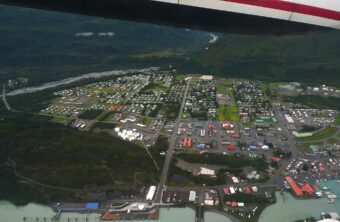
Skagway on Aug. 3, 2022. (Claire Stremple/KTOO)

The town of Skagway is preparing for tourists to rush in. With increased docking capacity at the port and a longer season, the municipality is expecting a record number of visitors this year.

The tourism industry in Skagway is on track to recover from its pandemic slump, with 1.2 million cruise passengers expected this year. That’s almost double last year’s numbers, and a 25% increase over the previous record year, 2019.

Renee Limoge-Reeve is vice president of community relations with the Cruise Lines International Association. She sees an increase in passenger numbers throughout the industry.

“We know from our research that intent to cruise is higher than pre-pandemic levels,” she said. “And that’s both among people who have cruised in the past, and people who have never cruised. Intent to cruise is through the roof, I think there is definitely a pent-up demand.”

All these passengers will visit multiple ports, making the boom regionwide. Ketchikan is also expecting a record-setting year.

“The Alaska market remains very very strong,” Limoge-Reeve said. “It’s a bucket-list destination, we know that. When you talk about cruising in the Caribbean, the ship is the destination. In Alaska, Alaska is the destination.”

Jaime Bricker is the town’s tourism director. She says she loves seeing the town come to life.

“It’s”I just had coffee with a friend this morning, and there were a ton of new people walking into the coffee shop, lots of hustle and bustle on Broadway,” she said. “Everybody is moving around and preparing for the season around here.”

The first cruise ship will arrive on April 18, and the last one is scheduled for Oct 25. This makes for a longer tourism season than in years past. Businesses will have to adapt to that timeline.

“I think there is a varying degree of acceptance in terms of opening earlier and staying open later, there are also other factors that each business has to consider,” Bricker said. “Like whether or not they have enough staff to cater to that early group of people or staff that will stay late into the season. And does it justify them staying open. I think it’s a decision that each business will have to make for themselves, and it will be interesting to see how that unfolds in Skagway.”

Bricker is optimistic staffing needs will be met.

“I have heard great things about the hiring for this year as opposed to the last several years in particular. It is refreshing to hear that people are ready to come back to Skagway and ready to work for the summer,” she said.

Changes on the waterfront also contribute to the increased number of visitors.

“There is a trend within the industry of having the larger ships that can accommodate more passengers, and we’ve got four berths that have been improved to accept some of those larger ships. Right now we are maximizing this infrastructure in the best way possible to maximize the number of people that can come to Skagway. And so all of those things have led to that growth,” she said.

Renee Limoge-Reeves, of the cruise lines association, sums up why so many visitors want to go to Skagway in the first place.

“It’s a gem in Alaska’s jewelry box,” she said. “We know that people go to Skagway, they see a beautiful little town that is extremely welcoming, we have wonderful excursion opportunities there, it’s a historical location, and we are thrilled to go.”

This year a part of the waterfront is returning under the municipality’s control, after a 55-year lease to a private company.  Associated docking fees from now on are paid to the municipality.

To mark the occasion, there will be a ceremony at Skagway’s shoreline park on April 19, the day after the first docking, at 5 pm.

Site notifications
Update notification options
Subscribe to notifications