Transportation

AMHS dock in Skagway sinks

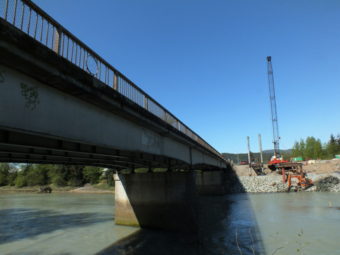
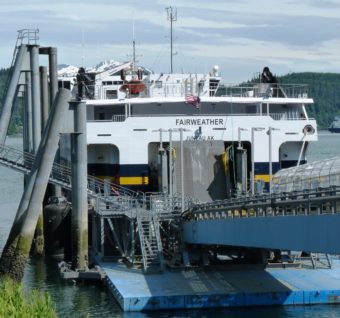
The AMHS dock in Skagway collapsed overnight. (Photo courtesy Alaska Department of Transportation and Public Facilities)
The AMHS dock in Skagway sank overnight. (Photo courtesy Alaska Department of Transportation and Public Facilities)

The state ferry dock in Skagway remains underwater and is closed indefinitely. The dock was completely submerged by about 9:30 a.m. Thursday.

Alaska transportation department officials say oil booms were laid around the area to collect contamination.

Marine engineers have been onsite and are still assessing the damage. Agency spokesman Jeremy Woodrow says the dock is resting on the seafloor and is fully submerged at high tide and partially submerged during low tide.

Absorbent boom has been deployed around the dock area. (Photo by Doug Smith/KHNS)
Boom has been deployed around the dock area. (Photo by Doug Smith/KHNS)

Skagway resident Gary Heger was one of the first to see it early Thursday morning.  He says the tugboat Anna T  was tied up on the east side of the dock and the west side was underwater. When the tug untied from the dock, the rest of the dock sunk.

“Last night (Wednesday) about 5:30 they had a fork lift on the dock and everything was fine,” he says. “Nobody’s really sure what happened this morning, but it was a surprise.”

DOT engineers were surprised, too. Woodrow says the 160-foot by 120-foot dock is made of 24 individual concrete chambers.

“The words that the engineer used is he’s perplexed. We actually have inspected every one of those individual chambers in the last year and there was no indication of any wear,” Woodrow says.

No ferries were scheduled into Skagway on Thursday. The Alaska Marine Highway System has canceled all sailings for the next two weeks. Woodrow says if the dock can be salvaged, it will take some time before it will be ready to accept ferry traffic.

Skagway dock 5/5/13 from ship
The Skagway Alaska Marine Highway floating dock seen from the MV Malaspina on May 5, 2013 (Mikko Wilson/360 North)

Original story:

The Skagway ferry terminal dock is fully submerged, according to state transportation officials.

DOT spokesman Jeremy Woodrow says an engineer is on his way to Skagway to find out what happened. Apparently the dock started to sink overnight and by early this morning it was totally underwater. The 160 foot by 120 foot dock is about 12-feet deep. It is made of 24 individual concrete chambers.

“The words that the engineer used is he’s perplexed,” Woodrow says. “We actually have inspected everyone of those individual chambers in the last year and there was no indication of any wear.”

Woodrow says the cause of the collapse remains a mystery until an engineer gets on site and a diver gets an underwater look. No ferries are scheduled into Skagway today (Thursday), but the LeConte is to sail there tomorrow. Woodrow says marine highway officials are working out a plan.

This is a breaking story. Check back for details.

Note:  Also previous reports indicated the dock had collapsed. That connotes structural failure and DOT’s Woodrow says the extent of the damage is still unknown.

As Legislature make progress on adjourning, KABATA bill falls apart

Knik Arm (Photo by Travis S.)

Less than two hours after the combative House and Senate seemed to reach a truce on education, a bill dealing with the proposed Knik Arm Bridge fell apart on the House floor.

The House rejected the Senate’s version by one vote on Wednesday night. Because 21 votes are required to pass legislation, the bill came up short when it got 20 yeas and 18 nays. Six Republicans broke ranks with their party to oppose the bill. They were Mike Hawker of Anchorage, Mia Costello of Anchorage, Lindsey Holmes of Anchorage, Kurt Olson of Kenai, Eric Feige of Chickaloon, and Paul Seaton of Homer. Two Republicans who were expected to support the bill were not present because of excused absences. Rep. Bob Lynn of Anchorage was excused for a family illness, while Rep. Lora Reinbold of Eagle River was absent because of a planned vacation.

While the bill originated in the House, it was dramatically changed in the Senate after an audit suggested that the project may be uneconomic. The new version sets up a financing plan for the billion-dollar bridge that involves a mix of federal highway grants, federal loans, and state bonds.

Because the House failed to concur, the bill may be sent to “free” conference committee with the power to rewrite it – just like was done with the education bill this week. That could extend a legislative session that has already gone three full days over its statutory deadline. While the Senate still needs to agree, the House has already named Kodiak Republican Alan Austerman, Chugiak Republican Bill Stoltze, and Anchorage Democrat Harriet Drummond.

The bridge bill is a major priority of Senate President Charlie Huggins, a Wasilla Republican.


Watch the House Floor Session courtesy of Gavel Alaska:

Delta vs. Alaska: Dueling airlines benefit Juneau

Delta Air Lines performs a test flight into Juneau on Wednesday in preparation for daily service to Seattle starting May 29. (Photo by Doug Wahto)

Delta Air Lines begins daily flights between Juneau and Seattle on May 29. For a long time, Alaska Airlines has been the only one flying that route.
Alaska travel analyst Scott McMurren says the power of competition goes a long way in lowering airfares.

“The moment that Delta’s rubber hits the tarmac in Juneau, fares will be at historic lows. The moment Delta leaves the market, fares will immediately return to their previous level. This is a great opportunity for Juneau travelers, and that great opportunity will last as long as Delta flies there and not a moment longer,” McMurren says.

An online spot check of round-trip flights between Juneau and Seattle in early June showed the airlines offered the same fares, $487.40. In September when Delta service ends, flights on Alaska Air Lines jump $80.

Adding service to Juneau is part of Delta’s expansion in Seattle. Right now, the airline makes 35 daily departures out of Sea-Tac Airport. By August, Delta hopes to increase that to 86 departures.

“We are reaching out to markets that are key travel markets for us that allow us to carry passengers both into Seattle as well as connect them onto international flights. We’re adding a significant amount of international service. We just added London Heathrow at the end of March and we are going to add Hong Kong and Seoul in June,” says Anthony Black, Delta spokesman.

The airline already flies from Seattle to Amsterdam, Paris, Beijing, Shanghai and Tokyo.

Connecting to international destinations is what Black says will set Delta apart from Alaska Airlines, which only flies internationally to Canada and Mexico.

Between Juneau and Seattle, Delta will be flying a Boeing 757. Alaska Airlines uses 737s. Black says a 757 can carry more passengers and has more powerful engines.

He also says Delta’s prices are competitive and, so far, Delta is pleased with bookings.

Marilyn Romano, regional vice president for Alaska Airlines, says she feels very secure with Alaska’s position in Juneau. She says Delta’s one flight a day between Juneau and Seattle during the summer doesn’t compare with Alaska’s eight flights a day.

“That’s our standard operating business coming in and out of Juneau and that doesn’t include all the other flights that we have – Anchorage to Juneau, or Juneau to other cities in Southeast Alaska – so as far as competing, I think we feel like we’ve been operating daily service into Juneau for over four decades,” Romano says.

Plus, there’s free baggage if you’re a member of Club 49, the airline’s program for Alaska residents, and bonus mileage, like last summer. Travelers flying on Delta from Juneau to Seattle will still get Alaska Airlines miles, though.

While Alaska and Delta are now competing in Juneau, the two airlines are partners for other destinations.

“At times, the competitive nature of our business is bigger than at other times and this is probably one of those times. We’re doing what we need to do to grow our business and Delta will do what Delta feels they need to do to grow their business, and at the same time, we are partners, so it’s a unique situation,” Black says.

Juneau International Airport manager Patty deLaBruere says competition is good for Juneau’s economy.

“Alaska Airlines, I think, has taken very good care of people up here but Delta may add a different flair on what they’re going to do for the travelers. So choice is good,” says deLaBruere.

That also means more revenue for the airport, an enterprise of the City and Borough of Juneau. Renting space for a check-in counter and offices, flying in and out, and parking its plane overnight in Juneau for the summer will cost Delta about $90,000.

Testimony mixed on Juneau Access project funding

Juneau Access map
Map of the proposed Juneau Access project (courtesy Alaska Department of Transportation and Public Facilities)

Juneau residents on Thursday weighed in for and against a $35 million appropriation for the Juneau Access project in Gov. Sean Parnell’s proposed capital budget.

The Senate Finance Committee took general comments on the spending plan. Those who spoke about the proposed road north of Juneau were split about evenly between supporters and opponents.

James Sullivan, a spokesman for the Southeast Alaska Conservation Council, called the project a boondoggle.

“We have felt for decades now that this project has been overblown in its usefulness, and that it won’t really serve the people of Juneau as well as many people think,” Sullivan said.

He asked the committee to pull funding for the project until the Alaska Department of Transportation completes a Supplemental Environmental Impact Statement.

In 2006, SEACC challenged the original Juneau Access EIS in court, saying it didn’t adequately consider alternatives to the road, such as improved ferry service. After several appeals, the Parnell administration started working on the new version in 2011. A DOT spokesman in early March said a draft document could be released within a couple months.

Supporters of the road say it would improve Juneau’s economy and quality of life. Juneau Chamber of Commerce CEO Cathie Roemmich urged the committee to fully fund Parnell’s request.

“This $35 million will get the road as far as the Kensington Mine,” Roemmich said. “That means that over 200 workers out there can drive home every day, instead of staying in small rooms and cots that other employees share. To us that’s really important, because we want to keep those Kensington Mine workers and all of our mine workers here in Juneau.”

Opponents said the state should not be building the road for a private company.

Sometimes called the Lynn Canal Highway, the entire project is supposed to go to the Katzehin River, where day boats would transport vehicles and passengers to Haines and Skagway.

Juneau Mayor Merrill Sanford and Deputy Mayor Mary Becker also testified in favor of the project.

During the public hearing, several other Juneau residents testified in support of a proposed arts complex in the city’s Willoughby District.

More testimony is scheduled on the capital budget this weekend and early next week.

Ferry LeConte breaks down, Aurora fills in

The ferry LeConte docks in Skagway in 2009. The ship is in drydock to repair a broken bow thruster. (J Webber/Creative Commons)
The ferry LeConte docks in Skagway in 2009. The ship is  tied up in Juneau due to a generator failure. (J Webber/Creative Commons)

The Alaska Marine Highway ferry Aurora is scheduled to take over LeConte sailings on Friday, April 4.

A generator on the LeConte failed on Wednesday, when the LeConte was on its way from Prince William Sound to Ketchikan for a mandated inspection.

Spokesman Jeremy Woodrow says the ship diverted to Juneau, where the inspection is being done.

Woodrow says the LeConte’s repair time is not yet known.

“They’re still working on assessing the situation. The LeConte will most likely be out for the weekend. But the Aurora will be capable of filling in for it until it is back online,” he says.

The Aurora and LeConte are nearly identical ships. Both carry about 300 passengers and 34 vehicles.

The Aurora missed sailings last month when part of its steering system broke down. The Juneau-based LeConte missed sailings in December due to problems with its bow-thruster, which is used for docking.  It sails to Haines, Skagway, Tenakee Springs, Angoon, Hoonah and Gustavus.

Senate committee advances transportation fund measure

Rep. Peggy Wilson speaks during a House Resources Committee meeting during the 28th Alaska Legislature, March 17, 2014. (Photo by Skip Gray/Gavel Alaska)

A measure setting up a road-and-ferry savings account has cleared its first state Senate committee.

What’s called the transportation infrastructure fund would also pay for airport, harbor and similar projects.

House Joint Resolution 10 has gained support from construction and development groups.

At a recent hearing, Tom Brice said the three laborers’ unions he represents support the measure.

“It breaks down some constitutional barriers that exist in terms of establishing long-term planning for the transportation needs to the state.”

Wrangell Republican Representative Peggy Wilson authored the resolution, which the House approved in March. It passed out of the Senate Transportation Committee yesterday.

Wilson told the panel the measure resurrects a system used in territorial days.

“There were already two transportation funds in existence before we became a state. One was for roads and one was for ferries and harbors. So we’re combining both of them into one.”

The next stop is the Senate Finance Committee, then the chamber’s floor.

Wilson’s resolution would put a constitutional amendment before voters in November. Passage would allow the fund to be created.

Separate bills establishing and appropriating $2 billion into the fund are not expected to pass this year. Wilson says that will come later.

She says the fund would pay for more transportation projects. Critics, including the governor, say it could shrink the amount of money spent.

Watch the committee hearing courtesy of Gavel Alaska:

Site notifications
Update notification options
Subscribe to notifications