Transportation

Historic Brotherhood Bridge getting dismantled, replaced

Construction is underway on a new crossing of the Mendenhall River at Glacier Highway.

By the end of this year, the historic Brotherhood Bridge will be removed and disposed. It will eventually be replaced by a new, wider bridge that will be able to handle an expected 50 percent increase in traffic over the next 75-years.

Anyone who lives and works within blocks of the mouth of the Mendenhall River has heard the sound of a pile driver pounding two-foot diameter pieces of steel into the river bottom for a work trestle.

John Smithson, senior project manager for Orion Marine Contractors, said the trestle will cross the river and serve as a platform for the massive cranes and pile drivers used in constructing the replacement for the Brotherhood Bridge.

“They got the steel frame on it for the second section,” Smithson said. “Now, they’re getting ready to place more mats on that. Crane mats, they call them crane mats.”

Greg Lockwood is engineering manager for the state Department of Transportation. He said the half-century old Brotherhood Bridge does not meet current code. For example, the current bridge’s pilings only go down 45 feet into deposits, which are subject to liquefaction during a major earthquake.

“Because of the soils there, we had to go so deep with those piling to hit something solid,” Lockwood said.

I think that was the biggest challenge of the design. Glacier sediment depositing there and the glacial till.”

The new bridge’s 4-foot diameter pilings will go to the bedrock or down as far as 290 feet. That’s six times as deep as the current bridge’s pilings.

The new, wider bridge also will accommodate four lanes of traffic.

“When we design a bridge, we design them for 75-years,” Lockwood said. “So, we needed to make sure that bridge was capable of meeting our traffic demands 75-, 80 years from now.”

It’s not just the bridge that’s getting replaced. The $25.1 million project should improve vehicle and pedestrian traffic on Glacier Highway from Riverside Drive to Engineer’s Cutoff.

Lockwood said each direction of travel will have two lanes across the bridge and the roadway on both sides of the bridge will be expanded.

I think that everybody in Juneau is aware that that has always been a pinch point there where the two lanes – as you’re heading out the road — drop down to one.”

A sidewalk will run along the downriver side of Glacier Highway and a 10-foot wide multiuse path will be on the upriver side. Bridge underpasses on both riverbanks will allow pedestrians to safely cross the highway without having to dodge traffic.

Orion’s John Smithson said they’ll first build the upstream span of two lanes to allow traffic to cross the river before they remove the current bridge in November. When that’s done, they’ll build the downstream span.

Lockwood said no one was willing to buy the historic 319-foot bridge. Smithson said Orion will dispose of it.

“Actually, the contract requires that we have it melted down,” Smithson said. “So, it’ll be shipped south to a plant. We have to get certificate that it’s been melted down. That’s due to the lead paint that’s on the material on the bridge.”

Lockwood says bronze medallions that were installed when the original Brotherhood Bridge was dedicated in 1965 have been recovered and will be installed in the handrail of the new bridge.

Alaska Native leader and now-retired engineer Roy Peratrovich, Jr. designed the bridge to commemorate the 50th anniversary of the Alaska Native Brotherhood.

Completion date for the current project is planned for October 31, 2015. That’s within days of the 103rd anniversary of the creation of the ANB in Juneau.


Previous stories:

Brotherhood Bridge for sale

State seeks input on road, ferry, trail improvement list

STIP comments due Wednesday

Alaska ferry workers authorize strike if negotiations fail

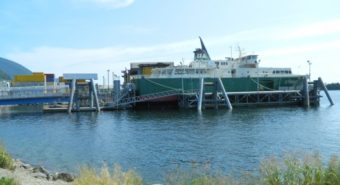
Fast ferry Fairweather docked in Auke Bay. (Photo by Ed Schoenfeld/CoastAlaska News)

Alaska Marine Highway workers have authorized a strike, if the union and state can’t agree on a new contract.

The Inlandboatman’s Union of the Pacific could call for workers to strike within the next month.

More than 600 ferry workers statewide are represented by the union. Their current contract expires on June 30, but the state and IBU have been at impasse over several issues, primarily cost of living adjustments. The state wants to reduce the COLA for new workers to close the gap between revenue and ferry operation costs. The union has said it would concede to no pay raises for two years, but wants to preserve the current cost of living adjustments for future workers.

With no agreement on the horizon, the union called for a strike authorization vote as a sign of solidarity and bargaining power. Union representatives said in April they hoped to get 80 percent of workers to support it. In a press release Tuesday, the IBU said 99 percent of workers voted to call a strike if bargaining remains stalled.

The state and union plan to meet June 10 for another round of negotiations.

Update: Auke Bay harbor seal pup taken to Alaska SeaLife Center

Auke Bay harbor seal pup
NOAA Fisheries is monitoring this harbor seal pup, which has been hauled out near the Auke Bay boat ramp since Thursday. The agency says Juneau residents should not harass the animal. (Photo by Kate Savage/NOAA Fisheries)

Update | Sunday May 25 8:30 a.m.

A specially trained team of marine mammal experts late Friday captured a harbor seal pup that had been hauled out near the Auke Bay boat ramp since Thursday.

The capture operation took about 20 minutes and the pup is in good condition, according to a NOAA Fisheries release sent Sunday morning. NOAA Spokeswoman Julie Speegle writes that the pup was taken to the Alaska SeaLife Center in Seward, where it will be trained to fend for itself. The plan is to reintroduce it to the Juneau area, she says.

Officials were worried for the pup’s safety with increased traffic expected in the Auke Bay area over Memorial Day weekend. Speegle says it’s common for harbor seal mothers to leave their young hauled out while the mothers forage for food. While there were adult harbor seals nearby, NOAA officials were not able to determine if one of them was the pup’s mother.

Original post | Friday May 23 1:00 p.m.

Marine mammal experts are asking Juneau residents to avoid disturbing a harbor seal pup that’s been hauled out near the Auke Bay boat ramp since Thursday.

With increased boating activity expected over Memorial Day weekend, officials are concerned for the pup’s safety. NOAA Fisheries Spokeswoman Julie Speegle says the animal appears to be in good health, but if it has too much interaction with humans its mother may abandon it.

“This is normal harbor seal behavior,” Speegle says. “Mothers will often leave their pups hauled out in a spot and the pups generally stay where their mama leaves them while the mother goes and forages for food. She just chose a really busy spot to leave her pup.”

Speegle says officials are not sure if the seal pup has been abandoned already. If so, a specially trained team of marine mammal experts may be brought in to capture the animal and take it to the Alaska SeaLife Center in Seward. The center would train the pup to fend for itself before releasing it back into the wild.

“We will see what activity is like in the Auke Bay area this weekend,” Speegle says. “And if the activity seems to be too much or too dangerous for the pup, then we may go ahead and take action, or we may wait and see if the mother comes back.”

Speegle says people should keep their pets on a leash to keep them from approaching the seal as well.

It’s illegal to harass harbor seals under the Marine Mammal Protection Act. If you see harassment, call NOAA Fisheries Law Enforcement at 1-800-853-1964.

Kito: Will there be enough return on Juneau Access to justify investment?

Last summer the road was extended to mile 42 and construction continued to improve existing stretches. (Photo by Heather Bryant/KTOO)
Last summer a ribbon-cutting opened three more miles of Glacier Highway and construction continued to improve existing stretches. (Photo by Heather Bryant/KTOO)

The draft supplemental environmental impact statement for a road out of Juneau is now under review by the Federal Highway Administration. That’s the last step in the process before federal highways names a preferred route and issues a Record of Decision.

State transportation department spokesman Jeremy Woodrow said the final SEIS, as it’s called, is expected sometime in the next six weeks.

“If it gets the blessing and we don’t need to do anymore revisions on it, we’ll stamp ‘draft’ on it and we can release it for public review.”                                     

Once that happens, DOT would hold hearings in Juneau, Haines and Skagway.

Federal highways issued a Record of Decision in 2006 to build a road between Juneau and Katzehin, where motorists would board a state ferry for the rest of the trip north.

Conservation groups immediately filed suit. In 2009, the U.S. District Court ruled the environmental impact statement was invalid, because it didn’t consider improved ferry service in Lynn Canal. That decision was upheld in 2011 by the Ninth U.S. Circuit Court of Appeals, requiring the supplemental study.

Little by little, however, the road north has grown, completed last summer to Cascade Point. This year $35 million is in the state’s budget for another extension. Woodrow said federal funds account for $30 million dollars and $5 million comes from the state.

“The talking point was that that would help us begin constructing the road toward Kensington (mine),” Woodrow said. “And really how this road’s going to be built, no matter what, is it’s going to be constructed in phases. It’s just such a large project.”

Rep. Sam Kito III at Juneau Chamber of Commerce on Thursday. (Photo by Rosemarie Alexander/KTOO)

It’s one of those mega projects the state may not be able to afford, according to  Juneau Rep. Sam Kito III. He told the Juneau Chamber of Commerce Thursday that Juneau Access has a lot of competition for funds statewide.

Kito is a civil engineer and said he likes big projects. But he wondered about the return on the estimated $500 million investment.

“Do we receive 500 million dollars’ worth of commerce or revenue back to the state or the city? I think that’s a tough one to support.”

Kito didn’t curry much favor with the chamber audience. The business organization and most of its members have long been road advocates.

He said he didn’t have strong personal feelings on building or not building the proposed road, which would not replace ferry use for the trip to Haines or Skagway.

“There may be some savings because the ferry is operating as a day boat as opposed to a 24-hour ferry, but there’s still ferry costs. Which means you still have 12-hours’ worth of fuel, you’re not going to be running full all the time, there may be ferries that are running mostly empty, and then you’re going to have an additional 65 miles of road to maintain,” he said.

Kito’s questions and concerns should be answered when federal highways releases the final SEIS and Record of Decision sometime this summer.

Ravn outlines safety improvements as NTSB pushes for investigation

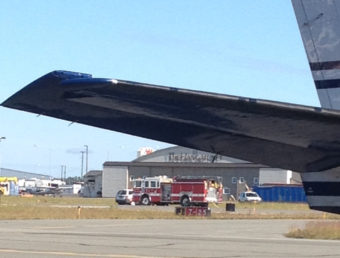
Wreckage of the Cessna 208 that killed two pilots in April. (Photo courtesy of the Alaska State Troopers)

The National Transportation Safety Board took the unusual move last month of asking the Federal Aviation Administration to investigate the Ravn family of companies. A report says Hageland failed to achieve safety outcomes, at the time losing operational control and launching flights without proper oversight. The company’s CEO says the report does not reflect the changes Ravn has made in recent months.

The FAA says it already was looking into the companies before the NTSB issued its request. Still, the board wants a hard look at the airlines, citing 6 accidents over the past two years, including two fatal crashes in the Y-K Delta. Bob Hajdukovich is President and CEO of Ravn. He says the report is a step behind the company’s efforts.

“Everything that is requested for in the letter has already happened or is in the process of happening, so really, what was the purpose of the letter?,” said Hajdukovich.

The NTSB says an inadequate risk assessment program may have played a role in the crash that killed four people in a Cessna 208 outside St. Marys in November. The agency says that flight is among many Hageland allowed to launch without knowing or addressing some risks.

Hajdukovich says since January, that process of deciding whether it’s safe to fly was made in tandem with a central control center in Palmer. Before, flights were release based out of hubs like Bethel or Nome.

“I think when you have a local control there is the potential for making more of an economic risk assessment as opposed to a pure risk assessment. So in other words, that person on the ground in Bethel can be impacted by 300 people in the lobby, 20 thousand pounds of mail, or bad weather. So there’s always a tension that’s there that you don’t want to be there when you’re truly trying to analyze the risk of the flight,” said Hajdukovich.

Wreckage of the St, Marys crash that killed four people. (Photo courtesy Alaska State Troopers)

The NTSB held off on making their recommendation after the operational control center was in place. But after two pilots died on a training flight in April, the agency moved ahead.

Hajdukovich lists millions of dollars in improvements at Era Aviation, now named Corvus Airline, which carries flights with 10 or more passengers. He adds Hageland is seeking 5-star rating in the Medallion Foundation safety program, which exceeds FAA regulations. In any case, Hajdukovich says safety is the top priority.

“That’s not a long term strategy to hurt airplanes or certainly hurt our customers so we’re going to take every opportunity to improve our safety systems. We have humans behind the wheel, and we have customers that can also be a part of our safety system. They should report that they were in bad weather and they didn’t think the pilot should be there. They should report that. They shouldn’t be so hungry to get home that they are part of that pressure pot, that pressure cooker,” said Hajdukovich.

The FAA says it will formally respond within 90 days. They report having increased surveillance since 2011 and had a team on site last week.

Locals question unprecedented mining road to Ambler

Two potential routes for the the prosed Ambler Mining District Industrial Access Road. (Map courtesy AIDEA)

The Alaska Industrial Development and Export Authority, AIDEA, met in Kotzebue yesterday with a game management group to discuss a proposed 220-mile road to a copper deposit in the Northwest Arctic Borough that’s potentially valuable.

If built, the Ambler Mining District Industrial Access Road (AMDIAR) would head west off the Dalton Highway near Evansville, pass through Gates of the Arctic National Preserve, and end in a remote area near three Upper Kobuk Valley communities.

“We’re already approaching 10 billion pounds of copper. That’s a major mine. So we don’t have a mine yet–but we certainly are getting something that has the size and potential to be a major mine,” said Ric van Nieuwenhuyse, head of the privately owned NovaCopper company.

“But, you won’t have a mining district without out road to it. So, that’s where AIDEA steps in,” Nieuwenhuyse told the Resource Development Council. He addressed them last April in Anchorage on the mining district, as well as the economic viability of a large-scale open-pit copper mine in the area.

AIDEA is spearheading the state’s push for the project. The road would be unprecedented in many ways, requiring construction of 15 long bridges over waterways in some of the state’s most remote wilderness. Though the project could take years, AIDEA is moving swiftly—a timetable one official called “daunting.”

In April, the agency began the long process of determining what the environmental impact of the road would be. $8.5 million for that study was set aside by lawmakers last month in the capital budget that passed in the Legislature, and will be part of what AIDEA sends to the feds if they apply for permits to begin work.

Karsten Rodvik is AIDEA’s director of external affairs. He says construction is still years away, and the process relies on input from those living where the road would pass by.

“We continue to work on the permit application process and are continually focused on a very active community involvement program,” Rodvik said. “We’re getting dates set in June for the Upper Kobuk communities and then throughout the summer we’re looking at establishing meeting dates for communities on the Koyukuk River.”

Feedback is important for AIDEA because under state law they’re required to have community support before developing projects.

But what exactly constitutes community support is not fully clear.

“The state does not have a good way to receive public comment,” said John Gaedeke, owner of a wilderness lodge close to the proposed road.

Gaedeke started a petition opposing the road that’s gathered over 1,600 signatures online. He’s also the head of the Brooks Range Council, a group of business owners who charge that AIDEA and the state haven’t been open with the people who stand to be most affected by the project.

“The agencies have not connected [with] me at all, even though the road would pass within about eight miles of my family’s business,” Gaedeke said. “So, huge impact to the area the lodge is in–and the state has made no attempt to contact businesses affected in the area. That I’ve seen.”

But both AIDEA and NovaCopper tout local support for the road. They cite backing from NANA, the borough’s Regional Corporation, for the  forthcoming AIDEA EIS process. NANA owns part of the Red Dog zinc mine 90 miles north of Kotzebue that’s often mentioned as a template for profitable mining projects in the state.

But Gaedeke and others opposed to the road say NANA doesn’t speak for them, and that their voices aren’t being heard. It’s a sentiment echoed by John Horner and the others on the Kobuk Traditional Council.

“We felt that they weren’t giving us much information to begin with,” Horner said in March after Kobuk passed a resolution against the AMDIAR.  “As far as I am concerned, the Native Village of Kobuk is opposing the road.”

In Kobuk, opposition is tied to subsistence, with concerns the road will disrupt the Western Arctic Caribou Herd’s migration. After years of decline, the worry is more activity in the area will further diminish the herd, and upend its migratory patterns in the region.

Representing 42 Interior communities, the Tanana Chiefs Conference in March also formally opposed the project after all six communities along the proposed route drafted their own statements against it. But coming from a regional non-profit in an unorganized borough (as opposed to the Northwest Arctic Borough, which is organized–a distinction with legal bearing under state mandates) it’s unclear how AIDEA will weigh that opposition.

Today’s Unit 23 Working Group meeting will have state and federal, regional, and local representatives to hear AIDEA’s plan for the road ahead.

Site notifications
Update notification options
Subscribe to notifications