Transportation

Single vehicle crash closes Egan Drive

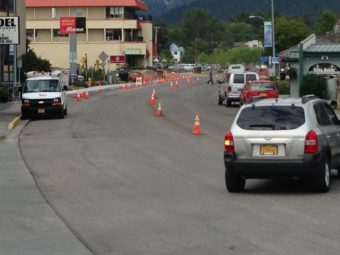
The single car accident yesterday afternoon on Egan drive closed both lanes of traffic on the overpass near Wal-Mart. (Photo by Greg Culley)
The single car accident yesterday afternoon on Egan drive closed both lanes of traffic on the overpass near Walmart. (Photo by Greg Culley)

A medical issue led to a single vehicle crash that closed Egan Drive in both directions Wednesday afternoon.

The crash happened on the inbound lane, near Walmart.

Juneau police in news release say 25-year-old Cory Kim crashed his vehicle into a guard rail. He was taken to Bartlett Regional Hospital. Police say he did not suffer any injuries in the crash. His medical issue was not specified.

JPD closed Egan Drive inbound for about 30 minutes. Outbound traffic was diverted to Glacier Highway.

Former Haines police officer hired as security officer for the Alaska Marine Highway

The ferry Taku sails into the Wrangell Narrows off Petersburg on its way south earlier this month. The draft summer 2014 ferry schedule keeps it sailing from Prince Rupert to northern Southeast. Ed Schoenfeld/CoastAlaska News photo.
The ferry Taku sails into the Wrangell Narrows off Petersburg. (Photo by Ed Schoenfeld/CoastAlaska News)

A former Haines Police officer with a questionable work history was recently hired by the state for a high level security position, but the state is not releasing much information about the hiring process or what it knew about his past.

Jason Joel was hired in May as the security officer for the Alaska Marine Highway System. He is the incident commander for the state ferry system in the case of a major security event. He has supervision over vessel and facility security officers. He works with the Coast Guard, Custom and Immigration and national, state and local law enforcement agencies.

In the last 26 years, Joel worked as a police officer in several departments in Florida and Alaska. He held many of those jobs less than a year. In at least three cases he agreed to resign in exchange for the departments keeping any details of his work and conduct confidential from the public and future employers.

Joel started at the Haines Police Department in 2006 and was promoted to sergeant after three years. A few months later he was demoted. Police Chief at the time, Gary Lowe, wouldn’t give a reason for the demotion.

Joel’s personnel file with the Haines Borough is confidential. The borough will only confirm it struck a deal with Joel in exchange for his resignation.

Several Haines residents confirmed to KHNS News they witnessed or experienced instances of Joel verbally harassing women, although none wanted their name used in this report. A former police dispatcher documented several instances of harassment from Joel while on the job. She said she reported the incident to the chief.

Several months after Joel left Haines, the Alaska Police Standards Council confirmed it was investigating him. In 2012 the council said it was moving ahead with a process to revoke his police certification. At that point, Joel voluntarily surrendered his certification, meaning he cannot work as a police officer anywhere in the state.

It’s not clear if the state asked about Joel’s certification during a background check.

“For the most part we really can’t get into the hiring process – that stuff is kept confidential,” Jeremy Woodrow, a spokesperson for the Department of Transportation, said. “Really what we can comment on is that he met qualifications for the position and that he’s accepted it and started working for the marine highway system.”

Woodrow says police certification isn’t a qualification for the job.

“He doesn’t need an APSC certification to perform the duties of a security officer for the marine highway system,” he said.

Woodrow also says the state can’t reveal how many applicants it had for the security officer job.

Aside from his work history, public records also show Joel filed for bankruptcy twice in 15 years. The first bankruptcy was in Florida in 1999 and few details are available. But his 2012 bankruptcy cases details nearly $80,000 in debt, not including a mortgage. Joel owes one Haines business, Lutak Lumber, more than $8,000. Owner Chip Lende says he doesn’t extend that line of credit to just anyone, but Joel held a prominent position in the community.

“When an individual when I think has been bestowed public trust because of the position they’ve been hired for we don’t expect them to abuse that when they come into the store looking for credit because we thinking they’re an honorable, trustworthy person because they’ve been hired under that pretense,” Lende said. “So when that trust is abused I think it’s a double slap in the face not just to the vendor but to the community because we’ve extended that credit based on that perceived relationship with the community for that person.”

Because the state’s hiring process is confidential, the public has no way of knowing exactly what the state knew about Joel before he became a state employee.

Joel did not respond to requests for comment.

TSA Pre-Check looking for Southeast applicants

TSA Officer Noah Teshner at Juneau International Airport.  (Photo by Rosemarie Alexander/KTOO)
TSA Officer Noah Teshner at Juneau International Airport. (Photo by Rosemarie Alexander/KTOO)

More than 3,200 Alaskans are getting through airport security faster these days as members of  TSA Pre-Check. 

In Juneau, about 230 frequent flyers have been cleared for the expedited security program. The Transportation Security Administration has opened a capital city office, hoping to increase that number. It’s one of ten enrollment centers across the state.

Pre-Check allows airline passengers to leave on their shoes, light jacket and belt. Depending on the airport, laptop computers, liquids and gels can stay in a carry on.

At Juneau International Airport, liquids and laptops must still come out of a bag, but across the U.S., 118 larger airports have dedicated Pre-Check lanes, including Anchorage and Fairbanks.

While some travelers luck out and get the clearance on a flight now and then, TSA spokesperson Lorie Dankers says only a successful security check assures it.

“You’re volunteering some brief biographical information about yourself, verifying your identity, verifying that you’re a U.S. citizen or a lawful permanent resident, and giving fingerprints so we can do a background check to make sure you don’t have any crimes that would disqualify you from being a low-risk traveler,” she says.

The application processing fee is $85. Those who qualify will get a Known Traveler Number to be used when booking flight reservations. The number is valid for five years. Individual reservations must include the KTN.

Some Pre-Check members say they find their KTN doesn’t guarantee expedited security. TSA travel tips indicate they may have to contact their air carrier for a solution. Eleven airlines participate in the program.

TSA has opened six Pre-Check enrollment centers in Southeast Alaska, including Juneau. The offices are not at airports, instead, Dankers says, it made sense to locate where maritime workers apply for their TSA Transportation Worker Identification Credential, or TWIC card.

“These weren’t new locations that were put in place. They are run by a TSA contractor, who handled our credentialing work. So when people go to apply for a TWIC, or renew their TWIC, they can apply for a TSA Pre-Check,” Dankers says.

The Juneau enrollment center is at 3161 Channel Drive. The other Southeast offices are in Craig, Ketchikan, Sitka, Skagway and Wrangell.


Editorial note: Information added to clarify some difficulty using KTN, and to add link to Pre-Check travel tips.

Capital transit plan still in flux due to leaner budget

Once the new transit plan is implemented, the Express bus may no longer stop at the Federal Building. (Photo by Lisa Phu/KTOO)

It’s unclear what changes Juneau bus riders can expect when the city unrolls the new transit plan in a few months.

After the city worked with Nelson/Nygaard Consulting Associates on the plan for a year, the Juneau assembly adopted it, but reduced Capital Transit’s budget.

This means parts of the plan are still in limbo.

It’s just before 8:30 in the morning. Greg Williams is one of about six people waiting for the Express bus at the Juneau Federal Building.

Williams uses Capital Transit every day to get to work at and says he loves it.

“I really do. I came from Homer and there’s absolutely no transit system in Homer and it’s a real pain. And it’s way better, more convenient that having a car. There’s no maintenance, there’s no insurance, there’s no gas. It really works for me,” Williams says.

He says it takes ten minutes to get to Nugget Mall and another minute to cross the street to Valley Lumber where he works. His day ends at 6 p.m. and the bus comes at 6:18.

Williams says he can afford a car, but, “I just like this. It’s really convenient for me.”

When the city starts to implement the new Transit Development Plan, Williams may have to catch the Express Bus from the Downtown Transportation Center instead of the Federal Building.

“It’s just going to take us a while to work out all the details,” says public works director Kirk Duncan. He adds it’s unclear if the Express will stop at the Federal Building once the plan is implemented.

Transit superintendent John Kern retired at the end of May. Duncan is acting superintendent.

“It’s a fluid plan. We’re still trying to make adaptions to the plan working with the consultants, working with the staff to make sure everything will come together,” Duncan says.

What Duncan does know for sure is midday service to North Douglas will end July 1. Riders also will see reductions to the express route and service to Back Loop Road. He says the reductions will make new service on Riverside Drive possible.

“Starting North Riverside going all the way down Riverside. It will provide service to the library, the swimming pool and the high school, so we’re really excited about that,” Duncan says.

The transit plan also calls for bus service to start earlier and end later. When or if this happens is still a question. Duncan says it will depend on how much it impacts the schedules of 38 drivers.

“The current system is very, very effective – drivers working four 10-hour shifts a week,” he says. “Now, adding another hour in the beginning, an hour at the end. What does that mean? Do we start paying more overtime, do we need more drivers?”

Former transit superintendent Kern says the new transit plan is meant to increase reliability by providing drivers more time to get from one stop to another. He says many riders are missing transfers.

“When traffic, construction, passenger loads get really heavy, there’s difficulty in making those connections. When the buses run late, we don’t ask drivers to wait for the other bus more than five minutes and that becomes a missed connection,” Kern says.

The plan being implemented in the fall won’t include routes to Costco or the ferry terminal, two destinations riders have prioritized for years. They’re part of the plan, but as longer-term recommendations. Kern says this in itself is an accomplishment.

“Just getting things into the plan is the first step. The Downtown Transportation Center was in the 1996 transportation plan for the first time. We opened the doors in 2011. So, sometimes good things take a long time,” he says.

It’s a big responsibility to change something many people rely on daily, Kern says:

“We are so much a part of people’s lives that’s so important to them – their ride to work, their ride home, their ride to the store, to school. There are going to some changes that people will have to adjust to.”

Kern says until the buses are actually operating under the new transit plan, it’s impossible to know how well it’ll work.

Full disclosure: Kirk Duncan is a member of the KTOO Board of Directors.

Bike to work month reaches its conclusion

Elementary school students meet at the Douglas Island Breeze In before biking to Gastineau School for Bike to School Day on May 7, 2014. (Photo by Annie Bartholomew/KTOO)

Juneau has had perfect weather for May’s National Bike Month. This year’s events included Bike to Work Day, Bike to School Day, and a Bicycle Commute Challenge.

Though Bike to School Day and Bike to Work Day have been organized for multiple years, it was the first time Juneau participated in a commute challenge. Cyclists formed teams in a friendly competition with the winning team having the most trips to and from work at the end of May. 26 teams signed up, with almost 200 people participating. The teams are from all over Juneau including employees from Alaskan Brewing Co., the USDA Forest Service and KTOO.

The challenge and temperate weather contributed to the event’s success according to Ben Lyman, a senior planner for the City and Borough of Juneau (CBJ) and a Bike to Work Day volunteer.

“When it did rain that one day, I think we had a lot more riders that day simply because of the challenge,” he says.

During Bike to Work Day on May 16, 98 cyclists were counted passing through Egan Drive and W. 10th St., a threefold increase from last year.

The challenge was coordinated by Juneau Rides, the advocacy branch of the Freewheelers Bike Club.

Sarah Bronstein, a planner with CBJ and a Juneau Rides volunteer, spearheaded the initiative. She had previously worked with the Cascade Bicycle Club which originally designed the event. Cascade currently hosts the roster of Juneau teams on their website.

Bronstein hopes that people discover that cycling is a convenient, safe method of transportation, even in Alaska.

“I want people to know that cycling in Juneau can be easy and fun, and that if you’re already a rider, that you’re not alone…” she says.

Children also got in on the fun, participating in Bike to School Day on May 7. Gastineau Elementary School students met at the Breeze Inn on Douglas and rode to school as a group. About 75 bicycles were counted outside the school that day.

“My goal as a P.E. teacher is to find something that kids love and introduce them to it, so that they’ll do it on their own,” says Dirk Miller, the P.E. teacher for Gastineau Elementary School and organizer of the event.

Juneau Rides next project is creating a printed map of bike routes in Juneau.

Delta follows through with $10,000 promise

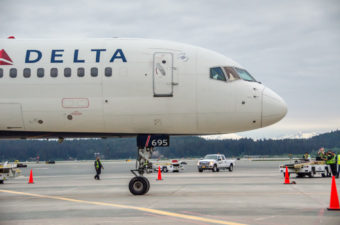
Delta Airlines gave the Juneau Community Foundation $10,000 for the Augustus Brown Swimming Pool last night. The check presentation coincided with the arrival of Delta’s first flight from Seattle to Juneau.

Delta’s Seattle Vice President Mike Medeiros pledged the amount during a CBJ assembly meeting in April, causing the packed city hall chambers to erupt in cheers. At the time, city manager Kim Kiefer had proposed temporarily closing the downtown pool to save the city money during a tight budget year.

Medeiros says the donation announcement was not planned. His purpose for being at the meeting that night was to introduce himself to the assembly. He had no idea city hall would be packed with pool supporters.

“As I got up and addressed the crowd I thought, ‘You know, this is important for us to demonstrate as a company that we want to be more than an airline that serves Juneau, we want to be a community partner.’ And I thought on the spot that this is a great way to step up and show that we can help contribute to something good in the community of Juneau,” Medeiros says.

The assembly passed the budget earlier this month and decided against closing the downtown pool. Medeiros says he’s communicating with Juneau’s Parks and Recreation Department to make sure the money is spent appropriately.

“The intent was that it would go to something related to the pool and I think that as I talk with that department that’s where our hope is that it will go, but we will count on the Parks and Recreation area to make the best use out of it,” he said.

Juneau Community Foundation Director Amy Skilbred says the money will go to its Aquatics Fund, and the Juneau Parks & Recreation Aquatics Facilities Advisory Board will make recommendations for its use.

Site notifications
Update notification options
Subscribe to notifications