Transportation

State to overhaul Southeast’s 20-year transportation plan

A small tent pitched on the deck of a ferry, with coastal mountains in the background.
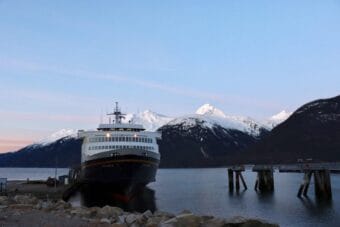
The Alaska Marine Highway System’s mainliner, the Columbia, during its weekly sailing from Washington state to Skagway in early 2025. (Avery Ellfeldt/KHNS)

The state is in the early stages of crafting a new plan to guide decisions about Southeast Alaska transit for the next two decades.

The Alaska Department of Transportation and Public Facilities aims to draft a plan for Southeast by the end of summer 2026 and finalize it by this time next year. The document will cover all communities from Yakutat to Metlakatla.

Jill Melcher, DOT’s Southcoast planning chief, said the new version would mark the first complete overhaul in more than 20 years.

“The last adopted plan was in 2004 and an unofficial update was done in 2014 that captured changes over 10 years,” she said. “Our region has changed significantly since 2014, and it’s time for an update.”

Agency staff say that in the early stages, a handful of themes have already emerged. They range from ferry reliability to resiliency amid climate change.

Now the state is asking for public input, both via email and during town halls.

During two virtual open houses this week, residents raised a long list of specific projects and broader issues – many revolving around more reliable ferry service and the Cascade Point ferry terminal project.

Mike Jackson, in Kake, raised sporadic ferry service in his community. He said the state has said Kake rarely gets ferries, in part because the terminal can’t accommodate larger ships. He said there’s been talk about updating the terminal with new catwalks to change that.

“So that is one of the things we talked about doing here,” Jackson said. “But if there’s a way to better serve Kake somehow, we sure would appreciate it.”

Participants also talked about the need for float plane dock maintenance and more airport parking. One raised the need for restoring ferry service from Ketchikan to Prince Rupert, British Columbia – an idea the state is studying now.

Haines local Patty Brown asked about the state’s ongoing study of what it would cost to build a road on the west side of the Lynn Canal that would, at least in theory, better connect Haines and Skagway to Juneau. She wanted to know how that might be incorporated into the 20-year plan.

Southcoast Region Director Christopher Goins replied that the study would wrap up in January.

“Based on that, we’ll look at the data, work with this team and depending on what we see from leadership, include or not include that moving forward,” Goins said.

But it was a related project that kept coming up during the town hall: the Cascade Point ferry terminal. The state says building a new terminal north of Juneau would cut costs and ease travel between Haines, Skagway and the capital city.

The idea has drawn fire from residents in all three communities, who say the state should prioritize improving ferry service instead.

When Wendy Anderson of Skagway made that point in the town hall’s virtual chat, Goins responded that the agency does believe the terminal would reduce travel times. But he stressed that Cascade Point would not replace the Auke Bay terminal for most passengers.

“There will be mainline service that continues up once a week,” Goins said. “What is moving would be the trips to Haines and Skagway from Cascade Point.”

At least two other comments came in regarding Cascade Point. One dubbed the planned terminal a “shameful waste of taxpayer dollars” that would be “harmful” to the general public.

The other asked about the funding that has already been allocated to the project – and whether more will be set aside soon. Goins responded that the state currently has a design-build contract and is carrying out the required public comment and environmental processes.

“If we ultimately can’t make it through that process for various reasons, then the project would not go forward, and the second part of that contract would not be fulfilled. Plain and simple,” Goins said.

Agency staff and contractors thanked participants for their insight and encouraged the public to keep them coming. Comments can be submitted at SEATP@DOWL.com.

Alaska Air Cargo delays could mean later Christmas packages for many rural communities

An Alaska Air Cargo freighter arrives in Nome, Dec. 18, 2025. It was the daily-scheduled flight's first arrival in Nome in a week after maintenance issues plagued the Alaska Air Cargo fleet.

An Alaska Air Cargo freighter arrives in Nome on Dec. 18, 2025. (Ben Townsend/KNOM)

Christmas presents may be arriving later than expected for many rural communities in Alaska. That’s after Alaska Air Cargo, Alaska Airlines’ cargo-specific carrier, placed an embargo on freight shipments for several hubs across the state.

According to Alaska Airlines, the embargo began on Dec. 16 and will end on Dec. 21.

The embargo excludes Alaska Air Cargo’s GoldStreak shipping service, designed for smaller packages and parcels, as well as live animals.

Alaska Airlines spokesperson Tim Thompson cited “unexpected freighter maintenance and severe weather impacting operations” as causes for the embargo.

“This embargo enables us to prioritize moving existing freight already at Alaska Air Cargo facilities to these communities,” Thompson said in an email to KNOM. “Restrictions will be lifted once the current backlog has been cleared.”

With the Christmas holiday just a week away, carriers like Northern Air Cargo have rushed to fill the gap. Gideon Garcia, the Anchorage-based company’s vice president of cargo operations, said he’s noticed an uptick in package volume.

“It’s our peak season, and we’re all very busy in the air cargo industry,” Garcia said. “We are serving our customers with daily flights to our scheduled locations across the state and trying to ensure the best possible holiday season for all of our customers.”

Garcia said the holiday season is a tough time for all cargo carriers, but especially those flying in Alaska.

“We operate in places that many air carriers in other parts of the country just sort of shake their head at in disbelief. But to us, it’s our everyday activity,” Garcia said. “The challenges we face with windstorms, with cold weather, make it operationally challenging.”

Mike Jones is an economist at the University of Alaska Anchorage. He said a recent raft of poor weather across the state only compounded problems for Alaska Air Cargo.

“I think we’ve seen significantly worse weather at this time of year that is at one of the most poorly timed points in the season,” Jones said.

Jones said Alaska Air Cargo is likely prioritizing goods shipped through the U.S. Postal Service’s Alaska-specific bypass mail program during the embargo period. That includes palletized goods destined for grocery store shelves but not holiday gifts purchased online at vendors like Amazon.

According to the U.S. Bureau of Transportation Statistics, Alaska Airlines was responsible for 38% of freight shipped to Nome in December 2024.

Alaska Air Cargo’s daily scheduled flight between Anchorage and Nome has only flown four times in the month of December, according to flight data from FlightRadar24.

An Alaska Air Cargo 737-800 freighter landed in Nome Thursday at 11:53 a.m., its first arrival in a week. Friday’s scheduled flight has been cancelled.

Alaska studies building a ferry terminal at Hyder to connect to the road system

Hyder is marked in red, located about 70 miles up the Portland Canal.

The state of Alaska is considering opening up a new ferry terminal in Southeast Alaska, connecting Alaska’s ferries to the Lower 48 road system without going through Canada.

The idea comes as Alaska continues to struggle with the closure of the ferry terminal at Prince Rupert, British Columbia. Now, the state is conducting a $250,000 study to see if a terminal on Alaska’s side of the border would be a good replacement.

For decades, the Alaska Marine Highway System relied on a terminal at Prince Rupert as its southern road connection. The state has leased the terminal from Canada since 2013, but it’s been closed for most of the past six years. There are numerous complications, like infrastructure challenges and disagreements with Canada over border control responsibilities. The dock needs over $20 million in repairs, and Alaska’s aging fleet isn’t certified for international travel anymore.

Jim Clark spoke about it at a regional development meeting in Ketchikan last year. He’s the former chief of staff for Governor Frank Murkowski, who worked on the ferry system for decades.

“If we can put a man on the moon, we ought to be able to solve the problem between here and 90 miles away at Prince Rupert,” Clark said.

Prince Rupert’s closed terminal has been a hot topic in many southern Southeast meetings. Some, like Robert Venables of the Southeast Conference, say they’re not ready to give up on Prince Rupert.

“It’s going to take everyone to lean into this thing,” Venables said. “It is problematic at the highest levels of bureaucracies to try to get back to Prince Rupert. But we’re going to give it our best, best push, and we’re going to keep pushing until it happens.”

The Prince Rupert connection isn’t completely off the table. But Alaska would need a federal waiver to bypass a requirement that steel materials for repairs be American-made. The state has requested this waiver in recent years without success. Canadian officials have opposed the requirement because the terminal is on Canadian soil.

And so, the state’s Department of Transportation has considered Hyder, Alaska — about 90 miles from Ketchikan — as an alternative.

“Fortunately, we have a lot of data for this site,” said Kirk Miller, an engineer with the state’s Department of Transportation, last year. “We’ve done engineering up and down this whole Causeway, the island, I’ve been working on their harbor and all these projects there for years. So, we have data, but not quite enough.”

This October, a new feasibility study began and is expected to be completed in mid-2026. The study is looking at all the details, like where a dock would go, the water depths, dredging, and environmental concerns.

It’s estimated the new terminal would cost about $30 million. It’s located about the same distance to Seattle as Prince Rupert – about 1,000 road miles. Prince Rupert is much larger than Hyder and has more amenities, but Hyder would be under Alaska’s control.

“I just want to really voice my support for Hyder,” said Bob Horchover, speaking in July as a member of the Alaska Marine Highway Operations Board, which makes recommendations to the state.

“In Hyder, we own the land, and most of the work is already done,” he said. “It’s a very adaptable situation. So, for me, there isn’t even a discussion.”

The state approved a 20-year ferry plan this year, based, in part, on a survey of over 2,500 Alaskans. Many respondents said restoring a road connection in Southeast was a priority.

Local governments agree. The Ketchikan Gateway Borough passed a resolution supporting a Hyder terminal if Prince Rupert doesn’t work out. Nearby Metlakatla feels the same. Mayor Albert Smith said that the lack of a Prince Rupert connection has hurt his town’s economy.

“With fishing, the rail system is real close to Rupert, so we could use the ferry to transport fish, and then it’s connected right to the 48s,” Smith said. “It’s a more efficient way than other ways of shipping.”

At least one Alaska lawmaker is on board: Republican Representative Jeremy Bynum of Ketchikan.

“I’m going to be a fierce fighter here on the legislative side and make sure we can get the funding in place that we need,” he said.

Whether Alaska rebuilds the Prince Rupert connection or builds a new terminal at Hyder, officials say either option would take five to eight years to complete the necessary infrastructure work.

Lightning strikes milk run flying from Juneau to Sitka Monday morning

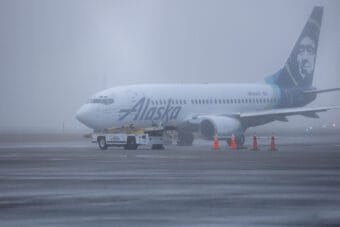
An Alaska Airlines plane prepares for take off at the Juneau International Airport on Wednesday, Dec. 11, 2024. (Photo by Clarise Larson/KTOO)

An Alaska Airlines flight headed from Juneau to Sitka on Monday morning was struck by lightning just before landing. 

Passenger Kathy Fitzgerald was on board the 27-minute flight. She said the plane was briefly engulfed in a bright orange and gold flash.

“It was like a giant flashbulb going off throughout the whole plane, coming from outside,” she said. “There was this huge, bright light — there was no loud sound, there was no shimmying or shuddering of the plane.” 

In her time flying through Alaska weather, she said she had never experienced anything like it. 

Fitzgerald was originally traveling from Anchorage, where flight 62 originated, back home to Ketchikan with her family. The leg between Juneau and Sitka was part of the milk run, and was supposed to continue to Ketchikan and Seattle.

According to a spokesperson for the airline, lightning strikes are not unusual.

“Our aircraft are designed to dissipate the electrical energy of the lightning bolt without damaging the aircraft systems,” the spokesperson said. 

The plane landed safely in Sitka, and the spokesperson said maintenance technicians were inspecting the aircraft as a precaution. 

The airline eventually cancelled the flight.

Angoon students return home after being stuck in Juneau

A white, blue and yellow ship with an orange raft hanging off its side. A small sign with the name "LeConte" is on the side of the ship.
The Alaska ferry MV LeConte docked at the Auke Bay Ferry Terminal on Sept. 2, 2025. The LeConte has been docked since Aug. 31 due to mechanical issues. (Photo by Jamie Diep/KTOO)

A group of 14 student athletes from Angoon finally returned home from Juneau Friday morning after a cancelled ferry left them stuck in the capital city for four extra days.

The students came to Juneau on Dec. 3 for a basketball tournament. Angoon School principal Emma Demmert was on the trip with the team and said their trip home on state ferry M/V LeConte was cancelled following record-breaking snowfall across Southeast Alaska.

While in Juneau, she said it was challenging to keep the cost of staying extra days from rising too much, but since Angoon and Juneau are so connected, local residents stepped up to keep students fed.

“I’m very thankful to be a part of the community that I’m in, because without them, you know, our kids wouldn’t have food,” she said. “And you know, they’ve really been reaching out and helping us in any way possible.”

Demmert said a Goldbelt Incorporated employee who went to school in Angoon as a child opened the corporation’s classroom up for students to use during the week.

Despite the change in plans, Demmert said the students behaved well, thanks to a schedule that included time for schoolwork, meals and swimming at Dimond Park Aquatic Center. 

“They’ve been going swimming at the swimming pool because it’s cheap entertainment, and it keeps them busy and it gets them tired,” she said.

Demmert said when the ferry was canceled, the group moved from their tournament lodging into the Aspen Suites hotel until they could leave on the next available ferry four days later.

Being stranded in other communities can be financially challenging; the cost of food and additional lodging eats into the school’s activities budget. But Demmert said traveling to other communities is worth the risks of getting stranded because the students work hard to maintain their eligibility and compete.

“They come to practice every day. They keep their grades up. Because of eligibility, they have to have a certain grade point average in order to even be able to travel,” Demmert said. “So given that, it’s like an award for all the hard work they’ve been doing.”

Despite incurring extra costs from this week in Juneau, Demmert said they hope to work out travel for competitions taking place over the rest of the school year.

State signs $1.3 million contract with Juneau Hydropower to electrify proposed Cascade Point Ferry Terminal

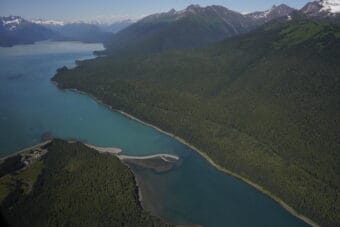
An aerial view of Berners Bay, where the state is proposing to build the Cascade Point Ferry Terminal. (Photo by Alix Soliman/KTOO)
An aerial view of Berners Bay, where the state proposes to build the Cascade Point Ferry Terminal. (Photo by Alix Soliman/KTOO)

The state approved a contract on Monday agreeing to pay Juneau’s new hydroelectric utility $1.3 million to power the controversial Cascade Point Ferry Terminal — a project that has yet to be finalized.

That money will pay for a transformer and engineering for a submarine cable required to connect the Alaska Department of Transportation’s proposed ferry terminal to the Sweetheart Lake hydroelectric project that Juneau Hydropower plans to bring online in 2028. 

According to the contract, the state will pay Juneau Hydropower whether or not the ferry terminal project proceeds.

“If they live up to their part of the bargain, we would be responsible to pay for that,” said Christopher Goins, southcoast regional director at the department.

Goins said one major reason the state signed this contract now is because the cost would rise if the department decides to electrify later on, after Juneau Hydropower designs its system without this addition. 

Duff Mitchell, the managing director of Juneau Hydropower, said the other main reason is that the equipment takes a long time to get here. 

“We’re looking at between 52 weeks to over three years, depending on the manufacturer,” he said. 

Mitchell said the transformer wouldn’t be used for anything else if the ferry terminal project doesn’t get built. 

“If, in fact, it goes forward, then we would use it,” he said. “Otherwise, it will be sitting there waiting for the future.”

The department plans to break ground on the first phase of the ferry terminal project in the summer, which will establish an access road and staging area, but not the terminal itself. The state extended the public comment period on the proposed Cascade Point Ferry Terminal to Jan. 9. 

Correction: This story has been updated to clarify that the funds will pay for engineering of the submarine cable, not the cable itself.

Site notifications
Update notification options
Subscribe to notifications