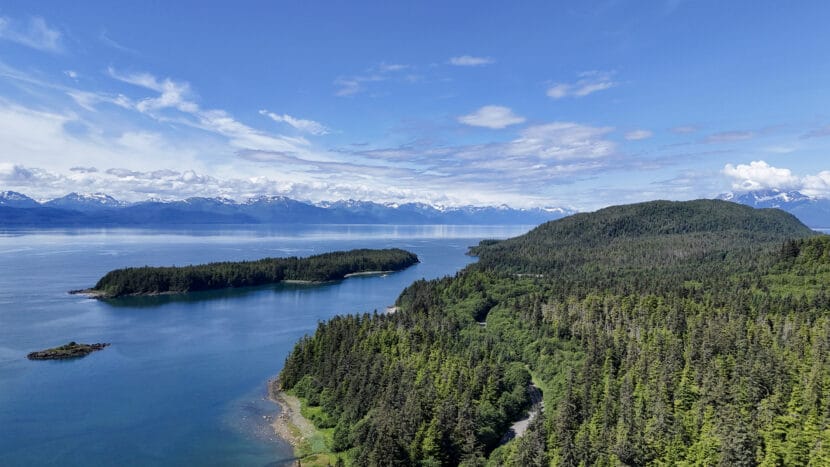
Glacier Highway leading toward Cascade Point on Saturday, July 26, 2025. (Photo by Clarise Larson/KTOO)
UPDATE, Dec. 1:
The comment period has been extended to Friday, Jan. 9, 2026.
Original story:
The comment period for the first phase of construction of a new ferry terminal north of Juneau ends this Friday.
The state’s proposed Cascade Point Ferry Terminal is slated to be located just beyond where the road ends in Juneau on land owned by Goldbelt Incorporated, a local Alaska Native corporation.
The Alaska Department of Transportation and Public Facilities began soliciting public comment for the first phase of construction in late October.
Shannon McCarthy, DOT’s communications director, said the current public comment period is only for the first stage of the project and is not the end of public input for the overall project. She said a no-build option is still on the table, even though DOT has already signed a $28 million contract for the first phase of construction.
“We have been talking about this project for a long time, and it really does fit in with kind of the philosophy of shorter ferry trips, longer roads, so that we can really have that operational efficiency,” McCarthy said.
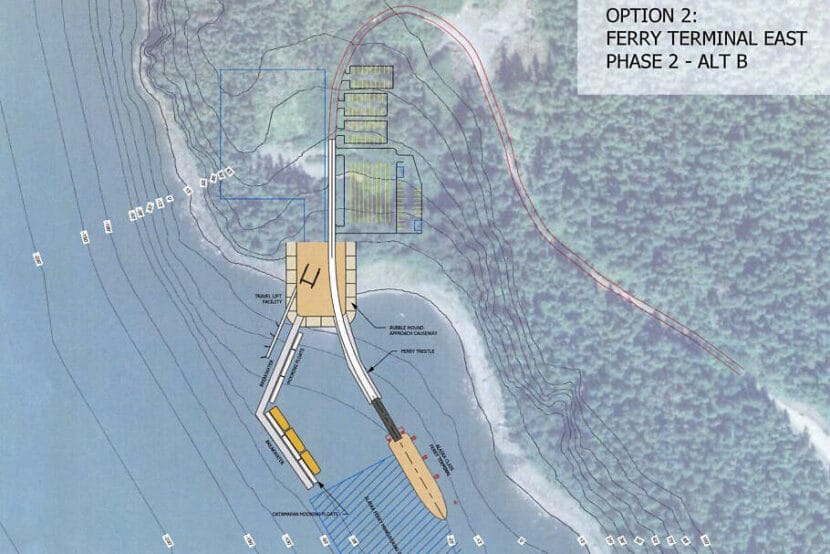
This is a concept design drawing of a new ferry terminal facility in Juneau at Cascade Point. (Alaska Department of Transportation and Public Facilities)
The first stage would develop the access road to the site and a staging area for future construction. According to DOT, construction could begin as soon as next summer.
The Cascade Point terminal would be Juneau’s second ferry terminal, located about 30 miles north of Juneau’s already existing terminal in Auke Bay.
Under the Dunleavy Administration, the state has been pushing for the project for several years, saying it would benefit travelers by reducing operating costs and travel time between Juneau, Haines and Skagway. A Canadian mining company also wants to develop an off-site ore terminal at the site in partnership with Goldbelt.
DOT recently released an economic analysis of the terminal that portrayed it as having more pros than cons, despite criticism from regional officials, conservation groups and members of the Alaska Marine Highway Oversight Board. City officials in Haines and Skagway have also openly opposed the project. The Juneau Assembly hasn’t taken a stance on the project.
“This is really a part of a larger strategy to really reinvest in the marine highway infrastructure,” McCarthy said.
Written and emailed comments must be submitted by this Friday. McCarthy said the public comment period for the second stage of the project is slated to open in the coming months.
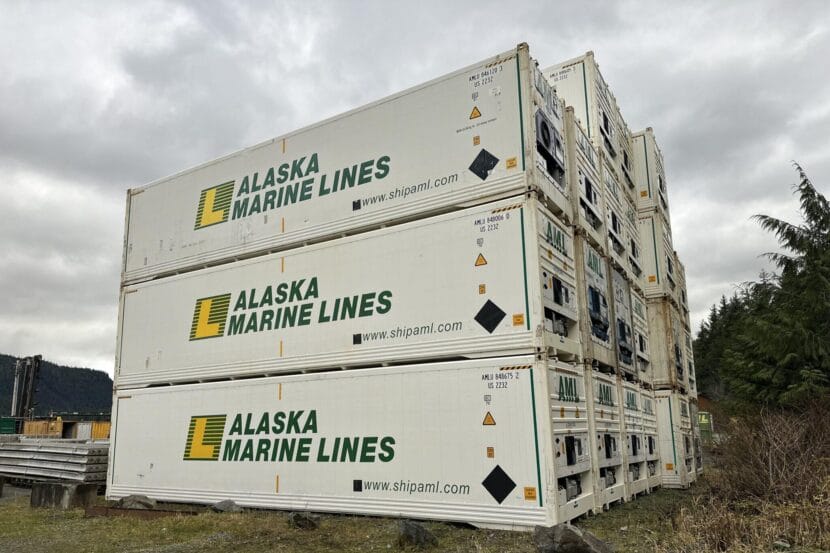
Alaska Marine Lines freight sits at a facility in Thorne Bay. (Hunter Morrison/KRBD)
An Alaska Marine Lines barge that was taking on water off the coast of British Columbia has continued its journey south to Seattle.
The barge was spotted floating lower than normal last week near Bella Bella, about 260 miles south of Ketchikan, on its way from Alaska.
According to an email from Alaska Marine Lines Director of Marketing Ryan Dixon, the barge was damaged during transit but was “secure” and “not sinking.”
Dixon said the barge was not carrying groceries or supplies for Southeast Alaska that could cause supply chain disruptions for the region. The barge also did not contain bulk cargo or petroleum products, according to the email.
On Tuesday, the company announced that a second barge was sent to offload some of its cargo. As of Sunday, both were en route to Seattle.
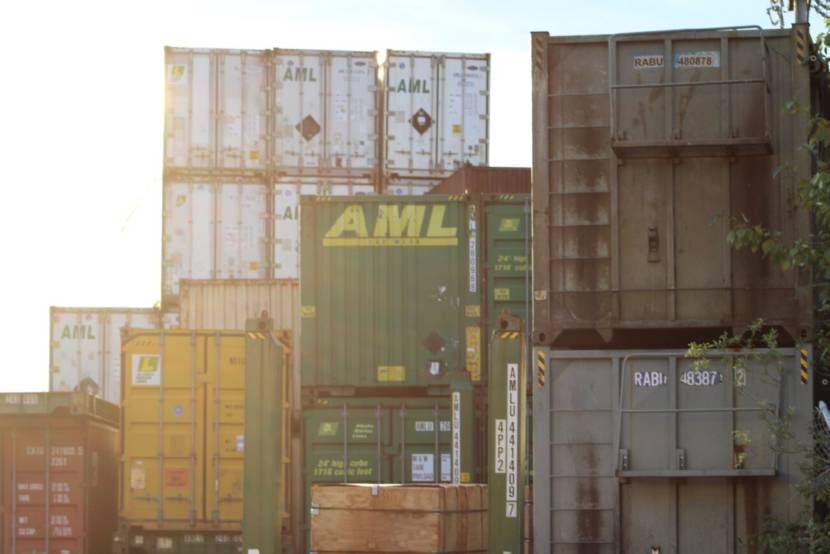
Shipping containers in Wrangell. (Photo by Sage Smiley / KSTK)
When people talk about Alaska’s reliance on imported food, they nearly always cite the same number: 95%.
The figure has been around for decades – appearing again and again in executive orders, media reports, state-commissioned analyses and speeches. But food systems experts can’t trace the number back to a verifiable, data backed source – or crunch it themselves.
“I think it is a very useful thing to just note that it is made up,” said Rachel Lord, policy director at the Alaska Food Policy Council, a Homer based nonprofit.
That’s not to say the figure is totally off base. It’s well established by now that the vast majority of food Alaskans purchase is imported from elsewhere. And Lord is among those who have said 95% is a reasonable ballpark estimate.
But uncertainty around the figure underscores the complex nature of tracking whether Alaska is becoming less dependent on imports over time – even as the Dunleavy administration seeks to push the state in that direction.
“How do we know if we’re succeeding, if we don’t actually have any metrics?” said Lord, who also spoke to the challenge in a recent High Country News article.
Glaring red flags
So where did the 95% figure come from? A web of reports and academic papers point in a few different directions.
A 2023 report prepared for Dunleavy, for instance, says the figure hasn’t been “substantiated, nor updated” since a journal mention in 1987. Another paper, published in 2010, says it dates back to the 1970s – and also nods to uncertainty around its precision.
“In 1977 it was estimated that 95 percent of food in Alaska is imported, despite our seemingly large number of avid gardeners, hunters, and fishers,” the paper says. “This figure has been used by many sources since then but research to verify it only began recently.”
A third report, published in 2014, attributes the statistic to speeches made by two different people, one in 1977 – and the other in 1998.
Original source aside, the figure has a few glaring red flags, said Mike Jones, a food systems economist at the University of Alaska Anchorage.
“Our biggest warning with something like this 95% statistic is that there are no units attached,” he said. “Is it 95% of the dollars we spend on food? Is it 95% of the weight of the food we have? Is it 95% of the calories of the food that we have?”
On top of that, it’s almost never framed consistently. In many instances, people will say 95% of Alaska’s total food supply is imported. But that doesn’t account for the significant role that hunting, fishing, farming and foraging play in local food systems.
“It’s [95% of] purchased food,” Lord said. “In rural Alaska, and a lot of communities, a huge amount of food eaten is subsistence, wild foods.”
Still, the figure abounds. As recently as March of this year, the Dunleavy administration included it in a video caption on Facebook, in which the governor announced his plan to create a Department of Agriculture.
As Jones sees it, the figure seems to have been repeated so often, for so long, it’s become conventional wisdom. But he’s not convinced it should stay that way.
“I think we search for numbers in describing the scope of a problem. And it’s appropriate to look for numbers,” he said. “I think if we’re using a number, then it’s important that it definitely comes from a verifiable source.”
So why isn’t there a verifiable source? The short answer is that it’s a complex math problem that’s made more difficult by major data gaps around both imports, and locally sourced food.
The point of doing that math would be to pinpoint a figure that would help track progress over time. But for the time being, Jones said, it might be better to rely on adjectives, as opposed to percentages.
“I tried very hard to use publicly available, particularly federal statistics, to be able to infer that for the state. And I found it to be a very, very difficult exercise.”
A spokesperson for the governor’s office nodded to Dunleavy’s plan to create an agriculture department as a potential solution.
“An additional benefit of the Department is that it will be able to facilitate collecting more detailed data that will allow for more precise, Alaska-specific food system measurements moving forward,” Deputy Press Secretary Grant Robinson wrote in an email.
Lord, of the Alaska Food Policy Council, said her organization is working on a grant-funded database with the same goal.
Lessons from Vermont
The challenge isn’t isolated to Alaska. David Conner is an economist with the University of Vermont who led the state’s efforts to count local food.
Conner and his team relied on some of the same datasets Jones has worked with. But he also built on that data by reaching out to grocery stores, schools, hospitals, distributors and more to get a sense of how much local food they purchased in the previous year.
From there, the researchers did their best to avoid counting any sale twice, and asked important questions like – is beer food?
“We have a fairly vibrant local brewery scene,” Conner said. “Do we count that?”
There’s also the reality that many agricultural products aren’t ultimately consumed by humans – or consumed locally. Like hay, which is used for livestock. The same is true in Alaska, where hatchery activity and floraculture – namely, peonies – make up for a substantial chunk of the agricultural production.
Back in Vermont, the researchers ultimately estimated that the state had likely surpassed its own goal to ensure local food accounts for 10% of total consumption.
Still, they wrote, “local food consumption estimates such as ours should not be taken at face value to the large data gaps.”
It all underscores that Alaska isn’t alone in importing the vast majority of its purchased food. That’s the case given that different areas are better suited to different crops – and that the U.S. food system hinges on long and winding supply chains. It’s true even in states with booming agriculture sectors.
“In many, many cases, food-producing regions are also the most food insecure, because the food is grown for export markets, not for local consumption,” Conner said.
Jones, with the University of Alaska, said it’s a good thing that Alaskans can access foods grown really far away. It’s necessary from both a nutrition and financial standpoint.
“I’m sure you could grow a mango in a Conex in Alaska. But nobody is trying to buy a $100 mango,” he said.
Still, many states think very hard about boosting local food production – and for good reason, Jones and Conner said. Doing so is good for the planet and yields fresher food.
“Maybe more importantly, when you buy locally grown food, the money tends to circulate more times in the economy and generate more wealth and more income before it leaves,” Conner said. “So it can really be an instrument of economic development.
Passengers arrive at the Ted Stevens Anchorage International Airport on April 20, 2022. (Jeff Chen/Alaska Public Media)
Ted Stevens Anchorage International Airport is among 40 airports across the country forced to slash air traffic by 10% starting Friday as the government shutdown becomes the longest in U.S. history.
U.S. Transportation Secretary Sean Duffy said Wednesday that traffic would be cut from the country’s busiest airports to maintain travel safety. Some air traffic controllers, who haven’t received a full paycheck in over a month, are calling out of work, he said, exacerbating staffing shortages and causing flight delays.
Airport officials confirmed by email Thursday that Anchorage International is included among the 40 airports where flights will be reduced. The Anchorage airport is one of the busiest cargo airports in the world. It’s unclear if passenger or cargo flights will be impacted, or both. Airport officials could not immediately be reached Thursday for comment.
In a statement, the state entity that manages the airport, the Alaska International Airport System, said its working to minimize impacts.
“ANC remains fully operational, and all safety and security functions continue without interruption. We are working closely with our federal partners and airline representatives to minimize any impacts to passengers and cargo operations,” said Teri Lindseth, development manager for the Alaska International Airport System.
Travel expert Scott McMurren, who writes the Alaska Travelgram newsletter, said he hasn’t seen this much uncertainty for airline passengers since the disruptions that followed the 9/11 terrorist attacks.
“When the Secretary of Transportation says he predicts ‘mass chaos,’ well, I have to plan for mass chaos,” he said. “That means a lot of flights may get through unscathed, but just because the flight gets through doesn’t mean the travelers themselves aren’t affected.”
Seattle-Tacoma International Airport, where many flights to and from the state connect through, is also on the list of airports forced to cut flights.
Alaska Airlines said that it canceled a limited number of flights in response to the Federal Aviation Administration directive, but international flights are not expected to be impacted. The airline said guests whose flights are canceled will be rebooked or get a refund.
Delta said it expects to operate the majority of flights as scheduled. The company is providing extra flexibility for impacted travelers to cancel their flights without penalty. In a statement, United said long-haul international and hub-to-hub flights wouldn’t be impacted by the reduction, but that reductions would impact regional and domestic flights.
Passengers with questions about specific flights should contact their airline.
Cars park outside the Kenai Aviation office on Monday, Nov. 3, 2025 in Kenai, Alaska. (Ashlyn O’Hara/KDLL)
Kenai Aviation announced Monday that it was ceasing all flight operations. The company said in a Facebook post it was “financially insolvent” after accruing debt during the pandemic, and would stop flying by the end of the day.
Since 2022, the airline has offered more than a dozen daily flights between Anchorage and the Kenai Peninsula, including to Kenai, Homer and Seward. Before Monday, it was one of three airlines serving the Kenai Municipal Airport, alongside Grant Aviation and Aleutian Airways, after Ravn pulled out of the region.
Joel Caldwell and his brother, Jacob Caldwell, purchased Kenai Aviation in 2018. Neither immediately responded to requests for comment Monday.
On Facebook, Joel Caldwell said he was “devastated,” writing: “We need capital, we need partners, we need a lifeline. That investor is out there, we just need to find them.”
Kenai Aviation serviced eight communities across Alaska with its mixed fleet of Beechcraft Super King Air and Tecnam Traveller P2012 aircraft.
Earlier this year, the federal Department of Transportation picked Kenai Aviation to run its essential air service route to Seward. That contract was expected to run through 2027. Around the same time, it also picked up the federal route between Anchorage and Unalakleet, near Nome. It was the only regularly-scheduled passenger airline serving the route. But in August, Kenai suspended flights after its only King Air plane was down for maintenance.
The company’s Facebook post said the grounded King Air compounded its financial troubles.
Interim Airport Manager Mary Bondurant said the the City of Kenai will collaborate with its remaining airlines to meet passenger demand and explore other airlines that may be interested in offering passenger flights to Kenai.
This is a concept design drawing of a new ferry terminal facility in Juneau at Cascade Point. (Alaska Department of Transportation and Public Facilities)
The Juneau Assembly doesn’t plan to take a stance on whether it’s in favor of the state’s proposed Cascade Point Ferry Terminal north of Juneau. That’s despite Haines and Skagway openly opposing the project.
The new ferry terminal would be located beyond where the road ends in Juneau on land owned by Goldbelt Incorporated, a local Alaska Native Corporation. The project is slated to cost tens of millions of dollars.
Juneau already has a ferry terminal in Auke Bay. The new terminal would be about 30 miles north of the Auke Bay terminal. The state has been pushing for the new terminal for several years, saying it would benefit travelers by reducing operating costs and travel time between Juneau, Haines and Skagway.
But in an interview, Juneau Mayor Beth Weldon said that the Assembly has other priorities to focus on right now.
“I don’t think we ever took a stance on it because we just had other, more pressing issues, like the flood,” she said. “We’ve been dealing with that for three years now, and now we’re dealing with budget cuts and everything else, so I don’t see it coming back on our plate for quite some time.”
Multiple Assembly members declined to share where they stood on the topic. Member Paul Kelly said he is “not yet convinced that this is the best solution to help Juneau and other communities in Southeast Alaska improve our interconnectivity.”
The state department of transportation has already signed a $28 million contract for the project’s first phase in July and construction could begin next summer.
An economic analysis released earlier this month by the department weighed the financial merits. Overall, it portrayed it as having more pros than cons. That’s despite its high price tag and criticism from regional officials and members of the Alaska Marine Highway Oversight Board.
The analysis concluded the project would allow for flexible travel in the region and would play a key role in bringing a proposed new gold mine in Juneau to fruition. Canadian mining company Grande Portage wants to develop an off-site ore terminal at the new ferry dock in partnership with Goldbelt.
The state began soliciting public comment on the first phase of the project last week. The comment period runs through Nov. 28.
Close
Update notification options
Subscribe to notifications
Subscribe
Get notifications about news related to the topics you care about. You can unsubscribe anytime.