Transportation

International relay persists despite broken ferry, troubled international relations

A wave of the Klondike Road Relay begins on Sept. 5. (Photo courtesy of Jaime Bricker)

Last year, the Klondike Road Relay got off to a late start when a tour bus crash delayed the race, forcing participants to skip the first few legs. This year, the event celebrated its biggest gathering, despite broken infrastructure and ongoing political tension.

Half party, half grueling mountain run, the 109-mile race stretches from downtown Skagway up the Klondike Highway, all the way to Whitehorse, Yukon. It retraces the steps of the gold miners, except these participants wear wild costumes, flashing safety lights and followed by support vehicles. One of those vehicles this year was an open trailer outfitted with a working hot tub.

Julia Frost from Juneau almost missed this year’s event. It was her first time running the relay. A mechanical issue on the Alaska Marine Highway System made the long journey even more challenging.

“The LeConte broke down so our three cars that we had booked could not come,” Frost said. “So we scrambled yesterday and found one rental car and one Turo for an obscene amount of money. But we were coming, we were doing this.”

So, how much did that broken down ferry cost Frost’s team?

“The Turo was $1,300 and the rental was like $1,200 — a lot,” Frost said. “I mean, we’re sharing it with 10 people, whatever. You know, it’s the whole experience.”

Angene Johnson from Anchorage didn’t so much want the Klondike Road Relay experience as much as her husband didn’t want to run two of the ten legs. The couple flew to Juneau and made it to Skagway before the ferry mishap. But Johnson worried about how they’d get home to their two children if the vessel wasn’t restored.

“We have not had any official communication yet, but we’re trying to start making some backup plans, just in case it’s not functional,” she said. “We have a number of potential worst case scenarios.”

Johnson’s teammate, Aaron Cravez, was less concerned.

“We got plenty of beer, so we’re good,” he said.

For Yukoner Kirsten Madsen, the race was about restoring a relationship.

“I definitely had some qualms,” she said. “As we were driving, I said this is the first time I’ve crossed the border since Trump’s election. And there have been other things that we didn’t do so far this summer because of that. But this race and the kind of friendly feelings we have about Skagway made it an exception for me.”

Madsen was part of team Tiger Fire.

“We’ve got some tiger ears and a bow tie and a tail that’s affixed in a weird, not quite accurate location, but it’ll work,” she said.

Race coordinator Ryan Sikkes says this is the biggest race ever at 2,000 entries sold. One team had to cancel because of the broken ferry.

LeConte remains out of service leading into Klondike Road Relay weekend

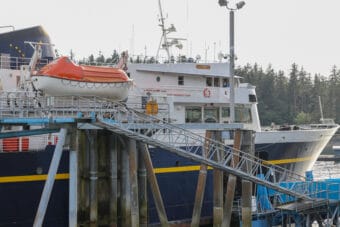
The Alaska ferry MV LeConte docked at the Auke Bay Ferry Terminal on Sept. 2, 2025. The LeConte has been docked since Aug. 31 due to mechanical issues. (Photo by Jamie Diep/KTOO)

The Alaska Marine Highway System ferry LeConte will continue to be out of service leading into the weekend.

The ferry, which services Southeast Alaska communities, was moored in Juneau because of engine trouble last weekend. Alaska Department of Transportation and Public Facilities’ staff said they hoped to have the ferry up and running by Thursday. However, spokesperson Shannon McCarthy said Thursday that it still needs some work. 

“Our mechanics are working around the clock to get that fixed,” she said. “Unfortunately, we are confident that we will not be able to get the ship back in the water and get the U.S. Coast Guard approvals in time for Friday’s sailing. So we are canceling that.”

The ferry began experiencing engine loss and other mechanical issues last weekend when traveling from Hoonah to Kake. Ferry staff decided to have it towed to Juneau for repairs. The service disruption left many on the ship stuck in Juneau, including the Kake City Schools cross-country team. 

McCarthy said the department is offering refunds or rebooking affected passengers on the MV Hubbard or a private catamaran, but it cannot provide transportation for vehicles.

Alaska Marine Highway staff scrambled to fix the ferry before the start of the Klondike Road Relay on Friday. Many runners in Juneau and Haines rely on the LeConte to transport their teams and vehicles to Skagway for the start of the race. 

“As vessels age, they require a lot more TLC,” McCarthy said. “We do try to get anything fixed when they’re in for their normal service in the shipyard, but because vessels are older, some unforeseen circumstances will happen.”

McCarthy said the department plans to share another update on the vessel’s status on Saturday.

‘We got a tired Tustumena’: State to open bids for long-awaited ferry replacement

A man on a ferry deck, seen through a rain-splattered window, brings down an Alaska state flag in the rain.
A crew member on the Tustumena in August 2024. (Theo Greenly/KUCB)

The Trusty Tusty, the Rusty Tusty — the Alaska ferry Tustumena has a few different nicknames. In the Aleutians, where the ship doubles as the only restaurant for many small villages along the route, people call it the McTusty.

“We’re going to have dinner,” Ellie Hoblet said when the Tustumena docked in False Pass on Aug. 8. “There’s no other places to get food.”

Hoblet was there with a handful of others from the fishing village of about 30 residents.

“Best restaurant in town,” Calum Hoblet said. “The clam chowder and the chicken strips, that’s the best.”

Herman, Timothy and Anna Tepper have grown up in False Pass and Kodiak, where they frequently travel on the ferry. “My favorite food on the Tustumena is the chicken tenders,” Timothy said during the ferry’s stop in False Pass in August 2025. (Theo Greenly/KUCB)

The Tustumena is more than just a ferry: it’s a lifeline for Aleutian communities. Barging in freight can be prohibitively expensive, so the ferry is a cheaper alternative. And a $350 ferry ticket is often the only way people in the Aleutians can afford to travel out of their communities — a one-way flight from False Pass to Anchorage costs more than $1,000.

But the aging vessel doesn’t make it up and down the chain as often as it used to. Meanwhile, the state’s efforts to replace it have been postponed and delayed for years, leading to reduced service and canceled sailings while the ferry undergoes repairs.

A vehicle waiting for the Tustumena on the dock in Cold Bay in August 2025. (Theo Greenly/KUCB)

The ship also doesn’t sail as late into the year anymore. Captain John Mayer says one reason for that is to avoid inclement weather.

“I’m far more prudent in the weather I choose to go out in because she is a 61-year-old ship,” Mayer said. “When I first started here, it wouldn’t be unusual to leave the harbor in 20-foot seas. Now I don’t even think about that.”

Before the pandemic, the Tustumena made two Aleutian chain runs each month during the summer. In earlier years, they sailed into October, when the crew handed out pumpkins for the famed “Pumpkin Run.”

“When we would pull into port, say, for Sandpoint, the whole town would be on the dock,” Mayer said. “Total chaos.”

Akutan residents collecting pumpkins from the Tustumena in October 2011. (Ian Dickson/Alaska Desk)

Mayer has worked on the Tustumena for about 25 years, working his way up to captain in 2015. He says he hopes a new ferry will mean they can sail as late and as often as before.

“Maybe with the new ship we can, because it could just be more resistant to heavier weather,” he said.

But improved ferry service won’t happen until the state builds the Tustumena’s replacement. That’s been in the works for over a decade, but it wasn’t made official until Gov. Mike Dunleavy announced the project in 2021. The Alaska Department of Transportation solicited for builders the next year, but nobody bid.

The Tustumena crew prepares to leave Sand Point in June 2024. (Theo Greenly/KUCB)

Craig Tornga, the ferry system’s marine director, told the marine highway’s advisory board at its July 25 meeting that they’d finally be going out to bid this fall.

“We got a tired Tustumena that needs a replacement,” Tornga told the board.

He said one of the biggest challenges is a requirement that 70% of the money spent on the project goes to American companies, a point that Captain Mayer also made.

“That’s been very exasperating,” Mayer said. “They simply do not make the systems you need for a new ship in this country.”

The original target date for replacing the Tustumena was 2027. Despite the fact that the project hasn’t gone out to bid yet, and despite the fact nobody bid on it the last time, Tornga told the board that they’re still trying to get the replacement ferry on the water at the end of 2028. But he said that date could change once they accept a bid and get a more realistic timeline.

Tornga said the marine highway system is meeting with potential bidders later this month, when he’ll give another progress report.

The Tustumena’s galley in August 2024. (Theo Greenly/KUCB)

Back in False Pass, on board the Tustumena, the galley was packed at 6:30 p.m., right when the ferry was supposed to leave. Standing in the galley, Mayer started to sound more like a restaurant manager than a boat captain.

“To-go order? Anybody here to go? Everyone staying on board?” he asked.

He said he didn’t want to set sail for Akutan while folks from False Pass were still waiting for food from the best restaurant in town.

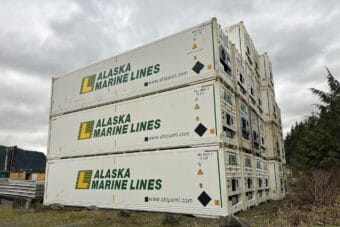
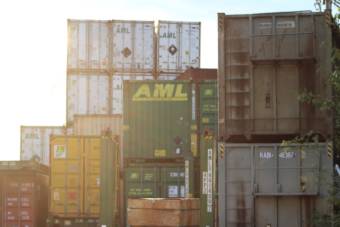
Alaska Marine Lines will no longer ship electric vehicles due to fire risk

In June, an international cargo ship, the Morning Midas, caught fire and ultimately sunk off the coast of Alaska. The ship was carrying around 3000 vehicles, including around 70 EVs and nearly 700 hybrids (U.S. Coast Guard Photo)

Alaska Marine Lines will no longer ship electric vehicles or plug-in hybrid vehicles to Alaska or Hawaii.

Last week, the barge company announced the policy change in a statement due to the fire risk associated with shipping large lithium ion batteries.

AML’s decision to stop shipping electric vehicles means reduced access for communities off the road system in Southeast Alaska, where EVs have become an increasingly popular option.

Alaskans can still bring electric vehicles up by ferry, though it can take longer. The Alaska Marine Highway System limits its policy to two electric vehicles per sailing. Once electric vehicles catch fire, they’re challenging to put out, according to Alaska Department of Transportation Spokesperson Sam Dapcevich.

“EV fires, I believe, kind of burn until they go out, and so you have to kind of contain them. Each vessel has two specialized blankets on board that can be thrown over a vehicle, and it sort of smothers it,” Dapcevich says. “We also have a policy to park those vehicles in a specific location on the ship, and we provide extra room around them for the possibility of needing to fight the fire.”

In June, a cargo ship southwest of Adak caught fire in the open ocean. It was carrying over 3000 vehicles, including nearly 700 hybrid vehicles and around 70 fully-electric vehicles. All crew members were rescued, but the U.S. Coast Guard could do little to contain the blaze due to the risks associated with lithium ion batteries. The ship burned for days before ultimately capsizing and sinking.

Dapcevich says it’s not just the fire that makes EVs high risk, especially on a passenger vessel like a state ferry.

“It’s the toxic fumes, and you’re in an enclosed space, and they can travel into through the ventilation system in the vessel,” Dapcevich says. “They can travel into passenger spaces, and so it’s just a very dangerous situation to have an EV fire on a boat. And that’s part of why we limit it.”

Dapcevich said Alaskans looking to bring up electric vehicles from the Lower 48 should flag that information when they’re making a ferry reservation.

In an email to KCAW, Alaska Marine Lines spokesperson Ryan Dixon said the barge company would continue to reassess its decision to stop shipping electric vehicles as industry safety standards improve. Hybrid vehicles that do not plug in will still be allowed on the company’s cargo ships, as well as smaller electric recreational vehicles, like e-bikes and 4-wheelers.

The new policy is effective immediately for Central and Western Alaska and Hawaii, but the change doesn’t go into effect for Southeast until September 1.

Regional airline Ravn Alaska calls it quits

A man stands at a gate in Unalaska's airport looking out at a Ravn plane on the tarmac.
A Ravn Alaska plane at Unalaska’s Tom Madsen Airport. (Photo by Theo Greenly/KUCB)

Regional air carrier Ravn Alaska announced on its website Thursday that it was closing, effective immediately.

A brief note on the site said Ravn was “no longer operating flights in Alaska” and that the company appreciated its years of service.

The Alaska-based airline had struggled since launching in late 2020, laying off staff and eliminating routes.

It first cancelled its route to Dillingham in 2022, less than a year after starting service to Bristol Bay. Just last year, the company laid off 130 employees. Most recently, Ravn announced it would stop serving the Bering Sea island community of St. Paul this fall.

The company’s former CEO, Rob McKinney, left his role last year, and Tom Hsieh — the president of Ravn Alaska’s parent company, FLOAT Alaska LLC — stepped into the top leadership position. Around the same time, the company announced it would cease flights to the Aleutians, including to Unalaska and Sand Point.

Hsieh did not respond to requests for comment Thursday.

Ravn Alaska had previously taken over service to the Aleutians from RavnAir, purchasing its license but operating as a distinct company.

Several regional airlines have stepped in to fill the gaps in rural Alaska communities. Aleutian Airways began serving Dutch Harbor and Sand Point in 2023. Last month, Kenai Aviation was accepted as the Essential Air Service provider to St. Paul, though it recently announced that service would begin about six weeks behind schedule due to aircraft maintenance.

Correction: This story has been updated to correct the years in which Ravn’s layoffs occurred.

Alaska is set to receive $120M for new weather stations and aviation safety

U.S. Sen. Dan Sullivan speaks at an aviation roundtable at Ted Stevens International Airport in Anchorage on Aug. 12, 2025.
U.S. Sen. Dan Sullivan speaks at an aviation roundtable at Ted Stevens International Airport in Anchorage on Aug. 12, 2025. (Matt Faubion/Alaska Public Media)

Alaska is set to receive around $120 million from the federal government for improving aviation safety through new weather stations and updates to telecommunication systems.

That’s according to U.S. Sen. Dan Sullivan, who spoke at an aviation roundtable at Ted Stevens International Airport in Anchorage this week. Rep. Nick Begich and officials from the U.S. Department of Transportation and the Federal Aviation Administration attended the event as well.

“These are historic investments that our state needs,” Sullivan said. “We have the highest by far of any state in the country – 2.3 times higher – crash rates.”

The funding comes from the federal budget reconciliation bill, or the Big Beautiful Bill, which was signed by President Trump last month. The bill includes more than $12 billion for aviation improvements across the country. In Alaska, some of the improvements will also be paid for by an investment from the Federal Aviation Administration that was announced back in April.

The funding is only one step toward addressing the state’s longstanding challenges, but people in Alaska’s aviation industry say they’re encouraged.

“We’ve been fighting for years and advocating for weather reporting stations,” said Dan Knesek, the vice president of commercial operations at Anchorage-based Grant Aviation

More reliable flights for villages off-the-road system 

Grant provides air service to communities across the state, delivers cargo and sends medevac planes. But Knesek said it is hard to make those flights between October and April.

Accurate weather information is crucial for pilots. When visibility is low, it helps them to decide whether they should fly. And carriers that fly relying on their instruments are required to have certified weather reports to take off.

But a lot of places in Alaska don’t have reliable – or any – weather reporting, which means that fewer planes make it in.

Knesek said there are times when flights can’t reach communities for a week.

“These communities are very dependent on our services,” he said. “They need to go to the doctor, or any of the basic services they need to fly to get.”

Alaska has about 160 aviation-specific weather stations. Adam White, with the Alaska Airmen’s Association, said that’s far from the density of weather stations in the lower 48. The Federal Aviation Administration is set to install an additional 174 weather observer systems for Alaska.

White said that still might not be enough, but any addition will help pilots and forecasters.

“We’ve got some parts of Alaska that there’s more than 100 miles to the nearest weather station in any direction. And that’s kind of crazy to think about,” White said. “So anything we can get is a huge increase in the information that we’ve got available to us.”

The FAA is now working with carriers and experts to prioritize places that need new stations most.

“We’re looking primarily at off-road system locations that (are) completely reliant on air service for the life and health and safety and well being of the community, and the typical weather patterns and the success rate of flights making it in and out of that community,” said White with the Airmen’s Association, one of the organizations advising on that process.

Questions remain about staffing and maintenance

Rick Thoman, a climate specialist at the University of Alaska Fairbanks, agrees that installing more weather stations is important for public safety and for weather and climate reporting. But he said it’s only one step.

“More stations are great, but they’ve got to work, and they got to report to the whole world reliably,” Thoman said.

Thoman said that on any given day, 10-15% of the aviation weather stations across Alaska are down or not fully reporting, He said the biggest issue is telecommunication infrastructure, which helps get information from the weather station out to the people who need it. Many Alaska villages still rely on copper wires for transmitting signals, and Thoman said sometimes people can’t even get parts to repair the antiquated systems.

The bill does include funding for improving telecommunications infrastructure.

At Tuesday’s conference, FAA administrator Bryan Bedford said the agency is still mapping out the details, but they are leaning toward updating stations to satellite technology and are now testing Starlink units.

Staffing to maintain the stations is another requirement for them to operate successfully – and to get certified, Thoman said.

“People have to go there to do the maintenance. Even if the FAA is contracting with local people, a human being has to go and do stuff,” Thoman said. “If money to support that is not included in that bill, then this is a big problem.”

Bedford said maintenance and staffing are not included in the bill. He said the agency still needs significantly more funding to improve aviation facilities and to look for workforce solutions, for example, through scholarships for technicians.

Site notifications
Update notification options
Subscribe to notifications