Transportation

State signs $28.5M contract to advance new ferry terminal over objections from Marine Highway board

A person takes a photograph of Chilkoot Inlet while on the MV LeConte shortly after departing Haines for Juneau on Sunday, Nov. 13, 2022. (Emily Mesner / ADN)

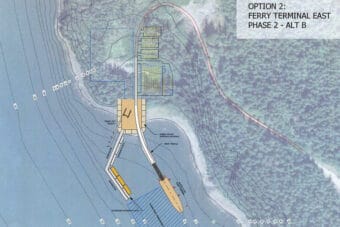
The administration of Gov. Mike Dunleavy has signed a $28.5 million contract for work on a new ferry terminal north of Juneau, days after an oversight board said the state had not proved that the project is economically viable.

Dunleavy administration officials say the new terminal at Cascade Point, located 30 miles north of an existing terminal in Auke Bay, will cut ferry time from Juneau to Haines and Skagway by two hours.

But the chair of the Alaska Marine Highway Operations Board — which was created by Dunleavy four years ago — says the department hasn’t shared “some kind of business plan or feasibility study” to establish that the terminal is necessary and economically viable.

“The Alaska Marine Highway System has been plagued for 50 years with one-off projects that get foisted upon it, that create operational challenges, that then the system and the users have to deal with,” said Wanetta Ayers, chair of the board, during a Friday meeting.

“This is another one of those situations where it’s going to get foisted upon the system and we’re going to have to cope with it for 20 or 30 years until somebody admits it’s not going to work,” Ayers added.

The Cascade Point ferry terminal is planned on land owned by Goldbelt Inc., a Juneau Alaska Native corporation. It has been under consideration since Dunleavy took office in 2019. In May, his administration announced its intention to seek bidders for the first phase of the project.

After receiving two bids, the transportation department signed a contract Monday with K&E Alaska Inc., an Oregon-based company with an office in Sitka. The contract, which has a 2027 completion date, covers engineering and environmental permitting, a bridge over Cascade Creek, a gate, site preparation and retaining wall construction.

The contract does not include any funding for the ferry terminal itself, which is set to cost tens of millions of dollars. The state expects to pay for the terminal using primarily federal funds.

Ayers said Friday that the Dunleavy administration had not provided answers to board members’ previous questions, and she is troubled by “the pursuit of this project in what is a very unconventional process, where design and now construction are way ahead of operational feasibility and customer service.”

Katherine Keith, a deputy transportation commissioner, said during the Friday meeting that the department had commissioned an independent economic analysis of the project, but it was still in “draft form” and had not been released. She did not provide any specifics on when it would be available to members of the board or the public.

“We continue to believe that this is a strong benefit to the state, to the system and the public, which is why we’re moving forward with expenditure of public dollars, but understand we haven’t communicated that in a complete narrative document to make it more accessible and comprehensive,” said Keith.

Keith pointed out that the Cascade Point project had been recommended in 2020 by a marine highway reshaping working group commissioned by Dunleavy.

Ayers, who served on the working group, said that report and its accompanying recommendations “came together on a wing and a prayer at the last minute to meet the governor’s deadline.”

“To stand on it as a justification for Cascade Point is, to me, a pretty big stretch,” said Ayers.

One of the primary reasonings provided in the working group report for the new ferry terminal was that it would “avoid the need to modify the new Alaska Class ferries to add crew quarters” by allowing for trips between Juneau, Haines and Skagway to last less than the 12-hour crew day mandated by the Coast Guard.

But that reason is partially moot because the state has already committed to retrofitting the Alaska Class ferries with crew quarters, at a cost of roughly $30 million, and because the route length between Cascade Point, Haines and Skagway exceeds the 12-hour crew day, according to Marine Highway spokesman Sam Dapcevich.

The trip from Cascade Point to Haines and Skagway, as envisioned by transportation planners, would run up against the 12-hour work limit for crew, “requiring full staffing and accommodations,” Dapcevich said in an email last week.

“A more efficient service model,” which wouldn’t necessitate crew sleeping onboard, would require ferry trips from Cascade Point to go either to Haines or to Skagway, rather than visiting both communities on a single trip, Dapcevich said. The Marine Highway System would then have to use a yet-to-be-constructed “shuttle” ferry between Haines and Skagway.

‘Standing on a cliff’

Ayers wasn’t alone among board members to raise concerns about the process used by the department to advance the Cascade Point project.

Board member Paul Johnsen, a former Marine Highway engineer, said it seemed that the board was “being ignored” by the transportation department. Member Bob Horchover, who was appointed to the board by Dunleavy, agreed.

“I’m against this until we have more information,” said Horchover. To move ahead with the project “without even a reason for doing it is, to me, a boondoggle,” he added.

Anthony Lindoff, vice chair of the board, said the department had not provided enough information for him to form an opinion of the project.

“I certainly don’t have enough information regarding Cascade Point to be unequivocal, one way or the other,” Lindoff said. “I’m just eager for more information.”

While the Dunleavy administration is moving ahead with the Cascade Point project, it is also working simultaneously on a study of a possible new road-and-terminal project on the west side of Lynn Canal.

A $2.4 million study of the project is set to examine multiple options, all of which are predicated on the existence of the Cascade Point ferry terminal, according to a service agreement signed in May.

The northern lights glow over Auke Bay as the Alaska Marine Highway ferry Kennicott approaches Juneau on February 25, 2024. (Marc Lester/ADN)

Keith told board members that the study, with initial findings expected in January, is set to examine connecting Cascade Point with new ferry terminals and road stretches on the west side of the canal, to better tie Juneau to the Alaska Highway. Keith said the “Chilkat Connector,” as the Dunleavy administration called it, would include construction of one or two new ferry terminals on the west side of the canal, along with several miles of new road.

Some board members said it appeared that Cascade Point would only be economical if paired with west Lynn Canal infrastructure, but with those infrastructure projects yet to be studied, moving ahead with Cascade Point was premature.

“If it was part of a larger infrastructure plan to build a road up the west coast of Lynn Canal, then that might have some more impact and be worth investing in that kind of a facility,” said Horchover.

“I’m a little concerned that we’re standing on the cliff and saying, ‘Why not? Let’s jump,’ ” he added.

Juneau Access

The Chilkat Connector study, like the Cascade Point ferry terminal, is funded using appropriations made by state legislators nearly 20 years ago for what is called the Juneau Access Project, a decades-old effort by the state to improve transportation options to the state’s capital that has been reimagined under each new governor.

Former Gov. Tony Knowles in 2000 nixed the idea of a 90-mile road north of Juneau toward Haines, saying its price tag — in the hundreds of millions — was too high. Former Gov. Frank Murkowski revived interest in the plan, and state lawmakers in 2006 approved $45 million for the Juneau Access Project, under a vision for a road from Juneau to the Katzehin River, allowing for quick ferry shuttles from there to Haines and Skagway and on to the mainland road system.

Former Gov. Sarah Palin paused the plan while she was in office, only for her successor, former Gov. Sean Parnell, to revive it, at a projected cost of more than $500 million.

The Parnell administration spent $5 million extending the Glacier Highway to the Goldbelt-owned land at Cascade Point. More than a decade ago, Goldbelt considered constructing a dock to transport Kensington Mine employees from Cascade Point to the mine. That hasn’t happened.

When Gov. Bill Walker was elected — and oil prices crashed — the Juneau Access Project was shelved again. Then came Dunleavy, who turned from the longer road to the Katzehin River to a plan that involved constructing the new Cascade Point terminal.

In 2023, the Dunleavy administration agreed to work with Goldbelt to study the feasibility of a terminal on land owned by Goldbelt. Members of the Alaska Marine Highway Operations Board wrote last year that “with the current information available to AMHOB and the public, we cannot see the merit of the proposed Cascade Point project.” The Dunleavy administration did not provide any further information to the board in response to their letter, members said.

A draft of the 20-year long-range plan for the Marine Highway System signed by Transportation Commissioner Ryan Anderson in February contains no recommendations regarding the Cascade Point terminal. It states that a feasibility study for the terminal was ongoing as of the time of the report’s publication. But department officials said this month that there is no ongoing feasibility study.

‘Rearranging the deck chairs’

Dunleavy vetoed a move by state lawmakers in May to reappropriate Juneau Access Project funding toward other transportation plans, stating the funds had already been obligated.

Since then, both the Skagway and Haines borough assemblies have formally expressed their opposition to the Cascade Point terminal.

“It is difficult to understand why the State is choosing to invest in the construction of a new marine facility rather than rehabilitating existing terminals, many of which — including those serving northern Southeast Alaska — are in urgent need of repair,” Skagway Assembly members wrote.

View of Auke Bay from the bridge of the Hubbard before it set sail to Haines and Skagway in Juneau on May 22, 2023. (Sean Maguire/ADN)

While Haines and Skagway leaders have bristled at the news that the Dunleavy administration is moving ahead with the terminal, one mining company celebrated the announcement.

Grande Portage, a Canada-based company with a plan to build a new gold mine near Juneau, said in a press release that it has an existing agreement with Goldbelt to cooperate on building a barge terminal at Cascade Point for transportation of ore.

Though the barge terminal is not contingent on the ferry terminal, “having the ferry terminal proceed first is highly advantageous as it would result in the development of infrastructure that will also be necessary for the ore terminal, particularly the new access road and bridge. This reduces the time and cost required for future ore terminal development,” Grande Portage wrote in its press release.

The work on Cascade Point comes as the Marine Highway System is wrapping up its work on a 20-year long-range plan. Ayers said work on that plan, and renewed focus on the system’s efficiency, have allowed it to move away from “just rearranging the deck chairs on the Titanic.”

“Here we are, spending lots of time and resources about planning and being strategic, and yet, the other hand is going to deliver us a one-off carbuncle,” said Ayers. “I feel like it’s undoing a lot of good progress.”

Alaska Airlines IT outage causes cancellations for Alaskan travelers

several Alaska Airlines planes parked at airport gates
Several Alaska Airlines planes are parked at Seattle-Tacoma International Airport gates on Jan. 5, 2022. (Jeff Chen/Alaska Public Media)

An IT outage that grounded all Alaska Airlines flights Sunday night led to cancellations Monday at airports in Alaska.

Seven flights out of Alaska had been canceled as of 10 a.m. Monday: three flights between Fairbanks and Seattle and four between Anchorage and Seattle. Several flights departed late early Monday, according to the website FlightAware.

“A critical piece of multi-redundant hardware at our data centers, manufactured by a third-party, experienced an unexpected failure,” Alaska Airlines said in a statement. “When that happened, it impacted several of our key systems that enable us to run various operations.”

Terry Haines, producer of the Alaska Fisheries Report and a radio host at KMXT, lives in Kodiak and was heading home from Redding, California when the outage hit. His flight was supposed to leave SeaTac at 5 p.m. Sunday, he said.

“They rerouted me. They had me flying from Seattle to Chicago, and then from Chicago to Anchorage, and then from Anchorage to Kodiak. And I said, ‘Well, maybe I can get on the phone and change this,'” he said.

He was able to change his flight to continue to Anchorage through Seattle, but by the time he was expected to get home, it was likely to be over a day late.

According to Alaska Airlines, the outage was not caused by a cybersecurity breach, and passenger safety was not jeopardized.

Over 200 flights nationwide had been canceled since Sunday evening because of the outage, the airline said.

Alaska Airlines grounded its fleet in April 2024 for about an hour because of an issue with a system that calculates weight and balance of planes.

“We appreciate the patience of our guests whose travel plans have been disrupted,” the airlines’ Monday statement said. “We’re working to get them to their destinations as quickly as we can. Before heading to the airport, we encourage flyers to check their flight status.”

Haines Assembly agrees to move towards smaller Lutak Dock plan

Failed steel beams between the cells at Lutak Dock, March 2025. (Photo provided by Haines Borough)

The Haines Borough Assembly all agreed for once about plans for the Lutak Dock.

In a rare unanimous vote, the Assembly directed the interim borough manager to come back to their next meeting with a new contract that includes a smaller, less expensive dock. If approved, the agreement would also end litigation between the borough and the dock contractor.

After years of setbacks and frustration, Haines might be closer to having a new freight dock.

Interim Borough Manager Alekka Fullerton presented a modified concept proposal at the last borough assembly meeting to replace the deteriorating Lutak Dock.

“This concept will look familiar to you since it’s very close to the option 1B which was developed by R&M in 2017,” she said. “The main difference is that it’s a bit smaller. The dock will be a little bit smaller, and incorporates only the most essential elements.”

Fullerton said the new plan preserves the roll-on/roll-off function and fuel transfer operations. Depending on how far the money stretches, at least five cells will be encapsulated.

“After the seismic survey is complete and the required ground improvements are evaluated, it may be that the final design will allow us to include encapsulation of seven cells instead of five … we won’t know that until we finish the seismic design,” Fullerton said.

The guaranteed maximum price (GMP) for the project is $25,400,000.

Harbor Master Henry Pollan answered concerns about losing uplands.

“We will lose a fair amount of our uplands,” he said. “My conservative estimates, it’ll be roughly 20 to 30% of our usable uplands will be ceded in this design. The other options were like 60 to 75% of our usable uplands. So this is the best case scenario that we can put together.”

Fullerton added it’s possible that at a later date, uplands could be reclaimed in a phase two build that is not yet funded.

The last approved design is still in environmental review. Fullerton said she did not believe the replacement design would need a new environmental review, but it might require a seismic study.

If the contract is approved, Fullerton said Turnagain Marine Construction will complete a 35-65% concept plan, which would be submitted to the U.S. Department of Transportation, Maritime Administration so that work on the grant agreement can continue. In the meantime, Fullerton said she will take the new plan to Port & Harbors, Planning & Commission and a Town Hall.

Assembly member Gabe Thomas thought the new concept was a good landing spot for a community that has bitterly argued over the best way to replace the infrastructure.

“This feels like it’s a kind of a medium compromise,” he said. “So hopefully we can just get the community behind it, and let’s get this thing built. Let’s stop fighting over it. There’s no mine.”

And it’s not just community members that have been fighting. Turnagain Marine sued the municipality after the company bought nearly $10 million in steel that the borough says the construction company was not authorized to purchase. The agreement would “release both parties from any claims related to any events prior to the execution of this change order.”

The roll call vote to bring forward a new contract was unusually verbose.

“Just on the record, I am going to compromise and I am going to say yes,” Assembly member Craig Loomis said.

And here’s Assembly member Cheryl Stickler: “Yes, yes, yes!”

Borough Clerk Mike Denker joked that there were a total of nine yes votes. There were in fact, six yes votes. The Assembly will see a contract at their July 8 meeting.

After 2-week burn, cargo ship carrying thousands of vehicles sinks in North Pacific

The 600-foot Morning Midas caught fire around June 3 near Adak Island. A United States Coast Guard cutter and aircraft crews responded to the fire, and all of the cargo ship’s crew members were evacuated safely.
The 600-foot Morning Midas caught fire around June 3 near Adak Island. A United States Coast Guard cutter and aircraft crews responded to the fire, and all of the cargo ship’s crew members were evacuated safely. (Courtesy of U.S. Coast Guard)

A cargo ship that caught fire off the Western Aleutians sank Monday morning amid salvage operations in the North Pacific Ocean.

The 600-foot Morning Midas was carrying thousands of vehicles when it began to burn around June 3, near Adak Island. The fire burned for about two weeks before officials reported it was out.

According to the ship’s manager, Zodiac Maritime, the damaged vessel went down Monday morning after taking on water in heavy weather.

Earlier this month, Zodiac said a tug with long-distance towing capabilities was on its way to the ship, but the company didn’t say when the tug was coming or where they planned to tow it.

The Liberia-flagged ship was on its way to Mexico when the fire broke out. A United States Coast Guard cutter and aircraft crews responded to the fire, and all of the cargo ship’s crew members were evacuated safely.

The vessel was carrying 3,000 vehicles, about 800 of which were either partly or fully electric.

The Morning Midas was 360 nautical miles from shore in international waters when it sank. Zodiac Maritime said in a Tuesday morning statement that Resolve Marine — an international salvage and response company with a facility in Dutch Harbor — has two salvage tugs on location.

Zodiac representatives said because the ship was so far from land, there was no realistic way to save anything on board.

The salvage company will remain on site with pollution control equipment to monitor the situation. Another specialized pollution response vessel is also on the way.

“We remain in close coordination with Resolve Marine and the United States Coast Guard, and we extend our sincere thanks for their professionalism, swift response, and continued collaboration,” Zodiac Maritime said in a Tuesday statement.

Juneau’s new Coast Guard icebreaker is on its way to Alaska

The U.S. Coast Guard icebreaker Storis on May 22, 2025. (Photo courtesy of the U.S. Coast Guard)

A polar icebreaker is destined for what will eventually be its new home port in Juneau. It set out on Tuesday from Pascagoula, Mississippi, on its maiden voyage as an official U.S. Coast Guard vessel, according to a news release. 

The 360-foot ship is built to operate in the Arctic and is meant to increase U.S. presence in the region. The Coast Guard estimates it will bring hundreds of Coast Guard personnel and their families to Juneau in the coming years.

The ship was previously named the Aiviq. It was renamed the Storis in honor of another Coast Guard ship that was stationed in Juneau in the 1950s.

The Storis is intended to serve as a stopgap while the Coast Guard builds a new fleet of icebreakers called Polar Security Cutters. It’s the first icebreaker the Coast Guard has acquired in more than 25 years.

It’s not a new ship —  the Coast Guard bought it for $125 million from a private entity late last year. Alaska’s congressional delegation tucked the funding to purchase it in a spending bill signed by President Joe Biden last year. 

A ProPublica investigation of the ship published earlier this year found it has a design problem and a history of failure.

The Coast Guard announced last summer that Juneau would be the vessel’s homeport. It’s currently headed to San Diego, according to a vessel tracker. It’s expected to arrive in Juneau this August, but it will leave again to be temporarily berthed in Seattle until the necessary shore infrastructure is finished in Juneau. 

British Columbia wildfire disrupts traffic on the Alaska Highway

A planned ignition lit by British Columbia firefighters near the Alaska Highway to contain the Summit Lake Wildfire, seen on June 3, 2025. (Photo by B.C. Wildfire Service)

A wildfire in northeastern British Columbia has led to intermittent closures on the Alaska Highway since it started burning last week.

The 70-mile stretch of highway west of Ft. Nelson had reopened to single-lane traffic as of Wednesday afternoon, but the BC Wildfire Service says circumstances could change quickly depending on how the Summit Lake Wildfire behaves.

Cell service is limited in much of the burn area. The wildfire service urges travelers to prepare for delays and consider downloading the BC Wildfire app for updates on conditions.

The fire has torched over 6,000 acres in the Northern Rockies since it started on May 28, and it’s nowhere close to being contained, according to the fire service.

Forty-seven firefighters are on the scene with helicopter support. The wildfire service suspects that lightning ignited the fire, which has spread quickly due to a multi-year drought.

There are a number of other fires in the area, and the wildfire service expects them to spread farther as windy weather moves in later this week.

Site notifications
Update notification options
Subscribe to notifications