Transportation

Alaska ferry engineers say they are critically short-staffed, with no easy answers

The Tazlina, Malaspina and LeConte moored in Juneau during a strike by the Inlandboatmen’s Union of the Pacific on July 25, 2019 (Photo by David Purdy/KTOO)

Meagan Nye doesn’t always know when or if her workweek will end. She’s an engineer on the Alaska Marine Highway System ferry Columbia. She is supposed to work two-week shifts at sea. But more and more often, those two weeks will turn into six.

“I love my job, but I don’t want to be there all the time, and I want to have a schedule so I can plan my off time and know if I’m going to be able to go home,” Nye said over the phone.

Nye is a second engineer. She works in the Columbia’s bowels, maintaining the ferry’s three boilers, fuel, HVAC, refrigeration, basically every complicated, whirring thing. She and five other engineers work in split twelve hour shifts so the engine room is manned 24 hours a day.

“We’re short staffed. We don’t pay what everyone else pays but we are under a contract. You can’t just leave, right? You could be subject to disciplinary action. You could be fired if you just leave. You cannot do that,” Nye said.

Many communities along Alaska’s southern coast are dependent on state ferries to get around and to fuel their economies. But those ferries move thanks to teams of on-board engineers, who say they are critically understaffed and the only solution is more state funding or fewer sailings.

The M/V Columbia – the largest ferry in the state’s arsenal – is meant to rotate two six-person teams of engineers every two weeks, meaning that the vessel has a total 12 engineer postings.

If that metal box in the bottom of the ship isn’t properly manned, then the ship doesn’t sail. Nye said it comes down to safety; there is a minimum number of staff needed to keep the vessel and its passengers safe.

“That’s our nightmare – having to cancel a sailing,” Nye said. “I feel personal responsibility if there’s any cancellation. That’s terrible.”

According to her, there are two ways to become a ferry engineer. You can do four years at a maritime academy or you can be what they call a “hawsepiper.” Hawsepipers essentially apprentice on the ferries as an “oiler” or unlicensed engine room staff for five or so years at sea, then study independently to take five licensing tests. Historically, many Alaskans have come through the hawsepipe to become ferry engineers. That’s what Nye did. But she said hawsepiping is more difficult now.

“We have a lot less people coming up the hawsepipe, because they have families, the cost, and they can’t just leave for that time and not be working. It’s just a lot more difficult now,” Nye said, adding that the regulations have tightened and brought more classes and more costs. “So we don’t have that source of engineers with the Alaska Marine Highway anymore.”

Staffing shortages aren’t exclusive to below deck crew. About three years ago, 60% of the ferry system’s jobs were vacant. They’ve been slowly closing that gap but AMHS Marine Director Craig Tornga said the ferry system is 10% short of the fleet’s minimum number of masters and bridge crew. The Marine Engineers’ Beneficial Association, the union representing Alaska’s state ferry engineers, said their vacancy rate is nearly 20%.

The ferry engineers’ union distributed a public petition entitled “The Alaska Marine Highway System is Sinking” that urged Gov. Mike Dunleavy to prioritize higher wages for ferry employees. The petition read that engineer shortages were making state ferry service unreliable and impacting the health of ferry-dependent communities.

Josh Chevalier, the chief engineer on the Columbia, said staffing is a problem for all ferry jobs but because engineers are behind the scenes, they are often forgotten by the public and lawmakers.

“When people are stressed out and unhappy, I have to balance the needs of the vessel with the needs of people’s lives,” Chevalier said.

Chevalier has worked in the ferry system for over twenty years. He noticed the problem with filling jobs beginning about a decade ago when wages for engineers went up on container ships and ferry systems in other states, while state funding for AMHS declined.

For Chevalier, the ferry system’s funding woes go back to a larger problem he sees in the state: the state’s major population centers like Anchorage have far more sway in the legislature and for voters on the road system and northern lawmakers, infrastructure like the ferries and the engineers down in their bellies are out of sight, out of mind.

“We haul a tremendous amount of traffic that never stops in Southeast. They drive up to Southcentral and stay in hotels and buy fuel and groceries, stay in Airbnbs, and so it’s a very valuable economic engine for the entire state, but I believe it’s viewed as a sort of welfare for Southeast Alaska,” said Chevalier.

The union for ferry system engineers brokered their current agreement with the state back in 2022. That agreement governs everything from what engineers wear to when they can get off the ship. It expires next month.

The state ferry engineers’ union has been bargaining with the state. They recently reached a tentative new three-year agreement. Union representatives declined to comment on the terms of the new agreement until it is made official. Union ferry engineers are currently voting on if they will accept the state’s terms. A spokesperson said the details of the new agreement will be released in early June.

Engineers like Nye said that agreement could essentially determine the ferry system’s future.

“I mean, the number one thing that will fix the problem is money, right? It’s the pay. It’s a pay issue, trying to attract people from the academies. It’s just not enough to attract people when they can make so much more money elsewhere,” she said.

The state recently reached an agreement with a different, bigger union of state government employees. That agreement included more healthcare coverage and an 11% pay increase.

According to Chevalier, a hiring push for engineers is a race against time. 30% of the ferry system’s engineers are approaching retirement age and he said in five years, busted boilers or a faulty refrigerator could be a much bigger problem.

State seeks contractors for a second Juneau ferry terminal

This is a concept design drawing of a new ferry terminal facility in Juneau at Cascade Point. (Alaska Department of Transportation and Public Facilities)

State officials took another step towards building a new ferry terminal at the end of the road in Juneau. They say it could shave more than an hour off the trip from the capital city to the road system in Haines.

Last week, the Alaska Department of Transportation and Public Facilities put out a request for proposals for a contractor to design and build the first phase of the project beginning this summer.

State officials have talked about building a new ferry terminal at Cascade Point for at least two decades. Shannon McCarthy with the Department of Transportation said now the project is finally moving forward. 

“This is another investment in the Alaska Marine Highway,” she said. “We’re looking at the whole system, and we’re going to keep on pushing until this is modernized and really convenient for Alaskans, and very stable in terms of scheduling.”

State officials say the new terminal isn’t meant to replace the Auke Bay Ferry Terminal, but to add to it. A ferry leaving from Cascade Point instead of Auke Bay could shave 30 miles off the trip from Juneau to Haines and Skagway, reducing travel time on the ferry by an hour and a half or more. 

The first phase of the project includes extending the end of Glacier Highway onto land owned by Goldbelt Inc., an Alaska Native corporation. Goldbelt agreed to partner with the state on the project in 2023. 

The phase also includes designing and preparing the area for development, along with purchasing the materials for construction. McCarthy said the state will put out a separate request for contractors for the terminal’s construction soon. That’s expected to start next summer and finish in 2027. 

“It really does come down to the customer in terms of we can turn vessels around faster, we can provide more service and we can provide it cheaper,” McCarthy said. 

DOT Commissioner Ryan Anderson said in a statement that the terminal reflects “the Governor’s clear direction to improve access and service reliability for Southeast communities.” 

Gov. Mike Dunleavy drastically cut ferry funding during his first term and the system has been struggling to recover since.

In total, the project is estimated to cost about $77 million. Some members of the Alaska Marine Highway Operations Board have questioned whether the benefits are worth the price tag. 

McCarthy said the first phase will be paid for using state funds previously appropriated for the Juneau Access project, an effort to improve road and ferry service in Juneau. However, lawmakers this session clawed back that funding to help curb the state’s budget deficit. It’s unclear if or how that move might impact the project. 

The state is accepting proposals from contractors until June 13.

Public gets a look at the options for a potential second Juneau-Douglas bridge

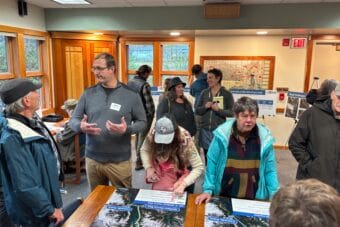
Attendees at an open house for a possible second bridge between Juneau and Douglas Island write down public comments on Thursday, May 16, 2025. (Photo by Clarise Larson/KTOO)

Since at least the 1980s, people have been talking about building a new bridge between Juneau and Douglas Island to supplement the existing downtown bridge. On Thursday night, about 150 people gathered at an open house downtown to talk about it some more.

Proponents for the so-called “second crossing” say it would ease the commute for Douglas residents, increase the island’s access to emergency services and open access to undeveloped city and tribal lands. 

North Douglas resident Barbara Berg said she would directly benefit from a second bridge.

“We do live far enough out that it’s – we have to factor that in when we go into shop and when we go to the doctor and all that kind of stuff. And if it were a quicker trip, yes, that would probably be a help,” she said. 

For the past few years, the city and the Alaska Department of Transportation have been studying possible locations for the crossing. The study is almost complete and they’ve whittled the project location down to five options: Salmon Creek, Twin Lakes, Vanderbilt, Sunny Point East and Sunny Point West. There is also a no-build option. 

A map of the project area for a possible second crossing between Juneau and Douglas Island. (Image courtesy of Alaska Department of Transportation and DOWL)

The need for a second crossing has been a common talking point brought up by residents after a cruise line and Goldbelt Inc. announced plans to develop a new cruise ship port on West Douglas last fall. The city recently rezoned more than 200 acres of city-owned property on North Douglas to increase the housing density in those areas. 

Greg Lockwood, the project’s manager with the state’s Department of Transportation, said getting input from residents is crucial for figuring out which option they ultimately choose. The open house was an effort to gather final public comments for the study. 

“Especially with a project like this, it’s controversial,” he said. “It’s so beneficial to get everybody together early on, see how everybody’s feeling, see what everybody’s freaked out about, and just get it all on the table early.”

The next step is an environmental review, which is required by the National Environmental Policy Act, or NEPA, which will take a deeper look at the options to assess any environmental consequences. Four of the five proposed routes would cut through the Mendenhall State Game Refuge.

Lockwood said it will likely take two years to complete the review. 

“In a best-case scenario, we could be doing the final design here in like three years and then you construction in like four or five years starting,” he said.

North Douglas resident Rich Parker looks at different alternatives for a possible second bridge between Juneau and Douglas Island on Thursday, May 16, 2025. (Photo by Clarise Larson/KTOO)

Denise Koch with the city’s Engineering and Public Works department said that they are already gathering funding for the project, but it’s going to be a big lift. Two years ago, the city received $16.5 million in federal funding to complete final designs.

“We’re talking about projects that are in the hundreds of millions of dollars, $340 million to $500 million, so what we would do is we would aggressively pursue federal funding,” she said.

She said it will likely also require some local buy-in – likely in the form of a local match to any federal contributions. That could be in the tens of millions of dollars.

In 2010, Juneau voters shot down a 10-year temporary 1% sales tax that would have provided funding for a new bridge. Some attendees at the open house, like downtown resident Stuart Cohen, argued that another bridge isn’t needed.

“Overall, this project is a luxury. It’s not a necessity,” he said. “As far as the safety stuff, yeah, we could get hit by a meteorite, but we don’t spend half a million dollars on a special meteorite shield, and I view the safety arguments in this about the same way.”

His comments and others shared at the meeting will help inform the process as it moves along. Officials say there will be more chances to comment in the future before there’s a final selection. 

Ferry board recommends retiring the M/V Matanuska

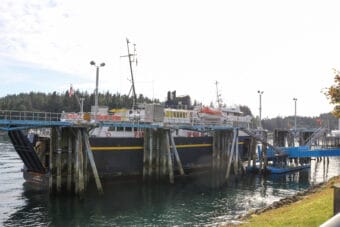
An Alaska ferry at a dock
The Matanuska waits at Ketchikan’s state ferry terminal on June 20, 2022, the day of the Alaska Marine Highway System’s first voyage to Prince Rupert, B.C. since 2019. (Photo by Eric Stone/KRBD)

Alaska’s oldest ferry is too expensive to repair, according to officials with the Alaska Marine Highway System, who say it would cost millions to fix the 62-year-old Matanuska.

Craig Tornga, the marine director, said seeking that funding would compete with other future projects.

“Funding is tight, and will those dollars stay there in the rural ferry program? You know, with the new administration? We just don’t want to be competing against our new build plan that’s in the long-range plan,” he said.

Tornga was speaking to the Alaska Marine Highway Operations Board during an April 25 meeting. The nine-member board makes recommendations to the state’s Department of Transportation, which controls the ferry system. The board made a formal recommendation that the Matanuska be officially retired from the fleet.

At the bare minimum, the ferry would require at least $45 million to return to service and around $130 million if it’s certified for international travel.

The ferry’s problems surfaced during an overhaul two years ago and then multiplied. Surveys of the ship showed asbestos in the crew quarters and deteriorating steel throughout. The Matanuska would need about 125,000 pounds of steel in repairs.

Operations Board Chair Wanetta Ayers said fixing it would be too challenging.

“It’s regrettable,” she said. “It will be a sad day when the Matanuska is no longer in the fleet.”

The Matanuska is a large ferry, carrying up to 450 passengers and dozens of vehicles. It used to be one of Southeast Alaska’s mainliners sailing the route from Lynn Canal north of Juneau all the way south to Prince Rupert, British Columbia. However, for more than two years, the Matanuska has been used as a hotel ship for ferry workers in Ketchikan. Tornga said it’s very useful right now, but it’s still too expensive to operate long-term, even as a hotel.

Board member Captain Keith Hillard said the Matanuska is a prime example of what happens when you defer maintenance.

“The report you just got here is a poster child of exactly where we do not want to be 10 years from now,” he said, “with the Tazlina, the Hubbard, the Kennicott, Columbia.”

He said it’s also a warning for the six new ferries the system plans to bring on in the next decade or so. He said it’s like the old adage: paying a little now can save a lot later.

Capital transit boosts bus services as tourism season ramps up in Juneau

A Capital Transit bus await passengers at the downtown transit center on Monday, April 15, 2024. (Photo by Clarise Larson/KTOO)

Juneau’s public transportation system is increasing its services for the summer tourism season starting Monday. 

Capital Transit Superintendent Rich Ross said the schedule changes are aimed at easing the annual overcrowding on buses from cruise ship visitors. 

“This is definitely a ramp-up compared to previous seasons,” he said. “So this year, we’re just trying to continue to make sure that there’s adequate service for locals and visitors alike.”

The new changes include extended bus hours on Sundays and holiday weekends, a new stop near Safeway and increased services from downtown to the Mendenhall Valley. 

Ross said the changes were prompted after the record-breaking 2023 summer season, when many visitors opted to ride city buses instead of private tours to see the Mendenhall Glacier.

“What was happening was buses were being completely filled up downtown at the downtown transit center, and then passing by local residents all the way to the glacier and back in the other direction as well,” he said.

According to data compiled by bus drivers during the 2023 season, nearly 400 people were left behind at bus stops — seven were in wheelchairs. That typically happened on days with more ships in town. 

Last summer, the city implemented a “tripper bus” service to try to alleviate the overcrowding. It was essentially an extra bus that would follow the buses that already go from downtown to the Mendenhall Valley near the glacier.

Ross said this year Capital Transit opted to increase the frequency of buses headed toward the Mendenhall Valley instead of continuing that service. Juneau is expected to see around 1.6 million passengers come off ships between now and late October when the season ends.

The city is using money collected annually from cruise ship passengers to help pay for the increased bus service. 

Capital Transit also recently launched a new mobile app that allows riders to pay fares with their phones.

Volcanic ash from possible Mount Spurr eruption could impact air travel in Juneau

Summit of Mount Spurr, as seen during a gas measurement flight on March 7, 2025. (Mitch Mitchell/Alaska Volcano Observatory)

As Southcentral Alaska prepares for Mount Spurr’s more than likely eruption in the coming weeks or months, officials say the impacts could reach as far as Southeast Alaska. 

The volcano about 80 miles west of Anchorage last erupted in 1992. Scientists say the main concern for residents in its vicinity will be ashfall. When and where that ash might land is still widely unknown, said Michelle Coombs, a geologist with the Alaska Volcano Observatory.

“It all depends on what the winds are doing, how strong they are, and how much ash comes out of the volcano,” Coombs said. “But the likelihood of any more than really a trace amount of ash in Southeast is pretty small.”

Juneau International Airport Manager Patty Wahto said she’s looking at how the ashfall could affect air travel in and out of Juneau and across the state.

“One of the things that we’re looking at is diverted flights, because if it goes off suddenly, can we handle diverted flights in here?” Wahto said. “Whether it’s just for a touchdown or refueling or whatever they need and making sure that we’re prepared.”

Plumes of ash can cause severe damage to the exterior of planes, impair visibility and cause engine failure. In 1992, when Mount Spurr last erupted, Anchorage saw about an eighth of an inch of ash. That was enough to shut down the city’s main airport for almost an entire day.

Some light ashfall also reportedly made its way to Juneau, according to a Juneau Empire article from August 1992. The paper reported that Alaska Airlines and Delta Air Lines temporarily stopped flights in and out of Juneau following the eruption, leaving many travelers stranded.

Stories published on the front page of the Juneau Empire on Wednesday, August 19, 1992. (Alaska State Library Historical Collection)

Officials at Ted Stevens Anchorage International Airport have already warned travelers that both cargo and passenger flights out of that location would be impacted. Depending on the amount of ashfall, flights originally routed for Anchorage could be sent further north to Fairbanks International Airport.

Wahto said Juneau’s airport will do its best to keep travelers informed about the impacts to flights.

“Juneau is prepared for that, we have weather delays and other issues,” she said. “A lot of Juneauites and Southeast folks are kind of always prepared, just in case there’s weather or, in this case, volcanic ash delay. They just hang tight.”

The State of Alaska has launched an online website that provides access to guidance and real-time updates on the volcano. 

Site notifications
Update notification options
Subscribe to notifications