Transportation

As cross-border relations turn ugly, Alaskans and Yukoners work to stay friends

Gov. Mike Dunleavy and the Premier of the Yukon Ranj Pillai, pose for a photo in the Cabinet office during a visit to Whitehorse on Thursday, February 8, 2024. (Photo by Justin Kennedy/Government of Yukon)

President Donald Trump’s recent threats to start a trade war with Canada and to turn it into the 51st state of the U.S. have not landed well with the populace of the sovereign nation to Alaska’s east.

Canadian sports fans have hurled boos at the U.S. anthem at recent hockey and basketball games. Leaders of border towns like Windsor, Ontario, long-integrated with Detroit, have protested by pulling funds for cross-border bus service and event sponsorships.

But in the far north, the historically tight bond between Alaskans and Yukoners has remained intact amid the fraught federal politics — at least for now.

If anything, the recent belligerence at the national level has inspired local pleas for pacifism. Alaska border-town officials have penned effusive letters to their Canadian counterparts, reinforcing commitments to traditions that have long united people on both sides of the remote, 1,500-mile border.

“This whole business with Trump and the tariffs and potential annexation that he’s throwing out there — it has upset a lot of Canadians. But we also recognize that our friends and family and neighbors across the border, we can’t paint them with that same paint brush,” said Diane Strand, mayor of Haines Junction, a small Yukon Territory outpost about a three-hour drive north of the larger-but-still-tiny Southeast Alaska town of Haines.

Strand recently received a letter from Haines’ mayor, Tom Morphet, saying that “as northerners, we sometimes have as much in common with our Canadian neighbors as we do with our own countrymen in the southern latitudes.”

Higher-level elected officials in Alaska and the Yukon territory also appear committed to maintaining a cordial relationship — even as Alaska Gov. Mike Dunleavy, a Republican and longtime Trump ally, remains quiet on the president’s rift-provoking ideas.

Jeff Turner, a spokesperson for Dunleavy, described the governor’s relationship with Yukon Premier Ranj Pillai as “productive and positive.” Dunleavy and Pillai spoke by phone earlier this month about “shared priorities,” including the potential effects of tariffs on both Alaskans and Canadians, according to Laura Seeley, a spokesperson for Pillai.

But Turner would not say whether Dunleavy supports Trump’s tariff proposal, which Pillai has called a “blatant attack” on Canada. Nor would Turner say whether Dunleavy supports Trump’s idea to annex Canada.

Pillai also discussed tariffs during a recent trip to Washington, D.C., where he met with Republican U.S. Sen. Lisa Murkowski and Republican U.S. Rep. Nick Begich III, Seeley said in an email.

“The Yukon and Alaska have a long-standing relationship built on mutual respect, trade, and shared challenges,” wrote Seeley. “That foundation remains strong, regardless of political shifts at the national level.”

Seeley added: “On the question of annexation, Canadians have been clear that is not going to happen.”

In a phone interview this week, Morphet, the Haines mayor, said he has worried that President Trump’s rhetoric about annexation and tariffs could make Canadians more hesitant to visit Haines, and he fears the town could see a drop in tourism as a result.

Strand, the Haines Junction mayor, said she has heard some constituents say they are now leery of traveling farther from town to the Alaska cities of Anchorage and Fairbanks — where they fear they’d no longer feel welcomed. But they’re still open to going to the small, nearby towns of Haines and Skagway where they know more people, Strand added.

The Haines Community Marching Band, featuring Tom Morphet, who has since been elected the town’s mayor, on trumpet, serenades a visitor from the Yukon Territory in November 2021. (Photo by Max Graham)

Efforts to maintain the cross-border bond could face a test at the upcoming Kluane Chilkat International Bike Relay, an annual bike race in June that runs from Haines Junction to Haines.

A Haines member of the relay’s board, a mix of Canadians and Americans, described some “animosity” at a recent meeting, according to KHNS, Haines’ public radio station.

But event planners told Northern Journal that they’re fully committed to holding the race in spite of the deteriorating national relations.

“We just want people to have a good time,” said Monika Kozlerova, a Whitehorse resident who coordinates the event. “We are trying to stay away from any politics.”

Another yearly event that brings together hundreds of people from both Alaska and the Yukon, the Buckwheat International Ski Classic, is also still expected to happen, according to event organizers.

That race, organized by a group mostly of Alaskans, is held on the Canadian side of White Pass, which is 45 minutes by car from the Southeast Alaska town of Skagway.

Costume-clad finishers eat burgers in a snow castle at the finish of the annual Buckwheat Ski Classic in White Pass last year. (Photo by Nathaniel Herz/Northern Journal)

“I’ve heard nothing but interest in the Buckwheat,” said Jon Hillis, a Skagway resident who helps plan the race, which is scheduled for March 15. “I think we’re relatively on pace in sign-ups. So, I don’t see a lot of impact so far.”

Hillis added, though, that Trump’s proposed 25% tariffs on Canadian goods — initially set to start Feb. 1 but now delayed until March 4 — could affect not only Yukoners but also people from Skagway.

Many Skagway residents, who have only small stores in town, frequently drive two hours north to shop at big box stores in Whitehorse.

“If those tariffs came into place, they would hurt a lot. I go up to Whitehorse at least monthly,” said Hillis, who buys supplies for his cleaning business there. “We’re all kind of holding our breath.”

Skagway’s elected officials last week voted to send a letter to Alaska’s congressional delegation voicing concerns about Trump’s tariff proposal. They also signed a letter to Pillai, the Yukon premier, saying that “economic lifelines” between Skagway and the Yukon “must not be hindered by policies that fail to recognize our unique cross-border relationship.”

Those words echoed Morphet’s letter to Strand, the Haines Junction mayor, and a nearly identical one from Morphet to the mayor of Whitehorse. Both of those letters affirmed that Haines “stands steadfast for continued warm and peaceful relations with our Canadian neighbors and family members, in perpetuity.”

Strand, in a phone interview this week, said she had drafted but not yet sent a response to Morphet. It notes, she said, that all the camaraderie is great, but urges Haines officials to go a step further and take a public stance in defense of Canada’s nationhood.

Morphet signaled support for that idea. “I think I can speak for most people in this town, if not all, that we’re not interested in invading Canada,” he said. “We like Canada the way it is. We like that they have great ice rinks. We like that they have great parks.”

Morphet also gave shout-outs to the country’s health care system and the veterinarians, winter apparel shops and ice-skate sharpeners of the Yukon — all of which have, at one point or another, served the Alaskans of Haines and Skagway.

Instead of making Canada a state, then, might Morphet want his town to become a part of Canada?

“I have more than a few friends who wouldn’t mind that,” said the mayor.

Northern Journal contributor Max Graham can be reached at max@northernjournal.com. He’s interested in any and all mining related stories, as well as introductory meetings with people in and around the industry.

This article was originally published in Northern Journal, a newsletter from Nathaniel Herz. Subscribe at this link.

After fatal plane crash, Northwest Alaska communities embrace victims’ families and Bering Air

Noatak residents hold hands and form a circle around a Bering Air plane on Sat., Feb 8. 2025. People in Noatak and other villages across Northwest Alaska came out to their airstrips to support the airline employees and pay respect to the victims of the crash of flight 445 that happened near Nome. (Photo courtesy of Juanita Onalik)

A Bering Air plane descended into Golovin on Feb. 8, two days after the fatal crash near Nome. Ten hearts were spray-painted next to the village airstrip. Residents painted them, one for each victim.

As officials were starting to look into the crash and examine the state’s long-standing aviation safety challenges, people in Northwest Alaska were standing by each other. Golovin was one of at least 19 villages where residents honored the victims and expressed their support for the pilots and staff of the regional airline.

In Shungnak, people held hands and circled the plane after it landed. In Brevig Mission, residents made signs and posters. In many places, people prayed, and in others they sang in Alaska Native languages.

“That’s what our people do, you know?” Shungnak resident Leona Commack said. “We are there for one another in times like this.”

A resident hugs one of the Bering Air employees as they exit the plane on Feb 8, 2025. (Photo by Mary Ungott)

The idea came from a health aide in Savoonga, Lara Wongittilin.

“I wanted something uplifting after the heartbreak, for the families, friends, Bering Air staff, search and rescue, and everyone else involved,” Wongittilin said. “I wanted to show our appreciation, respect, prayers and to let them know, we are standing with you all during this difficult time.”

People in Savoonga greeted a plane with a song that late Nathan Noongwook translated into St. Lawrence Island Yupik in the early ‘70s after his son died, his granddaughter Justina Noongwook said.

Since then, the community has been singing it during funerals. This time, they sang it to wish the victims of the crash an everlasting life, Justina Noongwook said.


Gambell residents sing while greeting the Bering Air plane on Sat., Feb 8. 2025. (Gambell residents sing while greeting the Bering Air plane on Sat., Feb 8. 2025. (Photo by Mary Ungott)

Four people on board flight 445 lived in Northwest Alaska. Others had close local ties, said Velma Jones from Noatak, a community of about 500 where 50 people showed up to the airstrip.

“We feel it, and we feel for their families,” Jones said.

Investigators have emphasized that the cause of the Bering Air crash, which killed all 10 on board, is still unclear. But documented gaps in the state’s weather reporting system have already been drawing attention, including by national transportation officials and Alaska’s congressional delegation. The group held a press conference earlier this week, where they brought up infrastructure issues in the state, which also has the highest rate of crashes in the nation.

Specifically, Sens. Lisa Murkowski and Dan Sullivan pointed to known issues with Alaska’s Automated Weather Observing System, which helps pilots decide if it’s safe to fly.

Many of the system’s stations are located off-the-road and use outdated technology, said University of Alaska Fairbanks Climate Specialist Rick Thoman. On any given day, 10% to 20% of the stations are down, and repairs are hard, he said. Thoman added that efforts and funding for weather station improvements have been limited.

“From my perspective, OK, that’s a start, but the amount of money that’s been allocated is nowhere near sufficient to systematically address the problem,” Thoman said.

Bering Air is the predominant air carrier in Northwest Alaska and is often the only way for residents to get to medical appointments, basketball games and other communities, as well as to receive mail, groceries and medical supplies. More than 80% of Alaskan communities are off the road system, making similar, small regional air carriers an important lifeline.

Jones said that pilots who commute people back and forth become a big part of their community.

“You get to know them personally, like you would know your neighbor,” Jones said.

Two Shungnak residents hold a sign that thanks Bering Air on Feb. 8, 2025. (Photo by Aretha Lee)

Kaylee Fagerstrom was one of dozens Golovin residents who welcomed the Bering Air plane, holding signs made by a local 7-year-old boy. Golovin said she wanted to express her support to victims’ families and pilots after the crash.

“We’re just showing our love to Bering Air so they don’t give up on us and don’t lose hope,” Fagerstrom said.

The National Transportation Safety Board has been investigating the cause of flight 445 crash. The preliminary report can take up to 30 days after the incident, and the final report can take up to several years.

Alaska Marine Highway System continues to struggle with staffing, officials say

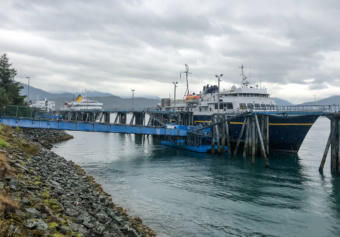
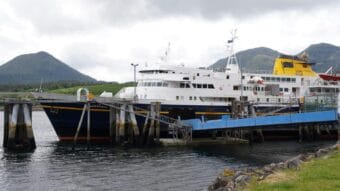
Security guards watch as passenger embark on the ferry Columbia in Ketchikan on Feb. 17, 2023. (Eric Stone/KRBD)

Alaska’s state ferry system continues to face stiff headwinds when it comes to staffing, state officials say.

Alaska Marine Highway officials say they’re struggling to attract and retain workers, especially licensed staff.

AMHS Marine Director Craig Tornga told House committees last week that the ferry system hasn’t been able to offer a seven-ship schedule since the pandemic, and when it comes to engineers and deck officers, he said the situation is getting worse, not better.

“In the licensed officers, both in the engine room and in the wheelhouse, we’re going the wrong direction right now, unfortunately,” he said. “We’re not making as many as we need, and through the retirements and going to the pilots, we’ve been going the wrong direction.”

The Marine Highway System is nearly 10% short of the minimum number of masters and mates it needs to run a full fleet, Tornga said. Add in a cushion in case crewmembers get sick, injured or take leave, and the ferry system is 30% short of its target number of officers. It’s a similar story for licensed engineers and lower-ranking deck crew.

And even among the deck officers the ferry system does have, Tornga said it is still short 31 officers with full pilotage, a qualification for navigating Alaska’s tricky tides and rocky shores that takes years to obtain.

Tornga said the state is working on new ways to help build the ranks of certified pilots: He told lawmakers the Marine Highway is working on a plan that would pay lower-ranking officers a partial salary to do ride-alongs on their way to getting pilotage.

But for now, Tornga said the Alaska Marine Highway System is serving as something of a “farm system” for other maritime employers — like, say, cruise ships, who’ve hired ferry workers away from the state.

“It’s just the nature of our market here with the cruise ship growth — where are you going to get them? You know, there’s a lot of guys that are qualified with pilotage over at AMHS,” he said.

Pay and working conditions are major struggles in recruiting and retention, Tornga said. For one example, masters working for Washington’s state ferry system can earn a full 25% more than they can in Alaska, and unlike their Alaska colleagues, they can go home to their families every night, he said.

Tornga also told lawmakers the ferry system would not run its popular cross-gulf route between Southcentral and Southeast Alaska this summer because the ferry Kennicott is in layup for upgrades.

The cross-gulf route hasn’t made the schedule for years, he said. But there’s demand: When the ferry system tried to make a run last year before mechanical issues forced them to cancel, Alaskans rushed to make reservations, Tornga said.

“When we put that on the schedule, the deck sold out, like, in two days,” he said.

Fundraisers, prayers and songs: Western Alaska mourns crash victims

Dan Grimmer, Nome city clerk, speaks during the vigil. (Ben Townsend/KNOM)

Tears, prayers and words of support filled Old St. Joseph’s Catholic Church in Nome Friday, where people gathered for a vigil to honor the people who died in the crash of Bering Air flight 445 and to support their families.

The plane, carrying nine passengers and a pilot, crashed on its way from Unalakleet to Nome on Thursday afternoon. Following a search by several agencies and volunteers, the U.S. Coast Guard found the Cessna 208B Grand Caravan 34 miles southeast of Nome on Friday. Responders were working to recover the victims, who are all presumed dead, on Saturday.

Nome resident Terry Komonaseak came to the vigil to support friends whose families have ties to the passengers.

“My grandpa always said, Iñupiaq will help Iñupiaq, which makes a lot of sense. Human beings should help human beings,” Komonaseak said. “You never know basically when you’re going to go – this incident has proven that. Hopefully, it’s gotten people closer together.”


About 60 Nome residents gather at the St. Joseph Catholic Church in Nome Friday, Feb. 7, for a vigil to honor the people who died in the crash of Bering Air flight 445. (Ben Townsend/KNOM)

Nine religious leaders from local churches spoke to around 60 people in the pews. Each of them shared a prayer and encouraged residents to rely on their community and local counseling services to help process their grief. Around the region, people were gathering and organizing fundraisers as they began processing the tragedy and searched for ways to heal.

Nome City Clerk Dan Grimmer said that the response to the crash was reverberating across the Nome community, so they wanted to encourage people, regardless of their religious beliefs, to gather.

“It is very difficult to live in this great state without brushing shoulders with your neighbor, without getting to know people from other communities, without becoming friends with them, without becoming family with them. So how do we find comfort when we need comfort?” Grimmer said from the stage. “As we see that others are hurting or they have been traumatized, it is important for us to lend them our strength, to show them love, kindness, patience – all the virtue that we can so that they can lean upon us until they become strong again.”

The crash was not the only tragedy affecting people in the room and in the region. Religious leaders spoke about other recent deaths that residents might be still processing.

“Nome has had its amount of trauma, and this is just something piled up upon trauma which has been here before,” said one of the residents, Stan Burgess.

But a tragedy of this magnitude has not happened in the region in years, said Unalakleet resident and Norton Sound Health Corporation representative Tony Haugen.

“And even to have lost one is one too many,” he said.

Haugen was in Nome because his flight home was canceled. Bering Air suspended its operations after the crash but resumed flights Saturday.

Haugen, who is also a board member of the Alaska Native Tribal Health Consortium, was learning about victims he might have known.

“Two of our employees were among those who perished,” he said.

Haugen said that people have been coming together in communities across Western Alaska.

“When the region has something that occurs like this here, it doesn’t only affect one community,” Haugen said. “We feel the pain region wide.”

Residents in several communities have started fundraisers for the families, like a cake walk in Unalakleet and an auction in Kotzebue. The owners of Kotzebue coffee shop Vibrant Brews said they would direct all Saturday proceeds to the families.

As Bering Air planes began landing again across the region, local residents showed their appreciation for the air carrier. In Savoonga, a group of people gathered at the airport Saturday to greet the incoming flight with Qagughmii’s song in St. Lawrence Island Yupik.

Amber Fernandez and other Shishmaref residents greeted the flight on Saturday, Feb. 8, 2025, to show appreciation for Bering Air and the Bering air pilots following a fatal plane crash. (Photo courtesy Amber Fernandez.)

Grimmer said that Bering Air’s crew is an integral part of Western Alaska communities, with personal ties to residents.

“This is a small region. That pilot was a member of their family,” Grimmer said. “Our heart goes out to them, because I can only imagine what they’re going through.”

Inside the church in Nome, the vigil ended with the crowd rising from their chairs to sing “Amazing Grace”. Then, Nome resident Nellie Weyiouanna spontaneously began the gospel song, “What A Day That Will Be,” as many among the audience joined in.

Alaska could see outsized impacts from Trump’s tariffs, if they all go into effect

The Fraser Border Crossing in Fraser B.C. (Mike Swasey/KHNS)

President Donald Trump sparked widespread concern in Alaska over the weekend when he announced steep tariffs on imports from the United States’ three largest trading partners.

By Monday morning, Trump had partially paused the policy. But that hasn’t stopped worries in Alaska. The tariffs could dramatically impact the state if they go forward. At stake is everything from grocery and lumber prices to the economies of border towns like Haines and Skagway.

“Things will become more expensive. That’s a fact,” said Gregory Wolf, the president of the Alaska International Business Center.

Wolf has worked on trade issues in Alaska for nearly four decades. He said tariff wars, no matter which countries they’re between, are nearly always a “lose-lose situation” – and that this time would likely be no different.

The tariffs came from an executive order on Saturday that placed 25% tariffs on Mexican and Canadian goods, with a lower tariff on energy resources from Canada. Trump also placed a 10% tariff on Chinese goods.

Trump said the tariffs were meant to push the three countries to curb the flow of undocumented immigrants and drugs including fentanyl into the U.S. But economists and lawmakers say the policy could have a sprawling set of unrelated impacts on Alaskans in particular.

Alaska’s unique vulnerability

Take the proposed tariffs on Canadian goods. Alaska is uniquely vulnerable to the policy, due in large part to the state’s reliance on Canada for timber, agricultural products and more. If the tariffs are implemented, the cost of Canadian goods could surge by as much as 25% for Americans, said Kevin Berry, chair of the economics department at the University of Alaska Anchorage.

“We are facing potentially higher costs from any good that’s produced and sold from Canada, as well as smaller markets for our own goods,” he said. “There’s also the potential for disruption when it comes to the Alcan, or transportation to the Lower 48.”

But Alaska also exports goods to Canada. If the tariffs take effect, and Canada were to respond in kind, that would make it more expensive for Alaskan companies to do business with its only neighbor, Berry said. Canada could also strike back by imposing fees for using Canadian highways, for instance, disrupting travel.

Canada is also a major investor in the state. The country has long been the largest investor in Alaskan mining operations, for example. That could change if the tariffs move forward, said Wolf.

Wolf said the same will be true of tariffs on China – and that Alaska has a lot to lose there, too. China has been the state’s top trading partner since 2011, with the exception of a period around 2018 when Trump imposed tariffs on China during his first term.

China already responded to Trump’s tariffs by imposing tariffs of its own on U.S. imports. The back-and-forth means Chinese consumers will pay more for products that U.S. companies want to sell them. Meanwhile, Americans, including Alaskans, will spend more on countless Chinese goods.

“It almost sounds, if you listen to the president, that China will write a check to us,” Wolf said. “That never happens. It’s never happened. It will never happen. The people who pay the tariff are the people in America who import the goods from China.”

Senate Majority Leader Cathy Giessel, R-Anchorage, shares the concern, though there’s not a lot state lawmakers can do about tariffs proposed by the president. Even so, she is drafting a resolution to formally oppose the policy. She says the tariffs would increase prices on a range of goods and necessities — bad news in a state where the cost of living is already exorbitant.

Giessel also emphasized that the tariffs also threaten something else: Alaska’s long-standing relationship with its only neighbor, including as it relates to military defense. She said Canada supports the U.S. Air Force, Navy and Coast Guard when Russian or Chinese aircraft threaten U.S. borders.

“These are significant partnerships that are being jeopardized by the proposal of these tariffs,” Giessel added.

Worries for border communities

Remote communities close to the border could also face impacts. That’s because their cost of living is already high, and they rely more heavily on goods coming from Canada.

“If we think about Haines or elsewhere, where a lot of the access to larger markets is in Canada, this can have an outsized impact on the cost of living,” said Berry, the economics professor from Anchorage.

There’s also Skagway, which sits close to Haines and just 15 miles from the Canadian border. Residents and businesses in the coastal tourist town frequently go to Whitehorse — two hours away — for groceries and other products.

Orion Hanson, a builder and member of the Skagway assembly, says he purchases supplies in Whitehorse for most of the homes he builds. He’s worried the tariffs, assuming they take effect, would make doing so more complicated and expensive.

He points out that Skagway and Alaska more broadly are both already grappling with housing shortages that tariffs would only make worse.

“As a builder, I have a lot of concerns about how much lumber prices would go up,” Hanson said. “I think steel prices would go up. I think concrete prices would go up. Let alone if fuel prices go up, that’s going to affect every facet of the economy.”

The tariffs may disrupt businesses like Hanson’s, depending on how much money they spend on Canadian goods. But the tariffs are less likely to impact residents who drive to Whitehorse for groceries or other supplies. That’s because they’re meant to target large scale importers and exporters, Wolf said.

The nitty-gritty details of the tariffs remain to be seen – as does whether they’ll even take force. But Hanson said the stakes are high.

“The cost of living is very expensive in Skagway. And I’m concerned that this would exacerbate that and make it worse and make it harder to live here year-round,” Hanson said.

The proposed tariffs on Canada and Mexico have been paused through February to allow for negotiations over steps the countries will take to crack down on border security and drug trafficking.

U.S. Senator Lisa Murkowski welcomed the pause in a statement on Tuesday.

“I’m glad to see that both Mexico and Canada are stepping up and working with President Trump to address border security and the fentanyl crisis. Our countries must work together to keep our people safe,” she said.

The tariffs on Chinese products took effect Tuesday. China responded by announcing its own tariffs on coal, crude oil and other U.S. imports.

Delta pulls out of Ketchikan and Sitka, leaving Alaska Airlines as the only major carrier

Delta's first flight of the summer season touched down in Juneau at 8:49 p.m. May 30 with 120 passengers from Seattle. (Photo by Heather Bryant/KTOO)
A Delta Air Lines flight touches down in Juneau. (Photo by Heather Bryant/KTOO)

Delta Air Lines has pulled its bookings for summer flights to both Ketchikan and Sitka, a seasonal service it had offered for nearly a decade. That leaves Alaska Airlines as the only major carrier in the two communities.

Scott Habberstad oversees community relations for the Alaska market of Alaska Airlines. During a Ketchikan Chamber of Commerce luncheon days after Delta’s Jan. 11 pull-out, Habberstad gave a presentation and took questions from the audience.

Habberstad said he was disappointed to see his competitor go.

“I love the fact that Delta was here, because competition makes you better, right? Really does,” he said.

But Habberstad was adamant that losing Delta would not affect the cost of flights in and out of Ketchikan.

“The fares will be the same as they were last year, as they were this year, and they’ll be the same next year,” Habberstad said. “We’re not here to gouge, we’re here to stay.”

Since 2015, Delta had been offering once-daily flights connecting both Ketchikan and Sitka to Seattle during the busy summer months. As the carrier has expanded its hub in Seattle, it has increasingly challenged Alaska Airlines’ dominance in its namesake state. That competition has meant lower prices for customers.

Scott McMurren, the long-time publisher of the Alaska Travelgram newsletter and travel columnist for the Anchorage Daily News, tracks the price of Alaska flights for a living. He said each time Delta has entered a city previously dominated by Alaska Airlines, prices have dropped.

And since Delta pulled its seasonal flights in Ketchikan, McMurren said Alaska Airlines’ prices already look to be substantially higher for the upcoming summer than they were last year.

“It’s important to just understand that when there is a monopoly in the market, prices drift up,” he said. “And this is not exclusive with Alaska Airlines, Delta does the same thing. All airlines do the same thing.”

But Habberstad insists Alaska Airlines does not intend to raise prices. In a phone call with KRBD, Habberstad said that the apparent increase could be due to sale pricing.

“It’s possible that there was a sale fare in the market, a special sale fare, for some reason when you were looking at it, and there may not be a sale fare today,” he said.

As for Delta, the Sitka and Ketchikan flights apparently just weren’t getting enough passengers to pencil out. In a statement sent to KRBD, a Delta representative said to better meet demand, those aircraft are being reallocated to Bozeman, Montana, “a market with strong year-round demand from Seattle.”

But the airline is continuing to expand in the state’s biggest cities. Delta has recently added a new route from Fairbanks to Salt Lake City and from Anchorage to Los Angeles.

Site notifications
Update notification options
Subscribe to notifications