Transportation

Broken ferry cable leaves Kake residents stuck in Juneau ahead of Thanksgiving

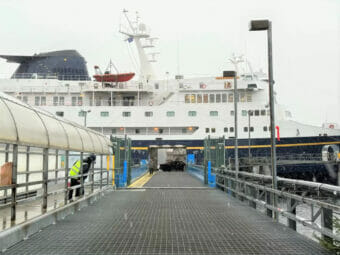
The MV Hubbard, photographed on Friday, Aug. 18, 2023. (Katie Anastas/KTOO)

A ferry attempting to moor in the Southeast Alaska village of Kake on Saturday was forced to return to Juneau after a cable that secures it to the dock broke. 

It left many Kake residents stuck in the capital city along with their vehicles and perishable foods like turkeys and vegetables ahead of Thanksgiving.

They were aboard the M/V Hubbard ferry, which traveled from Juneau and was supposed to moor in Kake on Saturday when it ran into a bit of a problem.

Danielle Tessen, spokesperson for the Alaska Marine Highway System, said the issue was caused by unexpectedly high-speed winds. 

“So what happened is the vessel mooring wire — which is what we use to attach or secure the vessel to the dock — had parted, which means it broke,” she said. “So, on Saturday, that vessel was unable to dock and let the folks off, and had to go back to Juneau.”

That meant the passengers had to quickly find lodging and a place to store their items and vehicles until they could make it home. In the interim, the Central Council of the Tlingit and Haida Indian Tribes of Alaska quickly offered to provide a connex as a temporary storage solution to keep perishable items from going bad. 

Kake is a remote village of about 500 residents that doesn’t have easy access to goods without flying or boating them in. Tessen said they’re working hard to try to get the cable fixed as soon as possible. 

“We’re focused on fixing that vessel mooring wire before Wednesday, so people can have their vehicles, which are filled of Thanksgiving goods that come home, and have before Thanksgiving,” she said. “If we’re unable to do that by Wednesday, it looks like Saturday is the day that people’s vehicles will be able to travel on the Hubbard back home.”

The cable breaking also meant people trying to board the ferry were stuck in Kake, including two traveling high school volleyball teams from Gustavus and Prince of Wales Island.

Anji Gallanos, the superintendent of Kake City School District, said the community heavily relies on the ferry being consistent and showing up, especially for sports. In the wintertime, the ferry only visits twice a month

“We loved hosting these games, but as you can imagine, having 36 extra visitors in a town with no restaurant and no real services for those kids meant that our community did a wonderful job of collaborating to bring in meals and food and really just extra support for those kids,” she said. “But all of this hinged on the fact that we really needed to have the ferry show up.”

All students were able to fly back home by seaplane, and Tessen said it’s working on a case-by-case basis to offer reimbursements to people impacted by the situation.

Gallanos said for years the community has advocated for the ferry to stop in Kake more often during the winter. She said this weekend’s dilemma highlights why. 

“We continue to advocate, and we continue to work with the Alaska Marine Highway System of the Department of Transportation to ensure that we can get more ferry service,” she said. “But it’s been an ongoing need to continually advocate for ferry support that we so desperately rely on in this community.”

According to Tessen, Kake’s ferry terminal is scheduled to get upgrades as part of the Statewide Transportation Improvement Plan in the coming years.

State ferry Tustumena’s replacement could face years of construction setbacks

A computer-generated mockup of the new Tustumena replacement ferry is seen in an undated image published by the Alaska Department of Transportation and Public Facilities. (DOT image)

State ferry passengers will have to wait even longer to sail on the ferry Tustumena’s replacement vessel. The more than $300 million project is not expected to be completed until at least the end of 2028 – a year later than originally anticipated.

Earlier this year the Alaska Marine Highway System had been estimating the new mainliner ferry would be done in 2027. But during an AMHS operations board meeting on Oct. 23, Director Craig Tornga said a Federal Transit Authority funding audit and long checklist of requirements has slowed things down.

“We’re still working through the programmatic side with the FTA,” Tornga explained. “We’re getting close. The FTA has commented that we’d have pre-award authority for all of the Tustumena funding by the end of the year.”

Once AMHS is given pre-award authority, Tornga said that essentially means then the Tustumena replacement project will be authorized to start soliciting bids.

Glosten, an architecture firm which has an office in Seattle, completed the final design for the replacement vessel back in 2022, but the project has yet to go out to bid for construction. The project’s request for proposal was expected to go out much earlier this year, and construction could have begun by December. Now, Tornga said that won’t happen until later this year.

That means the new Tustumena won’t likely be in service until 2030, making the original vessel 66 years old by the time it is fully retired. Tornga said there are several shipyards that have expressed interest in building the new ferry. The new vessel would be one of potentially several hybrid-electric ferries the marine highway system plans to have constructed in the coming years as part of its long-range plan.

The replacement vessel is set to be bigger than the existing Tustumena, carrying 250 passengers and up to 58 vehicles. In conjunction with the project, the ferry system is also looking to upgrade some of its terminals and infrastructure at various coastal locations across the state.

Meanwhile the Tustumena is in the midst of its scheduled winter sailings. The ferry’s last trip to Kodiak of the season is scheduled to arrive from Homer on New Year’s Day and depart for the last time that same evening.

After that the vessel goes into its annual overhaul, where it will receive much needed maintenance from January until April of 2025.

6 new hybrid ferries part of Alaska ferry system’s 20-year plan

A seating area on the Tazlina ferry on March 9, 2023. (Katie Anastas/KTOO)

The Alaska Marine Highway System’s plan for the next 20 years includes building six new hybrid ferries, increasing port calls, and recruiting Alaskans for jobs. New details of the plan were discussed at a day-long meeting in Anchorage on Oct. 23.

The plan stems from over a year of data crunching through engineering and research groups and gathering information from regional ferry groups and the public. The plan still needs to be approved by Governor Mike Dunleavy and the Alaska Legislature following a month-long public comment period.

However, the volunteer board that advises the ferry system, the Alaska Marine Highway Operations Board, voiced its support.

“It’s a new day,” said board member Wanneta Ayers. “This is a watershed moment to have this plan. And so, I’m hopeful.”

Hope is what many coastal Alaskans have been hanging on to in recent years as ferry services diminished. Some communities that used to get weekly service, are down to once a month or none in the winter.

The long-range plan aims to double port calls over the next two decades. Officials with the Alaska Marine Highway System (AMHS) think that’s possible, in part, by replacing the 50 and 60-year-old vessels with six new hybrids. The old ships break down, and there aren’t enough replacement ferries in the fleet, so vessels get docked, and sailings get canceled.

“They’ll just be more efficient vessels,” said AMHS Marine Director Craig Tornga. “And they’ll be purposely designed for their intended routes

Tornga said the hybrid fleet will be more reliable because of their backup battery systems.

“All of our boats will be hybrid because we always want redundancy in the system,” he said.

How the new fleet will be paid for isn’t clear. For certain, it won’t be from fares alone and the ferry system will continue to rely on federal grants. Recent federal awards come from the Bipartisan Infrastructure Law, which has designated $700 million to Alaska’s ferry projects.

Still, that only goes so far. Ferries are expensive – a new large one costs over $300 million. Governor Mike Dunleavy has vetoed millions in state funding for the marine highway system nearly every year he’s been in office. ( $5 million in 2019$13 million in 2020$8.5 million in 2021, $10 million in 2023, and another $10 million this year.)

The long-range plan is looking at new ways to raise revenue such as adding gift shops in terminals. Board Chair Shirley Marquardt said the plan will hopefully bring more stable revenue.

“This is never going to be a business, because it’s a function of the state,” she said. “However, the more it can operate as a business, the more it can operate with autonomy, the better chance the system has of avoiding so many snares and pitfalls we’ve had in the past that have done nothing, nothing good for the system.”

Who will run the future ferries is another story. Higher-level maritime workers need special certifications. But the system has long suffered from a shortage of those workers. The shortage even led to some vessels being tied up. Tornga said the long-range plan seeks to recruit Alaskans because they turn over less often than workers from out of state.

“We’re going to have a pathway as we start hiring Alaskans working in the high schools, introducing them to the maritime industry, and then having the system in place where they can see their pathway,” Tornga said.

AMHS also wants to digitize its system for scheduling, timesheets, work-rest logs, and crew certifications. Tornga said that’s still all on paper.

“We’ve been, I think I could say, in a 20-year time warp in this category, where we still have paper systems for payroll and everything else,” Tornga said.

The long-range plan includes infrastructure improvement projects for the system’s terminals and docks. They’re considering a new floating dock in Yakutat, a road built across Baranof Island to Sitka, and a new connection to the Lower 48.

One terminal still in question is at Prince Rupert, British Columbia. It closed five years ago, eliminating road access for many Southeast residents.

Ketchikan resident Lynne Dahl told the board to look at a new Alaska-based site.

“I’m suggesting that the board seriously consider building a dock and terminal in Hyder for residents of Southeast Alaska to get that road access through British Columbia, because Hyder is less than two miles from the Canadian border,” Dahl said.

Officials at the meeting said they could look at the feasibility of a Hyder location if they can’t come to terms with B.C. officials on over $20 million worth of repairs needed at the Prince Rupert dock. Both locations are about 1,000 miles to Seattle by road.

But when will these long-range improvements be felt by communities?

“The ‘when’ question keeps coming up,” Rep. Rebecca Himschoot of Sitka told the board. She represents a few dozen Southeast island communities in the Alaska Legislature. “What can I tell my constituents as a timeline — when can we start to see some things changing?”

Years, in some cases. Bringing new ferries online can take longer than expected. For example, the replacement vessel for the Tustumena keeps getting bumped further back. Now, it might not be done for another five years, according to the new plan.

There are still a few months before the long-range plan is made public. AMHS must get the final draft to the Commissioner of the Department of Transportation Ryan Anderson by the end of the year.

Then there will be a month-long public comment period before it heads to the governor and state Legislature for final approval.

Alaska’s 20-year ferry plan nears completion

The view from the solarium deck of the M/V Columbia near Klemtu, British Columbia. The M/V Columbia’s route often begins in Bellingham, Washington and travels up the Inside Passage to serve Southeast Alaska communities such as Ketchikan, Wrangell, Petersburg, Juneau, Haines, Sitka, and Skagway. (Jack Darrell/KRBD)

The Alaska Marine Highway System expects to roll out its long-range plan early next year, setting the course for the next 20 years.

It was recently discussed at the annual Southeast Conference. The final details are still being figured out.

“Our vision is for the 2045 long-range plan to chart a path forward to a thriving system,” said Craig Tornga, director of the Alaska Marine Highway System or AMHS. “It really defines our vision, sets our goals and develops our strategies for the future, and it also provides the framework for decision making and our resource allocation and then ensures that the future actions we take align with our vision.”

Tornga addressed the future of the state’s ferry system to hundreds who had gathered in Ketchikan last month for the Southeast Conference, which is a regional nonprofit that advocates for economic development.

AMHS convened a team to plan for the future – it included members of the conference, contractors, and the Alaska Marine Highway Operations Board, which advises the state on the ferry system.

The team held meetings with regional ferry groups across the state. And over the past year, they conducted a system-wide survey that received over 2,600 responses. It was compiled by the Anchorage-based McKinley Research Group led by Katie Berry. She said the number one concern was being able to rely on sailings.

“Reliability, Reliability, Reliability is what the communities and residents most impacted by the marine highway system want,” said Berry.

Like any other boat, it’s normal for things to break down on ferries especially when the state’s fleet is aging. Of the nine AMHS ferries, one is 60 years old, two are 50 years old and one is 47. The Tustumena is 60 years old, the Columbia and Leconte are both 50, and the Aurora is 47. There also aren’t enough replacement ferries in Alaska’s fleet for when things go wrong – meaning vessels get docked and sailings get canceled.

As for what ferries are used for, most of the McKinley survey’s respondents said that they use the ferry service to connect to the Lower 48, to the road system, for medical care, and for shopping. Other forms of transportation are most limited due to the cost and weather. Survey results have been broken down by community and are available online at DOT’s website.

The planning team came up with eight possible long-range service scenarios and paired them down to four. Now, Berry said, they’re figuring out which will be the best one.

“I want to be really clear that a plan like this is not something that you publish, and next year, Craig can snap his fingers and say, ‘Great, here’s your increase in service for all of these communities,’” Berry said. “It really will take this dedicated work in each of these focus areas to move on a 20-year path.”

One certainty in the long-term plan is replacing the 60-year-old Tustumena that serves the Kodiak and Homer areas and the Aleutians. The Tustumena Replacement Vessel, or TRV as it’s called, will have a backup battery system, making it the first hybrid vessel in the fleet. Siemens Energy is the engineering group working on those elements. Engineer Ed Schwarz said hybrid and battery-powered vessels are the future.

“When I first started, seven-eight years ago, working in this kind of systems hybrid business, you would have to go to Scandinavia to actually see one of these vessels running,” he said. “You’d have to go to Norway, you have to go to Germany, or Denmark or something like that to actually get on one of these vessels.”

Now, he said, hybrid ferries are in New York, Texas, and Washington. He said the newer systems require new safety measures – especially because the service life of ferries ends up being a lot longer than planned.

“When you’re integrating new technology, you’re changing the safety requirements on board the vessel,” Schwarz said. “So, training of people is really important, making sure that we’re conforming with the Coast Guard requirements for this new technology.”

The new hybrid Tustumena won’t be ready for sailing until 2027 or 28. And the estimated $315 million price tag is almost entirely covered by federal dollars.

Meanwhile, AMHS plans to have its final long-range plan report done by the end of the year and release the plan to the public at the start of next year.

The public still has time to give input – the Alaska Marine Highway Operations Board will take comments at its meeting on Oct. 23.

Tornga said they’ll revisit the plan annually in the years to come to keep it relevant.

The Alaska-Hawaiian acquisition is complete. What does it mean for Alaskans?

Alaska Airlines planes taxi to and from various Seattle-Tacoma International Airport gates on Jan. 5, 2022. (Jeff Chen/Alaska Public Media)

Alaska Airlines completed its $1.9 billion acquisition of Hawaiian Airlines on Sept. 18. Alaska Airlines is promising customers the ability to purchase flights on both websites, and more options for redeeming miles on international routes. The U.S. Transportation Department is requiring the airlines maintain service to Alaska and Hawaii’s rural communities.

Alaska Airlines did not respond to a request for comment.

But what do we know about what the deal means for travelers in Hawaii and Alaska? Scott McMurren, who writes the Alaska Travelgram newsletter, said the deal has benefits for Alaskans.

Scott McMurren: I think that the big benefit for Alaskans is access to Hawaiian’s international routes. Pago Pago in American Samoa, they also go to Tahiti, Auckland and Sydney. And then also, Hawaiian flies to four airports in Japan, and also to Seoul, South Korea. Those are, to me, the nuggets of this Hawaiian deal for Alaskans.

Ava White: Do you have any insight on what the potential downsides for Alaskans might be?

SM: I think that there’s a possibility of some dilution of that reward pool. And this goes even without the Hawaiian purchase. Frequent flier miles in general, and Alaska Airlines miles and Hawaiian miles in particular, are a depreciating asset. It’s like driving a new car off the lot. I think that this may serve Alaska’s corporate ambitions nicely, but it goes towards diluting the rewards going forward, in a general way.

AW: How might this impact tourism in Alaska?

SM: Just as it offers more options for us to go south, it also offers more options for Pacific Islanders and those in the South Pacific to come north. If you talk about tourism in Alaska, you gotta talk about the cruise numbers, and the airlift goes primarily to support those big numbers. You’re really talking about, you know, moving cruise passengers in and moving cruise passengers out.

AW: In Hawaii, the stakes of the deal are much higher. Residents are worried about potentially higher ticket costs and losing inter-island routes when the transportation department protections expire in 2030.

Hawaiian’s CEO, Joe Sprague, told Hawaii Public Radio the deal will preserve thousands of union jobs, and the majority of non-union workers will “receive some form of offer to continue forward with the company.”

I spoke with Hawaii Public Radio reporter Catherine Cruz, who’s been covering this issue and met with Hawaiian’s CEO earlier this week. She said Hawaiians are apprehensive about the acquisition.

Catherine Cruz: We have seen many airlines go out of business. And it’s not pretty, you know, from the loss of jobs with pilots and flight attendants and ground crew or cargo, you know, call centers, it’s tough. And as an island state, we depend on our harbors and our airports. There are, they are our lifelines. So whenever any of our airlines are in trouble financially, you know, we get worried.

Many of our workers head to the neighbor islands for construction jobs. So any loss of service is a big one. There’s also concern about folks [who] often fly to Honolulu for medical reasons, for doctor’s appointments, that kind of thing. So we really are the lifeline.

AW: Alaska Airlines has said it will keep the Hawaiian brand, what’s holding Alaska Airlines to this commitment?

CC: The regulators have weighed in, our governor has weighed in. A lot of folks have expressed the desire to keep our brand, just because it reflects a lot of the culture here in Hawaii. But we are nervous because we do have outside companies swoop in, and they do make changes. We just have to hold them, hold their feet to the fire.

AW: Honolulu is already bustling with tourism. Do you think that this could strain resources more?

CC: Obviously the hoteliers want to see their hotels filled, maybe residents don’t want to see 10 million visitors, like what we saw just before the pandemic. So, yeah, there needs to be a balance. There is an effort to try and manage the visitor numbers. So you know, you have to strike a balance between providing the transportation of service between the different islands and keeping our economy pumping.

Juneau planning commission OKs $8.5M roundabout project in Mendenhall Valley

Cars drive through where Mendenhall Loop Road intersects with Valley Boulevard and Mendenhall Boulevard on Thursday, Sept. 26, 2024. (Clarise Larson/KTOO)

A new roundabout in the Mendenhall Valley got approval to move forward from the Juneau Planning Commission earlier this week.   

Commission members voted 4-1 in favor of building a roundabout where Mendenhall Loop Road intersects with Valley and Mendenhall Boulevards. That’s despite receiving a number of public comments — including one from a member of the commission — asking them to shoot it down. 

On Tuesday, four commissioners recused themselves from voting on the project. That included commissioner Lacey Derr, who cited a conflict of interest because she lives near the intersection. But, in a written statement, she voiced concerns over hazards and congestion another roundabout could bring to the area. 

But some residents showed support for the project. Heidi Stears wrote to the commission that a roundabout at that location would improve traffic flow and reduce accidents.

According to a city report, the intersection has seen a series of accidents with minor injuries since traffic lights were added in 2004. It says the purpose of the roundabout is to improve the safety of the area for both vehicles and pedestrians.

Once constructed, the project would be the third roundabout on Mendenhall Loop Road. It’s estimated to cost $8.5 million and is scheduled to begin construction next April. The project is being done through the state’s Department of Transportation and Public Facilities.

Despite approval from the commission, the project could still face one more hurdle before being greenlit. The Juneau Assembly can choose to take up the issue if members want to voice opposition or modify the project. They have until Oct. 24 to do so.

Site notifications
Update notification options
Subscribe to notifications