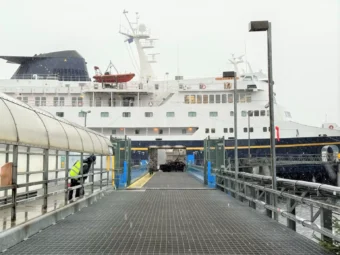
The 418-foot-long Columbia ferry is docked at the Vigor shipyard in Ketchikan, getting repairs, June 21, 2023. (Photo by Mikko Wilson/KTOO)
The Alaska Marine Highway System has been awarded $177.4 million to go towards operational costs, bringing WiFi to passengers and replacing the oldest ferry in the fleet.
Alaska’s Congressional Delegation announced the new funds on Friday.
Alaska Department of Transportation spokesperson Sam Dapcevich said they don’t yet know all the details of how the money will be spent. However, a big portion – $106.4 million – will go towards replacing the 60-year-old Tustumena or “Tusty” that serves Kodiak, Homer, and the Aleutian Islands.
“That caps off our funding needed for the current estimate to replace the Tusty,” Dapcevich said.
$66 million of the new federal funds is going to “support sustainable operations for rural communities.” Dapcevich said the state hasn’t yet determined exactly how that money will be spent, but that it will be used for operational costs.
$5 million is earmarked for setting up WiFi on all the ferries. Starlink is already available for crew and operations, but this would extend internet access to passengers.
“It requires adding access points throughout the vessel – you can’t just drop one router on top and everybody has service,” Dapcevich said. “So, that’ll take some time to, you know, wire everything in, and it would need to be firewalled from operations. So, it’ll take a little bit of time to implement, but I think in the long run, it’ll be a lot like Alaska Airlines, where a person can hop on and have a connection.”
Up until a few years ago, federal funding for Alaska’s ferry system came through the Federal Highway Administration. Now, it’s through the Federal Transit Administration, which Dapcevich said helps separate the ferry system from other transportation needs.
“AMHS used to come out of the same pot as the regular highways and airports and all that, and now it’s coming out of the FTA, which I think is an improvement,” he said.
Recent federal awards come from the Bipartisan Infrastructure Law, which has designated $700 million to Alaska’s ferry projects over the last three years.
The state ferry Malaspina sits in layup in Ward Cove near Ketchikan on May 10, 2020. (Photo by Eric Stone/KRBD)
A fire broke out on the decommissioned state ferry Malaspina in Ketchikan’s Ward Cove on Tuesday night, but was extinguished without injuries.
North Tongass Volunteer Fire Department Chief Jerry Kiffer said the fire aboard the vessel, which is being used as a bunkhouse for workers in Ward Cove, was reported at about 7:30 p.m. Tuesday. When firefighters arrived, there were no visible flames or smoke.
“We made contact with the owner of the vessel,” Kiffer said. “He indicated there was a fire on Deck 1 that had a storage area that had toiletries and cleaning supplies. It was located in an area that was fairly remote from the cabins, and was confined just to that particular room.”
Kiffer says the fire had been quickly contained by those aboard the Malaspina. When the fire was discovered by crew, they attempted to put it out with hand-held fire extinguishers but were unsuccessful. They then used a hose from one of the Malaspina’s fire stations to tamp down the fire.
“Our crew came in and finished extinguishment, completed overhaul and ventilated the ship,” he said.
Kiffer said there was smoke in the aft part of the ship. Although nobody was hurt, several people onboard were evaluated just to be safe.
Kiffer commended those aboard for their quick response when fire alarms sounded.
“Because the crew was onboard, because the crew acted quickly, they were able to knock that fire down to a point where it was safe for our crew to make entry onto the ship,” he said. “So kudos to them. They did a pretty decent job.”
Kiffer says fire department personnel wrapped up a little after 9:00 p.m. Tuesday night. The cause of the fire is under investigation.
The intersection by the Fred Meyer grocery store — where Yandukin Drive crosses Egan Drive — has long been one of Juneau’s most accident-prone areas. Dozens of crashes, some deadly, have occurred there over the years.
Sam Dapcevich, a spokesperson for the Alaska Department of Transportation, said making the state-owned intersection safer has been a long time coming.
“I know that it’s a very high priority for DOT, and DOT knows from our frequent communications with the community that it’s a high priority for Juneau, too,” he said. “So we are working hard to get it done.”
Juneau residents have been vocal about the need for safety changes for at least two decades. And, last fall the Juneau Assembly passed a resolution asking the state to make “immediate and substantial improvements” at the intersection following a fatal crash there just months before.
Recently, the state’s Department of Transportation and Public Facilities made small changes like extending the medians there, painting clearer markings and introducing a seasonal speed limit reduction.
But now, officials are looking for a company to design more substantive changes — like adding a traffic light, a pedestrian crossing and an alternative route.
Dapevich said the department hopes to start construction by 2026. The updates will happen in phases.
“We’ve got a great contractor team who’s going to review everything and make sure that we cross all the t’s and dot all the i’s, and we’re going to try to expedite it as much as possible,” he said.
In total, the improvements are expected to cost between $23 and $47 million. Most of that will likely be funded using federal-aid highway program funds.
The Tustumena arrives in Kodiak Wednesday, Aug. 7, 2024 after sailing under the bridge to Near Island. (Brian Venua/KMXT)
Kodiak residents gathered Wednesday to honor the state ferry Tustumena, which began service 60 years ago in 1964 and has become an icon for the Alaska Marine Highway System.
Affectionately known as the “Trusty Tusty,” the boat has been the sole ferry to serve Kodiak Archipelago communities the last few years.
The ferry was a few hours late because of the weather, but still hours ahead of the party planned for her. She has sometimes been called the “Rusty Tusty” when there are delays like this one.
John Mayer captained the ferry as she finally pulled in, greeted by folks waiting for friends and family to arrive. He spent nearly his entire 23-year career with the Alaska Marine Highway System on the Tustumena.
He said his favorite part is getting to meet the people he shuttles between communities.
“I love seeing us bring families into Kodiak and they’ll (be) waving to their family members on the dock and bringing people together,” he said.
Tustumena Captain John Mayer says he never gets tired of the views from the boat, but his favorite part of the ship is his bed, and sometimes the bar. (Brian Venua/KMXT)
He shuttles more than just passengers though. Over the years the Tusty’s brought many cars, vendors for Crab Fest, and even livestock to Kodiak Island.
The Tustumena is an icon in the state ferry fleet. She first arrived in 1964 from a shipyard all the way in Wisconsin. For the last several years she’s been running the Kodiak and Aleutian route and faced some of the toughest weather a boat can.
That wear is starting to show now though – the ship has spent extra time in yards for repairs and her hull has rust and a few cracks on her sides. Sixty years marks about double the amount of time her designers expected her to be in service.
Mayer said that’s why he talked to state Rep. Louise Stutes, R-Kodiak, about throwing the Tusty a 60th anniversary celebration.
“The genesis of this party idea was just over lunch one day, I was speaking with Representative Stutes, I said ‘Yeah, we should have a party,’ and now see what happened!” the captain said.
The Tusty’s horn blared to call the crowd’s attention as state Rep. Louise Stutes, R-Kodiak, began the lineup for speeches. (Brian Venua/KMXT)
Stutes has been a frequent voice of support for the ferry system to the Alaska State Legislature.
For the 60th anniversary, she partnered with several local businesses, nonprofits, and City of Kodiak Police to set up a block party at the ferry dock in town.
“It’s a feel-good for the community,” she said. “It really is a wonderful thing.”
Hundreds of people came for the celebration, with some sporting ferry-themed shirts and hats. People shared stories, learned about the vessel’s history, the Alutiiq Dancers performed, and there were even guided tours of the old boat. There were also free hot dogs and burgers in addition to food trucks nearby.
Kodiak Ferry Terminal Manager Amanda Becker said that although the terminal is visited by other ferries, named after the state’s glaciers, there’s something special between the Tusty and the island town.
“I mean Kennicott comes too and it’s okay,” she said. “But the Tusty is, she’s our old girl and she’s got character, she’s got an incredible crew.”
Becker is also usually the person to announce to Kodiak when the ship has maintenance delays and cancellations.
One of the overarching questions though is: When will the ship be retired?
The Tustumena’s replacement is expected to cost over $315 million, but the state has only set aside about $180 million for it.
The aging ferry has had several renovations like expanding its length and replacing several parts throughout its service. (Brian Venua/KMXT)
Stutes said progress getting funds to replace the Tusty is slow but she’s hoping for the best.
“I’m an optimist – we’re moving forward and in the meantime they’re doing a good job keeping the Tustumena safe for passengers and for operation,” She said.
Mayer said he’s been trying to take care of the Tustumena the best that he can.
“This ship isn’t getting any younger, – and I’m not either,” he said. “Y’know, 20 years ago they would take her out in rougher weather than I’m doing now, but I’m trying to be kind to the ship.”
Ryan Anderson, the commissioner of Alaska’s Department of Transportation, said his team is working to find any way they can to secure more funding from the federal government like through a toll credit program.
“It turns out that the Federal Highway Administration has a program that when you invest in your ship, so all the maintenance, all the overhauls, we use our revenues and we invest in those things, we can get credit for that,” Anderson told KMXT.
State Transportation Commissioner Ryan Anderson shows off his painted piece of the historic ferry’s hull. (Brian Venua/KMXT)
All of that money goes towards the state’s side of matching contributions for federal grants. The department has already started soliciting designs for parts of the replacement ferry like its elevator for cars.
“That elevator that’s on the Tustumena – that’s a very unique thing for a ferry and so we actually have to use that elevator as a model to design the new one,” he said. “So we’ve already got the contracts out for things like the elevator design.”
The Tustumena’s elevator can lift up to about 4,000 pounds at a time and spins to make loading easier. (Brian Venua/KMXT)
He also gave a speech at the party recognizing the importance of Alaska’s ferry system and shared some of the plans for the replacement.
“The new vessel is going to be bigger, it’s going to be longer, it’s going to be wider,” Anderson told the crowd. “It’s going to hold more people, it’s going to hold more cars and it’s going to be more efficient on top of that and the operating costs will be less.”
He said he hopes to have a new boat as soon as 2027.
There were also speeches from other high-profile individuals like Alaska Senate President Gary Stevens, City of Kodiak Mayor Pat Branson, Kodiak Island Borough Mayor Scott Arndt, Homer Mayor Ken Castner, and a poem written by Stutes’ husband, Stormy. U.S. Sen Lisa Murkowski was also slated to make an appearance but had last-minute plans with her family.
Mayer said he hopes to see that new boat and let the “Trusty Tusty” retire soon.
“In the maritime industry, it’s amazingly remarkable yet regrettable that she’s made it to 60 years,” Mayer said. “It behooves us to take a look back and see how much effort and funding and muscle and sweat that went into keeping her going all these years.”
For now though, the Tustumena is scheduled to sail the Kodiak and Aleutian route until it docks in the winter for repairs.
The Tustumena was decorated from the stern all the way to her bow with flags waving in a light breeze. (Brian Venua/KMXT)
Juneau Community Service Officer Nico Burris drives past City Hall while on duty in July 2024. (Clarise Larson/KTOO)
Juneau Police Department’s parking enforcement vehicles don’t look intimidating at first glance. The three-wheeled Go-4s look like they could roll over if they took too sharp of a turn.
Community Service Officer Nico Burris is one of the officers in charge of parking enforcement downtown using those vehicles.
“It’s kind of like a golf cart on steroids — it goes 40 miles per hour,” he said. “They’re basically custom-built for little patrol-type tasks and they’re pretty well suited to the narrow downtown streets and alleys here in downtown Juneau.”
Soon, Burris and the other officers will be doling out more expensive tickets for vehicles that they catch violating laws in downtown parking facilities. On Monday, the Juneau Assembly voted to increase parking penalties in city-owned garages using a tiered penalty structure.
That’s despite some members like Mayor Beth Weldon, who during an earlier meeting admitted she sometimes pushes the limits of her allotted parking time.
“I’m sure everybody else is very well organized and leaves lots of room between their times that they have to get there, but sometimes my life doesn’t allow that and so I may hit a little bit of a yellow line every once in a while,” she said.
Juneau Parks and Recreation Director George Schaaf said the new structure is aimed at deterring repeat offenders. It’s the first rate hike since 2013.
“What we’re proposing is an escalated fine structure so that we still understand people make mistakes we still issue warnings, but after two or three offenses people should understand what’s going on and we would like to try to get those folks to follow the rules by getting parking permits,” he said.
Starting on Aug. 28, the current $25 ticket for a first parking offense will bump up to $35. If you get two of those tickets, the third one will increase to $100, followed by $200, then $300. This applies to city-owned parking garages and facilities, but on-street parking fines will remain the same at $25 per violation.
The upgrades include new electronic pay stations, security cameras, a parking app and an online permitting system. It also added new cameras on the parking enforcement vehicles that can scan license plate numbers.
Alaska Seaplanes’ Pilatus PC-12, parked on the ramp at Erik Nielsen Whitehorse International Airport (Photo by Carl Ramseth/Alaska Seaplanes)
One unpleasant aspect of winter living in the northern Lynn Canal is transportation.
Sometimes the ferry isn’t running. So when Haines residents try to catch a flight to Juneau, they watch the sky expectantly, hoping the cloud cover will lift and allow small planes to land. Sometimes, this can last for days.
Here’s some good news: officials from Alaska Seaplanes say flight cancellations should be drastically reduced this winter. The company has recently rolled out new instrument navigation approaches to a number of Southeast communities, including Haines.
“IFR, so the flight rules under instruments, we are actually allowed to penetrate the clouds and not see anything but still just as safe as we are when we are flying VFR, if not safer,” said Gregg Hake, a pilot with Alaska Seaplanes.
He said there are two ways to pilot a plane. One is Visual Flight Rules, or VFR, which is often how smaller planes are flown. Pilots use their eyes to situate themselves within the landscape. The other is Instrument Flight Rules, or IFR. That’s the high tech way of flying where the instruments do the tracking. The pilot has to trust the technology, and follow a path — also known as an approach — that is recorded in the navigation system.
“If you imagine a tunnel through the sky at different altitudes, and around the terrain, that takes you from whatever altitude the approach starts at, down to the runway essentially, or close to the runway,” Hake said.
IFR is already in use in Southeast Alaska. The Federal Aviation Administration produces public approaches that are valid for all airplanes equipped with IFR systems. Hake said these are broadly used in the Lower 48, and there isn’t much to improve on.
“But it’s places like Southeast Alaska that are just so tricky to operate in and out of and there isn’t the same traffic volume that you would see down south, so the FAA doesn’t commit perhaps the same level of resources to producing more exotic approaches that we need,” he said.
But the FAA also certifies private approaches that are produced by particular operators. These approaches are tailored to a specific airplane’s capacity. This is the upgrade Alaska Seaplanes has recently rolled out.
Pilot Cable Wells has spent the last few years developing approaches for Island Air and its parent company, Alaska Seaplanes. There are many steps to the process.
“Site surveys, terrain surveys, figuring out what is possible to do in the terrain that still meets all the FAA requirements,” Wells said. “And then you have to go out and flight check everything, equip the aircraft with all sorts of sensors, and collate all this data and send it to the FAA for approval process.”
Wells said it takes a couple years to get an approach certified. In April, Alaska Seaplanes introduced new approaches for eight towns across Southeast, including Haines, Juneau, Kake, Klawock, Hoonah, Petersburg, Wrangell and Sitka.
Andy Kline is the marketing director for the company. He explained what the advantages are over the old approaches.
“Once you get to the runway, you have to be able to still see the runway at a certain limit,” Kline said. “But those limits have been lowered based on these new approaches and this new technology. And that’s one of the big reasons why we are able to get in Haines much more often now than we were even just a couple months ago.”
This means the planes can now fly with a lower cloud cover. Previously, if clouds around the Haines airport were lower than 1,700 feet, just low enough to touch the summit of Mount Riley, planes could not fly in. Now that limit is much less, at 940 feet.
Hake, the pilot, said this is a big improvement since the cloud cover around Haines is often around 1,000 feet.
“I think it will prove over time, to be a significant change in our reliability into the community,” Hake said.
Alaska Seaplanes has equipped most of its fleet with IFR. It costs money to train pilots and retrofit a plane with the proper equipment. And of course, producing the approaches was a significant investment. When asked if the company would pass on that cost to its customers, Kline said the improvements should pay for themselves.
“In a lot of ways, the less cancellations we have, the better our economic outlook is,” Kline said. “So we think that its’ going to be basically a hold harmless situation, as far as fare and things like that go, but people will be able to have a higher reliability, we have higher safety.”
Kline said he doesn’t have numbers yet on the reduction in cancellations, but he hears from pilots.
“Every single pilot that flies IFR has stories about ‘the plane in front had to turn around, because he wasn’t on these new approaches, we flew out, and we landed in Haines no problem.’”
There is no IFR approach to Skagway. Hake said it is unlikely to happen there.
“There just aren’t buffers in that tight little canyon, in the Taiya Inlet, that you need to fly safely in the clouds,” he said. “So I don’t know that there will be instrument approaches into Skagway for a very long time. Maybe when you are in an airplane that doesn’t have a pilot, they’ll do that … which could be sooner than you think.”
But he said he expects service to Skagway to also improve since planes can fly on instruments to Haines, then fly on visual the rest of the way if the northern Lynn Canal is clear.
Close
Update notification options
Subscribe to notifications
Subscribe
Get notifications about news related to the topics you care about. You can unsubscribe anytime.