Transportation

State Seeks Backup Options for M/V Tustumena

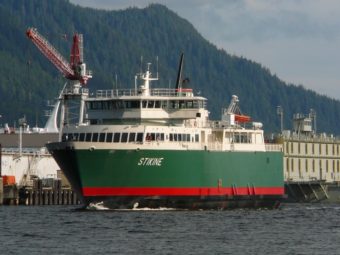
The Tustumena. (Photo by Kenneth Gill/Flickr Creative Commons)

In less than six weeks, the Tustumena ferry is supposed to wrap up repairs and set sail to southwest Alaska. But the shipyard says that delivery date isn’t looking realistic.

As the state faces yet another blown deadline for getting the Tustumena back in service, they’ve started looking for other ships to pick up the ferry’s route. And it doesn’t have to be a perfect fit.

Seward Ship’s Drydock has been working on the Tustumena for seven months now. At every turn, they’ve uncovered previously unknown problems — with the steelwork, the computer systems, and now, the propulsion controls.

The shipyard’s general manager, Pinkney Cunningham, wouldn’t talk about the Tustumena on tape. But he says his crews are still finding new work to do on the ferry.

Cunningham knows the Tustumena is scheduled to go back into service July 7. When asked if that’s realistic, he says, “It might be a stretch.”

The Department of Transportation says they’re still counting on the Tustumena for July sailings. But just in case, they’ve put out what’s called a “request for information” for vessels that could fill in this summer. They want anyone who has a Coast Guard-certified ship that can carry at least three cars and six people, to get in touch.

DOT spokesman Jeremy Woodrow says the request for alternate vessels isn’t a judgment on whether the Tusty will be ready on time. He describes it as a response to lobbying from a port community.

“The work, right now, is continuing to progress. But the city of Kodiak Chamber of Commerce actually sent a letter to the marine highway system requesting that we find an alternative, just in case we aren’t able to return to service as expected.”

Trevor Brown runs the Kodiak Chamber of Commerce. He says he was pleasantly surprised to find that the state did what the Chamber asked.

“Kodiak Chamber does applaud the Alaska Marine Highway [System] for taking steps to identify some alternative transportation services to – it looks like just for Kodiak, and Kodiak communities.”

Brown is right. The DOT put down Kodiak, Old Harbor, Ouzinkie, Port Lions, and then Homer as required ports of call.

That leaves out a major part of the Tusty’s route — the Aleutian Chain. Woodrow says it’s not included because it will be hard enough to find a vessel that can serve Kodiak.

“We figured we would try to at least see what’s out there for Kodiak, and then see if that can be applied to the chain communities.”

Brown, with the Kodiak Chamber of Commerce, says they never intended to leave anyone out.

“We don’t want to eliminate any of the chain runs. Everybody out to the west of us — we’re all kind of in the same boat on this one.”

The DOT’s request for other vessels to serve the route is open through June 5.

How safe are Alaska’s bridges?

On Thursday, a section of Interstate-5 fell into the Skagit River in Washington after a truck reportedly knocked into the steel framework. No one died, but the collapse did send cars did hurtling into the water. The bridge was built in 1955, and was considered to be outdated by federal standards. In Alaska, there are over a hundred bridges that fall into that obsolete category.

Map of Alaska's Bridges
(Department of Transportation)


Alaska has a reputation of dreaming big with its bridges. There’s the proposed Knik Arm bridge, with its $8 billion price tag. And then there’s the Gravina Island Bridge, the $400 million “Bridge to Nowhere” that never got built after it became politically toxic.

But how is Alaska doing with the thousand bridges that it already has?

Patrick Natale is the executive director of the American Society of Civil Engineers, and he says that Alaska gets about a C+ on his group’s infrastructure report card.

“It looks like you’re around the national average. The average is about one in four bridges have a concern. So, you’re there. That’s not a good sign.”

Just over 10 percent of the state’s bridges are labeled “structurally deficient,” which means they need maintenance or potentially replacement. Even more of the state’s bridges are considered “functionally obsolete.” Those bridges might be in decent shape, but they don’t meet contemporary engineering standards.

Natale says that Alaska — and the rest of the country — has a lot of work to do when it comes to fixing its bridges.

“I’m not saying they’re about ready to fall, but they need to be dealt with.”

Jeremy Woodrow is a spokesperson for the Alaska Department of Transportation, the agency responsible for dealing with that. He says not to worry — Alaska’s bridges are safe — but that yeah, the state’s infrastructure could use some improvement. He says that a C grade is about right.

“It’s a fair grade. You know, it’s understandable that infrastructure across the entire country is aging. It’s just the nature — a lot of our infrastructure was built up 60, 70 years ago, especially in the state of Alaska. And those bridges are getting toward the end of their lives.”

Still, Woodrow stresses that just because some of these bridges need improvement, not every one of them is a Skagit River bridge waiting to happen.

“The terms that are used for bridges are oftentimes may be scary terms for the general public, such as structurally deficient. It doesn’t mean the bridge is unsafe — it just means that the bridge is nearing a time where it needs to be rehabilitated or replaced. It doesn’t mean that it needs to be replaced tomorrow, it just means that it’s something you need to look at, and put it on your list, and make sure you have a plan to replace that bridge in the near future.”

According to a Department of Transportation report, the state needs to put around $60 million into bridge maintenance each year if it wants to keep that infrastructure in decent shape. Woodrow says that his department inspects each bridge in the state every two years to figure out which ones need the most attention. They judge them on a zero to nine scale, and anything that drops below a seven gets attention or gets shut down.

“If there’s ever a cause for concern, we will close a bridge prior to it getting to the point where it could reach failure,” says Woodrow.

In recent years, there’s only been one bridge closure in Alaska due to safety concerns. A bridge along the Copper River Highway near Cordova was closed in 2011 because of erosion around it, and remains shut down indefinitely.

Statter Harbor phase two in limbo

Statter Harbor boat launch
View of current boat in launch in operation at Statter Harbor. Phase One of Statter Harbor Master Plan includes new docks. Phase Two is a new boat launch and vehicle/trailer parking. Photo by Matt Miller/KTOO News

The Juneau Planning Commission could reconsider its vote to reject a conditional use permit for a new boat launch and parking area at Statter Harbor – but if it doesn’t, a frustrated Docks and Harbors Board is looking at its options.

The board held a special meeting Thursday night  to discuss the problem.

A week ago, city officials were cutting the ceremonial ribbon to celebrate completion of the first phase of the Statter Harbor Master Plan.   The night before, the Planning Commission had voted 4 to 1 to reject the second phase.

“Docks and harbors was as surprised as anybody,” said CBJ Port Director Carl Uchytil.

He hopes the commission will take another look at the project and vote to approve the conditional use permit.

“You know it’s had a 4 and a half year NEPA environmental assessment review and it is the right size for the community,” Uchytil said.  “It is optimally sized and this is what the regulatory agencies will allow us to build.”

The second phase of the Statter Harbor Master Plan calls for a two-lane boat launch and 179 onsite parking spaces for vehicles and trailers.

Phase One of Statter Harbor Master Plan includes new docks. Phase Two is a new boat launch and vehicle/trailer parking. Photo by Matt Miller/KTOO News

One impediment comes from neighboring Auke Bay Towers.  Condominium owners object to the plan and say it overestimates the need for parking. They’re concerned the uplands will become a boat storage area, though that’s not intended.   They also worry about the environmental impact to Bay Creek, construction noise, and lights from the boat ramp, among other things.  Uchityl has met with legal counsel for Auke Bay Towers homeowners to discuss their concerns.

But homeowners’ biggest concern is property values. They believe their condos will go down in value once work on the project begins.

At this point, the Planning Commission holds the key to the project.  It meets next week and could bring up the original vote, which was taken on an evening when three members were absent and one recused himself from the vote.  Only chairman Mike Satre voted for the permit then called for reconsideration.

The commission doesn’t have to bring it up.  If it decides to take a new vote, the original vote would be canceled and the new one would stand, according to Assistant City Attorney Amy Mead.

If the vote for reconsideration passes, then the ball is in the Planning Commission’s court to decide where they want to take it next.  They could either put the question off, they could decide it again right then, they could open it back up for public participation, and ask for additional testimony or evidence.  They have a lot of options available to them,” Mead said.

If the Planning Commission’s rejection of the permit stands, Docks and Harbors could appeal the decision to the Juneau Assembly.


Airport board recommends deLaBruere for manager’s job

The Juneau International Airport
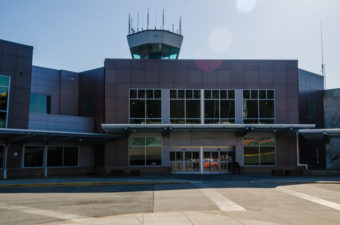
The remodeled Juneau International Airport terminal. (Photo by Heather Bryant/KTOO)

Acting Juneau International Airport Manager Patty deLaBruere will step into the top spot next month.

The Airport Board selection committee is recommending the board offer deLaBruere the job, even before advertising the position.

Committee member Joe Heueisen says she’s the perfect choice, with 15 years of experience as deputy under four previous airport managers.

“The first manager, Dave Miller hired her, and it wasn’t long before we discovered she was an awfully well-qualified person, so the last couple go arounds the board has tried to get her to apply for it and she’s been you know, happy where she was.  But we tried it again this time and she decided to go for it, and I think it’s an excellent choice,” Heueisen says.

When there is a strong internal candidate, the board has the flexibility to appoint without going through a full hiring process, according to CBJ Human Resources Manager Mila Cosgrove.

Heueisen says knowledge of the Juneau operation is very important.

It’s our thinking on the board and has been for a number of years that if at all possible we want to hire from within because of the on the job training.  It takes quite a while to get up to speed.  Secondly, we want to hire locally if possible, thirdly, maybe the state before we go out on a national head hunt, which is time consuming and very expensive and not always successful.  So we’re just tickled to death that we’re able to have Patty step right in,” he says.

Juneau International Airport is owned by the city and has been an enterprise board since August 1995.  deLaBruere starting working in airport management in 1998.

Airport Manager Jeannie Johnson has retired, and deLaBruere has been acting manager since May 2.  That’s a role she has filled many times in her job as deputy.

The full airport board will hold a special meeting on June 6th at 6 p.m. in the Alaska Room at the airport to vote on deLaBruere’s appointment.


Designers: Cover shuttle ferry car deck

An early drawing compares the proposed Alaska Class Shuttle Ferry with other ships. Image courtesy Department of Transportation.

Naval architects working on the new shuttle ferry recommend against uncovered car decks. 

Marine highway officials earlier said a partially open deck could save construction and operational costs.

But Project Engineer Will Nickum said it’s not the best option.

“The general recommendation we have is that it should be closed. That that would be the better approach long-term,” he said.

He said a closed deck would boost the comfort level and protect equipment. But it would increase construction costs by 1.5 percent.

Nickum, of Seattle’s Elliot Bay Design Group, spoke at this month’s Marine Transportation Advisory Board meeting.

Plans call for two shuttle ships sailing between Juneau, Haines and Skagway. They’re the latest approach to what’s called the Alaska-Class Ferry. (Read about plans for the shuttle ferry.)

Nickum said the shuttles’ target length is now 280 feet. That’s 20 percent longer than the small ferry LeConte.

“Comfort needs to be better than the LeConte-class vessels and approach that of the Taku. That is a serious requirement and we have to look at length to make sure we can meet that particular thing,” he said.

Comfort refers to the ride, especially in high winds and seas.

Designers continue to work with some earlier assumptions.

The ferries will not have staterooms or crew cabins. Food service will be limited. And they will be easily maneuverable for quick loading and unloading.

But there will be a few amenities.

“We think it makes sense to have a family and children space. We’d have a work space or quiet room. That would be the library space. We’d also have the traditional forward observation lounge,” he said.

Click here to see a short animation of how the shuttle ferry’s bow door could work. Courtesy Elliott Bay Design Group/Alaska DOT.

And that space may be on a level above the main passenger deck.

Nickum said the shuttles will also have a small theater, similar to some other ferries.

A draft report on vessel plans will be out for public review on June 13th.

Marine Transportation Advisory Board member Cathie Roemmich of Juneau expects some battles.

“You have a handful of people in a couple communities that are just going to give you negativity. They don’t like it and they don’t want it. I hope the public process is very swift and you guys can move on with the job,” she said.

Advisory board members also asked about a proposed bow-door system. And some worried whether the ships would be compatible with ramps and docks outside Lynn Canal.

Former board chairman Dave Kensinger of Petersburg urged designers to consider staffing as well as construction.

“I think the most important thing you do on whatever else you build is you make for sure it’s as cheap as possible to operate,” he said. “We did an exercise quite a few years ago and if you look at the life-cycle cost of one crewmember on one boat, it’s astounding.”

Designers are working on the assumption that the first vessel will be completed by mid-2016.

Read earlier reports:

Significant wave height charts, courtesy Glosten Associates/Alaska DOT: 

A chart showing Lynn Canal-area waves in strong north winds, measured in meters, in the worst weather month.


A chart showing Lynn Canal-area waves in strong south winds, measured in meters, in the worst weather month.

Juneau Airport looks to new fees, savings to pay for increased costs

Juneau Airport tower
The airport is facing higher costs of deicer, fuel, supplies and security. (Photo by Rocky B/Flickr Creative Commons)

Juneau International Airport’s fiscal year 2014 budget will be more than half a million dollars larger than expected, due mostly to increased supply costs and a new federal requirement that the Juneau Police Department provide security.

Officials with the city-owned airport presented budget revisions to the Juneau Assembly last night (Wednesday).

The new fiscal year begins July 1st, but the city has a biennial budget, meaning a preliminary spending plan was approved last year. At the time it was thought airport expenses for FY 14 would be just over $5.3 million. It’s now more than $5.8 million.

Acting airport manager Patty deLaBruere says higher costs for things like runway deicer, fuel and other supplies are to blame. But most is due to the need to hire five new Juneau police officers to provide airport security. Previously the airport contracted with a private company, but federal law now requires public safety be provided by sworn officers.

“We’re working with JPD to take over on October 1st. We were going to try an extend it to January 1st, but Goldbelt, who’s are contract security, elected to just end it with the contract itself. So Sept. 30th, instead of extending, they are going to end and JPD will take this over. As a result, it’s increasing our budget under services and charges by almost $254,000.”

The airport will pay for the increased expenses by raising fees and rental rates. Some fee increases, such as new parking rates have already been approved, while others will be phased in over the course of the year. Alaska Airlines will pay a new fee for every passenger screened by the Transportation Security Administration, which will provide money for the increased security costs.

Despite the fee increases, the airport will still be forced to use about $22,000 in savings to balance its FY 14 budget.

Juneau International Airport is a city-owned enterprise that runs on revenue from users, including passengers and airlines. It has a board of directors that is appointed by the CBJ Assembly.

Site notifications
Update notification options
Subscribe to notifications