Transportation

New ferry a “stretch Lituya,” not a “stretch LeConte”

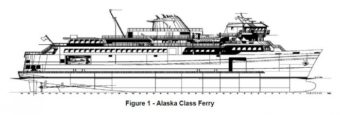
A drawing of a recent design of the larger Alaska Class Ferry created by Eliott Bay Design of Seattle.

More details are emerging about the Alaska Class Ferry redesign. The smaller shuttles could have partially open car decks. And three, rather than two, might be built.

State officials say they’re looking at more ways to cut the cost of what will be the Lynn Canal shuttle ferries. They’re what will replace a partially-designed ship that could handle a larger variety of routes.

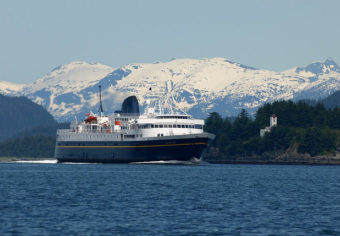
The ferry LeConte ties up at Auke Bay, Juneau’s ferry terminal. Photo courtesy Alaska Transportation Department.

“I have previously described the current, 350-foot Alaska Class Ferry as a stretch LeConte,” said marine highways chief Capt. Mike Neussl, addressing a recent phone meeting of the Southeast Conference’s Transportation Committee.

The LeConte, which serves northern Southeast, has a cafeteria and crew quarters, allowing for longer sailings. Neussl says the shuttle ships will have none of those amenities.

“The concept for the replacement Alaska Class shuttle ferry is more of a stretched or supersized Lituya,” Neussl says.

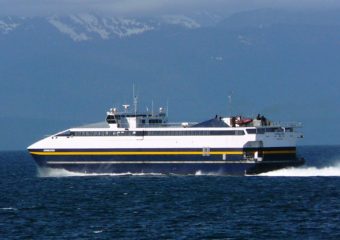
That ship, which links Ketchikan and Metlakatla, has an open car deck and a small passenger area. (See profiles of all state ferries.)

Neussl says details are far from being worked out. But having a partially uncovered car deck would save money.

The ferry Lituya serves Metlakatla and Ketchikan. Photo courtesy Alaska Marine Highway System.

Juneau Mayor Merrill Sanford says the weather’s too rough for that.

“All of have been in Lynn Canal in times when we shouldn’t have been and/or wished we weren’t. And unless you can really show me that it’s safe, that’s kind of a ridiculous concept to be even looking at,” Sanford says.

Ferries now sail a single daily Juneau-Haines-Skagway round trip. The LeConte runs in the winter and the larger Malaspina in the summer. Earlier Alaska Class Ferry plans called for much of the same.

Neussl says more and smaller shuttles would allow for a flexible schedule.

“The goal will be with these two vessels, and potentially a follow-on third vessel, is to run them one of them Juneau to Haines and back every day,” he says. “Or perhaps with two crews, twice a day. And to have an additional one of these vessels run back and forth four times a day or so between Haines and Skagway.”

An eventual third shuttle, if built, would be home-ported in Skagway and sail to and from Juneau.

The change from one large ferry to several shuttles raised the ire   of many involved with the marine highway — but not everyone.

Juneau Chamber of Commerce Executive Director Cathie Roemmich serves on the Southeast Conference’s Transportation Committee as well as the governor’s ferry advisory panel.

“We originally asked that we could get two small vessels. And over the past five and a half years, this shuttle/dayboat has morphed into this big ship,” Roemmich says.

Several committee members asked about community input into the new design.

Roemmich says she wants a review, but not a full set of hearings.

“But if we go back to the beginning, we will never get anything built. Because that’s what happened last time. We went from a shuttle/dayboat and it got out of control. And now we’ve lost that,” she says.

Ferry chief Neussl didn’t yet know how public input will be taken. But he said residents already shared their ideas during the larger ship’s planning process.

That raised questions from Mike Korsmo of Skagway.

“So what I’m hearing is basically, this plan is somewhat solidified. You’re going to say you’re taking public input, but you’re going to go ahead with this plan regardless of communities, mayors and legislators that don’t like it,” Korsmo says.

Neussl says the state is open to differing views, but wouldn’t commit to using new ideas.

Governor Sean Parnell announced the new Alaska Class Ferry plan in early December, surprising some lawmakers, advisory board members and ferry staff.

Further discussion is expected before the House and Senate Transportation Committees, both chaired by Southeast legislators. It will also be on the agenda for the next Marine Transportation Advisory Board meeting.

Small plane crashes while landing at airport; no injuries

The west end of the runway at Juneau International Airport was closed for nearly an hour Thursday afternoon, after a small single-engine aircraft crashed while landing.

The privately owned Cessna 150 apparently ended up on its side and sustained significant damage.

Airport Deputy Manager Patti deLaBreue says the pilot and a passenger walked away.  No names have been released.

She says the accident is under investigation by the Federal Aviation Administration’s Flight Standards Office and the National Transportation Safety Board.

She says the runway was wet but not icy at the time of the crash.

SE leaders concerned about ferry plan change

This poster from the Southeast Alaska Conservation Council promoted the Alaska Class Ferry over road-building.

You can tell a project’s in trouble when its website gets pulled off the ‘net. That’s what’s happened to the Alaska Class Ferry, which had a site including design elements, public comments and other information.

It’s down because Gov. Sean Parnell ordered an end to work on the 350-foot vessel, and begin design of smaller, less expensive ferries. (Hear the governor’s announcement and read about his decision.)

The announcement surprised Sen.Dennis Egan, a Juneau Democrat who was among those pushing to fund the original project.

“We’re all upset that we weren’t informed way early in this process about what they were going to do and different scenarios that they were trying to come up with,” Egan says. “We didn’t have a clue.”

And it’s not just the timing. Representative Beth Kerttula, another Juneau Democrat, says the new plan doesn’t make sense.

Juneau Rep. Beth Kerttula

“This is a real change of direction and frankly, I’m not on board. And I’m talking to the other members of the Southeast delegation and doubt many of them, if any, are either,” Kerttula says.

The governor said change was needed because price estimates rose by up to 40 percent. Ferry officials had warned the appropriated $120 million was not enough.

“The new contemplated design is more of a streamlined, simple vessel,” says Capt. Mike Neussl, the state Transportation Department’s deputy commissioner for marine operations. That means he runs the ferry system.

“The cost savings will come in the simplicity of no crew quarters, a smaller overall vessel and less amenities in terms of what the vessel contains,” he says.

Other design elements, such as food service and quiet rooms for the sick and elderly, are also off the table. Some of those features were meant to allow the ship more flexibility, so it could service more routes.

Many of the state’s ferries are old, and the Alaska Class Ferry was part of the replacement plan. Kerttula worries changing direction will push back the construction date.

“This really delays us. And that’s maybe more than anything something that aggravates me. We’ve been working hard, we were up and running, it was going on and here we are with a delay,” she says.

The state will keep its architect, Seattle’s Elliott Bay Design Group. And it will continue working with its expected builder, Ketchikan’s Alaska Ship and Drydock.

Neussl says contracts will have to be renegotiated before work can start.

“The design process for the new ship won’t be as complicated as the Alaska Class Ferry, so it shouldn’t take as long to get to the full detailed design on that. But I doubt that it will be done by next July, when the Alaska Class Ferry design was supposed to be done,” Neussl says.

The governor called for building two smaller ships with the money appropriated for one larger vessel. Both would operate in Lynn Canal, connecting Haines, Skagway and Juneau. That’s the same route as was planned for the larger ship.

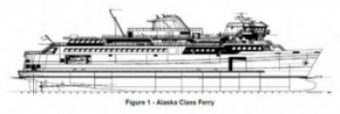
A drawing of the larger proposed Alaska Class Ferry from Elliott Bay Design Group.

The Malaspina, which carries about 90 vehicles per sailing, covers the busy summer season.

Egan says the new ships’ projected 40-vehicle capacity is not enough.

“Well, Hell! Do you know how many vehicles get on in Juneau and go to Skagway and Haines in the summer? Those ships are full,” he says.

The chairman of Parnell’s Marine Transportation Advisory Board says the announcement caught him by surprise, too.

Robert Venables of Haines calls it, quote, “A very disappointing and dramatic change of direction.” He’s traveling and couldn’t be reached by phone. But via email, he said the last board meeting, about a month ago, included no hint of a redesign.

He’s not alone in his surprise.

“It’s not the direction that we were looking at and we have been working on it for quite a while,” says Skagway’s Mike Korsmo, who serves on the Marine Transportation Advisory Board.

He wonders whether a smaller ship could handle the strong winds and rough waters of Lynn Canal winters.

“When we were looking at the Alaska Class, we were looking at it for the weather conditions, the routes it was going to run and the capacity it would need to handle. So if we’re going to smaller vessels, then we definitely have to take a serious look at how that’s going to work,” Korsmo says.

Despite their concerns, both board members say they’ll work with the governor and Legislature toward a new design.

One reason Parnell gave for the change is to make sure new ferries are built at Ketchikan’s shipyard.

The ferry Matanuska is tied up at Alaska Ship and Drydock, where the smaller Alaska Class Ferry is expected to be built.

“That was just wonderful to hear his recommitment to build the ferries here in the state,” says Alaska Ship and Drydock’s Doug Ward.

He says about 170 people work at the facility.

He expects other ship-building jobs, so any ferry construction delays won’t affect the workforce.

“It’s a state-owned shipyards, these are state-owned vessels, these are Alaskans building the vessels,” Ward says. “And that was one of the primary goals, to create new employment opportunities in year-round family-wage careers and to attract new invest.”

The new plan will undergo further discussion once the legislative session begins and the ferry advisory board holds its next meeting.

Parnell: Design smaller ferries, build them here

Ketchikan’s shipyard is where the 350-foot Alaska Class Ferry was supposed to be built, before cost estimates increased. Now, Gov. Sean Parnell wants two lower-cost, smaller, less-expensive ships. Photo by Ed Schoenfeld.

Alaska Gov. Sean Parnell announced Tuesday in Ketchikan that the state will immediately begin negotiations with the Ketchikan shipyard to design the first of at least two smaller ferries for the Alaska Marine Highway System, rather than the 350-foot ferry that had been planned.

Parnell says the $120 million budgeted for the project would not be enough to build the larger ferry in Ketchikan. He says he’s dedicated to constructing Alaska ferries in Alaska, which prompted the new plan.

The governor stopped by KRBD’s Ketchikan studio, and sat down with Leila Kheiry to talk about this new direction, as well as the upcoming legislative session.

In a press release, the governor said, “With declining oil production and declining state revenue, we have to be smarter with the people’s money while meeting Alaskans’ marine transportation needs. I have supported and will continue to support the increased service by mainliners from Bellingham all the way out the chain.

“By setting a new course, Alaskans can build two smaller Alaska Class Ferries and stay on budget, and at the same time provide the same or better level of service Alaskans expect from our marine highways.

Gov. Sean Parnell discusses his plans for new state ferries during an interview at KRBD-FM in Ketchikan.
Gov. Sean Parnell discusses his plans for new state ferries during an interview at KRBD-FM in Ketchikan. Photo by Leila Kheiry.

“While the ferry system produced record levels of revenue last year, we also face this reality: Costs continue to accelerate for the maintenance of our fairly old fleet. Building smaller Alaska Class vessels will have a major positive impact on our ferry system capacity. The smaller vessels will provide much-needed backup service should other vessels experience mechanical problems, and can add flexibility to the system when special community events require greater access.”

To date, the Legislature and governor had approved $120 million for this first Alaska Class Ferry project. Early estimates demonstrated the total cost for a 350-foot vessel would be closer to $150-167 million. The governor has now asked that funding for the first vessel be directed to the plan for the smaller vessels. Design work will commence in cooperation with Alaska Ship and Drydock officials as soon as possible.

The AMHS has been operating year-round since 1963, with regularly scheduled passenger and vehicle service to 33 communities in Alaska, as well as Bellingham, Washington, and Prince Rupert, British Columbia. There are currently 11 vessels in the AMHS fleet.

Basin Road Bridge reopens Dec. 6

Basin Road Bridge reconstruction has been underway since October 2011. The project will be done and the re-opened on Thursday, Dec. 6, 2012. Photo courtesy Silver Bow Construction.

The Basin Road Bridge will remain closed until Dec. 6th.

Weather has delayed some of the reconstruction on the old wooden-trestle bridge, and work crews need more time.

Silver Bow Construction had hoped to complete the job and re-open the bridge on Saturday, Dec. 1st,  but Project Manager Larry Gamez says they’re in the finishing phase:

“You know we’re so close, but we need six more days on that,”  Gamez says. 

 The project started in October 2011. The work has been done in phases to accommodate the high-traffic tourist season.

Basin Road provides access to Last Chance Basin, the mining museum and popular hiking trails.

The original bridge was built in 1936 when the AJ Mine was in operation.

Juneau Assembly approves funding for three projects

The Juneau Assembly approved three ordinances Monday to fund ongoing projects in the Capital City.

A four-year effort to map low-grade wetlands will be paid for with a $1.6-million state Department of Commerce, Community, and Economic Development grant.

Deputy Community Development Director Greg Chaney explained that the project will use LiDAR, or light detection and ranging, and aerial photography to identify wetlands suitable for development. He said the imagery will be “ground-truthed” to ensure proper labeling of wetlands.

“That’s one of the big parts of this project,” Chaney said. “We’ll have the initial aerial photography, LiDAR, and then that remote sensing will be used by people who go in the field and actually verify on the ground.”

The project is scheduled to wrap up in February 2016.

Meanwhile, the Assembly appropriated another $7-million grant from the state Commerce Department to fund the Dimond Park Library project. That’s about half of the estimated project cost. The rest will come from the city’s temporary 1-percent sales tax, Friends of the Library fundraising, and the city’s Library Endowment Fund. Also included in the estimated project cost is the city’s donation of about $1-million in land where the new library will be built.

The final appropriation was a more than $177,000 grant from the Alaska Department of Transportation for the Juneau Airport’s runway safety area improvement project. The nearly $24-million dollar project is mostly funded by the Federal Aviation Administration.

The Assembly approved all three measures unanimously.

Site notifications
Update notification options
Subscribe to notifications