The ferry Malaspina sails by downtown Sitka during 2010 Alaska Day festivities. Ed Schoenfeld Photo.
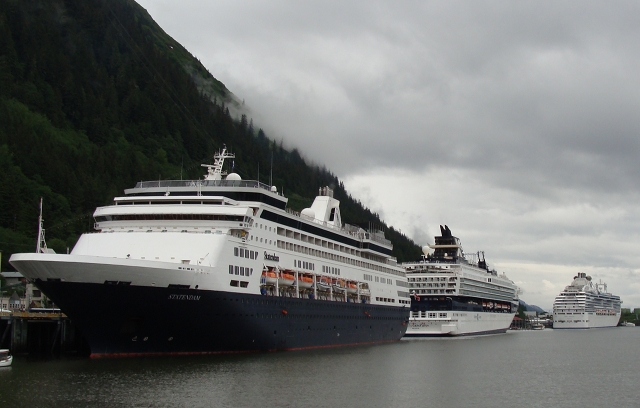
New federal air-pollution restrictions will affect cruise and some other vessels sailing Alaska waters.
But they will not impact state ferries.
“It is a big issue for the state of Alaska, it is not necessarily a big issue for the Alaska Marine Highway System. All of our ships operating within 200 miles of the coastline already burn low-sulfur fuel,” says Captain Mike Neussl, the state’s deputy commissioner of marine transportation.
State ferries made the switch a number of years ago, before Neussl came on board.
The new air-emission limits come from the federal Environmental Protection Agency. They apply to what are called Emission Control Areas, or ECAs, within 200 miles of the coastline.
Officials say they’re part of an international effort to lower pollution that contributes to human illnesses and deaths.
Neussl says the required fuel is already available at ferry ports.
“The suppliers there already carry ultra-low sulfur diesel because that’s what they have and that’s what we use. So it wasn’t a big switch, and the switch that the marine highways made wasn’t in direct response to this upcoming implementation of the ECA,” he says.
The new rules go into effect Wednesday, August 1st
The Juneau Assembly appears ready to make “housekeeping” changes to the city’s marine passenger fee, so it better conforms to the federal Maritime Security Act of 2002. The changes will not increase or decrease the $5 fee paid by cruise ship passengers who stop in the Capital City. (Photo by Casey Kelly/KTOO)
The Juneau Assembly is set to move forward with “housekeeping” changes to the city’s Marine Passenger Fee code.
The five-dollar per head fee for cruise ship travelers was enacted by Juneau voters in 1999, before Congress passed the most recent federal law governing how such money can be spent — the Maritime Security Act of 2002.
City Attorney John Hartle last night (Monday) told the Assembly Committee of the Whole that the city has always been careful to comply with the law, but it doesn’t hurt to tweak the code to make sure there’s no doubt.
“It’s hard for me to say what the risk of litigation is,” Hartle said. “I hear rumblings every year about the cruise industry is ready to litigate over our expenditures of these fees. But my view is, based on the latest case law, we strictly follow the law.”
That means spending the fee revenue on services and infrastructure used by the cruise industry and its passengers. The current code specifically identifies “emergency services, transportation impacts and recreation infrastructure.” It also says the fee is to be used to “mitigate” impacts by cruise ship passengers.
Since none of that language is in the Maritime Security Act, Hartle recommends that it be removed and replaced with the more general statement that the fee is to be used “for services and infrastructure rendered to cruise ships and cruise ship passengers.” He says the city would still be able to argue that the fee can be used to mitigate impacts if the industry ever decided to sue.
“We will say to the court, ‘When you bring a million passengers and I don’t know how many crew to a town of 30,000 in a three-month period, you’re going to have impacts and they’re going to need to be mitigated and they’re going to be expensive,'” Hartle said.
Assemblyman Randy Wanamaker questioned Hartle about the most substantive proposed change. Currently, boats with accommodations for 40 or fewer passengers are exempt from the fee. Hartle recommends making it 20 or fewer passengers to provide more protection from lawsuits charging that the city is singling out large operators. Wanamaker said he’d need more information to support such a change.
“I wonder about the cost of us collecting the extra funds from vessels down to twenty, whether it’s more of an administrative burden than it’s worth,” said Wanamaker. “And a disincentive for smaller vessels to come to the community.”
Hartle called on Port Director Carl Uchytil, who said only a handful of vessels would be affected and the administrative costs would not increase.
“Because they [the smaller vessels] come only every other week. It’s not a great deal of money, but I hear what the city attorney is trying to do to be consistent throughout the cruise industry and the reason to make these changes,” Uchytil said.
The committee voted unanimously to forward the proposed changes to the full assembly.
After the meeting Princess Cruises Director of Shore Operations Kirby Day said the measure passes muster with the industry.
“They’ll probably hear from some of the smaller cruise lines, just because nobody likes to see their costs go up regardless of what you’re spending,” Day said. “But my view is that it’s probably a minimal issue and most of this was just to dot the I’s and cross the T’s.”
The ordinance will be scheduled for a public hearing at the Assembly’s August 13th regular meeting.
The Transportation Security Administration and Alaska Airlines are asking travelers to get to Juneau International Airport a little early this weekend.
One of two X-ray machines used by TSA to check carry-on luggage needs repairs, and is not expected to be fixed until Monday.
Officials say passengers should get to the airport at least two hours before departing flights are scheduled to leave.
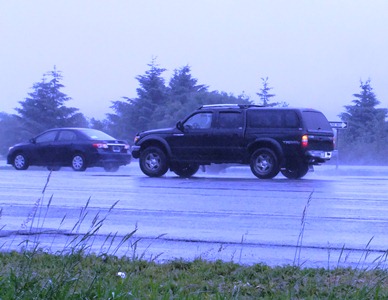
A year after getting new pavement, sections of North Douglas Highway between Fish Creek Road and the boat launch are set to receive asphalt repair tomorrow (Thursday) through Saturday.
State Department of Transportation Spokesman Jeremy Woodrow says the pavement settled more than expected atop new culverts installed during last year’s work.
“If you’ve been driving out that area lately, you’ll notice that there’s some dips along where the culverts were put in last year,” Woodrow says. “They’re going to actually be smoothing that out and making it a smoother section of road.”
Woodrow says the culverts themselves are fine and will not be affected by the repairs. He did not have a cost estimate for the work, but says it will be paid for with funds leftover from the $6-million dollar budget for last year’s project.
SECON construction crews will be working on North Douglas between 7 a.m. and 7 p.m. over the next three days. During that time traffic will be one-lane only and drivers can expect 15 to 20 minute delays.
Left turns lanes at Yandukin Drive and the Fred Meyer access road have re-opened. The lanes were widened for better visibility of on-coming traffic. Works crews on Friday re-opened left turn lanes off Egan Drive at Yandukin Drive and the Fred Meyer access road.
Thanks to good weather earlier this week, the project is two days ahead of schedule. State Transportation Department Project Manager Dan Noziska says crews will be back in about two weeks to paint the lines.
The area has a high accident history. Noziska expects that will be reduced now that the turn lanes are wider and more offset.
“We shifted each one about four or five feet so that basically meant you have almost full vision of each oncoming lane in each direction now,” he says.
“You’re not going to have to peak around to see if somebody’s coming in that inside lane. You’ll be in a position where you can see that inside lane.”
Noziska says the near $700-thousand project is all federally funded.
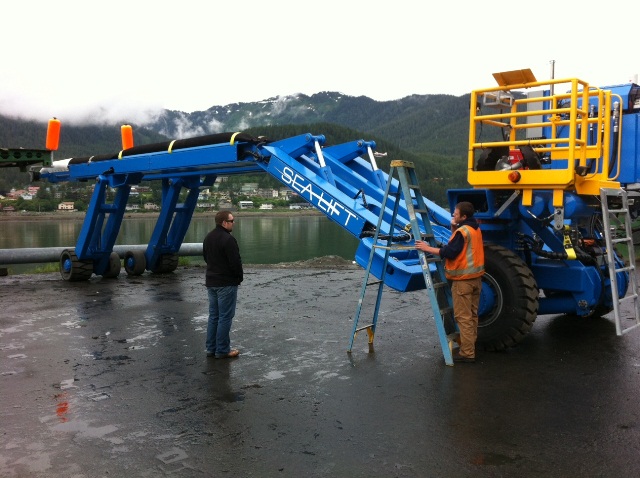
A brand new 45-ton boat lift arrived in Juneau last week and is already turning heads at the Auke Bay Commercial Loading Facility. (Photo courtesy CBJ Docks and Harbors Dept.)
Juneau’s Docks and Harbors Department got a new piece of equipment last week, but it’ll probably be another three months before it’s fully operational.
The hydraulic boat lift is capable of hoisting vessels up to 45-tons and 65-feet in length out of the water. It arrived at the Auke Bay Commercial Loading Facility on Friday, and is already attracting attention from passersby.
Juneau Port Director Carl Uchytil says it looks like a big blue forklift. But the forks feature inflatable bumpers that are easier on a boat’s hull.
“We picked this model because of the number of wooden hulled vessels that we think we’ll be hauling out,” Uchytil says. “Many of the wooden fishing boats we have are 50-60 years old. So we thought this was the best device for the Juneau commercial fishermen.”
Uchytil says Docks and Harbors staff will be trained to use the lift by employees of the manufacturer — Sea-Lift of Bellingham, Washington.
But it won’t be used in earnest until October. That’s because it can’t lift boats out of the water until a wash down area is built at the commercial loading facility.
“Department of Environmental Conservation has very strict water collection rules,” Uchytil says. “We need to collect the water that we use to pressure wash off the hulls. So, whatever contaminants that were on the hull, we would collect and ensure that that doesn’t get in the waterway.”
The lift cost $750,000 dollars and was paid for with a part of $3.6-million TIGER grant the city received as part of the American Recovery and Reinvestment Act, also known as the stimulus act.
Docks and Harbors has requested $1.3-million from a proposed extension of the city’s temporary 1-percent sales tax, which would allow the lift to be used at Statter Harbor in addition to the loading facility.
Close
Update notification options
Subscribe to notifications
Subscribe
Get notifications about news related to the topics you care about. You can unsubscribe anytime.