Transportation

Proposed Riverside Drive bus route dropped for now

A proposal to beef up bus service on Riverside Drive will be put on hold until a Capital Transit Development Plan is revised.

Juneau’s bus service considered moving some portions of Route 4 off Mendenhall Loop Road and onto the south end of Riverside Drive, to provide service closer to Thunder Mountain High School. The city held several hearings earlier this summer and took a survey of riders.

City Manager Kim Kiefer says changing the route isn’t possible with current connections. She says the city’s public transportation plan will be updated instead.

“And that plan will look at the route for Riverside and look more in-depth at how we have our current route systems in place and how can we do it so we would be able to provide some level of service to the Dimond Park area,” she said.

The Assembly Monday night heard an update on the Capital Transit plan at the Committee of the Whole.

State will accept $20 million for transportation projects

U.S. Secretary of Transportation Ray LaHood said his agency discovered nearly half a billion dollars of previously allocated money. The money was earmarked between 2003 and 2006. For whatever reason, states never spent the money.

“You know I don’t know every reason, but it really doesn’t make any difference,” Secretary LaHood said on a Friday conference call. “The fact is the money was not spent, and in the no-earmark era, we need to spend it. And in an era when unemployment and the construction building trades much higher than other industries, we need to get the money out the door.”

Alaska is slated to receive more than $20 million. It must submit its plan for federal approval by October 1st, then obligate it by the end of the year. The state must select construction-ready-projects and show how the money will be spent. Construction can wait until next year, or at least warmer, brighter weather.

Governor Sean Parnell will accept the money, even though he’s been reluctant to take federal dollars in the past.

The announcement caught the state Department of Transportaion by surprise, said Brenda Hewitt, with the state DOT. Officials there are deciding which projects to fund, and according to Hewitt, that should not be a problem.

“There are so many needs for transportation for Alaska. We have such a huge state and our transportation needs are pretty diverse,” she said.

The move is part of President Barack Obama’s “we can’t wait” approach.  The president is sidestepping Congress in hopes of showing would-be voters he’s more proactive than the legislative branch.

The announcement comes just three months before voters take to the polls to elect a president in an election where jobs and unemployment are the major themes.

Politics, Secretary LaHood insisted, had nothing to do with the announcement.

Alaska Airlines flight loses cabin pressure, makes emergency landing

An Alaska Airlines headed from California to Seattle was forced to make an emergency landing after the plane’s cabin lost pressure.

Passenger Roslyn Richardson told ABC News that all the babies on the flight started crying at the same time. Then adult passengers felt their ears painfully popping.

Examiner.com reports the pilots called in the emergency citing “catastrophic electrical failure with loss of some flight controls and cabin pressure.” The plan was diverted to San Jose, CA where it landed safely. Passengers made it to Seattle approximately eight hours later.

Preliminary inspections revealed that it wasn’t an electrical problem but a sensor on the landing gear that malfunctioned. The sensor identified the plane as being on the ground instead of in flight and turned off the automatic flight controls and cabin pressure.

The Boeing 737-400 has been grounded and is being inspected by Alaska Airlines maintenance crews, according to Flight Global News.

The following clip from ABC News explains what happened.

video platform
video management
video solutions
video player

Juneau Airport seeks $2-million in left over FY ’12 FAA funds

An Alaska Airlines flight comes in for a landing at the Juneau International Airport.
An Alaska Airlines flight comes in for a landing at the Juneau International Airport. (Photo by Heather Bryant/KTOO)

Juneau International Airport is asking the Federal Aviation Administration for $2-million dollars to install additional approach lighting at the east end of its main runway.

The city-owned airport already has $1-million dollars for the project, thanks to a 2010 earmark inserted into a transportation bill by Senator Lisa Murkowski. But Airport Manager Jeannie Johnson says that only pays for three lights, when ideally there should be at least eight.

Even with modern advances in aircraft navigation, Johnson says Alaska Airlines estimates it had more than 450 missed approaches in Juneau last year. The majority of those flights eventually landed, she says, but only after taking another pass.

“Alaska Airlines is excited to get even three on that end of the airport,” she says. “Because it helps them get into Juneau more often when they’ve got more lights down there to see when the weather’s really bad.”

Alaska’s Congressional delegation is backing the airport’s request. Senator Murkowski and Congressman Don Young have written letters of support to Acting FAA Administrator Michael Huerta. Johnson says she expects Senator Mark Begich to do the same by the end of the week.

Young and Murkowski’s letters play up the fact that Juneau is the state capital and has no road access. Both call the airport a “critical lifeline.”

The airport is asking for the project to be listed as a priority under the FAA’s “Needs Assessment Program,” and for the agency to appropriate unused funds from fiscal year 2012 projects to complete it. The federal government’s fiscal year ends September 30th.

Johnson’s not sure if the agency will have enough to meet the request, but says it doesn’t hurt to ask.

“I don’t know how much money is left over,” she says. “So, our request is for $2-million. If there’s a million dollars left over, I guess my thought is that our chances are pretty slim. But if there’s more than that, I would hope that we would get at least part of it.”

If the request is unsuccessful, Johnson says the scaled-down project will move forward early next year on the east end of the runway. The west end already has a full system of approach lights, she says.

The Congressional delegation’s support for the project was an information item at Wednesday’s Juneau Airport Board regular meeting.

Mat-Su officials ponder ferry’s fate

Officials in the Matanuska-Susitna Borough are trying to figure out what to do with their $80 million ferry.

The commuter ferry Susitna was completed earlier this year, but remains docked in Ketchikan since there are no places for it to land in either the borough or Anchorage.

The borough assembly in July learned that it’s costing taxpayers almost $67,000 a month to keep it in Ketchikan.

Borough assembly members are considering whether to sell it or just beach it, and will discuss it again at the Aug. 9 meeting.

Towns take on new federal maritime emission limits

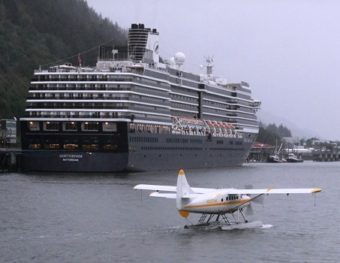
Smoke comes out of a Celebrity Cruise Line  ship stack as it sails into Juneau today (July 30). New EPA rules require cleaner fuel and fewer emissions.

Some Alaska communities are pushing back against a new requirement that ships sailing within 200 miles of the coast burn cleaner fuel. They say the rule, which goes into effect Wednesday, Aug.1st, will hurt cruise traffic and increase shipping costs.

One community is Skagway, where tourism dominates the summer economy.

“It takes years to get a cruise line. And it takes a second to drive one away,” says Steve Hites, owner of the Skagway Streetcar Company and a member of the town’s Port Commission.

He’s telling Skagway’s assembly about new air-emission limits set by the federal Environmental Protection Agency. They cover ships in coastal Emission Control Areas, also called ECAs.

Hites says cleaner fuel is more expensive, and cruise lines will pass that on to customers.

“The cost of the ECA on a cruise ticket could be $150, or three times the cost of the Alaska head tax. We lost five big ships because of the head tax. By extrapolation, will we lose 15 ships?” he asks.

Click here for iFriendly audio

Skagway’s assembly passed a resolution Hites asked for by a unanimous vote. It calls for state officials to fight the new requirement, which lowers sulfur dioxide emissions within 200 miles of shore.

The northern Lynn Canal community is not alone. Haines and Sitka are among other Southeast towns passing similar resolutions. (Read the Sitka resolution.)

Anchorage Mayor Dan Sullivan also issued a statement saying the rules could impact barge traffic. And U.S. Senator Lisa Murkowski took to her chamber’s floor to point out that rural Alaska would see the highest price hikes from more expensive shipping.

“The EPA’s one-size fits all approach to environment regulation. Perhaps you can’t quite shoehorn that in, in all situations,” Murkowski says.

The statements and resolutions came after the Parnell administration sued the EPA and other federal agencies to block or amend the rules.

The industry is also fighting the EPA. Alaska Cruise Association President John Binkley says ships might shift to other countries without such regulations.

“Alaska is an expensive destination because there are long distances to travel. So fuel becomes a much more important component of the overall cost of the ship,” Binkley says.

The EPA wouldn’t provide anyone for an interview. But a press release says sulfur pollution from bunker fuel, used by cruise ships and some barge lines, has been linked to respiratory illnesses. It says children, the elderly and asthmatics are among those most at risk. (Read some history of the emissions issue.)

Some Alaskans support that approach.

“Compared to having a tremendous amount of air pollution in Alaska waters, personally, I think that it’s worth it,” says Gershon Cohen, a Haines clean-water-and-air activist who’s been involved in cruise ship issues.

“It’s not going to come out of the cruise industry’s pocket one way or another. They’re going to pass that cost on the consumers. And for the thousands that the consumers are spending, I don’t think they’re really going to ever notice,” Cohen says.

Cohen says the real issue should be reducing dangerous pollution. He says it’s clearly visible as ships sail between Skagway, Juneau and points south and west.

“There is a pall over Lynn Canal. There is a tremendous amount of air pollution there. A lot of folks in Skagway are concerned. They saying the air pollution is killing the trees above Dewey Lake. So, if we’re killing people in our coastal communities from air pollution from ships, that this is probably like a pretty good idea to take care of it and make them use cleaner fuel,” he says.

The cruise industry says it will comply, but wants the EPA to enact an alternative plan that would cost less money.

While some barge lines, such as Totem Ocean Trailer Express, will be affected, others will not.

“In the Southeast market, Ketchikan all the way to Haines and Skagway, no,” says Kevin Anderson, president of Seattle-based Alaska Marine Lines. “Our tugboats burn diesel and these regulations are not going to affect us. So there’s not going to be an added fuel surcharge because of that.”

The state ferry system is also not affected. Marine highway chief Mike Neussl says the change was made years ago.

“It wasn’t a big switch and the switch that the marine highways made was not in direct response to this upcoming implementation of the ECA,” he says.

There’s another way the emission limits could affect shipping and travel. Binkley of the cruise association suggests they could increase competition among buyers.

“There will be more competition for the ultra-low-sulfur diesel, like is burned in trucks and whatnot. Presumably the price will go up for that as there’s more demand for that part of the barrel of oil that’s refined,” Binkley says.

Canada and a number of other nations are also imposing the new standards, which are part of an international treaty.

Opponents worry that impacts will be far worse in 2015. That’s when the EPA will further limit fuel sulfur content by a factor of 10.


Site notifications
Update notification options
Subscribe to notifications