Education

For many students, an unsteady home life puts education out of reach

Preliminary figures indicate that 2,830 students dropped out of Alaska schools in the previous academic year.  Forty-one percent were Alaska Native.  Today we continue our series on dropouts with a look at why students choose to leave school.

A variety of causes

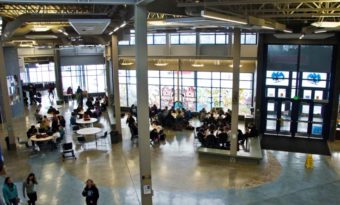
Students study in the hallway at Yaakoosge Daakahidi Alternative High School. (Photo by Heather Bryant)

Ninety-three youth dropped out of Juneau schools in the 2011-2012 school year, some as early as the 7th grade. Of the 379 Juneau freshman enrolled this year, about a third will not graduate, according to the Juneau School District.

“My sense is there is a history of failure on some level,” Bernie Sorenson says.

Sorenson coordinates the Juneau School District’s Credit Achievement Recovery and Employability Skills program, or CARES, which helps students who are on the verge of dropping out.

“For some the basic is: make sure we have enough money to put food on the table, or find a place to sleep the next night,” Sorenson says.

In Juneau alone there were as many as 93 children under 18 who were homeless in January 2012, according to a survey by Project Homeless Connect; but that number may represent only a portion of the total number of homeless youth in Juneau. Schools generally don’t account for many of these external factors.

Nancy Seamount is the School Liaison for the CARES program.

“I had a kid today that I said okay so—he’s a non-attender but he came today—so I said what incentive would it take for you to get to school?  And he looked at me and said ‘one dollar.’  I said what? He said ‘one dollar a day.’ I said so what would you use that one dollar for?  ‘To ride the bus.’”

“So the first thing people think of, ‘well can’t he take the school bus?’ They don’t understand what’s going on in some of our families. There’s a lot of chaos going on. He might need to come late. He needs a bus pass,” Seamount says.

She says her years as an elementary counselor offered insight to the problems students face.

By the time students were in 5th grade, Seamount observed students dealing with violence at home, sexual abuse, drug and alcohol issues, or divorce.

“What that tells me is that adults are struggling,” Seamount says.

Sorenson says students who drop out often do so as a result of lost confidence, even from failing just one class early on.

[one_half][box][quote]I had a kid today that I said okay so—he’s a non-attender but he came today—so I said what incentive would it take for you to get to school?
And he looked at me and said one dollar.
I said what?
He said one dollar a day.
I said so what would you use that one dollar for?
‘To ride the bus.’”[/quote][/box][/one_half]

“The whole self-esteem thing  kicks in, as a freshman. One course and they’re already self-doubting whether they can even graduate on time,” Seamount says.

In the 2010-2011 school year, 1,144 Alaska Natives dropped out statewide.

University of Alaska Southeast Assistant Education Professor Alberta Jones has studied what motivates Native students to succeed.

She interviewed more than 200 mostly Native students from middle school to doctoral candidates and examined factors outside the education system as well as teaching methods.

“Children who were resilient and succeeded had some protective factors, according to the research. And that was extended family or schools and community. And the students having school connections with teachers or other adults made a difference too; they had the power of five,” Jones says.

That’s five adult role-models.

“Some other common threads in the research were having positive values, having good social skills, having a positive identity,” Jones says.

Jones also interviewed non-Native students.

The problems are universal. State Education Department statistics indicate 1,635 non-Native students dropped out in the 2010-2011 school year; some could blame teaching methods.

Teachers are a piece of the puzzle

Jones interviewed effective teachers, as reported by students. She says effective teachers push, encourage and tell their students ‘don’t give up.’

“So just that whole rigor piece of relationships. That effort and energy. Then I saw another aspect of relationships, the personalization piece, which we know about, we hear that a lot. That’s the attitude and personality with their students,” Jones says.

The students described the teachers as fun and friendly. Particularly striking to Jones are teachers who would do just about anything to get their students to attend class:

Juneau High School enrollment figures for 2012.

“One teacher said he plays a guitar outside his door at the middle school. Another teacher said he stands outside of his classroom door and talks about anything except the subject he teaches. It’s like ‘hey Johnny, did you and your cousin get your car fixed this weekend?’”

Dirk Ahrens remembers personal involvement like that from his junior year in high school. He and his high school sweetheart–now wife–Ginny were part of the “Project 2000” program.

“It was a lot more one on one with the students. Did all sorts of stuff just getting us out into the community. And by the end of the year I’d go to every class,” Dirk Ahrens says.

But by the time senior year rolled around, neither Ginny nor Dirk felt motivated to stay in school.

“I was stubborn and didn’t want to listen to the teacher,” Ginny Ahrens says.

Dirk was “living at home, 18 years old, didn’t want to be at home with my mother anymore. And so I went and got a full-time job and just started from there.”

After high school Ginny and Dirk broke up. Eventually Ginny got her GED and Dirk earned his high school diploma from a university in Washington State, where he moved after high school. Ginny became an army recruiter and Dirk a general manager at Costco and both wound up in Juneau again. They married and have two children.

Ginny says she hopes her children’s educators are more mentor than disciplinarian. She expects her kids to graduate from high-school.

Alaska’s graduation rate hovers around 70 percent. Increasing the number of graduates is a statewide problem and is not solved by academic solutions alone.

How can the system help?

Tomorrow we look at how the system responds to students at risk of dropping out.

Find out more about the American Graduate Program, find links and hear interviews with Juneau students and educators here.

Part 1 – Statistics offer a grim look into the future of high school dropouts

Part 3 – At risk students find a second chance in alternative programs


Statistics offer a grim look into the future of high school dropouts

Ninety-three students dropped out of Juneau high schools in the last school year.  Statewide, more than 2,830 students quit school for one reason or another.

Unless they go back and complete their high school education, their future will likely be far less bright than their former classmates.

KTOO News today begins a series on the impact of dropping out of high school, the reasons why some youth choose to leave school, and programs to reverse their course.

We’ll take a look at some of the social and economic impacts of dropping out of high school.

Talk about a gloomy future

“There’s certainly very strong evidence that high school dropouts have a shorter life span, are much more likely to be incarcerated, significantly more health problems,” Kelly Tonsmeire says.

After all, says Tonsmeire, director of the Alaska Staff Development Network, our world is rapidly changing…

“You know the picture is really, really bleak for kids without a high school education in this new global world we live in,” she says.

The Alaska Staff Development Network is dedicated to improving student achievement statewide, through professional development programs for local districts.

Consider this: In 1940, less than a quarter of Americans over the age of 25 had a high school diploma.  By 2008, that had risen to 85 percent, and nearly 28 percent of that group had at least a bachelor’s degree, according to the U.S. Census Bureau.

But people still drop out of school and communities across the country face economic and social problems related to low education attainment.

The Census Bureau estimates the median income for dropouts aged 25 to 64 at just under $11,000 a year.  A high school graduate can make almost twice that.

In Alaska, however, wages tend to be higher.  State labor economist Dan Robinson says the difference in earnings is significant between jobs that don’t require a diploma and those that do.

“The openings that require less than high school pay about $29,000 a year.  Just moving into that next category, the openings that require a high school diploma or more and the earnings go up to $47,000 dollars,” Robinson says.

The National Center for Education Statistics indicates that students from low-income families have a dropout rate of 10 percent, while the rate is about half that for students from middle income families and far less for those in upper income brackets.

Money troubles lead to legal trouble

Poverty also leads to greater reliance on welfare, Medicaid and Medicare, and higher rates of incarceration.  The Bureau of Justice Statistics shows that nearly 31 percent of those convicted of crimes in the U.S. had not finished high school.  The rates were lower – though not dramatically — for inmates who had a diploma, and far less for those who had some vocational or college training.

The statistics are hard to collect; not all states require prisoners report their educational level.

The Alaska Department of Corrections does not, but a recent sample of 10 percent of offenders, about 650 inmates, indicates that more than half (59 percent) had completed the 12th grade.  Eighth grade was the average education of those without a diploma.

State prisons offer adult basic education that lead to a GED.  Deputy Corrections Commissioner Carmen Gutierrez says it’s popular among the general inmate population.

Alaska Inmate Participation in the GED Program.

“Last year, in fiscal year 2012, we had 251 inmates receive their General Education Diploma and that number has consistently been going up since 2007,” Gutierrez says.

That year 182 inmates completed their GED.  Gutierrez says the program is limited by the number of education coordinators statewide.   A smaller program run through the Anchorage School District offers 32 youthful offenders the opportunity to earn a high school diploma.

The prison system also has vocational and college courses. Thirty-four year old Tisha Megus has been in Hiland Mountain Correctional Center for the last four years.  She’s taken one college class and for the last two years has been enrolled in a construction course.

She does have a high school diploma, and without it she would not have been able to take the construction classes, which have evolved into an apprenticeship.

“Without this I wouldn’t have the apprenticeship.  I get out in November so that’s going to carry through once I get out, so I can do the apprenticeship once I get out also,” Megus says.

But many of the 435 inmates at Alaska’s women’s prison will not have such opportunity unless they get their GED.

“I would imagine it would be extremely hard, especially getting out and having no education to back me up with, or no money to go back to school with.  I’m pretty thankful for everything that they have here,” Megus says.

Rural Complications  

2010-2011 Annual Dropout Rate by Ethnicity
Chart from the Alaska’s Public Schools: 2010-2011 Report Card to the Public

Some of the highest drop-out rates are found in Alaska’s rural villages, where the population is primarily Native.

Carl White is a former elementary school principal, and now works in the Bering Strait School District truancy office.

“In our region, the Northwest Arctic as well as the Norton Sound region, we’re number one in suicide for kids between 15 and 25, and much of dropout prevention and suicide prevention intermingle,” White says.

He says dropouts are usually treated as a problem after the fact, but risk factors begin early in a child’s life.  According to White, students have a greater chance of dropping out if they are behind in reading or math, have poor attendance, or have been suspended.

At risk in Juneau

In the next part of our series we take a look at risk factors through the eyes of Juneau educators, who are trying to help kids stay in school.

Find out more about the American Graduate Program, find links and hear interviews with Juneau students and educators here.

Part 2 – For many students, an unsteady home life puts education out of reach

Part 3 – At risk students find a second chance in alternative programs


Still time to register to vote in the November election

Sunday is the last day to register to vote in the November general election.

Regional Division of Elections offices will be open around the state both Saturday and Sunday.

Lt. Gov. Mead Treadwell has been on the stump this fall encouraging people to register.

He says it’s often hard to tell how many people are not registered, so Alaska uses Permanent Fund Dividend lists.

“When we compared that list to our voter list, we found about 20,000 people weren’t registered to vote, so that’s pretty good,” Treadwell says.

The Elections Division has been sending Happy Birthday post cards to young Alaskans turning 18, reminding them to register to vote.

Treadwell also has been speaking to high school students across the state, including Juneau, to encourage 18-year-olds as well as those who will be 18 before the Nov. 6 election to register to vote.

“We want to make sure that Alaska’s one of these places where there are no impediments to getting you to register to vote,” he says. “We do have a 30-day requirement and I think that’s important because that allows us to make sure what goes on the books is accurate. We do want to know who you are when you show up to vote, but the voter ID we send out doesn’t have picture on it and you can vote without an ID if you’re known to election officials. You can do a questioned ballot anytime and we’ll check it out later.”

Treadwell says the Division of Elections will be cleaning voter rolls to eliminate those who have moved out of state or are deceased.

Elections Division offices in Juneau, Anchorage, Fairbanks, Mat-Su and Nome will be open on Saturday, from 10 a.m. to 4 p.m. and on Sunday, from noon to 4 p.m.

Registration forms also can be submitted by mail, fax or e-mail to the Division of Elections. Regional office mailing addresses and fax numbers can be found by clicking here.

Story, Carlson, Sargeant win school board seats

Andi Story and Phyllis Carlson have been re-elected to the Juneau Board of Education. And after a two-year break, Destiny Sargeant will return to the board.

Five people ran for three seats on the school board. Story was the top vote getter with 3,740. Carlson received 2,990 votes, and Sargeant had 2,639. Will Muldoon and Michelle Johnston trailed with 2,094 and 1,660 votes, respectively.

Story is beginning her fourth term on the board. She says stable funding for Alaska’s school districts is her priority. Most of that comes from the state, so she will be lobbying the legislature again next year.

“There have been job losses in the state’s five largest school districts so I think we’ll have more support statewide,” she says. “And that’s the key. Really, its parents, the community realizing that flat funding the budget means cuts to programs and services. It was hypothetical when we were doing the budget cuts in April. Now it’s the fall and people are experiencing what that means and in order to get more revenue, we need to be conveying that to the capital.”

Destiny Sargeant has been elected to the Juneau School Board. This will be her second term, though not consecutive. She served one term from 2007 to 2010.
Sargeant served on the school board for one term, but didn’t run for re-election so she would have more time to spend with her children. Now they’re through high school and she’s says she’s ready for the challenge, and it won’t take long to get up to speed.

“I do think there’s a fine balance between the right programs, the right curriculum. And I know we can still have an excellent school system in spite of the budget. I won’t let budgets get us down,” she says.

School board members will be sworn into office on Oct. 16. The board then will be asking for school site council representatives and community members to volunteer for a committee to begin working on the budget.

UA Regents increase tuition

The University of Alaska Board of Regents have voted 9-1 to increase tuition.

The board on Friday approved what the university system is calling the lowest increase in over a decade.

Meeting in Juneau, the board approved UA President Pat Gamble’s proposal to raise tuition by 2 percent for resident undergraduates and a 4 percent increase for non-resident undergraduates. Regents also approved a 2 percent increase to the graduate resident and non-resident rate.

The increases would apply to all UA campuses and take effect beginning in the fall of 2013.

The university says a full-time undergraduate enrolled in 15 credits should expect an increase of $45-$60 per semester. Information provided by the system shows the increase would be $105-$204 per semester for out-of-state, full-time undergraduate students.

Sealaska Heritage gets education & Soboleff Center grants

Image courtesy the Sealaska Heritage Institute.

Sealaska Heritage Institute has received a total of $4.5 million for educational programs and the Walter Soboleff Center to be built in downtown Juneau.

The federally funded Alaska Native Education Program has awarded three grants; the first for about $2 million over two years, dedicated to construction of the Soboleff facility.

The second grant is $1.2 million over three years for cultural orientation programs for teachers in the Juneau School District and University of Alaska Southeast.

The heritage institute has already signed an agreement with the school district and UAS for educational programs. SHI president Rosita Worl says the program for teachers’ began informally this fall.

“It (the grant) will also allow us to develop culturally relevant resources,” Worl says. “We know that teachers are extraordinarily busy and we know they have definite requirements they have to teach to, so providing supplemental materials that speak to our culture, I think, will also help them.”

A third grant over three years is for $1.37 million for math summer camps for Southeast Alaska middle school students. Worl calls the proposed classes math “boot camp.”

“We have partnered with the University of Alaska in the teacher-training program and we see where our students are coming into the university not prepared in math — in general. I mean we do have students who are doing well in math, but in general,” she says. “So we decided that we were going to go after programs where we could help our students in math.”

Such programs will be part of the Walter Soboleff Center when it is completed. It will have classrooms and event spaces as well as ethnographic collections and a research facility. Worl says about half the funds have been raised for the center, estimated at $20 million.

Alaska Native organizations, school districts and universities are eligible to compete for funds from the Alaska Native Education Program. It was created by the late U.S. Senator Ted Stevens for Alaska Native education programs, because Alaska does not have benefit of educational funding through Bureau of Indian Affairs schools, unlike other states.

Site notifications
Update notification options
Subscribe to notifications