University of Alaska

University of Alaska faculty rally at the Capitol as administration and union continue mediation

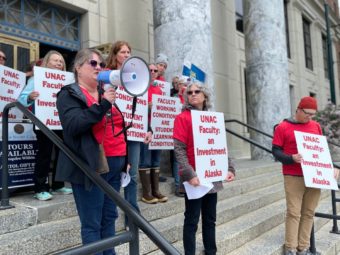
A woman speaks into a megaphone on the steps of the Alaska state capitol while others around her hold signs in support of university faculty
Associate Professor of Chemistry at University of Alaska Southeast Lisa Hoferkamp looks at colleague Jill Dumesnil, professor of mathematics, as she talks during a United Academics rally June 22, 2022, in front of the Alaska State Capitol. (Photo by Lisa Phu/Alaska Beacon)

In between two scheduled mediation sessions this week, University of Alaska faculty members and supporters rallied at the Alaska State Capitol on Wednesday, calling for a fair and competitive negotiated contract.

“We deserve a fair contract and I think that the administration is stalling,” Lisa Hoferkamp said. Hoferkamp is an associate professor of chemistry at the University of Alaska Southeast and has been with the university for 22 years.

“We worked very hard, especially during the pandemic. We’ve made a lot of sacrifices in an effort to keep the University of Alaska together. And now, when it finally comes time to reciprocate or to show something, the administration refuses to negotiate fairly.”

Hoferkamp was one of about 15 university faculty joined by a dozen supporters from other unions representing state workers and supervisors, as well as school employees, rallying in front of the Capitol.

The University of Alaska administration and faculty union United Academics have been negotiating the terms of the collective bargaining agreement since late August 2021. The two parties started federal mediation in May and had three sessions that month. There was a fourth session this past Monday and another one scheduled Thursday. The rally at the Capitol Wednesday was United Academics’ third public event this summer to show solidarity.

“Faculty are tired. They have worked tirelessly through very difficult and extraordinary times. We’ve received one single 1% raise in six years and have lost approximately 20% of our purchasing power during that time. And so, we’re feeling a little pinched. Faculty, in general, are feeling a little pinched,” said Jill Dumesnil, professor of mathematics at the University of Alaska Southeast. Dumesnil is also organizational vice president of the union for the Juneau campus and sits on the union negotiating team.

In April, the administration offered what it called its “best and final offer.” In the midst of the federal mediation process, the board of regents in May approved implementing the offer, a contract the faculty union didn’t agree with, that had raises of 3%, 2.5% and 2% over three years. The move was an attempt to get the increases in the state budget before the Legislature adjourned. It failed though; the budget that passed did not include any increases for full-time faculty.

The faculty union has proposed faculty increases of 5%, between 3% and 7%, and between 3% and 6% over the next three years, with the latter two years’ increases determined by the consumer price index. The union wants the university to provide real cost of living adjustments that match inflation.

“Differing views”

In a June 16 email update to the UA community, UA President Pat Pitney described the June mediation sessions as a “resumption of negotiations” with United Academics. Last month, when the administration unilaterally implemented the contract, Pitney said an impasse had been established in negotiations. The claim has been disputed by the union.

“Resumption of negotiations after implementation of the Best and Final Offer does not mean that the university is reverting to the expired [collective bargaining agreement]. That would serve no one well and would only create confusion,” the email said. Pitney wrote the administration has been and will continue to operate under the implemented terms of the best and final offer.

“I have every expectation that we ultimately will reach an amicable and comprehensive agreement” to replace the terms of the best and final offer, Pitney wrote.

Pitney wrote the administration would request a supplemental appropriation for the provisions of an agreement that require spending when the Legislature reconvenes in January 2023.

Pitney also warned, “UA will only agree to terms that can be supported by the Board of Regents and the Department of Administration, be funded with a Legislative appropriation, and that will avoid a gubernatorial veto. A package that is too rich might not get appropriated, or worse, might get appropriated without additional funds to pay for the increases.”

Dumesnil with the faculty union said “the university administration and United Academics have differing views” on the status of the collective bargaining.

“My view is mediation has been ongoing,” she said in response to Pitney’s characterization that negotiations are resuming. “We’ve had ongoing negotiation. We’ve had mediation scheduled. We have a mediation session scheduled for tomorrow.”

A June 17 United Academics update to its more than 1,000 members said the length of time between mediation sessions was due to summer scheduling conflicts.

“The bargaining units have not reached agreement, and we have not agreed that we are at impasse, nor has our state labor agency confirmed that we are at impasse, as required by state law. The monetary terms, or any terms, of a CBA cannot be unilaterally implemented by an employer,” the update said, citing Alaska statute.

Union membership wants a new collective bargaining agreement that members can ratify, the regents can approve, and the Legislature can appropriate.

“That’s our ideal situation,” Dumesnil said. Regarding an ideal timeline, she said, “We do have a mediation session scheduled for tomorrow. So now is ideal.”

Starting this fall, you can take Alaska Native language courses for free at UAS

Photo of the UAS sign in Juneau
The main University of Alaska Southeast campus is located near Auke Bay in Juneau. (Photo by Bridget Dowd/KTOO)

University of Alaska Southeast will offer some Alaska Native language classes for free, starting in the fall.

Alaska Native Languages professor X’unei Lance Twitchell says this is part of revitalizing the Lingít, Haida and Tsimshian languages.

“We kept saying, Indigenous peoples did not choose to be in this situation. Our language was banished, it was prohibited, it was made illegal,” he said. “We were tortured and abused and all kinds of things to get us to stop speaking. So why should we have to pay to learn our own language?”

There has been a decline in the use of Alaska Native languages over the last hundred years due to genocide and assimilation. And many elders who were birth speakers died during the COVID-19 pandemic.

For the Lingít language, fewer than 50 people who have been speaking the language since birth are still alive.

But Twitchell says there has been a shift toward language revitalization over the last decade. When Outer Coast in Sitka offered a year of free Lingít courses during the pandemic, 600 people signed up.

“Education was a vehicle of oppression and genocide and assimilation. So our goal is to transform it into a vehicle of opportunity and equity and healing,” he said. “I think it’s going to be medicinal. I think it’s going to alter the course of the way things are going. And it’s really exciting.”

Arts and Sciences Dean Carin Silkaitis says one of their main jobs is to support faculty and find ways to say yes.

“You have to open doors, you have to bring seats to tables,” they said. “And I think creating free curriculum is a way to create more access for people.”

Silkaitis says the free classes are made possible with help from Sealaska Heritage Foundation and a Language Pathways grant. Students who select the free option won’t earn credits or receive a grade.

Twitchell also serves on the Alaska Native Language Preservation and Advisory Council for the state. The council has advised the governor and the legislature to make Native languages a statewide priority, to normalize their use and to reform state education to include Native languages.

Twitchell says free language instruction is one step toward achieving some of those goals.

“I think it’s going to reach a point where we’ll look back and we’ll say, ‘You remember how rare it was, when we didn’t speak it, to hear Lingít? You remember when hardly anybody knew Lingít?'” he said. “And then I think my hope is we look back at that and say, ‘What a strange time that was.'”

Disclosure: KTOO staff and reporters take Lingít language lessons from Twitchell.

Correction: Outer Coast in Sitka is the institution that offered a year of free language courses during the pandemic.

Amid Alaska’s permafrost areas, more soil is staying thawed year-round, UAF scientists find

A woman sits on the tundra with miscellaneous scientific equipment
Louise Farquharson, a University of Alaska Fairbanks permafrost expert, checks conditions off the Seward Peninsula’s Kougarok Road on July 23, 2019. The Seward Peninsula, in northwestern Alaska, had nine sites of new talik formation that emerged in 2018, according to research by Farquharson and her UAF colleagues. (Photo by Vladimir Romanovksy/UAF)

Beneath the surface of Alaska’s partially frozen landscape, permafrost is being replaced by what might be considered its opposite: soil that stays unfrozen, even in winter.

Taliks are sections of year-round thawed soil that are wedged in areas with permafrost, generally between the lower layers that remain in freeze and the active surface layers that freeze and thaw with the seasons.

Now talik formation is speeding up, thanks to warmer winters, increased snowfall and the combination of those factors, according to research by permafrost experts at the University of Alaska Fairbanks.

The findings are detailed in a study published this week in the journal Nature Geoscience.

The study uses the temperature readings from long-established permafrost monitoring sites that have been sending data nearly continuously since as early as 1999. The 54 sites chosen for the investigation into talik formation ranged from the Canadian border area in the east to the Seward Peninsula in the west. The sites were both below and above the Arctic Circle and are places where permafrost is classified as discontinuous and where the state of freeze might be considered marginal. None of the sites had any unusual surface disturbance, such as wildfire scarring, that might have hastened thaw.

The state of thaw took a big jump in the winter of 2017-18, when new taliks were found at 24 of the sites, the study found. That coincided with exceptionally snowy and warm conditions that winter.

White, wooden crosses at a cemetery, many of them leaning
Permafrost thaw is causing grave markers to tilt at the cemetery in the Seward Peninsula village of Teller, seen here on Sept. 2, 2021. (Photo by Yereth Rosen/Alaska Beacon)

Warmer winter air temperatures are tied to talik formation, as is thick snow cover, which insulates the ground from the winter cold, said lead author Louise Farquharson, a research assistant professor at UAF’s Geophysical Institute.

The talik expansion is ominous, Farquharson said.

Since the presence of talik enables further thaw, talik expansion has implications for release into the air of carbon long sequestered in permafrost, she said. “This is going to really accelerate the amount of carbon mobilization that happens,” she said.

More talik also likely means more problems for structures and facilities on the ground surface, where thaw is already creating numerous maintenance and repair challenges in Alaska, Farquharson said. And there are yet-to-be determined effects on the flow of water over the landscape, including the possible new movement of contaminants and mercury through groundwater, she said.

Farquharson and her colleague calculated that a decade from now, if carbon emissions and warming continue at present rates, talik formation will be happening in up to 70% of the zone considered to be discontinuous permafrost — and by 2090, talik layers in some parts of the black spruce forest and other ecosystems will be nearly 40 feet thick.

Unlike the abrupt permafrost collapses found at eroding coastal bluffs, at areas of intense wildfire or at sinkholes in ice-rich areas of tundra landscapes, talik development is not obvious to the casual observer.

But it affects a lot more territory, Farquharson said.

“If we look at talik development, it’s a slower process but it’s much more widespread,” she said. “The taliks are going to form across the whole landscape.”

A muddy coastal bluff that is falling apart
Thawing permafrost is hastening erosion of a coastal bluff in the Seward Peninsula village of Teller, as seen on Sept. 2, 2021. Unlike such surface disruption, the development of talik — year-round thawed soil — is not obvious to casual observers. (Photo by Yereth Rosen/Alaska Beacon)

In time, that will include higher-latitude areas where the permafrost layers are, for now, unbroken. “This is going to expand northward into continuous permafrost,” she said.

Taliks can sometimes refreeze, if air temperatures are cold enough and snow is sparse enough. Farquharson and her colleagues actually found two examples of refreeze in their study, at Healy near Denali National Park and near Tanacross in the eastern part of Interior Alaska.

But do not expect any such refreezing after about 2030, according to the study. By then, if warming trends continue as expected, conditions will no longer allow refreezing, no matter how little snow falls.

“We’re kind of in a flickering-light phase right now,” Farquharson said.

The pattern of snow-linked talik formation persisted last winter, which featured record or near-record early winter snowfall in Interior Alaska. In Fairbanks, winter rain that created a durable coating of ice was followed by heavy snow, all creating havoc for drivers and for utilities. At Denali National Park, it was the snowiest December on record, according to the National Weather Service. Heavy snow collapsed the roof of the only grocery store in Delta Junction, about 90 miles southeast of Fairbanks.

Soil temperatures over the past winter were “significantly warmer” than the previous winter, Farquharson said. “That snowfall wasn’t good for permafrost,” she said.

Nome seen in the distance across an expanse of open ground
Nome, seen from the Kougarok Road on Sept. 2, 2021, is built on tundra landscape underlain by discontinuous permafrost. The formation of talik — ground that does not freeze in the winter — poses thaw threats to structures in Nome and similar Alaska communities. (Photo by Yereth Rosen/Alaska Beacon)

For Fairbanks and the area around it, patterns of snow and winter precipitation have changed in the past decades, but in somewhat complicated ways, said Rick Thoman, a scientist with the Alaska Center for Climate Assessment and Policy at UAF.

Total winter snowfall in the region hasn’t increased or decreased, but the snow season has become compressed, Thoman said. “We’re getting more snow in a shorter period of time,” he said. Meanwhile, winter rain events, such as the one that drenched Fairbanks last winter, have become more frequent, he said.

There is a climate-change link to that precipitation pattern. The Bering Sea has become, over time, less icy, allowing more evaporation from open water later in the year, he said. “In Interior Alaska, that’s the primary source of moisture in the wintertime,” he said.

University of Alaska regents approve faculty pay increases. But the union says negotiations aren’t over.

University of Alaska Southeast (Photo by Heather Bryant/KTOO
University of Alaska Southeast campus in 2013. (Photo by Heather Bryant/KTOO)

The University of Alaska Board of Regents has taken unilateral action to increase salaries for its full-time faculty, despite ongoing federal mediation with the faculty’s union on a new collective bargaining agreement.

“This is an unusual step for sure,” said UA President Pat Pitney about the unprecedented action approved by the regents during a special meeting Monday.

Pitney said mediation has failed to bring the university and United Academics, or UNAN, significantly closer together on the terms of a new three-year collective bargaining agreement.

“And so last Friday we declared that we were at impasse,” Pitney said.

With time running out to get a new contract approved and funded by the Legislature before the session ends, Pitney said the university feels compelled to act.

“It is the eleventh and a half hour,” she said.

UA faculty have only received a 1% raise over the past 5 years, and among provisions in the faculty contract submitted to the Legislature is a 3.5% salary hike for the new fiscal year which starts July 1, followed by 2.5% and 2% raises the following two years. Pitney said the increases are consistent with those in other UA employee agreements before the Legislature.

“UNAC”s compensation and benefits position by contrast was more than 4 times the level the university is offering, unsustainable by any standard,” she said.

Tony Rickard is a professor of mathematics education at the University of Alaska Fairbanks and chief negotiator for United Academics. He said the union has adjusted its proposals to try to reach an agreement and wants to keep talking.

“This a very puzzling action by President Pitney and the Board of Regents,” said Rickard. “They seem to think that the mediation is over, and it’s not. We mutually agreed to a session that we have yet to have.”

Rickard said UNAC will be at the third and final mediation session scheduled for Wednesday.

“And we expect the university to be there too,” Rickard said.

It’s unclear if the university will attend, but UA lead negotiator David Eisenberg told regents on Monday that declaring an impasse only means the university is not legally required to keep negotiating.

“That said, obviously we are going to receive and consider any reasonable proposals from the union,” said Eisenberg.

There’s some speculation that a UA faculty contract could be considered by the Legislature outside the regular session, but Pitney said a special session is unlikely in an election year.

State Supreme Court affirms Dunleavy decision that drained fund for Alaska college scholarships

The University of Alaska Anchorage held commencement ceremonies on Sunday, May, 1, 2022. (Photo by Bill Roth/ADN)

The Alaska Supreme Court affirmed Tuesday a lower court decision against a handful of Alaska college students who sued the administration of Gov. Mike Dunleavy, challenging a decision that drained Alaska’s $410 million Higher Education Investment Fund.

The decision means the Alaska Performance Scholarship program and WWAMI, the state’s equivalent of medical school, do not have a dedicated funding source and must compete with other programs in the state’s annual budget process, but a separate effort by the Legislature may reinstate a dedicated account.

“Although the plaintiffs tried to make this case about supposed policy calls made by the executive branch, the Court recognized that the State was just following the Alaska Constitution,” Deputy Attorney General Cori Mills said in a statement released after the court’s ruling.

“No one disputes that the performance scholarships are an important program, which is why Governor Dunleavy included appropriations to pay for the scholarships in his budget. But that does not mean that the Higher Education Investment Fund falls outside of the reach of the constitutionally required sweep into the CBR (constitutional budget reserve),” Mills said.

The scholarship programs remain funded through at least June 30, and the budget making its way through the Legislature has money to fund the programs in the next fiscal year.

The Legislature is separately considering a bill that would remove the fund from the state treasury so that it can’t be emptied by the end-of-session legislative sweep. That measure, House Bill 322, passed the state House on Monday, and is heading to the Senate for consideration.

“We are not giving up,” Pat Pitney, president of the University of Alaska System, said in a statement Tuesday. “We have been simultaneously working to fund HEIF and the programs it supports through legislative action.”

The fund “is too important,” Pitney said. “Our state’s future is inextricably linked to the success of our people and their access to high-quality workforce training and higher education.”

Pitney said the university will dedicate its efforts to “solving this issue by supporting HB322.”

That bill would create separate accounts for higher education scholarships and for the Alaska Marine Highway System.

“Ongoing crucial state services such as the Alaska Marine Highway System should not suffer the destabilizing effects that may result from the sweep of the funds,” said Rep. Dan Ortiz, I-Ketchikan. The bill would create “needed certainty” both for the ferry system and for the higher education investment fund, he said.

The bill originally applied only to the Alaska Marine Highway System fund and was amended to cover the education fund.

“It’s about our workforce. It’s about our future engineers, our future business accountants, our teachers. Many important jobs that need to be filled,” Rep. Andi Story, D-Juneau, said on the House floor, before the House voted 25-15 to pass the bill.

Lawmakers who opposed the measure said that creating separate accounts defied the state’s constitution.

In the Superior Court decision that was affirmed by the Supreme Court, Anchorage Superior Court Judge Adolf Zeman said that Dunleavy’s administration correctly classified the higher-education fund as part of the state’s general fund in 2019. That made it subject to a clause in the Alaska Constitution that requires leftover general fund money to be automatically swept into the Constitutional Budget Reserve, a special savings account.

The Alaska Legislature regularly votes to reverse that sweep, but it failed to do so in 2021 because of opposition by Republican legislators in the state House. That failure, combined with the administration’s classification, drained the fund.

This story was originally published by the Anchorage Daily News and is republished here with permission.

Earth’s atmosphere could be one source of water on the moon, UAF study finds

Two images of the moon with small green patches indicating the presence of water or ice
Depiction of water/ice at the moon’s poles. (NASA)

University of Alaska Fairbanks scientists are studying water on the moon — it’s origins, where its located and how much may be there. The water could be valuable to development of a moon base.

UAF Geophysical Institute associate professor Gunther Kletetschka led a team that looked at one source of moon water, the moon’s impact with hydrogen and oxygen ions during its passages through the tail of earth’s magnetosphere.

Kletetschka said his group studied “how the water would get from the earth to the moon, using this periodic passage of the moon through this magnetic tail, and how much water would be able to be transferred.”

According to an article about moon water on the Planetary Society website, lunar missions have confirmed the presence of water, most prominently as ice in sun-shaded craters at the moon’s poles. To try to better locate and quantify the water, Kletetschka and his team used data from a NASA lunar orbiter to locate gravitational anomalies that indicate deep-water deposits.

“We have this gravity field technique which allows us to locate exactly where the water would go if it’s deposited in the polar regions of the moon, and we find that there was a distribution of this kind of a water indicator around impact craters,” Kletetschka said.

Researchers estimate that the moon’s poles could contain 840 cubic miles of water — about as much as Lake Huron, the Earth’s eighth largest lake.

Better understanding the moon’s water resource is important to NASA’s Artemis Project, which aims to establish a sustainable human presence at a base at the moon’s south pole. The moon’s ice and water could be sourced for drinking water and air and also used to create a fuel for space vehicles.

Kletetschka’s team’s research was published in the journal Scientific Reports in March.

Site notifications
Update notification options
Subscribe to notifications