University of Alaska

Scientist from the Last Frontier explores Final Frontier

I Heart Pluto
This image of Pluto from New Horizons’ Long Range Reconnaissance Imager (LORRI) was received on July 8, and has been combined with lower-resolution color information from the Ralph instrument. (Photo courtesy of NASA-JHUAPL-SWRI)

An Alaskan scientist is part of a mission to explore Pluto, the last major planetary object in the solar system to be visited by an unmanned spacecraft.

New Horizons, launched in 2006, is expected to fly by Pluto July 14 and provide the first-ever views of the distant dwarf planet.

Peter Delamere, a space physicist at the University of Alaska Fairbanks Geophysical Institute, says he’ll be thrilled like everyone else to see the new, fresh images sent back by the probe at the climax of its 3 billion mile journey. But Delamere will be most interested in how particles from the solar wind can provide clues about the composition and strength of Pluto’s atmosphere as those particles stream around the dwarf planet.

Excerpt of interview with Peter Delamere of UAF’s Geophysical Institute:


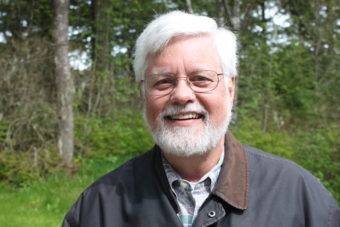
Peter Delamere (Courtesy of UAF Geophysical Institute)

Interview highlights

Delamere has been with the New Horizons mission since its start in 2001: He says it was driven by research speculating that Pluto may have an atmosphere. “While this may have an atmosphere, it’s thought to be an escaping atmosphere,” Delamere says. “It may be something that was similar to Earth’s primordial atmosphere in a state of what’s called hydrodynamic escape.”

How can they find out more about Pluto’s atmosphere? The solar wind’s supersonic flow slows down and creates a bow wave or bow shock when it collides with a planetary object like Pluto. As the solar wind flows around Pluto, Delamere says it may create a cavity on Pluto’s lee and ionize any particles streaming away from a weak atmosphere. Protons or ionized hydrogen from the solar wind may pick up and carry along ionized nitrogen from Pluto’s atmosphere. Methane may also be an atmospheric component.

Particles in the bow wave around Pluto can be measured with two particle instruments on board New Horizons: Huge amounts of particle data will be collected by the spacecraft just as it flies by Pluto and into the wake of the bow shock, but that data will be sent back to Earth in a trickle that may last months. During the actual fly-by, priority will be placed on sending back high-resolution imagery. Particle data from New Horizons will also be compared with information sent back by both Voyager probes, which are now in the heliosphere or near the interstellar space boundary.

What is space physics? Delamere says it’s essentially the study of the space environment from the Sun to the Earth. “We look at the space around the stars and how the Sun interacts with the Earth, and how the solar wind streaming from the Sun interacts with the Earth’s magnetic field,” Delamare says. “All of that is related to the study of auroral physics.” Delamere says he got into the field of space physics after watching the aurora when he was an undergraduate student in Minnesota. He says he eventually researched how Jupiter’s moon Io interacted with the gas giant, and later examined the aurora of Jupiter and Saturn.

Go to NASA’s New Horizons website for the latest news, images, and fly-by countdown clock

New Horizons was about 3.7 million miles (6 million kilometers) from Pluto and Charon when it snapped this portrait late on July 8, 2015. Color information obtained earlier in the mission from the Ralph instrument has been added. (Photo courtesy of NASA-JHUAPL-SWRI)

UA System presidential candidate promises to listen and share

Jim Johnsen at a meet and greet in Juneau, July 7, 2015. Johnsen is a candidate for University of Alaska president. (Photo by Jeremy Hsieh/KTOO)
Jim Johnsen at a meet and greet in Juneau, July 7. Johnsen is a candidate for University of Alaska president. (Photo by Jeremy Hsieh/KTOO)

The candidate to be the state university system’s next president is meeting with students, faculty and community members around the state this week.

To see a schedule of UA system presidential candidate Jim Johnsen’s visits or to submit written feedback, go to the Board of Regents’ website.

Jim Johnsen has a professional background in organized labor, academia and, most recently, in corporate business as a senior manager for Alaska Communications and Doyon Limited, the Alaska Native corporation for the Interior.

In June, the University of Alaska Board of Regents selected him as its single finalist to lead the system. The candidate is tall, energetic and quick with a smile.

If he gets the job, he says students and faculty can expect him to be present on campuses around the state, listening and sharing ideas for how to strengthen the university in tough fiscal times.

Here’s how Johnsen describes the job.

“In large part to be the voice of the university for the state,” he said. “To represent the university in the legislature, to represent the university with the governor, and the governor’s staff … so there’s an external side to things with big corporations, and other NGOs, Congress, etc. so that’s the outside piece. The inside piece is to make sure the university is organized in a way that delivers the best and widest access to students using technology, etc., delivers high quality academic programs cost effectively.”

He highlighted two areas he wants to work on, remedial education and Arctic research. He says over half of the university system’s students require remedial education, a major challenge.

His ambition for the university system as an Arctic research center is to be the best.

“Alaska right now has the number one research university in the world when it comes to Arctic research,” he said. “We’ve gotta keep that, and we’ve gotta, in fact, grow that, because over the next 10, 20, 30 years, there’s going to be a lot of action in the north. And I think we want to position ourselves to continue to be leading in the study of and the understanding of that very, very important part of the world.”

Courtney Enright was the board’s student regent during the main selection process.

“What I really was looking for was someone who focused on students, or understood that students have an important role in the university,” she said. “So somebody that had that understanding of that connection of students as the customer, effectively, for the university.”

Enright graduated in May and spoke from Louisiana, where she’s beginning a new job. She said Johnsen was an exemplary candidate. She suggested students keep an eye on tuition rates as one gauge of his performance.

“The president does submit formally the tuition recommendation every year to the Board of Regents,” she said. “That’s one of the biggest measures students really look at. But, given the fiscal challenges of the university, it’s a little bit more uh, I think complicated these years than to just judge based on that number.”

The regents are expected to finalize their selection at the end of the month.

UAS Juneau goes smoke-free Wednesday

A ban on all tobacco products goes into effect July 1 on UAS's Juneau campus. (Photo by Lisa Phu/KTOO)
A ban on all tobacco products goes into effect July 1 on UAS’s Juneau campus. (Photo by Lisa Phu/KTOO)

The University of Alaska Southeast campus in Juneau goes completely smoke-free on Wednesday.

UAS will join thousands of colleges nationwide with similar policies banning tobacco use by students, staff and visitors.

No more cigarette, e-cigarette or hookah breaks between classes; the ban applies to all tobacco products. Anyone looking for a nicotine fix will have to leave campus to get it.

The ban is part of a university-wide policy approved in December by the Board of Regents.

The University of Alaska is not alone in adopting a tobacco-free policy. Institutions of higher learning have been banning tobacco on their campuses for years.

UAS Vice Chancellor of Administration Michael Ciri has been following the issue. He says the university is entering the discussion somewhat late.

“But I don’t necessarily think that is a bad thing,” Ciri says. “We were able to learn a lot from other universities that drafted smoke-free policies and, I think, have a better policy for that.”

The regents’ decision to make all University of Alaska campuses tobacco free was primarily to reduce employee healthcare costs.

“When there’s smoking-related illnesses, that is a real, actual cost borne by the University of Alaska. If we pay for fewer employee-related health issues, that provides an immediate savings to the institution,” Ciri says.

The smoking ban will apply to all university property and buildings. Ciri says UAS Facilities Services has been surveying campus to create a simple graphical map.

“We need to be very clear about, OK, actually the property line is right there because if I were a smoker and I am willing to comply with the letter of the law, what I would want to know is, specifically, where’s your property line? Because I’ll stand right on the other side of it,” Ciri says.

Some students have already voiced concern about the university’s enforcement plan, or lack thereof. Like graduating senior Trevor Luedke:

“I think it’s going to be impossible to enforce.”

Administrators admit that enforcement will depend on “the consideration and cooperation of both users and non-users of tobacco.”

In other words, Ciri says, no one will be tasked with enforcing the new policy.

“There’s not going to be a smoking czar or the smoking police going around with little seltzer bottles, hitting people,” Ciri says laughing.

However, Ciri points out that the smoking ban is just one of many conduct policies students are asked to observe. The expectation is that people are going to be courteous.

Site notifications
Update notification options
Subscribe to notifications