University of Alaska

University of Alaska defines consent in new student code of conduct

The University of Alaska system updated it's Student Code of Conduct to include a definition of consent.
The University of Alaska system updated it’s Student Code of Conduct to include a definition of consent.


The University of Alaska system has defined “consent” for the first time when it comes to sexual misconduct terminology. The definition is in the university’s new student code of conduct, which is the basis of university disciplinary proceedings. One expert calls the definition good, but thinks it could go further.

“Consent is defined as being clear, knowing and voluntary. It can be withdrawn at any time. It’s defined as being active, not passive and cannot be given while an individual is incapacitated,” says Michael Votava, reading from the  University of Alaska’s updated Student Code of Conduct.

Votava is the director of student conduct and ethical development for the University of Alaska Anchorage. He was part of the working group that established the definition.

“Past consent does not imply future consent. And that silence, or an absence of resistance, cannot be interpreted as consent,” Votava adds.

It can be words or actions that create mutually understandable clear permission.

“So in other words, UA is not requiring a verbal yes,” Votava says.

He gives this example:

“If there were two parties that were involved in a romantic encounter and one party started removing their clothes and started motioning with their finger for the other party to come toward them and had a smile on their face, that’s in my mind, I think a reasonable person would argue that that was a form of nonverbal consent,” Votava says.

“Why not start with verbal? Because verbal is the most common way we make agreements for anything,” says Mandy Cole, deputy director of AWARE, Juneau’s domestic abuse and sexual assault prevention nonprofit.

“What I would like to see and what I think is kind of a best practice is that we get more used to getting verbal consent and that we get more used to saying the words, ‘Do you want to have sex with me?’” Cole says. “Because honestly if you feel comfortable enough to have sex with somebody, you should be comfortable enough to say the words.”

Cole says UA’s definition of consent has the necessary elements. Other higher education institutions like The State University of New York, Northwestern University and University of California have similar language defining consent as either words or actions.

Cole says it’s difficult to require a verbal agreement, but she’d like society to move in that direction.

“It’s kind of a new thing really. When I went to college, no one said a word to me about consent. Certainly no one ever said a word to me about getting verbal consent before sexual contact, so I think this is developing,” Cole says.

One company Consent Game Changers has gone beyond verbal by selling consent kits. Each pouch comes with a contract card, breath mints and a condom. The company’s website says the contract gives both parties “the confidence of a documented consensual encounter (or to at least remind you to have the consent conversation).”

Cole says she’s happy UA has defined the term and is part of a national conversation, even if it was prompted by an increasing number of sexual assault reports in colleges.

More than a year ago, the U.S. Department of Education put UA on a list of about 60 colleges nationwide being investigated as part of a compliance review or for mishandling sexual assault complaints. That list is now at about 130.

Cole says advancing the conversation about consent keeps people safer and more prepared to discuss sexuality.

“So that we don’t continue propagating this idea that sex is about power,” Cole says. “So if we talk about sex being more about consent and agreement, and it’s freely and knowingly decided by both people, then it takes away some of the old thinking about what is legal and what’s not legal.”

Cole says it’s more about what’s right.

Fish waste-to-compost project starting in Dillingham this month

Around this time next year, Dillingham gardeners should have access to compost made from the waste of locally caught salmon. A grant-funded project is taking off at the local landfill in August, and it will need some good fish waste to get going. 

“I’m calling it the Fish Waste Compost Project,” says Gabe Dunham, the Marine Advisory Program Agent in Bristol Bay. Dunham inherited the project and is nudging it past the planning phase this month.

Producing the compost will take a fair amount of fish waste this year, and the plan calls for a focus on making use of subsistence fish waste. Though it’s a little late in the season for most people’s fishing efforts, Dunham is hoping that the scraps from whatever salmon are caught, likely silvers, and ends up in a separate waste bin marked UAF Sea Grant that’ll be available by the second week in August.

The City has allowed the project to use a portion of a closed landfill cell, and final approval from the state is still pending.

Dunham says the composting technique has been proven at other projects. An electric fence should help deter bears and covering each compost row with top soil and fabric should cut down on the stench.

Since the project is grant funded for now, the compost will be free next year and probably up for sale after that.

Federal agency launches website to help universities, colleges deal with campus violence

The Office on Violence Against Women has launched a website aimed at helping colleges and universities deal with sexual assault, domestic violence, dating violence and stalking on campus. (Screenshot)
The Office on Violence Against Women has launched a website aimed at helping colleges and universities deal with sexual assault, domestic violence, dating violence and stalking on campus.

The Office on Violence Against Women this week launched a website aimed at helping colleges and universities deal with sexual assault, domestic violence, dating violence and stalking on campus. The office, which is in the U.S. Department of Justice, calls the site a “comprehensive online clearinghouse.”

An introductory video on the site features Bea Hanson, principal deputy director of the office. She says the site includes information from a variety of sources focused on prevention, policy and other topics.

“It’s designed to provide campus administrators, faculty and staff, campus and community law enforcement, victim service providers, students, parents and other key stakeholders with the resources needed to enhance campus safety,” Hanson said.

The website was launched  nearly a year after the U.S. Department of Education’s Civil Rights Office announced it would be investigating post-secondary institutions across the nation — including the University of Alaska system — to determine whether they are handling reports of sexual violence according to federal law.

An Aug. 5 list from the Department of Education shows 129 institutions are under investigation. The department says the list includes institutions that are being investigated for cause and others that are subject to a compliance review. An attorney for the university told KTOO in September that their investigation fell into the latter category.

In February, the University of Alaska launched a survey to determine if sexual assault on campus was a bigger problem than they knew and how well they were handling it. The survey was sent out to 15,000 randomly selected students, faculty and staff who can respond anonymously. A university attorney said the results of the survey would not be published.

Ketchikan campus director takes interim UAS provost position

University of Alaska Southeast Ketchikan Campus Director Priscilla Schulte has accepted a temporary assignment as provost for UAS in Juneau. (Photo courtesy of University of Alaska)

University of Alaska Southeast Ketchikan Campus Director Priscilla Schulte has accepted a temporary assignment as provost for UAS, effective Aug. 9, and will relocate to Juneau for the coming academic year.

According to UAS, Schulte will continue in her role as director of the Ketchikan campus, and will return periodically to Ketchikan during her stint as interim provost.

A university provost is a high-ranking administrator, in charge of academic programs. As provost, Schulte will represent UAS in leadership venues, including Board of Regents and Summit Team meetings, and Statewide Academic Council, according to the university.

A search for a permanent provost is expected to commence in August, and UAS plans for the new provost to start work in early summer of 2016.

Sikuliaq docks in Nome, previews upcoming research missions

The research vessel Sikuliaq will work in the Chukchi and Beaufort Seas through November. (Photo by Emily Russell/KNOM.)

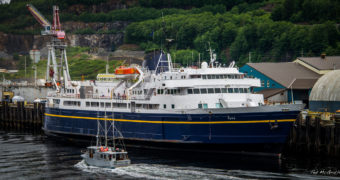
The research vessel Sikuliaq docked in Nome July 21 and opened its doors to local visitors. While touring the ice-capable ship — owned by the National Science Foundation and operated by the University of Alaska Fairbanks — visitors asked questions of the crew and learned about their upcoming missions.

The Sikuliaq will be working in the Chukchi and Beaufort Seas through November on three different research assignments, according to the vessel’s master, Capt. Mike Hoshlyk. He explained the Sikuliaq’s water sampling system, which can measure the properties of water as deep as 10-thousand meters.

Just how deep is that?

“The height of Everest. Deeper than Everest,” said Hoshlyk. “You could go to the Marianas Trench.”

Peter Worcester is the chief scientist on one of the upcoming missions. He won’t be researching the world’s deepest trench, but he will use the Sikuliaq to gather data on ocean acoustics, which could shed light on the changing conditions of Arctic waters and sea ice.

“The basic idea is very simple,” said Worcester. “If you have a sound source here and a receiver here, and you measure very accurately how long the sound takes to travel that distance, that’s a very good measure of the average temperature.”

Faster sound means warmer waters — and valuable information on how ocean temperatures are changing. Several visitors were curious about climate change, including how the Sikuliaq itself may contribute. One visitor asked, “With the disruptions up there is [the Sikuliaq] contributing to the climate change?”

Those “disruptions” referred to oil exploration and drilling — two things the Sikuliaq doesn’t do. While the research vessel can cut though roughly 3 feet of ice, Joan Braddock says it’s not an icebreaker. Braddock is the Dean of the School of Fisheries and Ocean Sciences at UAF and says the Sikuliaq only works in seasonal ice, which is less invasive.

“I think the impact — at least at this point – of research vessels is pretty minimal. But you’re right. As there are more and more ships, there’s going to need to be thoughtfulness,” said Braddock. “We’re certainly going to be a part of the discussion to make sure we’re doing things right with this ship — so that we’re answering questions that are important to Alaskans but not causing problems.”

The Sikuliaq shipped out Thursday to tackle those questions. But the vessel will be back in Nome for the U.S. Arctic Research Commission meeting during late August.

Federal auroral program to be transferred to UAF

Aerial view of the High Frequency Active Auroral Research Program site looking towards Mount Sanford, Alaska. (Public Domain photo by United States Federal Government)

The University of Alaska Fairbanks will take ownership of Gakona’s High Frequency Active Auroral Program, also known as HAARP.

After two bumpy years waiting for the U.S. Air Force to decide what to do with HAARP, the university has won its bid to take over the facility for research purposes.

About a year ago UAF, with the support of scientists around the globe, managed to delay the Air Force’s plan to close and demolish the HAARP compound.

UAF spokeswoman Marmian Grimes says the university will take ownership of the $200 million facility next month.

“It’s a transfer, and next month the facilities and equipment will formally transfer from the military to the university, and then we have two years to work with the Air Force to come to an agreement to transfer land,” Grimes says.

The university must still negotiate with the military for 1,500 acres of land out of the 5,500 acres the Air Force owns in Gakona. The university system is loaning UAF $2 million dollars to get the facility back into operation. Grimes says a plan is in place to raise money to cover the loan and costs associated with operations.

“Scientists would pay to use the facility for their research projects, and that would support operations; that’s a common model for the university and research community,” Grimes says. “The Sikuliaq, which just recently came on board, uses the same sort of model. We use the same model at Poker Flat research range as well. We are also working to identify some anchor tenants to help cover operating costs.”

Head of UAF’s Geophysical Institute, Bob McCoy, has been instrumental in persuading the Air Force to give HAARP to the university.

“The government’s invested about $290 million federal dollars. In the last decade or so, the Navy, the Air Force and DARPA (Defense Advanced Research Projects Agency) all chipped in $40 to $50 million each, and they expanded it and increased the power and made improvements,” McCoy says. “So it really is exquisite. It’s a good catch for the State of Alaska and the University in Fairbanks to get this excellent facility, and both the chancellor and the president both saw that, and were eager to have this added it to our portfolio here.”

HAARP is one of only three similar facilities in the world.  One is in Norway and another in Russia.  Research into the Earth’s ionosphere was the primary job at HAARP when the Air Force operated it. In June 2013 the military announced research was coming to an end and made known its intention to shutter HAARP.

Last July, HAARP was saved days before bulldozers were ordered to move in. Grimes says scientists rallied to put pressure on the Air Force to scrap the demolition plan.

“National Research Council has been involved, we’ve spoken to the National Science Foundation, as well as a wide variety of scientists regarding the possibility of keeping the facility open and running it as a university facility. We’ve found a lot of support there. The scientific community wants to keep this facility. It’s regarded as the best in the world, more powerful than the other two facilities,” Grimes says.

UAF faculty and graduate students have used HAARP for research over the past few years, and now the university plans to expand programs there. Bob McCoy says HAARP turns the ionosphere into a laboratory.

“There’s a lot of science that can be done. The Navy, in the past, has been interested in using the ionosphere like an antenna to generate extremely low frequency waves to communicate with submarines, even things like creating simulation in the ionosphere to modulate radio waves. There’s a whole bunch of applications,” McCoy says.

HAARP has been beaming radio waves into the atmosphere since 1997 in an effort to understand the ionosphere, which has a strong influence on satellite communications. But its mission is often misunderstood, and has given rise to speculation that its work is linked to top secret military research.

Site notifications
Update notification options
Subscribe to notifications